POPULAR COURSES
Master Programs


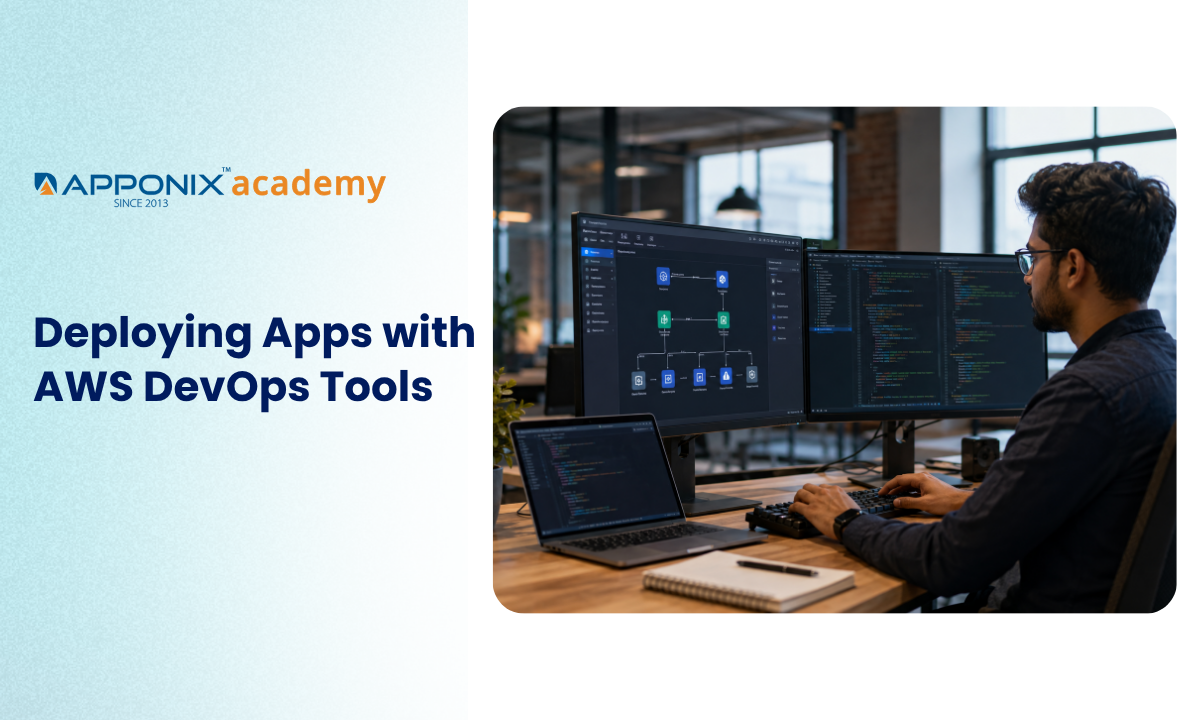
Table of contents:
|
1. Step 1. Secure Your Code with AWS CodeCommit |
|
2. Step 2. Compile and Test with AWS CodeBuild |
|
3. Step 3. Automate Releases with AWS CodeDeploy |
|
4. Step 4. Orchestrate Everything with AWS CodePipeline |
|
5. Why Choose Apponix? Master Cloud Deployments with Apponix Technologies |
|
6. Conclusion |
The traditional methodology of manual software deployment is no longer viable in modern enterprise architecture. Historically, moving application code from a developer repository to a live production server required complex manual scripting, scheduled maintenance windows, and significant human intervention.
This legacy approach inherently creates release bottlenecks, introduces fatal human errors, and leads to severe configuration drift across different server environments. To achieve high velocity software delivery without sacrificing system stability, the global technology industry has fundamentally shifted toward automated Continuous Integration and Continuous Deployment pipelines.
Amazon Web Services provides a powerful, fully managed suite of native DevOps tools specifically engineered to automate this entire lifecycle.
Utilizing services like AWS CodeCommit, CodeBuild, CodeDeploy, and CodePipeline, engineering teams can entirely remove manual touchpoints from their release cycles. Every single code update automatically triggers a sequential process that builds the application, runs extensive automated testing, and safely deploys the final software package directly to production servers or containerized environments. This automated infrastructure ensures absolute consistency, accelerates product releases, and allows organizations to execute instant rollbacks if performance issues are ever detected in production.
As cloud automation is now the backbone of modern software engineering, tech companies aggressively seek professionals who can architect and manage these precise AWS deployment pipelines.
Mastering these native cloud automation tools requires more than theoretical reading. It requires active experience in configuring real-world cloud infrastructure. For IT professionals looking to bridge the gap between basic academic theory and actual industry requirements, completing an intensive, project-based DevOps course in Bangalore is the most effective strategy to secure a role as a cloud release engineer.
Let us break down the exact technical workflow of deploying an application using the AWS DevOps toolchain.
Step 1. Secure Your Code with AWS CodeCommit

The very first phase of an automated pipeline begins where your developers actually write and store their source code. Before you can execute any automated deployment, you need a highly secure and centralized environment to manage different code versions and allow your engineering team to collaborate seamlessly.
Instead of building and maintaining your own independent Git servers, Amazon provides AWS CodeCommit. This fully managed source control service hosts secure Git based repositories directly within your cloud environment. When your engineering team finishes building a new software feature, they push their code into CodeCommit. This single action of pushing the code acts as the initial trigger that sets the entire CI CD pipeline into motion.
The table below breaks down how CodeCommit simplifies version control compared to traditional self-hosted repositories
|
Deployment Challenge |
How AWS CodeCommit Solves It |
Core Technical Benefit |
|
Server Maintenance |
Completely managed infrastructure |
Zero patching or manual backups required |
|
Data Security |
Automatic encryption at rest and in transit |
Complete protection of proprietary source code |
|
Access Management |
Native integration with AWS IAM policies |
Tight control over production branch merges |
|
Webhook Failures |
Direct triggers inside the AWS ecosystem |
Instant signaling to the next pipeline phase |
By centralising your version control directly within the AWS ecosystem, your team eliminates third-party integration bottlenecks and complex webhook configurations.
The exact moment a developer commits their final code block, CodeCommit securely locks the changes in place and immediately signals the next phase of your pipeline to begin the build process.
Step 2. Compile and Test with AWS CodeBuild

Once your developers commit their source code securely, that code needs to be translated into a functional software package. In traditional environments, this requires maintaining dedicated build servers that sit idle most of the day but become massive bottlenecks during peak development hours. To eliminate this severe inefficiency, the pipeline automatically triggers AWS CodeBuild.
CodeBuild is a fully managed continuous integration service that compiles your source code, runs extensive automated tests, and produces software packages that are strictly ready for deployment.
You never have to provision, manage, or scale your own build servers. The service scales continuously and processes multiple builds concurrently, ensuring your pipeline never experiences a queue delay even when your entire engineering team commits code simultaneously.
Understanding how CodeBuild executes these tasks is critical for any cloud engineer
-
The Buildspec Document: CodeBuild relies on a YAML-formatted build specification file stored at the root of your source code. This file gives the service explicit instructions on exactly how to install dependencies, execute your unit tests, and package the final application.
-
Secure Compute Environments: Every single build runs in a completely fresh and isolated container environment. Once the build finishes, the environment is immediately destroyed, guaranteeing that no residual data or security vulnerabilities ever leak between different builds.
-
Automated Security Testing: Modern cloud pipelines heavily integrate security checks directly into the build phase. CodeBuild runs software composition analysis and static application security testing to catch critical vulnerabilities before the code ever reaches a live server.
-
Final Artifact Generation: If your code passes all functional and security tests without a single error, CodeBuild securely packages the compiled software into an artifact, such as a Docker image, and uploads it directly to Amazon Elastic Container Registry or Amazon Simple Storage Service.
Engineering teams drastically reduce their continuous integration overhead. CodeBuild ensures that buggy or insecure code fails the pipeline immediately, effectively protecting your production servers from catastrophic crashes and saving your organization from massive revenue loss due to downtime.
Step 3. Automate Releases with AWS CodeDeploy

Once your source code has been successfully compiled and tested by CodeBuild, the final artifact is ready to be released to your live production environment.
In a manual deployment scenario, this is the exact moment where engineers are forced to take servers offline, causing immediate system downtime for the end user. To solve this critical bottleneck, the pipeline automatically hands the final software package over to AWS CodeDeploy.
CodeDeploy is a fully managed deployment service that automates software releases across various computer services, including Amazon Elastic Compute Cloud instances, containerized Amazon Elastic Container Service workloads, and serverless AWS Lambda functions.
Automating the release process, CodeDeploy eliminates the risk of human error during production updates and ensures your application remains highly available throughout the entire deployment phase.
Cloud architects utilize several advanced deployment strategies within CodeDeploy to protect system uptime
-
Blue Green Deployments: Instead of overwriting your live servers, CodeDeploy provisions a completely new set of identical servers called the green environment.
The new code is deployed and tested on the green servers while your live traffic continues to hit the old blue servers. Once the green environment is verified, the load balancer instantly reroutes all user traffic to the new servers, resulting in absolute zero downtime.
-
In-Place Rolling Updates: For teams with strict infrastructure budgets, CodeDeploy can perform rolling deployments on existing server fleets.
The service safely takes a small batch of servers offline, updates them with the new code, and brings them back online before moving to the next batch.
-
Canary Deployments for Serverless: When deploying serverless functions using AWS Lambda, CodeDeploy allows you to shift a very small percentage of user traffic, such as ten percent, to the new version of your function.
If the new function executes without errors, the service gradually shifts the remaining traffic over a specified time period.
-
Automated Rollback Triggers: CodeDeploy constantly monitors Amazon CloudWatch alarms during the release.
If the new application version causes an unexpected spike in CPU usage or generates HTTP error codes, CodeDeploy immediately halts the release and automatically rolls the entire system back to the previous stable version.
Implementing these intelligent deployment strategies ensures that your users never experience a broken application or a maintenance page during an update.
AWS CodeDeploy gives enterprise engineering teams the absolute confidence to push new software features multiple times a day without ever sacrificing the stability or performance of their production infrastructure.
Step 4. Orchestrate Everything with AWS CodePipeline

While CodeCommit, CodeBuild, and CodeDeploy each perform critical individual tasks, they require a central orchestrator to function as a single automated unit.
Without an orchestration layer, developers would still have to manually trigger the build process after committing code and manually start the deployment once the build finishes. To achieve true continuous delivery, Amazon provides AWS CodePipeline.
CodePipeline is a fully managed continuous delivery service that models, visualizes, and automates the entire software release process. It acts as the master controller that connects your source code repository to your build server and finally to your deployment environment, ensuring data flows securely between each phase without human intervention.
The table below illustrates exactly how CodePipeline manages the workflow across different deployment stages
|
Pipeline Stage |
Integrated AWS Service |
Orchestration Action |
|
Source Stage |
AWS CodeCommit |
Automatically detects new code pushes and pulls the latest commit |
|
Build Stage |
AWS CodeBuild |
Provides the isolated build environment and executes automated tests |
|
Deploy Stage |
AWS CodeDeploy |
Takes the successful build artifact and safely pushes it to production servers |
Visualizing this entire workflow through a single graphical interface, engineering managers can instantly pinpoint exactly where a software release failed. If a unit test fails during the build stage, CodePipeline automatically halts the entire release and prevents the broken code from ever reaching the deployment phase.
Mastering how to connect these separate cloud services into one continuous automated loop is a highly specialized technical skill. For IT professionals aiming to build these enterprise-grade architectures from scratch, enrolling in a comprehensive AWS course in Bangalore provides the exact hands-on experience required to construct flawless pipelines and secure senior cloud engineering roles.
Why Choose Apponix? Master Cloud Deployments with Apponix Technologies
Reading technical documentation about cloud orchestration is very different from actually building enterprise-grade deployment pipelines.
To become a highly paid cloud engineer, you need hands-on experience configuring live AWS environments. As a premier Training institute in Bangalore, Apponix Technologies specializes in bridging the massive gap between theoretical academic knowledge and actual industry requirements.
Here is exactly why engineering professionals constantly choose Apponix to rapidly accelerate their cloud careers
-
Real World Project Execution: Our curriculum is not based on outdated textbooks. You will build and deploy actual CI CD pipelines using live AWS environments, giving you exact production-level experience before you ever step into an interview.
-
Industry Expert Mentorship: All of our trainers are working senior cloud architects with extensive experience in multinational corporations, bringing real-world troubleshooting scenarios and production cases directly into the classroom.
-
Dedicated Placement Assistance: We view career placement as a highly structured process rather than just an empty promise. Our dedicated HR team provides rigorous resume building, mock technical interviews, and direct referrals to our extensive network of hiring partners.
-
Flexible Access and Support Whether you choose the physical classroom experience or our live online sessions, you receive uninterrupted twenty-four-seven access to our cloud labs and recorded sessions so you can learn at your own exact pace.
Combining intensive practical labs with aggressive career support, Apponix ensures that you graduate with the exact technical confidence and interview skills required to secure high-level DevOps engineering roles across the global tech industry.
Conclusion
The era of manual software deployment is officially over. Technology companies can no longer afford the system downtime, human errors, and massive revenue losses associated with legacy release processes. By mastering native cloud automation tools like AWS CodeCommit, CodeBuild, CodeDeploy, and CodePipeline, you position yourself as a highly critical asset to any modern software organization.
Automating deployment pipelines allows development teams to release secure and high-quality code at incredible speeds without ever sacrificing server stability. If you are ready to stop performing repetitive manual IT tasks and start architecting highly scalable cloud infrastructure, it is time to drastically upgrade your technical skill set.
Take the definitive step toward a high-paying tech role and let Apponix Technologies help you build a future-proof engineering career today.

Apponix Academy
Apponix Academy