POPULAR COURSES
Master Programs



Table of contents:
|
1. Beginner Projects: Exploratory Data Analysis & Classification
|
|
2. Interactive Systems & Competitive Modeling
|
|
3. Intermediate Projects: Applied AI & Sequential Modeling
|
|
4. Unsupervised Learning & Computer Vision Foundations
|
|
5. Why Choose Apponix? |
|
6. Conclusion |
Building a career in data science with Python requires far more than completing basic syntax tutorials or memorizing function definitions. In today's competitive tech job market, hiring managers look past certificates to evaluate what you can actually build, debug, and deploy.
Whether you are working through self-paced online modules or evaluating a Data science course in Bangalore to accelerate your transition into tech, showcasing production-ready code is the single most effective way to demonstrate job readiness to recruiters and technical leads.
The gap between writing isolated scripts in a Jupyter Notebook and shipping end-to-end data pipelines can feel overwhelming. Many ambitious learners get stuck wondering where to find real-world datasets, how to structure professional open-source repositories, or how to write clean, modular code that scales.
To help you build an employer-ready portfolio, we have curated ten high-impact projects spanning exploratory data analysis, machine learning classification, natural language processing, time-series forecasting, and deep learning.
Each project includes direct links to production-grade GitHub repositories, technology dependencies, core feature sets, and practical industry applications so you can dissect, adapt, and deploy real-world code today.
Beginner Projects: Exploratory Data Analysis & Classification
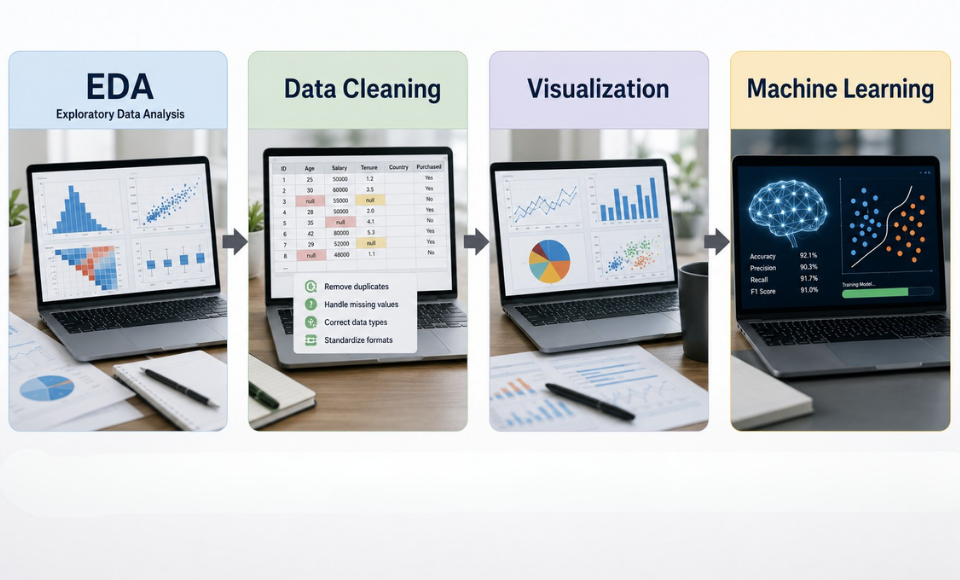
Starting your portfolio with foundational exploratory analysis and binary classification sets the stage for mastering Python for data analysis.
These initial projects teach you how to handle messy datasets, build clear data visualizations, and construct baseline machine learning pipelines that answer concrete business questions.
1. Netflix Movies & TV Shows Exploratory Data Analysis

GitHub Repository: Netflix-EDA on GitHub
This project dives deep into a multi-thousand-row dataset of Netflix titles to uncover content distribution trends, regional production preferences, and rating patterns across TV shows and movies.
Built using core libraries like Pandas, Matplotlib, and Seaborn, the code implements clean data wrangling functions, missing-value cleaning workflows, and visual distribution plots that map content additions over time.
Content streaming platforms use similar exploratory data pipelines to optimize content acquisition strategies, analyze viewer demographics, and balance licensing decisions across global regional markets.
Pro Tip: Try extending this repository by adding basic sentiment analysis on the movie description column using NLTK or TextBlob to categorize content by mood or tone.
2. Telco Customer Churn Prediction

GitHub Repository: Telco-customer-churn-prediction on GitHub
This project addresses one of the most critical business metrics in subscription industries identifying customers at risk of canceling their accounts before they churn.
Utilizing Pandas, Scikit-Learn, and XGBoost, the codebase demonstrates categorical feature encoding, numerical scaling, class imbalance handling, and evaluates classification models using ROC-AUC metrics and confusion matrices.
Telecommunication providers and SaaS platforms deploy automated churn risk classifiers directly into customer management systems to trigger targeted retention discounts and personalized outreach.
3. Credit Card Fraud Detection

GitHub Repository: Credit-Card-Fraud-Detection on GitHub
Fraud detection presents a classic extreme-imbalance classification challenge where legitimate transactions drastically outnumber fraudulent events, requiring specialized sampling techniques.
Built using Python, Scikit-Learn, Imbalanced-Learn, and Seaborn, the pipeline implements SMOTE oversampling, NearMiss undersampling, and Random Forest models to maximize recall while controlling false positive rates.
Banking networks and payment gateways process millions of live transactions daily through similar low-latency anomaly detection systems to flag compromised cards within milliseconds.
Pro Tip: When presenting this project to hiring managers, highlighting why you prioritized Precision-Recall AUC over standard Accuracy scores on a dataset where 99.8% of transactions are legitimate is a misleading metric.
Interactive Systems & Competitive Modeling
Stepping beyond basic static models involves building interactive web applications and tackling complex Kaggle science projects. These intermediate builds demonstrate your ability to handle non-linear feature interactions, build content recommendation algorithms, and wrap predictive models in user-facing web dashboards.
4. Interactive Movie Recommender System

GitHub Repository: movie-recommender-system on GitHub
This project constructs a content-based recommendation engine that calculates vector similarities between movies using metadata tags, genres, keywords, cast, and director information.
Powered by Python, Pandas, Scikit-Learn (CountVectorizer and Cosine Similarity), and Streamlit, the repository includes a complete pipeline that vectorizes text descriptions and serves real-time recommendations through an interactive web UI.
E-commerce platforms, media streaming services, and personalized marketing engines rely heavily on similarity matrices and recommendation pipelines to increase user engagement and extend session durations.
Pro Tip: Host your Streamlit app on Streamlit Community Cloud and link the live web application directly at the top of your GitHub README.md file so recruiters can test your app without cloning the repo locally.
5. House Price Prediction with Advanced Regression

GitHub Repository: house-prices-kaggle on GitHub
This project focuses on predicting residential property values using 79 explanatory variables, covering everything from square footage and zoning classifications to structural quality metrics.
Leveraging Python, NumPy, Pandas, Scikit-Learn, LightGBM, and XGBoost, the codebase features advanced feature engineering, log-transformations for skewed target distributions, group-wise imputation, and ensemble model stacking.
Real estate valuation platforms, mortgage underwriters, and property investment funds deploy stacked regression pipelines to generate automated valuation models (AVMs) with high pricing accuracy.
Intermediate Projects: Applied AI & Sequential Modeling
Tackling sequential time-series data and unstructured natural language marks a significant step forward in your portfolio journey. These intermediate Python data analysis projects focus on deep learning architectures, text tokenization pipelines, and seasonal forecasting models designed for real-time decision-making systems.
6. Stock Price Prediction using LSTM Neural Networks

GitHub Repository: stockpriceprediction on GitHub
This project builds a time-series forecasting model using Recurrent Neural Networks (RNNs) and Long Short-Term Memory (LSTM) layers to predict financial asset price trends based on historical trading data.
Engineered with Python, Keras/TensorFlow, Pandas, and Matplotlib, the codebase processes sequential stock prices through sliding-window data generators, normalizes input features using MinMaxScaler, and evaluates model predictions against actual market curves.
Quantitative trading firms and financial risk managers deploy deep sequence models to analyze market volatility, evaluate asset risk profiles, and support algorithmic execution strategies.
Pro Tip: Time-series models can easily overfit due to look-ahead bias during data scaling. Always ensure you fit your MinMaxScaler exclusively on the training split before transforming the validation and test splits.
7. Twitter Sentiment Analysis with NLP

GitHub Repository: Twitter-Sentiment-Analysis on GitHub
This project constructs a natural language processing pipeline that cleans, tokenizes, and classifies social media posts into positive, negative, or neutral sentiment categories.
Built using Python, NLTK, Scikit-Learn, and Logistic Regression, the pipeline performs text cleaning (stop-word removal, lemmatization, special character stripping), extracts TF-IDF feature vectors, and evaluates classification performance on real-world tweet datasets.
Brand monitoring agencies and customer experience teams leverage sentiment classification pipelines to track brand perception in real time, flag escalating PR crises, and analyze product review trends.
8. Walmart Retail Sales Demand Forecasting
GitHub Repository: Walmart-Sales-Forecasting on GitHub
This project addresses multi-store sales forecasting across various retail departments, accounting for holiday promotions, economic indicators, temperature shifts, and store-level seasonality.
Leveraging Python, Pandas, Matplotlib, Seaborn, and Random Forest Regressors, the codebase analyzes store-level promotional markdowns, constructs lag features, and predicts upcoming weekly revenue distributions.
Retail enterprise chains rely heavily on automated demand forecasting engines to optimize supply chain inventory levels, reduce stockout risks, and allocate staffing across regional distribution centers.
Unsupervised Learning & Computer Vision Foundations
Rounding out your portfolio requires demonstrating competence in unsupervised pattern recognition and computer vision. These final two projects cover customer persona clustering without ground-truth labels and deep learning image classification pipelines designed for spatial data.
9. Customer Mall Segmentation using K-Means Clustering

GitHub Repository: Customer-Segmentation-Using-K-Means-Clustering on GitHub
This project applies unsupervised machine learning algorithms to group retail mall visitors into distinct customer personas based on demographic factors, annual income, and spending behavior scores.
Built using Python, Pandas, Seaborn, and Scikit-Learn, the codebase uses the Elbow Method and Silhouette Analysis to determine optimal cluster counts (k) before executing K-Means clustering and visualizing high-density target segments.
Marketing departments, e-commerce platforms, and credit card issuers utilize customer segmentation pipelines to design tailored promotional campaigns, structure tiered loyalty programs, and optimize customer lifetime value (CLV).
Pro Tip: Distance-based clustering algorithms like K-Means are highly sensitive to variable scale. Always apply feature scaling (StandardScaler or MinMaxScaler) before fitting your model to ensure features with larger numerical ranges don't dominate cluster assignments.
10. PyTorch Deep Learning Image Classifier
GitHub Repository: pytorch-examples on GitHub
This project constructs a Convolutional Neural Network (CNN) architecture from scratch using PyTorch to process, classify, and evaluate multi-class image datasets.
Engineered with Python, PyTorch, Torchvision, NumPy, and Matplotlib, the repository covers custom dataset loaders, spatial tensor transformations, batch normalization, loss evaluation loops, and GPU-accelerated tensor computation.
Computer vision classification pipelines power automated quality control in manufacturing, medical diagnostic imaging, autonomous vehicle vision systems, and satellite imagery analysis.
Pro Tip: When working with smaller image datasets, use Transfer Learning by fine-tuning pre-trained neural networks (such as ResNet-50 or EfficientNet) rather than training a CNN from scratch to achieve higher accuracy with significantly less training time.
Why Choose Apponix?
Building an impressive GitHub portfolio is an essential milestone, but transforming independent open-source projects into an enterprise-ready technical profile requires hands-on mentorship, code reviews, and industry exposure. As a leading Training institute in Bangalore, Apponix Technologies bridges the gap between self-guided learning and professional software execution.
Our project-driven data science programs empower learners through structured technical development:
-
100% Repository & Portfolio-Focused Learning: Learn how to write modular, production-tested Python code, package environment dependencies, and deploy live web dashboards that capture the attention of hiring teams.
-
Direct Mentorship from Senior Engineers: Receive personalized code reviews from experienced tech professionals who evaluate your repository architecture, git commits, and algorithms against enterprise standards.
Gain access to dedicated placement support, resume optimization sessions, mock technical interviews, and direct referral pipelines with top product companies and global innovation hubs.
Conclusion
Building a standout data science portfolio isn't about copying thousands of lines of code or collecting dozens of scattered Jupyter Notebooks. It's about selecting a handful of high-impact projects, dissecting their architecture, and demonstrating that you can take raw data, build robust models, and solve real-world problems.
As you work through these ten repositories, focus on polish and execution: write comprehensive README.md files, document your data preprocessing decisions, host your interactive web apps on free cloud platforms, and highlight the business impact of your metrics.
Ready to elevate your code and launch a high-growth career? Connect with the program advisors at Apponix Technologies today, explore our practical training tracks, and build the job-ready technical muscle memory needed to stand out in the tech industry.

Apponix Academy
Apponix Academy