POPULAR COURSES
Master Programs




Table of contents:
|
1. Why Full-Stack Developers Are Core Corporate Assets
|
|
2. MERN Stack vs. Java Full-Stack: Choosing Your High-Growth Path
|
|
3. Essential Technical Competencies for Modern Full-Stack Engineers
|
|
4. Salary Landscape & Industry Hiring Sectors in Bangalore
|
|
5. Why Choose Apponix Technologies for Full-Stack Training |
|
6. Conclusion |
The fast-paced software industry demands versatile engineers capable of bridging client-side interfaces and complex server-side architectures. Pursuing a Full-Stack Development Career offers unmatched job security, rapid skill progression, and high earning potential in Asia's leading tech hub.
Enrolling in a trusted Training Institute in Bangalore provides aspiring developers with the structured mentorship, hands-on lab projects, and end-to-end framework fluency needed to build scalable digital products.
Modern software development has moved away from hyper-isolated engineering silos.
Fast-moving startups, SaaS platforms, and enterprise capability centers no longer look solely for developers who know only front-end design or back-end database queries in isolation. Instead, product teams heavily favor full-stack engineers professionals who understand the complete lifecycle of a web application.
From crafting intuitive user interfaces with modern JavaScript frameworks to designing RESTful APIs, optimizing relational databases, and containerizing microservices for cloud deployment, full-stack engineers serve as the primary engine driving modern software innovation.
Why Full-Stack Developers Are Core Corporate Assets

The shift toward agile product delivery and microservices architecture has transformed how engineering teams build software.
Rather than maintaining isolated front-end and back-end development departments, modern organizations prioritize cross-functional engineering teams where developers can own feature delivery end-to-end.
Eliminating Communication Overhead in Sprint Cycles
In traditional development setups, building a single application feature required hand-offs between separate UI designers, back-end engineers, and database administrators. This isolated approach often led to bottlenecks: back-end developers waited for UI specifications, while front-end developers were delayed by incomplete API endpoints.
Full-stack developers eliminate this friction. Because they understand data modeling, server logic, and client-side state management, they can:
-
Design relational and NoSQL database schemas tailored to application requirements.
-
Build secure, scalable RESTful and GraphQL APIs.
-
Connect back-end logic directly to responsive user interfaces without cross-team delays.
By handling the entire implementation pipeline, full-stack engineers significantly accelerate feature delivery and reduce sprint friction across product teams.
Economic Efficiency and End-to-End Feature Ownership
For fast-growing startups and global enterprise capability centers alike, versatility translates directly into cost efficiency and faster time-to-market. A developer who can build a user interface, write back-end business logic, and containerize the application for cloud deployment provides tremendous architectural value.
This demand for end-to-end feature ownership has created a surge in high-paying Software Developer Jobs across top technology hubs. Organizations actively seek versatile professionals who can adapt to changing technology stacks and solve complex architectural challenges.
The Need for Versatile Tech Stacks
|
Feature Aspect |
Isolated Single-Stack Approach |
Full-Stack Engineering Approach
|
|---|---|---|
|
Feature Ownership |
Fragmented across multiple specialists |
Single developer or cross-functional pair owns the feature end-to-end |
|
API Integration |
Frequent friction over payload structures and specs |
Seamless alignment between server endpoints and UI state management |
|
Problem Solving |
Limited visibility into system-wide performance bottlenecks |
Holistic debugging across database queries, server logs, and UI rendering |
|
Deployment Speed |
Slower release cycles due to multi-team hand-offs |
Rapid iterative deployments via continuous integration pipelines |
Enrolling in a structured Web Development Course bridges the gap between basic coding concepts and enterprise-grade system architecture, giving developers the multi-disciplinary skills required to excel in modern software engineering environments.
MERN Stack vs. Java Full-Stack: Choosing Your High-Growth Path
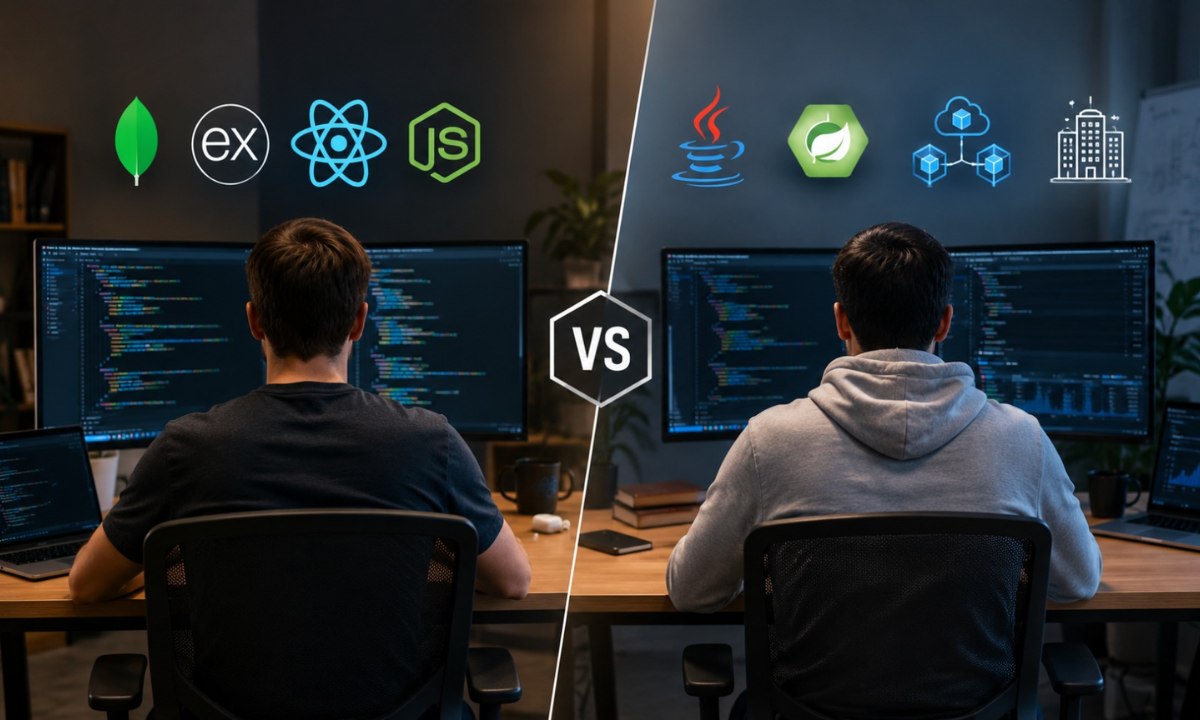
Selecting the right technology stack is a critical decision when planning your full-stack engineering journey. In Bangalore's thriving technology ecosystem, the debate around MERN Stack vs. Java Full-Stack continues to shape enterprise hiring and startup product development. The two leading software stacks—MERN Stack (MongoDB, Express.js, React, Node.js) and Java Full-Stack (Java, Spring Boot, Microservices, React/Angular)—offer distinct advantages depending on business requirements, application architecture, and long-term scalability.
Both pathways offer exceptional career growth, but they cater to different business models, application architectures, and organizational scales.
The MERN Stack: Speed, JavaScript Unification, and Modern SaaS
The MERN stack has become the industry standard for fast-moving startups, SaaS platforms, and modern web applications. By utilizing JavaScript (and TypeScript) across both the client-side and server-side, MERN allows developers to build high-performance applications with unified codebase paradigms
Key advantages of the MERN stack include:
-
Single-Language Unification: Writing both front-end UI components and back-end REST/GraphQL APIs in JavaScript or TypeScript reduces context switching and speeds up development.
-
Flexible NoSQL Document Storage: MongoDB provides dynamic JSON-like schema flexibility, making it ideal for evolving product requirements and rapid prototyping.
-
Non-Blocking Event-Driven I/O: Node.js handles high concurrency and real-time asynchronous operations efficiently, making it well-suited for streaming platforms, chat applications, and collaborative tools.
Enrolling in an industry-aligned MERN Stack Course equips you with the skills to build high-throughput web applications, manage component state using React, and deploy scalable Node.js microservices.
Java Full-Stack: Enterprise Scalability, Security, and Microservices
Java remains the backbone of global enterprise computing. For financial institutions, healthcare providers, e-commerce giants, and Global Capability Centers (GCCs), Java's robust typing, memory management, and mature ecosystem make it the preferred choice for mission-critical systems.
Key advantages of Java Full-Stack include:
-
Enterprise-Grade Frameworks: Spring Boot and Spring Cloud simplify the creation of production-grade microservices with built-in security, dependency injection, and transaction management.
-
High Scalability & Performance: Java's strongly-typed environment and multithreading capabilities excel at processing high-volume transactional workloads safely.
-
Long-Term Enterprise Demand: Millions of legacy and modern enterprise applications rely on Java, guaranteeing sustained hiring across multinational corporations and tech consultancies.
Completing comprehensive Java Full-Stack Training ensures you master object-oriented system design, relational database ORM mapping with Hibernate, and building enterprise microservice architectures.
Tech Stack Comparison Matrix
|
Architectural Parameter |
MERN Stack Ecosystem |
Java Full-Stack Ecosystem
|
|---|---|---|
|
Core Programming Language |
JavaScript / TypeScript |
Java (JDK 17+) |
|
Back-End Framework |
Node.js with Express.js or NestJS |
Java with Spring Boot & Spring Security |
|
Database Architecture |
MongoDB (NoSQL Document Store) |
PostgreSQL / MySQL / Oracle (Relational DBs) |
|
Primary Industry Fit |
SaaS Startups, E-Commerce, Real-Time Web Apps |
BFSI (Banking), Healthcare, Enterprise GCCs |
|
Target Application Type |
Agile MVPs, Single-Page Apps, API Gateways |
Distributed Microservices, High-Security Portals |
Both technological routes offer lucrative career trajectories. Choosing between them depends on whether you prefer the rapid, flexible environment of modern JavaScript development or the structured, highly typed architecture of enterprise Java systems.
Essential Technical Competencies for Modern Full-Stack Engineers

To thrive in 2026, full-stack developers must possess deeper technical muscle memory than just writing basic CRUD (Create, Read, Update, Delete) applications.
Employers prioritize engineers who understand end-to-end system flow, how client requests traverse network gateways, execute backend logic, interact with database layers, and render efficiently on the user's screen.
1. Modern Front-End Engineering & Component Architecture
Front-end development is no longer limited to styling static web pages; it revolves around building complex, dynamic user experiences with client-side state management and server-side rendering.
-
Component-Based Frameworks: Mastering declarative UI libraries like React or enterprise frameworks like Angular to build reusable, modular component architectures.
-
Next.js & Server Components: Utilizing hybrid rendering patterns (SSR, SSG, and ISR) for rapid initial page loads and optimal search engine indexability.
Managing complex application states using Redux Toolkit, Zustand, or Context API while avoiding unnecessary re-renders and memory leaks.
2. Back-End Systems, API Design & Async Processing
The server side handles business logic execution, user authentication, and data transformation under heavy concurrent loads.
-
RESTful & GraphQL API Architecture: Designing secure, versioned endpoints with structured payload contracts, proper status codes, and comprehensive Swagger/OpenAPI documentation.
-
Authentication & Authorization: Implementing stateless security mechanisms using OAuth 2.0, JSON Web Tokens (JWT), role-based access control (RBAC), and session management.
-
Asynchronous Execution & Microservices: Processing background tasks using event queues (Kafka, RabbitMQ, or Redis) to maintain high server throughput during traffic spikes.
3. Database Architecture, ORMs, and Query Optimization
Modern applications rely on robust data persistence layers capable of serving thousands of simultaneous requests without bottlenecks.
-
Relational & Document Databases: Designing normalized schemas in PostgreSQL or MySQL, alongside dynamic NoSQL document modeling in MongoDB.
-
ORM & Query Builders: Utilizing Object-Relational Mapping (ORM) tools like Hibernate, Prisma, or Sequelize to interact safely with databases while preventing security vulnerabilities.
-
Performance Tuning: Writing optimized indexes, reviewing query execution plans, managing connection pools, and caching frequent queries with Redis.
4. Cloud Native, DevOps & AI-Assisted Workflows
Understanding how code lives and executes in production environments is an expected baseline for mid-level and senior roles.
-
Containerization & CI/CD: Packaging web services into isolated Docker containers and establishing automated continuous integration pipelines via GitHub Actions.
-
Cloud Deployment & Serverless: Deploying scalable web applications onto platforms like AWS (S3, EC2, Lambda), Google Cloud, or Vercel.
-
AI-Augmented Development: Leveraging developer tools like GitHub Copilot, GitHub Projects, and automated code auditors to accelerate boilerplate creation, organize development workflows, write unit tests, collaborate on version-controlled code, and debug errors efficiently.
Earning an industry-backed Full-Stack Certification validates these cross-functional engineering competencies, providing tangible proof to recruiters and engineering managers that you possess production-ready capabilities.
Core Technical Competency Matrix
|
Domain Layer |
Key Engineering Competencies |
Primary Toolstack & Frameworks
|
|---|---|---|
|
Front-End Layer |
Single-Page Applications, Server Components, State Management |
React, Next.js, Angular, TypeScript, Tailwind CSS |
|
Back-End Layer |
REST/GraphQL APIs, Microservices, Middleware, OAuth2/JWT |
Node.js (Express/NestJS), Spring Boot, Python FastAPI |
|
Data & Persistence |
Schema Design, Query Optimization, Caching, ORM Mapping |
PostgreSQL, MongoDB, Redis, Prisma, Hibernate |
|
DevOps & Cloud |
Containerization, CI/CD Automation, Cloud Hosting, Version Control |
Docker, Git/GitHub, AWS, Vercel, Kubernetes |
Salary Landscape & Industry Hiring Sectors in Bangalore
Bangalore, widely recognized as Asia’s technology capital, offers some of the highest compensation packages for full-stack engineers in the region. Driven by a dense concentration of global capability centers (GCCs), SaaS unicorns, and fintech giants, full-stack developers in Bangalore enjoy a 15% to 25% salary premium compared to other Indian technology hubs.
Compensation Breakdown by Experience Tier
Earning potential in full-stack engineering expands rapidly as developers gain experience owning entire feature pipelines, optimizing database performance, and designing cloud-native architectures.
|
Experience Level |
Typical Engineering Roles |
Average Salary Range (Bangalore) |
Key Value Drivers & Differentiators
|
|---|---|---|---|
|
Entry-Level (0 to 2 Years) |
Associate Full-Stack Engineer, Junior Web Developer |
₹5 LPA – ₹8.5 LPA |
Clean GitHub portfolio, REST API proficiency, state management fluency |
|
Mid-Level (3 to 6 Years) |
Full-Stack Engineer, Senior Software Developer |
₹11 LPA – ₹22 LPA |
Microservices design, DB query optimization, cloud containerization |
|
Senior Level (7+ Years) |
Lead Full-Stack Architect, Principal Engineer |
₹25 LPA – ₹48+ LPA |
System design at scale, technical leadership, cross-stack governance |
Market Insight: Fresh graduates and career switchers who demonstrate verifiable hands-on project work such as deployed microservices or full-fledged SaaS applications frequently command starting packages at the upper bound of the entry-level salary tier
Top Hiring Sectors Driving Full-Stack Demand
Full-stack talent acquisition is active across several dominant industry verticals concentrated along major Bangalore tech corridors like Outer Ring Road, Indiranagar, Whitefield, and Electronic City:
-
Global Capability Centers (GCCs): Technology hubs for Fortune 500 multinationals actively recruit full-stack engineers to build and maintain internal enterprise platforms, cloud integrations, and core business tools.
-
Fintech & Digital Banking Platforms: High-growth financial institutions and payment processors demand developers who can build secure, low-latency transaction interfaces backed by resilient microservice architectures.
-
SaaS & Product Unicorns: Fast-scaling software-as-a-service providers seek full-stack developers proficient in modern JavaScript frameworks (React, Next.js, Node.js) to drive rapid feature releases and product iterations.
-
E-Commerce & Digital Marketplaces: Large retail platforms hire cross-functional engineers to optimize search indexing, manage high-concurrency payment checkouts, and build responsive web and mobile interfaces.
Enrolling in a high-caliber Full-stack developer course in Bangalore ensures your technical skill set directly aligns with the rigorous hiring standards of these top-tier engineering organizations, putting you on a fast track toward high-growth roles.
Why Choose Apponix Technologies for Full-Stack Training
Transitioning into software engineering requires more than watching video tutorials or memorizing syntax; it demands writing clean, modular code, building real-world web applications, and understanding how production systems deploy. Apponix Technologies delivers a hands-on learning environment designed to transform aspiring coders into enterprise-ready software engineers.
When you train at Apponix, you enter a career-focused ecosystem engineered for workplace readiness:
-
100% Practical Project-Driven Labs: Build, debug, and deploy dynamic web applications from scratch, mastering both client-side UI workflows and server-side API microservices.
-
Mentorship from Senior Industry Engineers: Learn directly from active software architects and lead developers who bring years of real-world enterprise experience, code review practices, and system design insights into every session.
-
Production-Grade GitHub Portfolio: Develop verifiable, open-source repositories showcasing clean code architecture, database schemas, RESTful endpoint integrations, and containerized Docker setups.
-
Dedicated Career & Placement Support: Benefit from 1-on-1 resume optimization, mock whiteboarding interviews, system design coaching, and direct interview opportunities through an extensive network of hiring partners.
Combining rigorous technical training with real-world project creation and career mentorship, Apponix provides the tools and confidence required to clear technical interviews and launch a successful career in software engineering.
Conclusion
The software industry in 2026 continues to reward multi-disciplinary engineers who can own product features from user interface design to database deployment. By developing cross-stack fluency, mastering modern frameworks, and understanding cloud-native architecture, you position yourself at the center of the global technology economy.
To kickstart your professional transformation, follow this 4-step execution roadmap:
-
Master Core Front-End & Back-End Syntax: Build a firm foundation in HTML5, modern CSS, JavaScript (ES6+), and basic server-side programming principles.
-
Choose Your Core Technology Stack: Deepen your expertise in either modern JavaScript/TypeScript (MERN) or enterprise Java microservices based on your career goals.
-
Build & Deploy Full-Scale Applications: Create end-to-end web applications with secure authentication, relational or NoSQL databases, and cloud hosting (AWS/Vercel).
-
Polish Your Portfolio & Prepare for Interviews: Present your public GitHub projects, refine your resume to highlight measurable impact, and practice whiteboarding system design concepts.
Taking systematic action today equips you with the technical capability, hands-on confidence, and portfolio needed to thrive in modern engineering teams and command competitive compensation packages.
Reference:
https://www.attitudetallyacademy.com/Blog/why-full-stack-developers-are-in-high-demand-2/

Apponix Academy
Apponix Academy