POPULAR COURSES
Master Programs


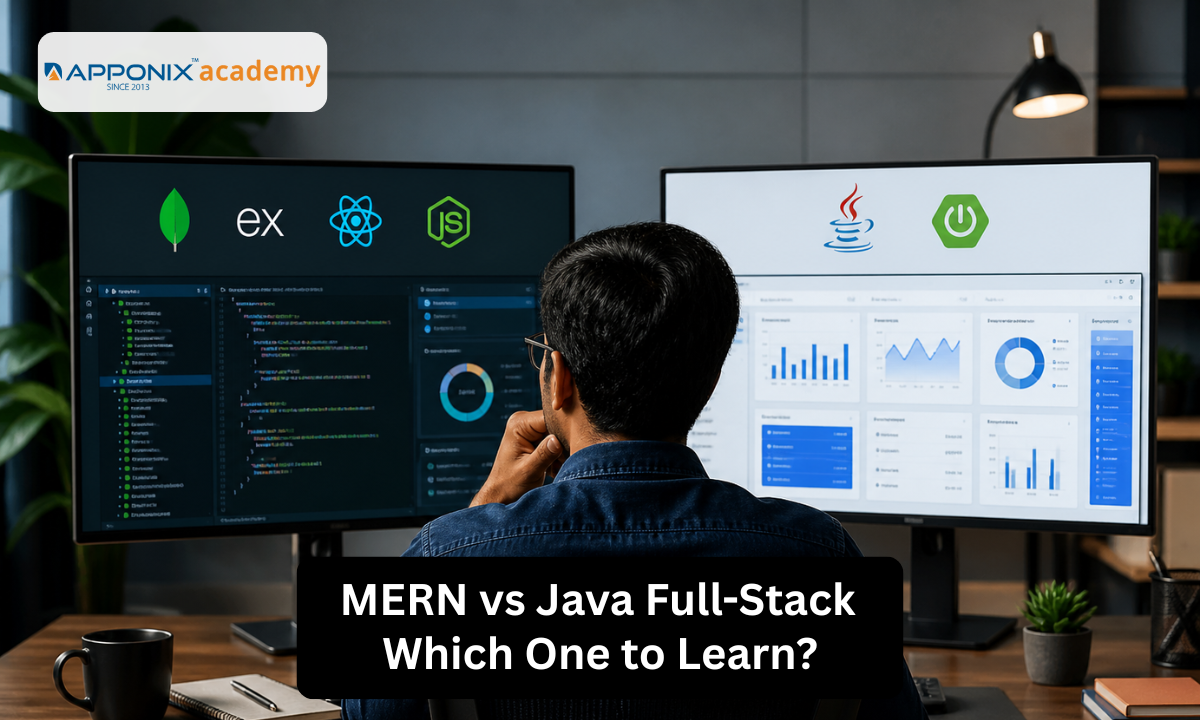
Table of contents:
|
1. Decoding the MERN Stack (The Innovator's Choice) |
|
2. Decoding Java Full-Stack (The Enterprise Heavyweight) |
|
3. MERN vs Java Full-Stack: The Core Technical Differences |
|
4. Building the Bridge: How Each Stack Handles RESTful APIs |
|
5. The Job Market of Startups vs. Multinational Corporations
|
|
6. Why Choose Apponix? The Dual Pathway to Success |
|
7. Conclusion |
The transition from learning basic programming to choosing a professional specialization is the single most critical juncture in a software engineer's career.
Every single day, ambitious candidates searching for a highly practical Full-stack developer course in Bangalore encounter a massive wall of contradictory technical advice. When students consult with Apponix Academy, a premium Training Institute in Bangalore, our experts constantly hear the same frustration.
Social media influencers loudly declare that JavaScript is the only future of the internet, while senior corporate architects firmly insist that Java is the only language that actually matters in the real world.
This conflicting noise completely paralyzes aspiring developers. The fear of choosing the "wrong" technology prevents talented individuals from ever starting their careers. To cut through the industry hype, candidates must accept a few thought-provoking realities about modern software engineering:
-
The Perfect Language is an Absolute Myth
-
Speed vs. Stability
-
The Cost of the Wrong Choice
This comprehensive guide will permanently resolve the ultimate developer dilemma. We are completely stripping away personal developer bias to look exclusively at objective, global market data.
At the end of this analysis, you will understand exactly how both the MERN and Java ecosystems function, where they are currently being utilized, and precisely which stack you should choose to guarantee your professional success in 2026.
Decoding the MERN Stack (The Innovator's Choice)
In the fast-paced world of technology startups, survival depends entirely on speed. Companies must build, launch, and modify their digital products faster than their competitors. This massive demand for rapid, agile development birthed the MERN stack.
MERN is an acronym representing four distinct technologies that work together to build incredibly fast, highly interactive web applications.
The absolute greatest superpower of the MERN stack is its unified language environment. Historically, engineers had to learn SQL for the database, Java or PHP for the server, and JavaScript strictly for the visual interface.
The MERN ecosystem eliminates this friction. By utilizing JavaScript across all three architectural layers of the application, developers can build the entire digital product using a single programming language.
To fully understand this ecosystem, here is a detailed breakdown of the four technologies powering modern startups:
|
The Technology |
The Architectural Layer |
The Corporate Function |
|
MongoDB |
Database (The Data Vault) |
A highly flexible NoSQL database. Instead of using rigid tables, it stores information in dynamic document formats. This is absolutely perfect for applications managing unpredictable or rapidly changing data structures. |
|
Express.js |
Backend Framework (The Bridge) |
A lightweight server framework built specifically to route data. It acts as the digital traffic controller, taking requests from the user interface and securely retrieving the correct information from the database. |
|
React.js |
Frontend Library (The Visuals) |
Created and maintained by Meta, this library builds the actual user interface. It allows developers to create reusable visual components, making complex websites feel as fast and smooth as a native mobile application. |
|
Node.js |
Runtime Environment (The Engine) |
This is the foundational technology of the entire stack. It is the specific engine that finally allowed developers to run JavaScript on a backend server instead of just inside a web browser. |
When these four tools are combined, they create an incredibly powerful development pipeline. Innovators and product companies aggressively choose this specific combination for three highly strategic reasons:
-
Native Data Flow: MongoDB stores data in a format almost identical to standard JavaScript objects (JSON). This means information flows seamlessly from the database to the user's screen without requiring any complex translation code in the middle.
-
Rapid Prototyping Capabilities: Because the engineering team only needs to write in one language, a small group of developers can build a fully functional application prototype in a matter of weeks. This speed is critical for startups trying to secure quick investor funding.
-
The Global Talent Pool: JavaScript consistently ranks as the most popular programming language in the world. Companies choose MERN because they can hire specialized developers rapidly and scale their engineering departments without heavy recruitment friction.
While MERN entirely dominates the agile startup space, it is not the universal answer for every single business model. When massive multinational banks need to process billions of secure global transactions simultaneously, they turn to a completely different technological heavyweight.
Decoding Java Full-Stack (The Enterprise Heavyweight)
While startup companies prioritize rapid deployment and speed, multinational banking institutions, global healthcare providers, and massive logistics firms prioritize something entirely different: absolute, unbreakable stability.
When a global financial system processes millions of credit card transactions per second, a minor software glitch does not just cause a temporary inconvenience; it results in millions of dollars in immediate losses. To prevent these catastrophic system failures, the world's largest corporate entities rely almost exclusively on Java.
Unlike the MERN stack, which uses a single language across the entire application, the Java Full-Stack is a specialized hybrid environment. It deliberately separates the visual frontend from the server logic, pairing a modern user interface (often built with React or Angular) with a highly structured, strictly typed backend.
Here is a detailed breakdown of the specific digital machinery powering Fortune 500 companies today:
|
The Technology |
The Architectural Role |
The Corporate Function |
|
Java |
Core Server Language |
The foundational programming language. It is strictly typed, meaning the code forces developers to declare exactly what type of data they are using, drastically reducing accidental errors and system crashes. |
|
Spring Boot |
Backend Framework |
This is the absolute powerhouse of enterprise development. It provides pre-built, highly secure templates that allow developers to rapidly build robust RESTful APIs, ensuring the server communicates flawlessly with the visual frontend. |
|
Hibernate |
Database Connectivity |
Writing complex SQL queries manually is prone to human error. Hibernate acts as a digital translator, automatically mapping Java objects directly to a relational database, ensuring financial records and user data remain perfectly structured. |
|
Relational Databases |
The Data Vault |
Enterprise systems rarely use flexible NoSQL databases. Instead, they rely on rigid SQL databases like MySQL or Oracle to guarantee strict data integrity for things like exact bank balances. |
The technology community frequently claims that Java is an outdated language, yet massive corporations refuse to abandon it. This loyalty is not based on nostalgia; it is based on three highly strategic engineering advantages:
-
Unmatched Multithreading Capabilities: Startups often struggle when thousands of users log in at the exact same time. Java is natively designed to handle "multithreading," meaning it can process thousands of complex, simultaneous user requests without the server slowing down or crashing.
-
Impenetrable Security Architecture: Financial institutions face constant cyberattacks. The Spring Security framework provides enterprise-grade authentication, incredibly deep authorization layers, and automated protection against common web vulnerabilities straight out of the box.
-
The Legacy Ecosystem: The world's banking and telecommunications infrastructure was built on Java over the last two decades. Companies are not going to rewrite billions of lines of perfectly functioning code in JavaScript. They need dedicated Java Full-Stack developers to maintain, upgrade, and scale these existing massive systems.
Understanding the independent strengths of MERN and Java is critical. However, to make an informed career choice, candidates must view a direct, side-by-side technical comparison of how these two distinct ecosystems actually operate in the real world.
MERN vs Java Full-Stack: The Core Technical Differences
When developers evaluate MERN vs Java full-stack, they must look beyond simple popularity metrics and understand exactly how these ecosystems operate under heavy pressure. While both stacks are fully capable of building modern web applications, their underlying architectural philosophies are opposite.
MERN prioritizes flexibility and speed, whereas Java prioritizes strict rules and unbreakable structure. To highlight exactly how these differences impact daily engineering tasks, here is a direct technical comparison of the two environments:
|
The Technical Metric |
The MERN Stack Environment |
The Java Full-Stack Environment |
|
Language Architecture |
Uniform. JavaScript is utilized across the frontend, the backend server, and the database. |
Hybrid. Java strictly controls the backend, while JavaScript/TypeScript handles the visual frontend. |
|
Server Processing |
Single-threaded and asynchronous. It handles multiple tasks by never waiting for one task to finish before starting the next. |
Multi-threaded. It creates dedicated, independent processing lanes for thousands of simultaneous user requests. |
|
Data Flow & Storage |
Native JSON. Data flows seamlessly from the NoSQL database (MongoDB) directly to the screen without complex translation. |
Object-Relational. Data must be carefully translated from Java objects into rigid SQL database tables using Hibernate. |
|
The Primary Superpower |
Rapid prototyping and real-time data streaming (perfect for chat applications or social media feeds). |
Extreme security and data integrity (perfect for calculating taxes or processing global banking transactions). |
Building the Bridge: How Each Stack Handles RESTful APIs
The absolute most critical function of any modern backend server is creating RESTful APIs. These APIs act as the digital messengers that securely carry information between the database vault and the user's screen. The way each technology stack builds these APIs perfectly illustrates their core differences.
-
The MERN Approach (Flexible and Fast): Building APIs in the MERN ecosystem using Express.js is incredibly fast. Because the entire stack speaks the same digital language, developers do not need to write complex translation code.
The server simply grabs a JSON document from MongoDB and hands it directly to the React frontend. This lightweight process allows small engineering teams to build fully functional APIs in a matter of hours.
-
The Java Approach (Strict and Secure): Building APIs using the Spring Boot framework takes significantly more time, but the result is virtually indestructible.
Java requires developers to explicitly define every single piece of data before it moves. If a user tries to submit text into a field designed strictly for numbers, the Java API will instantly reject the request before it ever reaches the database. This rigid structure prevents the catastrophic system errors that frequently plague loosely typed languages.
Understanding these technical mechanics is vital for passing technical interviews. However, the most important factor in choosing a specialization is not how the technology works, but rather which specific companies are currently paying top salaries for these skills.
The Job Market of Startups vs. Multinational Corporations
Understanding the technical differences between programming languages is only the first half of the career equation. The most critical factor in choosing a specialization is matching the technology directly to the exact type of corporate culture you want to join.
The job market in 2026 is distinctly divided into two massive hiring sectors, and each sector aggressively recruits for a completely different technology stack.
The MERN Market (Agile Startups and SaaS Platforms)
Startups and product-based innovators are in a constant race against time. They must secure investor funding, build functional prototypes, and acquire active users before their initial capital runs out. Because of this high-pressure environment, they heavily prefer the MERN stack.
-
The Target Industries: Tech startups, creative digital agencies, e-commerce innovators, and Software-as-a-Service (SaaS) providers.
-
The Corporate Hiring Logic: These organizations hire MERN developers because a single engineer can fluently build both the frontend visual interface and the backend server using just JavaScript. This cross-layer capability keeps engineering team sizes small and initial payroll costs entirely manageable.
-
The Career Trajectory: MERN developers often experience incredibly rapid career growth. They are frequently given massive creative responsibilities early in their careers, directly building core product features from day one instead of just maintaining older systems.
The Java Market (Multinational Corporations and FinTech)
Massive global enterprises operate on an entirely different scale. A multinational bank does not care about launching a digital product quickly. They care exclusively about ensuring a server never crashes during a global financial transaction. For these corporate heavyweights, Java remains the absolute gold standard.
-
The Target Industries: Global banking and FinTech, international healthcare networks, massive logistics firms, telecommunications giants, and government infrastructure projects.
-
The Corporate Hiring Logic: These organizations manage billions of highly sensitive daily transactions. They absolutely require the rigid structure and impenetrable security frameworks provided by Java and Spring Boot. Furthermore, these companies possess millions of lines of existing legacy Java code that must be constantly maintained, secured, and scaled.
-
The Career Trajectory: Java developers enter a highly structured corporate ladder. While the initial learning curve is exceptionally steep, these roles offer unparalleled job security, comprehensive corporate benefits, and consistently high long-term salary ceilings regardless of global economic conditions.
Ultimately, deciding which stack to pursue is not about finding the universally superior coding language. It is about deciding whether you want the fast and dynamic environment of a tech startup or the highly secure and structured environment of a global banking institution.
Why Choose Apponix? The Dual Pathway to Success
Deciding whether you belong in a fast-paced startup or a multinational banking institution is a massive decision. However, making the choice is only the beginning.
The actual challenge is finding a training environment that teaches these complex ecosystems to a corporate standard. This is exactly where Apponix Academy separates itself from generic online tutorials.
We recognize that there is no single "best" technology, which is why we do not force our students into a single mold. Apponix offers elite, highly specialized master programs in both the MERN Stack and the Java Full-Stack.
Regardless of which technological pathway you choose, our training ecosystem is built entirely around securing your immediate employment:
-
100% Interview Guarantee: We take the anxiety out of the job hunt. Students who complete our comprehensive master programs receive a minimum of 10 to 20 guaranteed interviews, ensuring your resume lands directly in front of active hiring managers.
-
Active Corporate Instructors: You are taught by senior engineers who are currently working in the industry. Whether you are learning React for MERN or Spring Boot for Java, you are learning the exact coding standards companies are demanding this month.
-
Unrestricted Practical Labs: Theoretical knowledge will not pass a technical interview. Apponix provides 24/7 access to practical servers where you will build complete, deployable applications to prove your skills to recruiters.
-
Expert Career Counseling: If you are still unsure which stack fits your background, our dedicated career advisors will analyze your university degree and personal goals to place you in the perfect program.
Apponix eliminates the massive gap between classroom learning and corporate employment. You choose your specialization, focus entirely on mastering the code, and we focus entirely on launching your career.
Conclusion
The battle between the MERN stack and Java Full-Stack is not a competition to see which language is superior; it is a reflection of a highly diversified technology market. If your ultimate career goal is to build rapid prototypes, work in an agile environment, and drive product innovation, the MERN ecosystem is your perfect match. If your goal is to engineer unbreakable, highly secure digital infrastructure for the world's largest financial and global enterprises, Java remains the undisputed king.
Both pathways offer incredible salary trajectories, immense job security, and the opportunity to build the future of the internet. The only wrong choice you can make in 2026 is delaying your decision.
Take immediate control of your professional trajectory. Contact Apponix Academy today to book a free demo class, consult directly with our expert career advisors, and begin your job-guaranteed journey toward becoming a highly paid software engineer.

Apponix Academy
Apponix Academy