POPULAR COURSES
Master Programs



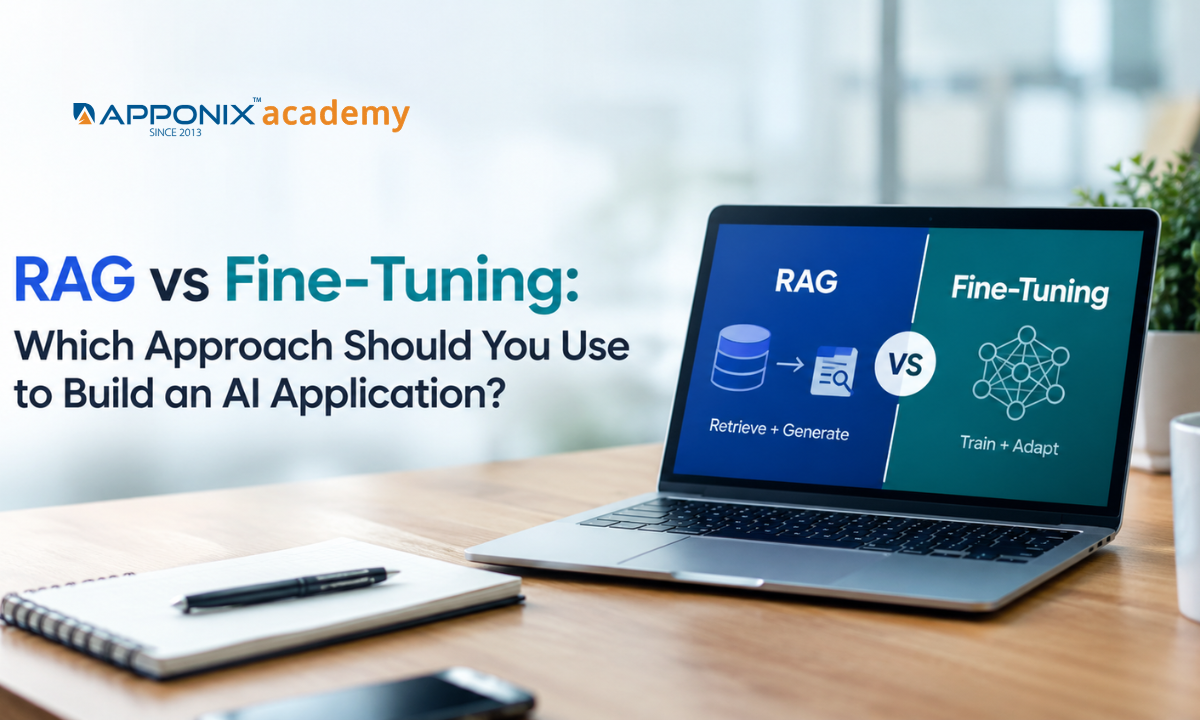
Table of contents:
|
1. What Is Retrieval-Augmented Generation (RAG)?
|
|
2. What Is Fine-Tuning in AI?
|
|
3. RAG vs Fine-Tuning: What Are the Key Differences? |
|
4. How Do RAG and Fine-Tuning Compare in Terms of Cost? |
|
5. What Data Do You Need for RAG and Fine-Tuning? |
|
6. When Should You Use RAG or Fine-Tuning? |
|
7. Can You Combine RAG and Fine-Tuning? |
|
8. How Do You Choose the Right Approach for Your AI Project? |
|
9. Conclusion |
Building an AI application involves more than selecting a large language model (LLM). You also need to determine how the model will access information, respond to users, and handle specific tasks. Two common approaches are Retrieval-Augmented Generation (RAG) and fine-tuning. RAG connects an AI model to external knowledge sources, while fine-tuning adapts a pre-trained model using additional training examples. To understand the technology behind these approaches, explore this guide on how large language models work.
Both methods can improve an AI application's performance, but they address different requirements. Your choice depends on the application's purpose, available data, budget, and expected results. For those looking to develop relevant skills, AI training courses can provide a foundation for understanding AI technologies and their practical applications.
What Is Retrieval-Augmented Generation (RAG)?

Retrieval-Augmented Generation (RAG) is an approach that enables a large language model to retrieve relevant information from an external knowledge source before generating a response.
Instead of relying only on information learned during training, the model uses retrieved documents or data to answer a user's question. These sources may include company documents, product manuals, knowledge bases, websites, and internal databases.
For example, a customer support chatbot can retrieve the latest return policy before answering a question. When the policy changes, the knowledge base can be updated without retraining the language model.
How Does RAG Work?
A typical RAG pipeline follows these steps:
-
Data preparation: Documents are collected, cleaned, and divided into smaller sections called chunks.
-
Embedding generation: The chunks are converted into numerical representations called embeddings.
-
Information retrieval: When a user asks a question, the system searches for relevant information using a vector database or another search method.
-
Context building: The most relevant results are added to the model's prompt.
-
Response generation: The LLM uses the retrieved information to generate an answer.
Developers can explore a practical example in these real-world AI project ideas, which include a document question-answering project using RAG.
What Are the Benefits and Limitations of RAG?
RAG makes it easier to maintain current information, connect multiple data sources, and provide references to source documents when the application supports citations. It can also reduce the need for repeated model training when information changes.
However, RAG depends on the quality of its retrieval pipeline. Poor document chunking, outdated content, irrelevant search results, or weak ranking can lead to incomplete or inaccurate answers. Testing retrieval accuracy and checking responses against source documents are essential parts of implementation.
What Is Fine-Tuning in AI?

Fine-tuning adapts a pre-trained AI model using additional training examples. During this process, the model's parameters are adjusted to improve its performance on a particular task.
It can help a model classify text consistently, follow a specific response format, or generate content in a preferred style. Fine-tuning is useful when an application requires a more consistent output pattern than prompting alone can provide.
How Does Fine-Tuning Work?
A typical fine-tuning workflow includes:
-
Define the task: Identify the behaviour or capability the model needs to improve.
-
Select a pre-trained model: Choose a model that suits the task and available resources.
-
Prepare the dataset: Collect accurate, relevant, and representative training examples.
-
Train the model: Apply a suitable fine-tuning method to adapt the model.
-
Evaluate performance: Compare the fine-tuned model with the original model using relevant test cases.
-
Deploy and monitor: Integrate the model into the application and track its performance over time.
For example, a business could fine-tune a model to categorise customer support tickets or generate product descriptions that follow a consistent brand voice.
Fine-tuning requires high-quality training examples. Poor data can reduce performance, while excessive or poorly designed training may affect the model's ability to handle unfamiliar tasks. It is also not a reliable way to keep frequently changing facts up to date.
RAG vs Fine-Tuning: What Are the Key Differences?
The following table compares the two approaches across common AI development requirements.
|
Comparison factor |
RAG |
Fine-tuning |
|
Primary purpose |
Retrieve relevant external information |
Adapt model behaviour |
|
Knowledge updates |
Update the connected data source |
May require further training |
|
Data requirements |
Searchable documents and records |
Curated training examples |
|
Initial investment |
Data preparation and retrieval infrastructure |
Dataset preparation and training |
|
Ongoing costs |
Storage, retrieval, and inference |
Hosting, inference, and maintenance |
|
Suitable applications |
Knowledge assistants and document search |
Classification and specialised output generation |
|
Source references |
Can provide references to retrieved documents |
Does not inherently provide citations |
|
Main limitation |
Depends on retrieval quality |
Depends on training data and model capabilities |
Neither approach is automatically cheaper or more accurate. The results depend on the model, implementation, data quality, and application requirements.
How Do RAG and Fine-Tuning Compare in Terms of Cost?
The total cost of an AI application includes development, infrastructure, model usage, evaluation, and maintenance. The main cost drivers differ between RAG and fine-tuning.
What Are the Costs of RAG?
RAG requires an initial investment in document processing, embedding generation, search infrastructure, and application development. Depending on the project, you may also need a vector database.
Ongoing expenses include storing and indexing documents, retrieving relevant information, and sending additional context to the LLM. Retrieving large amounts of text can increase token usage and per-query costs.
The total expense depends on the size of the knowledge base, the frequency of queries, the retrieval system, and the model used to generate responses.
What Are the Costs of Fine-Tuning?
Fine-tuning costs include preparing training examples, running training jobs, evaluating model performance, and deploying the adapted model. Expenses vary according to the model architecture, training method, dataset size, and computing resources.
A fine-tuned model may reduce prompt complexity or improve performance on repeated tasks. However, any savings depend on inference costs, hosting requirements, and ongoing model maintenance.
RAG may be more practical for applications that rely on frequently updated information, while fine-tuning may be worthwhile for stable, specialised tasks. A prototype and realistic cost estimate can help determine which approach offers better value.
What Data Do You Need for RAG and Fine-Tuning?
The data requirements depend on how the application will use information.
For RAG, you need reliable documents or records that the system can search. Examples include product documentation, company policies, technical manuals, and approved knowledge-base articles. The information should be current, well organised, and accessible only to authorised users.
For fine-tuning, you need examples that demonstrate the desired output or behaviour. These may include labelled text, classification examples, question-and-answer pairs, or structured input-output records. The examples should be accurate, consistent, and aligned with the intended task.
If your organisation already has useful documentation but limited training examples, RAG may be a practical starting point. Fine-tuning becomes an option when you have enough representative examples to support meaningful training and evaluation.
When Should You Use RAG or Fine-Tuning?
The best approach depends on the application's main requirements, the available data, and the performance gap you need to address.
When Should You Use RAG?
RAG is suitable when answers need to draw on current, private, or frequently updated information.
Common use cases include:
-
Customer support assistants: Retrieve current product information, return policies, and troubleshooting guides.
-
Enterprise knowledge search: Help employees find information across internal documents.
-
Document question-answering systems: Answer questions about reports, contracts, manuals, and research papers.
-
Technical support tools: Retrieve relevant documentation to assist with troubleshooting.
-
Research assistants: Retrieve relevant source material to support information-based responses.
For these applications, the quality and relevance of the source information are important factors in the final answer.
When Should You Use Fine-Tuning?
Fine-tuning may be useful when an application needs consistent outputs or improved performance on a defined task.
Common use cases include:
-
Text classification: Categorise customer messages, feedback, or support tickets.
-
Structured output generation: Produce responses that follow a defined format.
-
Brand-specific writing: Adapt the tone and style of generated content.
-
Specialised language tasks: Improve performance on a domain-specific task when suitable training examples are available.
-
Repeated workflows: Process similar inputs with consistent output patterns.
Fine-tuning is most useful when the task can be demonstrated through suitable training examples and the improvement can be measured through evaluation.
AI technologies support a wide range of business applications. This overview of artificial intelligence applications across industries provides further examples.
Can You Combine RAG and Fine-Tuning?
Yes. RAG and fine-tuning can work together when an application needs both reliable access to information and specialised model behaviour.
For example, consider an AI assistant used by a financial services company. RAG could retrieve approved product information and internal policy documents. A fine-tuned model could help classify customer queries or follow a specific response format.
A combined approach can be useful for complex applications, but it also adds development and maintenance work. Teams should first establish a baseline using a standard model, well-designed prompts, and reliable data retrieval. Fine-tuning can then be introduced if evaluation identifies a specific performance gap it can address.
Understanding how generative AI works can help developers evaluate where these techniques fit into a broader AI solution.
How Do You Choose the Right Approach for Your AI Project?
Use these five steps to make an informed decision.
-
Define the problem: Determine whether the main challenge is accessing relevant information or achieving consistent model behaviour.
-
Assess your data: Check whether you have reliable documents, suitable training examples, or both.
-
Estimate the budget: Include development, infrastructure, inference, evaluation, and ongoing maintenance.
-
Set evaluation criteria: Measure accuracy, relevance, response time, consistency, and cost using realistic test cases.
-
Build a prototype: Compare possible approaches with representative inputs before committing to a larger implementation.
For many knowledge-based applications, starting with RAG is a practical option because it allows teams to connect existing information without retraining the model. For specialised tasks, fine-tuning may deliver better results. Some applications benefit from both.
Developers who want to build a foundation in AI concepts and related technologies can explore the AI Course in Bangalore.
Conclusion
RAG and fine-tuning serve different purposes in AI application development. RAG connects a model to relevant external information, while fine-tuning adapts its behaviour for specific tasks.
Selecting the right approach depends on your application's requirements, the data available, and the expected cost of development and maintenance. Test your options with realistic examples and measurable performance criteria before choosing a solution. A well-evaluated prototype can help you identify the simplest approach that meets your needs without adding unnecessary complexity.
Reference:
1)https://developer.ibm.com/articles/awb-rag-vs-fine-tuning/
2)https://dev.to/agrima-06/rag-vs-fine-tuning-which-one-should-you-use-for-your-ai-app-cfa

Apponix Academy
Apponix Academy