POPULAR COURSES
Master Programs



Tabel of contents:
| 1. AI Applications in Healthcare |
|
2. AI in Banking and Financial Services
|
|
3. AI in Manufacturing
|
|
4. AI in Retail and E-Commerce
|
|
5. AI in Agriculture
|
|
6. AI in Education
|
|
7. AI in Transportation and Logistics
|
|
8. AI in Transportation and Logistics
|
|
9. AI in Cybersecurity
|
|
10. AI in Media and Entertainment
|
|
11. What Technologies Power AI Applications? |
|
12. Why AI Is Becoming Important Across Industries |
|
13. How to Start Learning AI |
|
14. Challenges and Responsible Use of AI |
|
15. Why Choose Apponix for AI Training? |
|
16. Conclusion |
|
17. FAQs About Artificial Intelligence Applications |
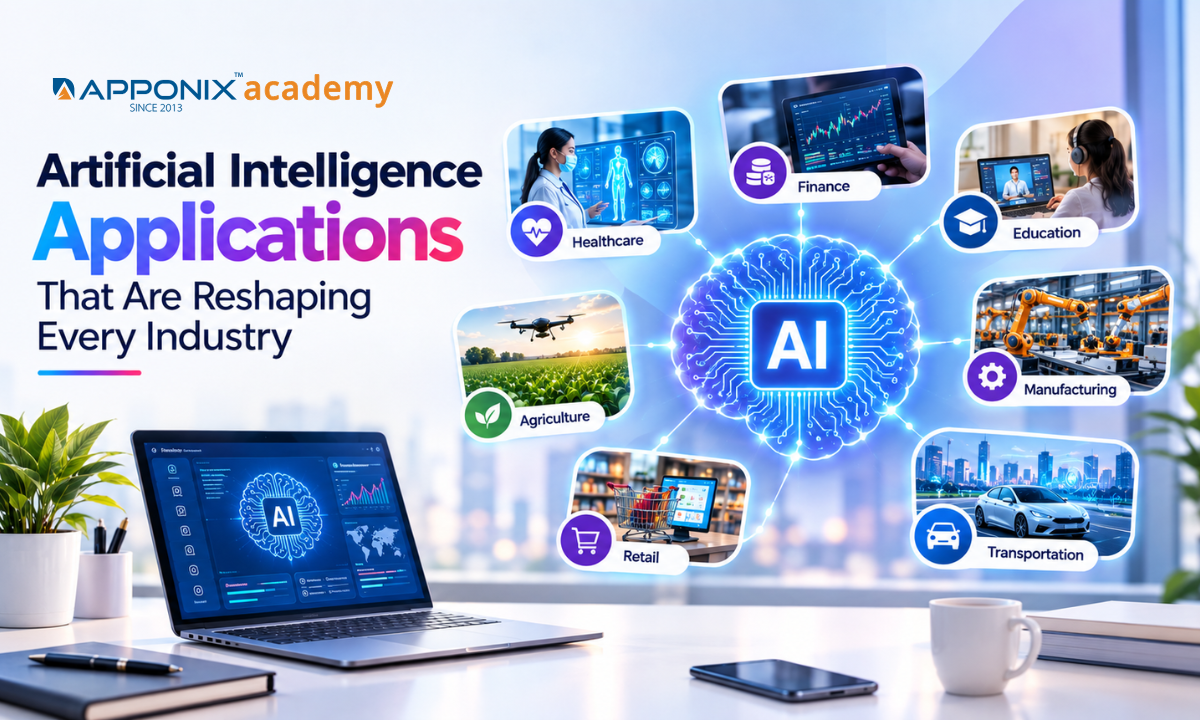
Artificial intelligence is no longer limited to research labs or large technology companies. It is now being used to solve practical problems across healthcare, finance, agriculture, education, manufacturing, retail, and transportation. From detecting health conditions and identifying fraud to predicting crop problems and personalising customer experiences, artificial intelligence applications are becoming part of everyday business and public services.
AI is especially useful because it can process large amounts of data, identify patterns, automate repetitive tasks, and support faster decision-making. In India, AI is already being used in areas such as healthcare, agriculture, education, finance, and public services.
In this guide, we’ll explore how AI is being used across industries, including healthcare, banking, agriculture, education, retail, and cybersecurity. We’ll also cover the technologies behind these applications, the skills needed for an AI career, and what to consider when choosing an AI training programme.
1. AI Applications in Healthcare

Healthcare is one of the key industries where AI is being used to support diagnosis, identify health risks, personalise care, and improve everyday workflows. AI can analyse large amounts of medical data and identify patterns that may be difficult to find manually.
Medical Imaging and Diagnosis
AI can assist healthcare professionals in analysing X-rays, CT scans, MRI scans, mammograms, and other medical images. It can help identify certain abnormalities and support tasks such as tumour detection and diabetic retinopathy screening.
Predictive Analytics in Medicine
AI can analyse electronic health records, medical images, and other patient data to identify possible health risks. Predictive analytics in medicine is being explored for areas such as sepsis, cardiovascular events, cancer risk, and chronic disease management. This can help healthcare teams identify patients who may need closer attention.
Personalised Care and Healthcare Workflows
AI can analyse patient information to support more personalised care and assist with tasks such as documentation, patient communication, and administrative work. However, AI is a supporting tool, not a replacement for healthcare professionals. Medical AI systems require proper validation, human oversight, and monitoring before being used in real-world clinical settings.
2. AI in Banking and Financial Services
Banks and financial companies handle large amounts of data, making AI useful for analysing transactions, managing risks, automating tasks, and improving customer service. In India, AI is increasingly being used in real-world financial operations.
Fraud Detection
AI can analyse transactions and identify unusual patterns based on factors such as spending behaviour, location, and device information. Machine learning models can learn from previous transactions and help detect suspicious activity more quickly.
Credit and Risk Assessment
AI can analyse financial and customer data to support credit assessment and risk management. It can help identify potential repayment risks and signs of financial difficulty, allowing lenders to make better-informed decisions.
Customer Service and Automation
AI-powered chatbots and virtual assistants can handle common customer questions and provide support around the clock. Financial institutions also use AI for document processing, compliance checks, data analysis, reporting, and other repetitive tasks.
Because AI is used for important financial decisions, these systems need strong security, proper monitoring, and human oversight to ensure they are reliable and responsible.
3. AI in Manufacturing
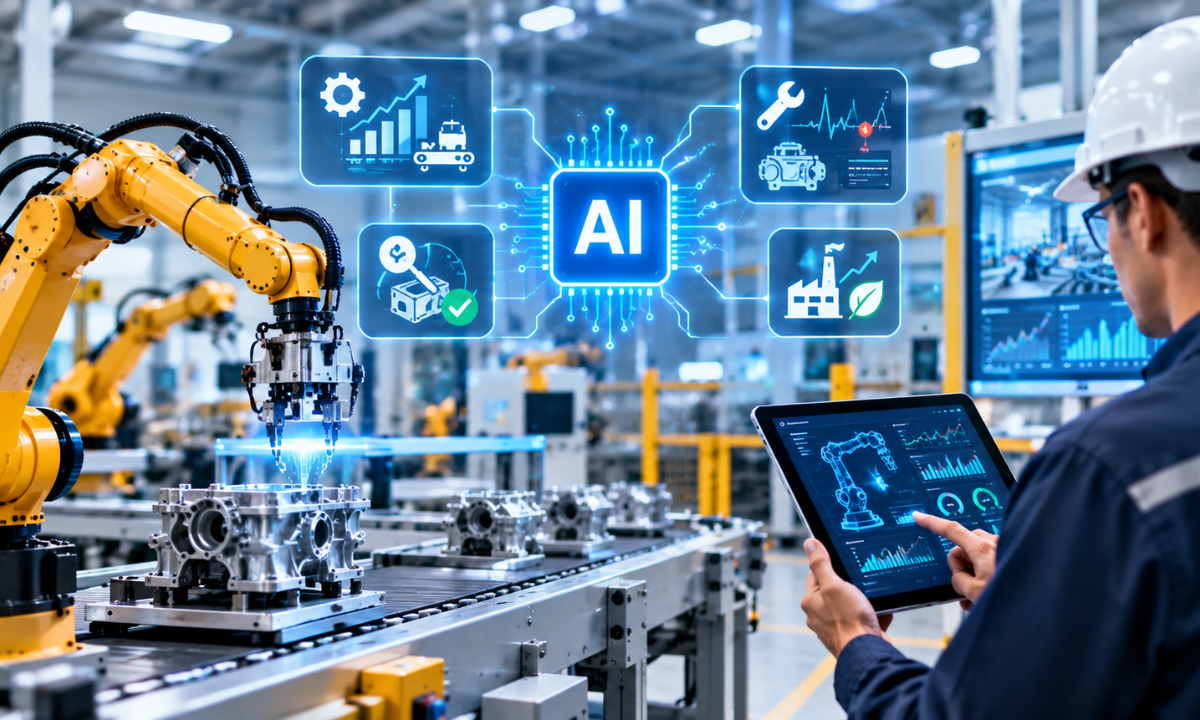
Manufacturing companies use AI to improve production, reduce downtime, and maintain product quality. AI can analyse machine and production data to identify problems early and help companies make better decisions.
Predictive Maintenance
AI can analyse data from machines and sensors to identify signs of possible equipment failure. This allows manufacturers to perform maintenance before a machine breaks down and reduce unexpected downtime.
Quality Control
AI-powered computer vision can inspect products during production and identify defects that may be difficult to spot manually. This helps maintain consistent product quality.
Production and Supply Chain Optimisation
AI can help manufacturers forecast demand, manage inventory, plan production schedules, and improve supply chains. This allows businesses to respond to changing demand while reducing delays and unnecessary waste.
4. AI in Retail and E-Commerce
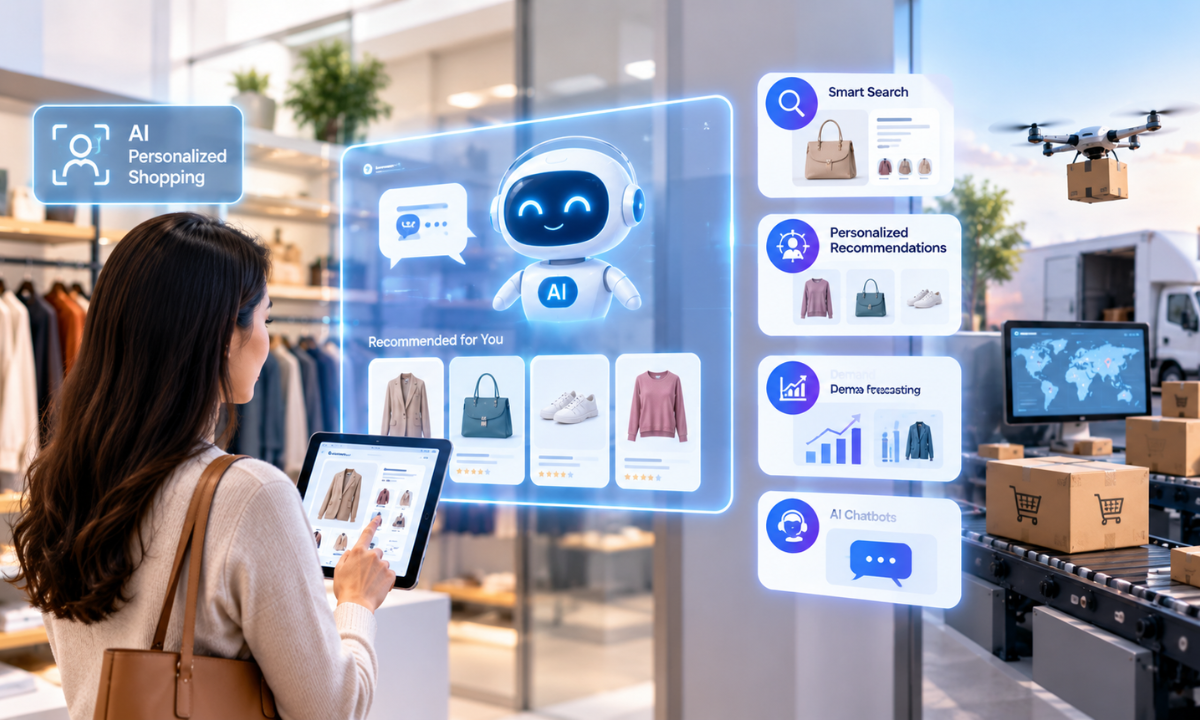
Retail businesses collect large amounts of customer and sales data, making AI useful for understanding buying behaviour and improving the shopping experience.
Personalised Recommendations
AI can analyse a customer’s browsing and purchase history to suggest products that may interest them. This is why shoppers often receive different recommendations based on their previous activity.
Demand and Inventory Forecasting
AI can analyse sales patterns, seasonal trends, and other data to predict product demand. This helps businesses manage inventory, reduce shortages, and avoid excess stock.
Customer Service
AI-powered chatbots and virtual assistants can answer common questions, provide product information, and support customers at any time. AI can also automate parts of customer interactions and business workflows.
5. AI in Agriculture
AI is being used in agriculture for crop monitoring, pest detection, weather forecasting, crop identification, and farmer advisory services. In India, these applications are helping farmers make better decisions and respond to agricultural problems more quickly.
Crop and Pest Detection
AI can analyse crop images to identify signs of pests or diseases. India's National Pest Surveillance System uses AI and machine learning to support early pest detection and provide useful advisories.
Weather and Crop Predictions
AI can combine weather, soil, crop, and historical data to help farmers make decisions about sowing, irrigation, and crop management. AI can also work with satellite imagery to provide more localised information about crops and farming conditions.
6. AI in Education
AI is changing how students learn and how educational institutions manage their work. It can help create more personalised and flexible learning experiences instead of using the same approach for every student.
Personalised Learning
AI can analyse a student’s performance and learning patterns to suggest suitable content, exercises, or topics that need more practice.
AI Tutors and Learning Assistants
AI-powered tutors can answer questions, explain concepts, provide practice exercises, and give immediate feedback. They can also support students outside regular classroom hours.
Automating Educational Tasks
AI can assist with assessment, content creation, student performance analysis, and administrative tasks. This can give teachers more time to focus on teaching and interacting with students.
AI is not meant to replace teachers. Instead, it can support both educators and students while keeping human guidance at the centre of education.
7. AI in Transportation and Logistics
AI is helping transportation and logistics companies make better decisions about routes, deliveries, vehicles, inventory, and demand. Instead of relying only on fixed schedules and historical information, companies can use real-time data and AI models to respond to changing conditions. Recent research in India also highlights AI's role in improving transport efficiency and logistics planning.
Route Optimisation
AI can analyse traffic, weather, delivery locations, and other factors to suggest more efficient routes. This can help businesses reduce travel time, fuel usage, and delivery delays.
Demand Forecasting
AI can study previous orders, seasonal patterns, and current market conditions to predict future demand. Businesses can then plan inventory, vehicles, and staffing more effectively.
Predictive Maintenance
AI can monitor vehicle and equipment data to identify signs of possible problems before they become major failures. This can help reduce unexpected breakdowns and keep vehicles and other assets in operation.
Warehouse and Delivery Automation
AI is also being combined with robotics, computer vision, and real-time tracking to improve warehouse operations, order fulfilment, and last-mile delivery.
8. AI in Transportation and Logistics
AI helps transportation and logistics companies improve routes, deliveries, vehicles, inventory, and demand. By using real-time data, businesses can respond better to changing traffic, demand, and delivery conditions.
Route Optimisation
AI can analyse traffic, weather, and delivery locations to suggest better routes. This can help reduce travel time, fuel use, and delivery delays.
Demand Forecasting
AI can study past orders, seasonal trends, and market conditions to predict future demand. This helps businesses plan their inventory, vehicles, and staff more effectively.
Predictive Maintenance
AI can monitor vehicle and equipment data to identify possible problems before they lead to major failures. This helps reduce unexpected breakdowns and keep vehicles in operation.
Warehouse and Delivery Automation
AI can work with robotics, computer vision, and real-time tracking to improve warehouse operations, order fulfilment, and last-mile delivery.
9. AI in Cybersecurity
As businesses rely more on digital systems, AI is becoming an important tool for cybersecurity. It can analyse large amounts of network and user activity and help security teams identify potential threats faster.
Threat and Anomaly Detection
AI can analyse activity and identify unusual patterns that may indicate a security threat. Machine learning systems can also learn what normal activity looks like and flag behaviour that is different from it.
Phishing and Fraud Detection
AI can help detect suspicious emails, websites, login attempts, and transactions by identifying patterns linked to previous threats.
Automated Security Response
Some AI systems can prioritise security alerts and take predefined actions when a potential threat is detected. However, human oversight is still important, especially when security decisions can affect critical systems.
10. AI in Media and Entertainment
AI is changing how content is created, recommended, and delivered in the media and entertainment industry. Streaming platforms, gaming companies, publishers, and creative teams use AI to understand audiences and create better content experiences.
Content Recommendations
AI can analyse what users watch, listen to, or read and recommend content based on their interests and previous activity.
Content Creation
Generative AI can help create text, images, audio, video, and other creative content. It can also help professionals develop ideas, create drafts, and complete repetitive tasks faster.
Gaming and Interactive Experiences
AI can make games more responsive, personalise user experiences, and support the creation of characters and game content.
However, AI-generated content still needs human creativity, editing, quality control, and responsible use. AI can speed up creative work, but human judgment remains important.
What Technologies Power AI Applications?
AI applications are built using different technologies. Each technology has a specific role, and they often work together.
-
Machine Learning: Helps computers learn patterns from data and make predictions or decisions. Used in fraud detection, recommendations, forecasting, and risk assessment.
-
Deep Learning: Uses multi-layered neural networks to work with complex data such as images, audio, video, and language.
-
Natural Language Processing (NLP): Helps computers understand and work with human language. Used in chatbots, translation, voice assistants, and sentiment analysis.
-
Computer Vision: Helps AI understand images and videos. Used in medical imaging, manufacturing quality checks, object recognition, and crop monitoring.
-
Generative AI: Creates new text, images, audio, video, and code. It is increasingly used for content creation, automation, research, and customer support.
These technologies can work together to build AI solutions for different industries.
Why AI Is Becoming Important Across Industries
The growing use of AI is not simply because the technology is new. Businesses are adopting it because it can help solve practical problems and work with amounts of data that would be difficult to process manually.
Some of the main reasons include:
-
Automating repetitive work: AI can handle certain routine tasks and reduce manual effort.
-
Faster decision-making: AI can analyse large amounts of information and identify useful patterns quickly.
-
Better predictions: Businesses can use AI to forecast demand, risks, customer behaviour, and other outcomes.
-
Personalised experiences: AI can help companies tailor products, services, and content to individual users.
-
Improved efficiency: AI can help optimise processes, reduce waste, and identify areas where resources can be used more effectively.
-
Handling large amounts of data: AI can process information at a scale that would be difficult for people to manage manually.
The important shift is that organisations are increasingly moving beyond simply experimenting with AI and looking for ways to apply it to real business and operational problems. In India, this is also reflected in the growing focus on AI and machine-learning skills across areas such as generative AI, NLP, computer vision, robotics, AI security, and sector-specific applications.
How to Start Learning AI
You can learn AI step by step instead of trying to learn everything at once.
-
Start with Python
Learn basic Python programming, as it is widely used in data analysis, machine learning, and AI development. -
Learn Mathematics and Statistics
Understand basic statistics, probability, and mathematics to learn how machine learning models work and how to evaluate their results. -
Learn Machine Learning
Start with supervised and unsupervised learning, classification, regression, clustering, and model evaluation. -
Explore Advanced AI Technologies
Once you understand machine learning, explore deep learning, NLP, computer vision, generative AI, and large language models. -
Work on Real Projects
Use real datasets and build small AI applications to gain practical experience and improve your problem-solving skills. Platforms such as AIKosh also provide access to datasets, models, tools, and real-world AI use cases.
Challenges and Responsible Use of AI
|
Challenge |
What It Means |
|
Data Privacy and Security |
AI uses large amounts of data, so personal and sensitive information must be handled responsibly. |
|
Bias and Fairness |
Biased training data can lead to unfair AI results. Regular testing and monitoring are important. |
|
Accuracy and Reliability |
AI can make mistakes or provide incorrect information, so human review is important, especially in critical industries. |
|
Impact on Jobs |
AI can automate tasks while creating new roles, making reskilling and continuous learning increasingly important. |
The goal is to use AI in a safe, transparent, useful, and human-centred way rather than simply adopting it as quickly as possible.
Why Choose Apponix for AI Training?
Choosing the right Training institute in Bangalore can help learners build their AI knowledge in a structured way.
Apponix can support learners by combining AI concepts with practical learning, helping them understand not only how AI works but also how it can be applied to real-world problems.
A good AI training programme should help learners:
-
Build strong foundations in Python and machine learning
-
Understand modern AI technologies
-
Work on practical projects
-
Develop problem-solving and analytical skills
-
Build a portfolio for job applications
-
Prepare for different AI and machine learning career paths
AI learning is also not limited to technical programming skills. IndiaAI highlights the importance of analytical thinking, continuous learning, innovation, teamwork, and technology skills for people building careers in AI.
Conclusion
Artificial intelligence is becoming part of how organisations solve real-world problems, from predictive analytics in medicine and fraud detection to manufacturing, retail, agriculture, and logistics.
For learners, this growth creates opportunities to build skills in machine learning, data science, generative AI, computer vision, and NLP. With practical skills and responsible use of AI, learners can prepare for growing AI career opportunities in Bangalore and beyond.
FAQs About Artificial Intelligence Applications
What are artificial intelligence applications?
Artificial intelligence applications are practical uses of AI technologies to solve problems, automate tasks, analyse data, make predictions, or improve decision-making. They are now being developed across sectors including healthcare, agriculture, finance, education, manufacturing, retail, and transportation.
Is AI only useful for technology companies?
No. AI is increasingly being applied outside the traditional technology sector. Healthcare, banking, agriculture, education, manufacturing, logistics, media, and government services are all exploring or deploying AI-based solutions.
What should I learn first to start a career in AI?
Python, mathematics and statistics, data analysis, and machine learning are good starting points. After building these foundations, learners can move into areas such as deep learning, NLP, computer vision, generative AI, or LLMs.
Are AI jobs available in Bangalore?
Yes. Bangalore has a strong technology and startup ecosystem, creating opportunities across AI, machine learning, data science, software development, and related roles. India's wider AI ecosystem is also expanding through initiatives focused on AI skills, research, datasets, and practical applications.
Do I need a computer science degree to learn AI?
Not necessarily. A technical background can make some concepts easier, but learners from other educational backgrounds can also move into AI by developing programming, mathematics, data, and machine learning skills progressively.
Is an AI certification enough to get a job?
A certification can demonstrate that you have completed structured training, but it should not be considered a substitute for practical skills. Projects, problem-solving ability, technical knowledge, and the ability to explain your work can be equally important when building an AI career.

Apponix Academy
Apponix Academy