POPULAR COURSES
Master Programs


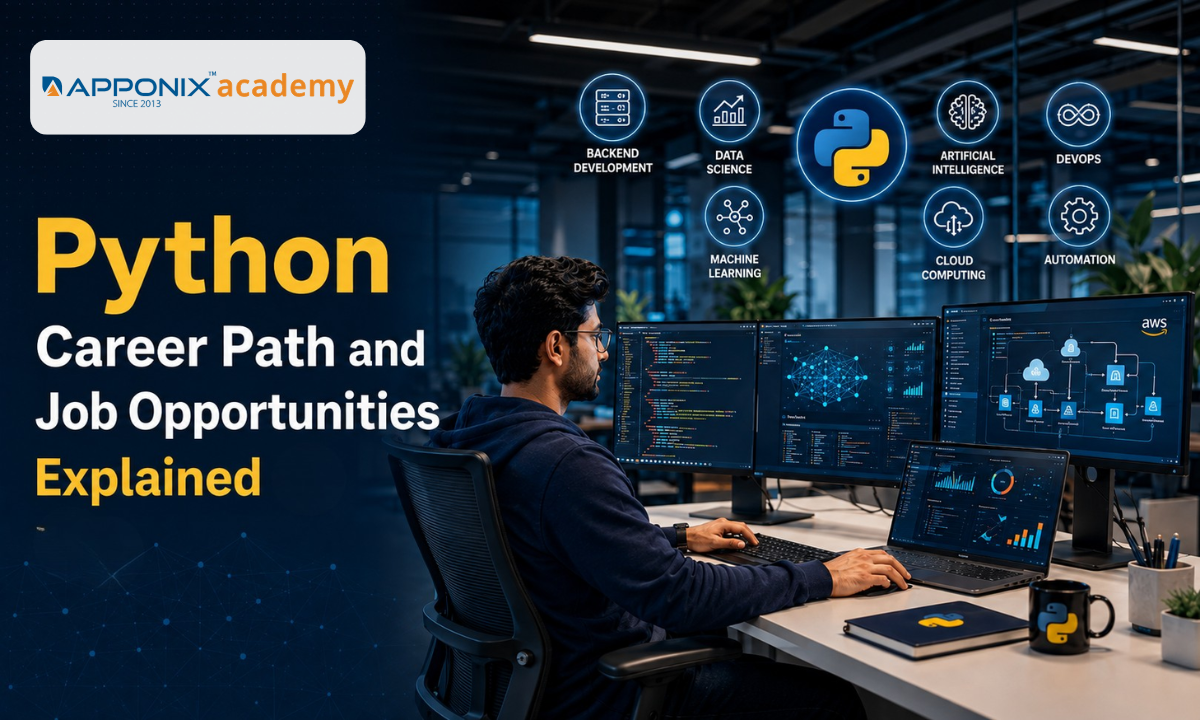
Table of contents:
|
1. Mapping Python Specializations: Web, Data, AI, and Automation
2. Python Technical Domain Summary |
|
2. Deep Dive into Key Roles: Responsibilities, Tech Stacks & Workflows
|
|
3. The Bangalore Hiring Advantage: Compensation Benchmarks & Career Trajectories
|
|
4. Decision Matrix: Which Python Role Matches Your Background?
|
|
5. Why Choose Apponix Technologies for Your Python Journey? |
|
6. Conclusion |
Exploring the vast array of Python career opportunities available in 2026 is one of the most strategic decisions an aspiring software professional can make. Enrolling with a top-tier Training Institute in Bangalore provides the structured guidance, hands-on project experience, and industry mentorship required to transition successfully into high-paying software, data, and artificial intelligence roles.
In 2026, Python continues to stand as the undisputed powerhouse of the global technology ecosystem. Driven by the rapid acceleration of Generative AI, Large Language Model (LLM) orchestration, enterprise cloud automation, and high-concurrency microservices, Python has transcended its origins as a simple scripting language to become the operational backbone of modern engineering.
From startup MVPs in HSR Layout to global capability centers (GCCs) along Bangalore's Outer Ring Road, organizations rely on Python for its unparalleled readability, vast open-source library ecosystem, and seamless binding with high-performance C/C++ backend engines.
Whether you are a fresh graduate stepping into the technology sector, a manual QA tester aiming to transition into automation engineering, or a non-technical professional seeking a reliable entry point into software, Python offers a uniquely flexible foundation.
Its low syntactic friction allows beginners to grasp core computational logic quickly, while its specialized frameworks ranging from Django and FastAPI to PyTorch and Pandas provide a high ceiling for lifelong career advancement across multiple specialized domains.
Mapping Python Specializations: Web, Data, AI, and Automation

One of Python’s greatest strengths is its domain versatility. Unlike single-purpose languages restricted to specific runtime environments, Python operates as a universal tool across the modern computing stack.
When evaluating the diverse Python career options available today, understanding how these four core pillars align with your background and interests is essential for choosing the right learning path.
The Four Core Python Technical Domains
1. Backend & Web Systems Engineering
Backend engineers focus on building server-side business logic, designing secure database schemas, and architecting high-concurrency Application Programming Interfaces (APIs). Using high-performance Python frameworks, engineers construct scalable web applications capable of handling millions of requests per day.
-
Core Tooling: Django, FastAPI, Flask, PostgreSQL, Redis, Celery.
-
Primary Objective: Deliver robust, scalable server application logic and REST/GraphQL APIs.
2. Data Science & Advanced Analytics
Data professionals leverage Python’s numerical processing ecosystem to transform raw unstructured data into actionable strategic insights. They clean massive datasets, perform statistical modeling, build interactive executive dashboards, and automate complex ETL (Extract, Transform, Load) pipelines.
-
Core Tooling: Pandas, NumPy, Matplotlib, Seaborn, SQL, PySpark.
-
Primary Objective: Extract business intelligence, identify operational trends, and guide decision-making through quantitative analysis.
3. Artificial Intelligence & Machine Learning Engineering
AI and Machine Learning specialists sit at the cutting edge of modern software engineering. They design, train, fine-tune, and deploy predictive algorithms, computer vision models, natural language processing (NLP) systems, and Generative AI applications.
-
Core Tooling: PyTorch, TensorFlow, Scikit-Learn, OpenCV, LangChain, Hugging Face.
-
Primary Objective: Build intelligent systems that learn from data, automate decision-making, and power next-generation AI products.
4. DevOps, Cloud & Automation Engineering
Automation specialists write Python scripts to eliminate manual administrative overhead, orchestrate cloud infrastructure on platforms like AWS or Azure, automate quality assurance regression testing, and build continuous integration (CI/CD) pipelines.
-
Core Tooling: PyTest, Boto3 (AWS SDK for Python), Ansible, Fabric, Selenium, Requests.
-
Primary Objective: Streamline cloud operations, enforce software quality, and automate repetitive infrastructure workflows.
Python Technical Domain Summary
|
Domain Pillar |
Key Frameworks & Libraries |
Typical Deliverables |
Primary Work Environment
|
|---|---|---|---|
|
Backend Web |
Django, FastAPI, SQLAlchemy, Redis |
REST APIs, microservice backends, database layers |
SaaS product firms, E-commerce platforms |
|
Data Science |
Pandas, NumPy, SciPy, Matplotlib |
Analytical models, ETL pipelines, BI reports |
FinTech, Healthcare, Retail analytics hubs |
|
AI / ML |
PyTorch, TensorFlow, LangChain, Transformers |
Predictive models, LLM agents, vision systems |
R&D labs, AI startups, GCC innovation units |
|
Automation / Cloud |
PyTest, Boto3, Paramiko, Selenium |
Infrastructure scripts, test suites, cloud tools |
DevOps teams, IT consultancies, Managed Services |
Mapping your logical strengths and career aspirations against these four technical pillars, you can select a domain focus that aligns with active market demand.
Deep Dive into Key Roles: Responsibilities, Tech Stacks & Workflows

To make an informed decision about your career direction, you must look beyond generic job titles and understand the practical daily realities of each specialization.
Examining active listings for Python developer jobs across major technology hubs reveals that enterprise employers prioritize candidates who combine core programming fluency with domain-specific toolkits and production-proven workflows.
1. Python Web & API Engineer
Web and API engineers design the server-side architecture that powers modern web applications, mobile app backends, and enterprise SaaS platforms. They focus on turning business requirements into secure, high-concurrency software services that scale seamlessly under user load.
-
Primary Responsibilities: Designing RESTful and GraphQL APIs, managing database migrations, implementing authentication protocols (OAuth2/JWT), and optimizing server response times.
-
Core Tech Stack: Django, FastAPI, Flask, PostgreSQL, Redis, Celery, Docker, and Git.
-
Daily Workflow: Building new feature endpoints, writing unit tests with PyTest, optimizing SQL queries, reviewing pull requests, and debugging production performance bottlenecks.
Mastering web engineering requires a deep understanding of asynchronous programming in FastAPI or the robust "batteries-included" architecture of Django. Engineers in this space work closely with frontend teams and cloud administrators to ensure seamless data flow and high availability across distributed server clusters.
2. Data Engineer & Data Analyst
Data-focused Python specialists build the data pipelines and analytical engines that allow organizations to make evidence-based strategic decisions. They bridge the gap between raw data collection and executive decision-making.
-
Primary Responsibilities: Ingesting structured and unstructured data, building automated ETL pipelines, transforming raw logs into clean analytical tables, and creating BI dashboards.
-
Core Tech Stack: Pandas, NumPy, PySpark, Apache Airflow, SQL, Snowflake, and BigQuery.
-
Daily Workflow: Writing data extraction scripts, running complex analytical SQL queries, validating data integrity, automating scheduled pipeline jobs, and building visualization reports.
Data roles demand strong quantitative reasoning alongside Python proficiency. By converting chaotic, high-volume data streams into structured data warehouses, these professionals empower business leaders to identify market trends, optimize operational costs, and predict customer behavior.
3. Machine Learning & AI Engineer
AI and Machine Learning engineers develop intelligent algorithms that enable software to recognize patterns, make autonomous decisions, and interact using natural language processing. This role sits at the cutting-edge intersection of computer science, mathematics, and product engineering.
-
Primary Responsibilities: Fine-tuning Large Language Models (LLMs), building Retrieval-Augmented Generation (RAG) pipelines, training predictive models, and deploying model inference endpoints to cloud production.
-
Core Tech Stack: PyTorch, TensorFlow, Scikit-Learn, Hugging Face, LangChain, Vector Databases (Chroma/Pinecone), and CUDA.
-
Daily Workflow: Cleaning training datasets, experimenting with hyperparameter tuning, monitoring model drift, optimizing inference latency, and integrating AI endpoints into core backend applications.
Success in AI engineering requires staying aligned with rapid advancements in generative artificial intelligence and neural network architectures. These specialists do not merely consume pre-trained models; they adapt, optimize, and serve them securely at enterprise scale.
4. Python Automation & DevOps Engineer
Automation and DevOps engineers use Python to streamline software delivery, manage cloud infrastructure programmatically, and ensure system reliability through automated testing and continuous monitoring.
-
Primary Responsibilities: Writing Infrastructure as Code (IaC) automation scripts, orchestrating cloud resources on AWS/Azure, configuring CI/CD pipelines, and writing automated end-to-end test suites.
-
Core Tech Stack: PyTest, Boto3 (AWS SDK), Ansible, Fabric, Selenium, Docker, and Kubernetes.
-
Daily Workflow: Automating repetitive system administration tasks, writing integration test suites, managing server configuration templates, monitoring cloud resource usage, and resolving deployment failures.
Treating infrastructure and quality assurance as code, Python automation engineers dramatically reduce time-to-market for software releases. Their work eliminates manual human error, enforces security compliance, and ensures that deployment pipelines remain resilient under heavy production loads.
The Bangalore Hiring Advantage: Compensation Benchmarks & Career Trajectories
As India's Silicon Valley, Bangalore offers the highest compensation density and fastest role progression for Python specialists in South Asia.
Whether working in global capability centers along Outer Ring Road or high-growth SaaS unicorns in Indiranagar, building a long-term software developer career around Python opens doors to lucrative remuneration packages and rapid technical leadership transitions.
Salary Benchmarks by Experience Tier in Bangalore
Compensation in Bangalore varies significantly based on technical depth, domain specialization, and employer type. Data science and AI/ML engineers generally command a 15% to 30% premium over general scripting roles.
|
Experience Level |
Typical Industry Role |
Average Salary Range (Bangalore CTC) |
Top-Tier Product & GCC Range
|
|---|---|---|---|
|
Entry-Level (0–2 Years) |
Junior Python Engineer, Data Analyst Trainee |
₹4.5 LPA – ₹7.5 LPA |
₹8.0 LPA – ₹12.5 LPA |
|
Mid-Level (2–5 Years) |
Software Engineer, ML Specialist, Backend Developer |
₹9.0 LPA – ₹16.0 LPA |
₹18.0 LPA – ₹26.0 LPA |
|
Senior (5–8+ Years) |
Lead Architect, Senior AI Engineer, Engineering Manager |
₹18.0 LPA – ₹32.0 LPA |
₹35.0 LPA – ₹50.0+ LPA |
Employer Categories & Compensation Drivers
Understanding how different company structures reward Python skills helps you target organizations aligned with your financial and professional goals:
-
Global Capability Centers (GCCs): Enterprise technology hubs for global Fortune 500 banks, retail giants, and healthcare firms offer high base salaries, extensive corporate benefits, and structured growth ladders.
-
Product-Led Startups & SaaS Unicorns: Fast-paced technology firms in Koramangala and HSR Layout offer equity options (ESOPs), rapid responsibilities, and competitive pay for developers who can ship production code quickly.
-
IT Services & System Integrators: Established consulting firms across Whitefield and Electronic City provide stable employment, large-scale project exposure, and global client mobility for mid-to-senior engineers.
These organizational structures provide distinct entry points depending on your preference for rapid innovation or large-scale enterprise stability. Aligning your career goals with the right company tier ensures sustained compensation growth as your technical experience matures.
Long-Term Career Trajectories
A strong Python foundation allows engineers to pivot across distinct leadership tracks as they gain industry experience:
-
Individual Contributor (IC) Track: Junior Developer → Senior Python Specialist → Staff Engineer → Principal Cloud/AI Architect.
-
Engineering Management Track: Software Engineer → Tech Lead → Engineering Manager → Director of Engineering / VP of Technology.
-
Specialized Domain Track: Python Developer → Data Engineer → AI Research Scientist / Lead ML Systems Architect.
Choosing between these career pathways allows professionals to continuously elevate their impact, whether by designing complex distributed software systems or leading high-performing engineering teams toward key product milestones.
Decision Matrix: Which Python Role Matches Your Background?

Choosing the right specialization from the diverse range of Python professions available today requires evaluating your existing academic background, technical exposure, and natural problem-solving strengths.
Rather than starting completely from scratch, aligning your learning path with your prior experience significantly reduces training friction and accelerates your transition into high-growth software roles.
Career Background to Python Specialization Matrix
|
Current Background / Domain |
Ideal Python Specialization |
Strengths to Leverage |
Primary Skill Gap to Bridge
|
|---|---|---|---|
|
CS / Engineering Freshers |
Backend Engineering / Full Stack |
Algorithmic logic, core CS fundamentals |
Production frameworks (FastAPI/Django), CI/CD |
|
Manual QA & SysAdmins |
Automation Engineering / DevOps |
Domain test knowledge, Linux OS familiarity |
Python scripting (PyTest/Boto3), Cloud APIs |
|
Math, Stats & Finance Graduates |
Data Analyst / Junior Data Scientist |
Quantitative aptitude, statistical reasoning |
Pandas, SQL data wrangling, data pipelines |
|
Non-Tech Career Switchers |
Junior Web Developer / Scripting Specialist |
Business communication, domain expertise |
Core Python syntax, Object-Oriented Programming |
Tailored Transition Pathways by Professional Background
1. For Computer Science & Engineering Freshers
Fresh engineering graduates possess strong theoretical knowledge of data structures, algorithms, and computational logic. Transitioning into software development requires translating academic theory into production-ready application architectures.
-
Recommended Track: Backend Web Engineering or Full-Stack Development.
-
Immediate Focus Areas: Building RESTful microservices with FastAPI or Django, mastering database ORMs, and integrating Git version control with automated unit testing.
-
Strategic Advantage: Computer science graduates can immediately leverage their core logic to build enterprise software features without struggling through basic algorithmic principles.
Starting your journey in backend web systems provides a firm foundation in database schema design, application security, and server performance. This base makes future transitions into system architecture or cloud engineering straightforward.
2. For Manual QA Testers & System Administrators
IT professionals currently working in manual test execution, network monitoring, or system administration already understand software delivery lifecycles, operating system kernels, and software defect logging.
-
Recommended Track: Python Automation QA or DevOps / Cloud Engineering.
-
Immediate Focus Areas: Mastering PyTest for test automation frameworks, learning Selenium/Playwright for web testing, and using Boto3 to programmatically manage AWS cloud resources.
-
Strategic Advantage: Your deep domain experience in defect tracking and environment provisioning allows you to automate existing manual processes instantly.
Shifting from manual verification to programmatic automation elevates your contribution from routine test execution to strategic infrastructure design, resulting in significant compensation jumps across Bangalore's hiring market.
3. For Mathematics, Statistics & Business Graduates
Professionals with backgrounds in economics, commerce, statistics, or mathematics excel at quantitative analysis, financial modeling, and identifying business trends.
-
Recommended Track: Data Analyst or Junior Data Scientist.
-
Immediate Focus Areas: Data cleaning and manipulation with Pandas and NumPy, writing analytical SQL queries, and creating interactive visualization dashboards with Matplotlib and Seaborn.
-
Strategic Advantage: Your natural comfort with statistical modeling and executive reporting allows you to interpret raw data outputs far more effectively than purely technical coders.
Combining business domain knowledge with Python's data processing libraries enables you to bridge the gap between technical engineering teams and C-suite decision-makers.
4. For Non-Technical Career Switchers
Career switchers coming from sales, customer success, marketing, or operations bring valuable domain knowledge, client management skills, and real-world business context.
-
Recommended Track: Junior Web Developer or Scripting Specialist.
-
Immediate Focus Areas: Mastering foundational Python syntax, object-oriented programming (OOP) principles, basic HTML/CSS integration, and relational database concepts.
-
Strategic Advantage: Your prior business experience makes you an effective communicator who understands customer requirements and product usability.
Focusing on clean, readable code and building a public portfolio of functional web applications proves to hiring managers that you possess both practical coding capability and strong workplace communication skills.
Why Choose Apponix Technologies for Your Python Journey?
Transitioning from theoretical coding tutorials to production-ready software engineering demands structured guidance, hands-on lab practice, and active corporate mentorship. Enrolling in a comprehensive Python course in Bangalore at Apponix Technologies provides the immersive environment required to build job-ready applications, master modern frameworks, and launch sustainable programming careers across India's premier technology hub.
Apponix delivers a project-driven learning experience designed to bridge the gap between basic syntax and enterprise software execution:
-
40+ Hours of Practical Sandbox Coding: Practice building web apps, data pipelines, and automation scripts inside live interactive coding environments rather than static slides.
-
Mentorship from Active Enterprise Engineers: Learn directly from seasoned full-stack developers and data leads who bring real-world architectural patterns into every classroom session.
-
Real-World GitHub Portfolio Construction: Build and publish 2 to 3 production-style projects featuring Django web applications, REST APIs, and automated data workflows to showcase to recruiters.
-
Complementary AWS & Linux Skills Integration: Gain a competitive edge with complementary cloud foundation training, enabling you to deploy and manage Python applications on cloud servers.
-
Guaranteed Interview Support & Resume Engineering: Receive dedicated 1-on-1 resume optimization to clear ATS filters, accompanied by mock technical interviews and direct hiring connections across top Bangalore firms.
Combining rigorous practical instruction with cloud platform training and direct career coaching, Apponix ensures you move beyond basic coding tutorials to become a confident, job-ready developer prepared to excel in technical hiring evaluations.
Conclusion
Launching a rewarding career in software engineering begins with a systematic, step-by-step roadmap tailored to modern market demands. Start by mastering foundational Python syntax, object-oriented principles, and standard data structures until writing clean, readable code becomes second nature.
Next, select a dedicated specialization path, whether backend web development, data analytics, AI engineering, or cloud automation, and commit to building real-world projects using industry-standard frameworks like FastAPI, Django, or Pandas. Package these applications into a public, well-documented GitHub portfolio that clearly demonstrates your ability to write modular code, interface with databases, and handle errors gracefully.
Finally, refine your technical resume, practice whiteboarding core algorithms, and actively connect with enterprise hiring networks across Bangalore to turn your coding proficiency into a successful, long-term technical career.
Reference:
1. https://codegnan.com/python-career-opportunities/
2. https://www.republicschools.in/blog/python-career-paths-explained-data-ai-web-or-automation/

Apponix Academy
Apponix Academy