POPULAR COURSES
Master Programs




Table of contents:
|
1. What Exactly Is API Security? |
|
2. Biggest API Threats You Need to Know About |
|
3. API Security Best Practices That Actually Work |
|
4. API Security Across the Development Lifecycle |
|
5. Learn API Security and Cybersecurity in Bangalore With Apponix |
|
6. Frequently Asked Questions |
|
7. Conclusion |
Here’s a question that might make you a little uncomfortable.
Right now, at this exact moment, how many APIs are running in your application? Do you know? And more importantly, do you know how many of them are actually secured?
If you hesitated on either answer, you’re in good company. And you’re also in real danger. Because here’s the truth that every developer, architect, and business owner needs to hear clearly: APIs are the most targeted attack surface in modern software. Not databases. Not user interfaces. APIs.
In 2024, API attacks surged dramatically as attackers discovered that APIs—those invisible communication bridges between your applications, services, and data—are frequently built fast, deployed faster, and secured last. The result? Billions of records exposed. Businesses disrupted. Reputations destroyed.
But here’s the good news. API security is completely learnable, implementable, and maintainable—when you know exactly what you’re protecting against and how to protect it. Whether you're learning through a training institute in Bangalore or enrolling in a Cybersecurity course in Bangalore, building strong API security skills is more accessible than ever. Let’s break it all down, right now.
What Exactly Is API Security?

Let's start with the absolute foundation before anything else.
An API — Application Programming Interface — is essentially a contract between two pieces of software. It defines how they talk to each other: what requests can be made, what data gets exchanged, and what responses are returned. Your mobile app uses APIs to fetch data from your server. Your payment gateway uses APIs to process transactions. Your cloud services use APIs to communicate with each other.
API security is the practice of protecting those communication channels — and the data flowing through them — from unauthorized access, abuse, and attack. It encompasses authentication, authorization, encryption, input validation, monitoring, and the overall design philosophy of how APIs are built and exposed.
Without API security, every API endpoint in your system is a potential open door into your most sensitive data and business logic.
Biggest API Threats You Need to Know About
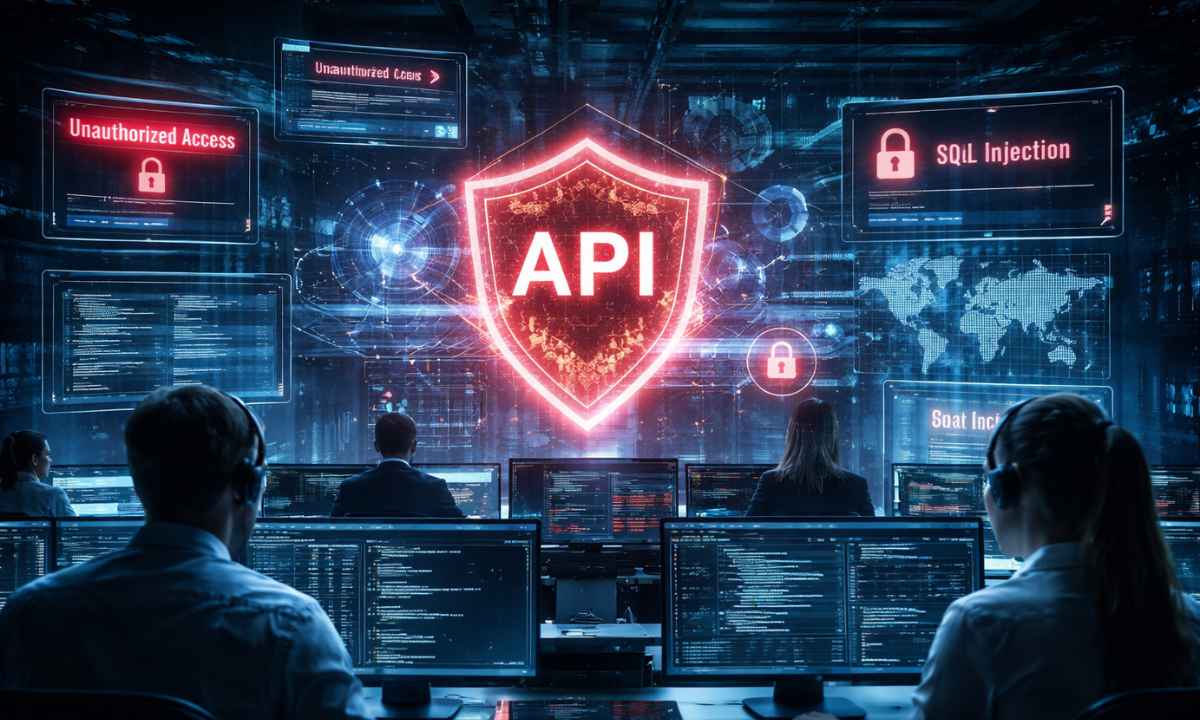
Here's where it gets genuinely eye-opening. The OWASP API Security Project — the gold standard reference for API vulnerability awareness — publishes a regularly updated list of the most critical API security risks. Understanding these threats is the first step toward defending against them.
1. Broken Object Level Authorization (BOLA): This is the most commonly exploited API vulnerability. It occurs when an API doesn't properly verify that a user has permission to access a specific object — meaning an attacker can manipulate object IDs in API requests to access data belonging to other users. Terrifyingly simple. Devastatingly common.
2. Broken Authentication: Poorly implemented authentication mechanisms allow attackers to impersonate legitimate users, steal tokens, or brute-force their way into accounts. Weak token validation and missing session expiry are the most frequent culprits.
3. Excessive Data Exposure: APIs that return far more data than the client actually needs — trusting the front-end to filter what's displayed — expose sensitive fields to anyone who intercepts or directly calls the API response.
4. Rate Limiting Absent or Broken: Without rate limiting, attackers can hammer your API with thousands of requests per second — scraping data, brute-forcing credentials, or overwhelming your infrastructure in a denial-of-service attack.
5. Injection Attacks: SQL injection, command injection, and NoSQL injection attacks through API parameters remain stubbornly common wherever input validation is missing or incomplete.
6. Mass Assignment: When an API blindly binds client-provided data to internal objects without filtering, attackers can manipulate fields they shouldn't have access to — like escalating their own account privileges.
API Security Best Practices That Actually Work
Now that you understand what you're defending against, let's talk about how to defend effectively.
1. Always Use an API Gateway
The first line of defense for any API is a properly configured gateway. API gateways centralize security enforcement — applying rate limiting, blocking malicious clients, enforcing TLS termination, and logging every request consistently across every endpoint. No API should be publicly accessible without going through a gateway.
2. Implement Strong Authentication With OAuth 2.0
Use a centralized OAuth authorization server for authentication and token issuance. Issue access tokens with limited permissions using scopes and claims, and enforce authorization in the API itself — not only at the gateway level. Apply the same authentication controls to internal APIs as you do to public-facing ones.
3. Apply the Principle of Least Privilege
Grant users and systems only the minimum permissions required to perform their specific tasks. Avoid excessive privileges at every level — from API scopes to database permissions. Every unnecessary permission is an unnecessary risk.
4. Enforce HTTPS Everywhere — Without Exception
All API traffic must be encrypted using TLS. Enforce TLS 1.2 as the absolute minimum standard, and push toward TLS 1.3 wherever possible. Never allow unencrypted API communication in any environment — including development and staging.
5. Validate and Sanitize Every Input
Validate all data received from API clients before processing it. Implement strict input schemas, reject unexpected fields, and sanitize all string inputs to prevent injection attacks. Never trust client-provided data implicitly — not even from your own front-end applications.
6. Implement Rate Limiting and Throttling
Apply rate-limiting policies at the gateway level so they are enforced consistently across all endpoints. Rate limit authentication endpoints especially aggressively — these are the targets of credential stuffing and brute-force attacks.
7. Encrypt Data at Rest and in Transit
All sensitive data handled by your API — especially personally identifiable information (PII) and regulated data — must be encrypted both in transit (TLS) and at rest on the server. Require digital signatures to ensure only authorized parties can decrypt sensitive API payloads.
8. Monitor, Log, and Alert Continuously
Implement comprehensive logging of all API requests, authentication attempts, and error responses. Set up real-time alerting for authentication failures, unusual traffic spikes, and repeated error patterns. Without visibility, you cannot detect or respond to attacks in progress.
API Security Across the Development Lifecycle
Here's a critical mindset shift that separates mature security teams from reactive ones: API security is not a deployment-time activity. It's a design-time activity.
Plan API security architecture before you write a single line of code. Define authentication flows, authorization models, data exposure boundaries, and rate-limiting policies during the design phase. Security retrofitted onto an existing API is always more expensive, more fragile, and less effective than security designed in from the beginning.
Learn API Security and Cybersecurity in Bangalore With Apponix
Understanding API security conceptually is one thing — building the hands-on skills to implement it professionally is another. If you're a developer or IT professional based in Bangalore looking to formalize your cybersecurity expertise, Apponix Technologies offers one of the most comprehensive Cybersecurity courses in Bangalore designed specifically for working professionals and career switchers alike.
Apponix's cybersecurity training covers the full spectrum of modern application security — including API security fundamentals, OWASP Top 10 vulnerabilities, ethical hacking, penetration testing, network security, and security compliance frameworks. The curriculum is structured to take you from foundational concepts all the way through to industry-recognized certifications, giving you practical skills that employers actively look for.
What sets Apponix apart is the emphasis on real-world, hands-on labs. Rather than learning security theory in isolation, students work through live attack-and-defense scenarios — the kind of experience that directly translates to securing APIs, applications, and infrastructure in production environments. With both classroom-based and online learning options available, Apponix makes professional cybersecurity training accessible, whether you're in Bangalore's tech corridor or working remotely.
For developers who want to move beyond writing code into understanding how that code gets attacked — and how to stop it — Apponix's Cybersecurity course in Bangalore is a structured, practical, and career-accelerating investment.
Explore Apponix's Cybersecurity Course in Bangalore: www.apponix.com
Frequently Asked Questions
1. What's the difference between API authentication and authorization?
Authentication verifies who is making a request — confirming the identity of the caller. Authorization determines what the verified caller is allowed to do. Both are required, and both must be enforced at the API level — not just at the gateway.
2. Are internal APIs less risky than public APIs?
No — and this is a dangerous assumption. Internal APIs are frequently less monitored and less hardened than public ones, making them attractive targets for attackers who have already breached a network perimeter. Apply the same security controls to all APIs regardless of visibility.
3. How often should I test my APIs for security vulnerabilities?
Continuously. Integrate automated security scanning into your CI/CD pipeline so every code change triggers a security test. Supplement with scheduled penetration tests, at a minimum quarterly for APIs handling sensitive data.
4. What is an API key, and is it sufficient for API security?
An API key is a simple shared secret used to identify a client application. While useful for basic identification and rate limiting, API keys alone are insufficient for securing APIs that handle sensitive data or perform privileged operations. Use OAuth 2.0 access tokens for proper authentication.
5. Where can I learn API security and cybersecurity professionally in Bangalore?
Apponix Technologies offers a structured Cybersecurity course in Bangalore with hands-on labs, OWASP coverage, penetration testing training, and certification preparation — making it one of the top choices for developers and IT professionals in the city looking to build verified security skills.
Conclusion
APIs are the nervous system of modern software — and like any nervous system, they're both extraordinarily powerful and extraordinarily vulnerable when unprotected. The threats are real, they're active right now, and they're targeting the exact kinds of weaknesses that most development teams haven't fully addressed yet. But the defenses are equally real, well-understood, and entirely implementable with deliberate effort.
Start with a gateway. Enforce authentication. Apply least privilege. Validate everything. Monitor always. Build security in from day one rather than bolting it on at the end. And if you want to go deeper — with the structured knowledge, hands-on labs, and professional credentials that the industry recognizes — Apponix's Cybersecurity course in Bangalore gives you exactly that foundation.
That's not just good API security practice — that's good engineering, and good career strategy.

Apponix Academy
Apponix Academy