POPULAR COURSES
Master Programs



Table of contents:
|
1. Convergence over Competition and The Evolving Technical Synergy
|
|
2. The Modern Technical Toolkit: Beyond Code Syntax |
|
3. Navigating the Indian Tech Landscape for Demand & Compensation |
|
4. Structuring Your Learning Paradigm and Practical Portfolios over Paper |
|
5. Why Choose Apponix? |
|
6. Conclusion |
The global enterprise technology landscape has crossed a critical threshold, where manual data engineering has fully merged with real-time model execution.
In 2026, building a sustainable career requires mastering the core intersection of artificial intelligence and data science to remain architecturally competitive. For tech professionals and graduates looking to navigate this transition smoothly, enrolling in an advanced AI Course in Bangalore at Apponix provides an immediate on-ramp to mastering the automated production lifecycles that global corporations now demand.
This architectural paradigm shift is driven by a massive transition away from passive, static database monitoring toward autonomous orchestration layers. In the current enterprise landscape, companies are moving rapidly beyond manual pipeline construction toward self-healing data architectures.
Instead of constructing brittle, isolated ETL (Extract, Transform, Load) pipelines that break under minor structural updates, modern systems utilize semantic data fabrics where incoming event streams automatically enforce data lineage, proactively prevent model drift, and fuel autonomous agents that execute business logic in real time.
Failing to understand this technical convergence means risking structural obsolescence. Today, data is no longer just a passive record used to generate backwards-looking corporate reports; it functions as an active product and an immediate feedback layer that optimizes machine learning frameworks and drives continuous, real-time business decisions.
This comprehensive guide deconstructs the core competencies, technical toolsets, and deployment mechanics that separate traditional database administrators from elite transformation architects.
Let's trace how these domains have permanently combined their trajectories.
Convergence over Competition and The Evolving Technical Synergy
For years, academic circles treated analytical data processing and neural network modeling as isolated academic disciplines.
Software teams frequently separated data analysts into reporting silos while machine learning engineers worked in separate research environments. In 2026, this artificial boundary will completely collapse. Advanced computing systems have proven that an algorithmic model is only as viable as the telemetry infrastructure supporting it.
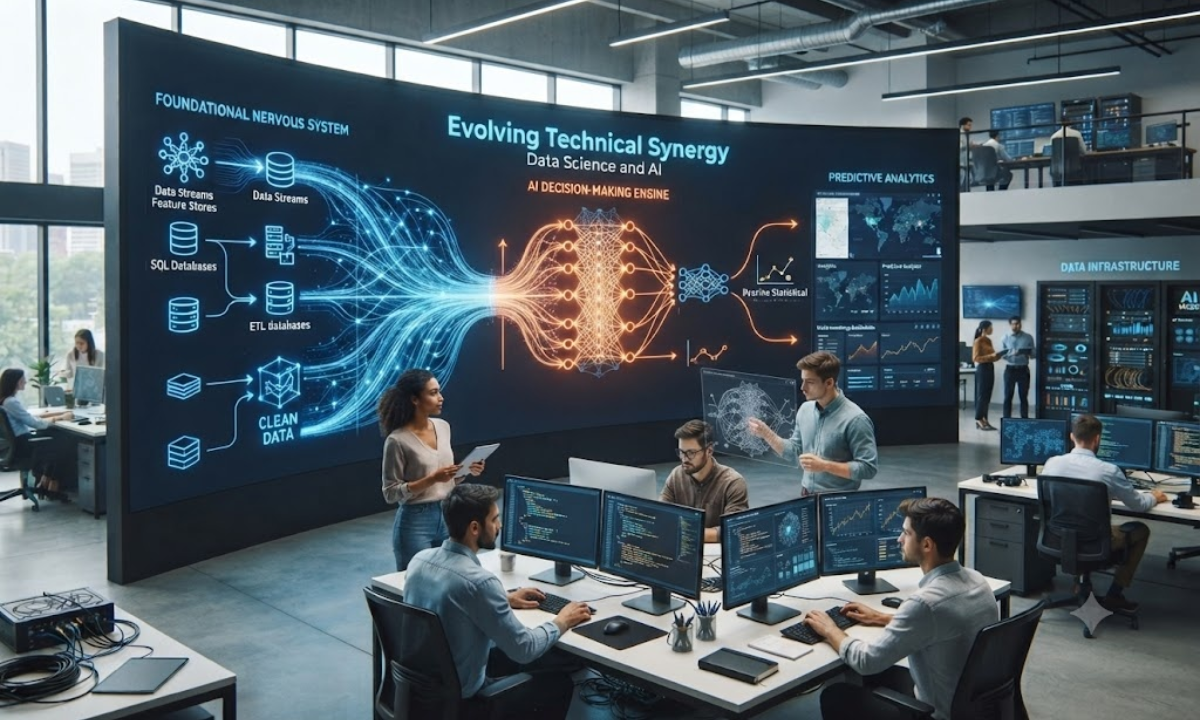
To understand the core technical relationship, think of data science as the foundational nervous system and artificial intelligence as the decision-making engine. AI models do not generate value in a vacuum; they require clean, highly structured, and continuously validated feature stores to calculate accurate statistical probabilities.
Without precise data curation, advanced deep learning models quickly suffer from data poisoning and compounding logical errors.
The Symbiotic Production Pipeline
-
Data Ingestion & Cleaning: Raw enterprise telemetry is captured, validated, and normalized to build clean baseline architectures.
-
Feature Engineering: Curation of highly optimized feature stores to serve predictive mathematical algorithms.
-
Vectorization & Alignment: Converting multi-format datasets into high-dimensional geometric spaces.
-
Model Inference: Live model execution fueled by a continuous infrastructure feedback loop.
This structural dependency defines the future of artificial intelligence across corporate architectures.
Modern software environments have shifted from training massive, generalized models toward deploying specialized, hyper-targeted small language models (SLMs) that process internal corporate data directly at the edge. This transition relies heavily on advanced data science practices:
-
Statistical Alignment: Before a neural network can optimize a logistics path or automate fraud detection, data professionals must execute robust exploratory data analysis, clean skewed distributions, and eliminate underlying feature bias.
-
Vector Database Optimization: Modern search tools rely on transforming raw operational text, audio, and video logs into multi-dimensional mathematical vectors. Designing and tuning these high-speed vector spaces requires deep statistical knowledge.
-
Continuous Feedback Loops: Once an intelligence engine goes live in production, it continuously generates new interaction data.
Data scientists must analyze this incoming operational telemetry to catch data drift where real-world user behavior changes over time, rendering old training data inaccurate.
Defining the New Analytical Scope
This structural shift is fundamentally defining the future scope of data science as a distinct engineering discipline. The era of writing simple SQL scripts to compile historical sales charts is rapidly drawing to a close.
Modern enterprise architectures demand engineers who can architect live feature pipelines, manage real-time event streaming via tools like Apache Kafka, and format unstructured datasets for direct ingestion by deep learning transformers.
After shifting your focus from historical reporting to predictive pipeline architecture, you position yourself at the absolute core of the modern tech stack.
Enterprise platforms no longer need professionals who can merely display what happened yesterday; they are aggressively headhunting engineers who can build the data pipelines that predict what will happen tomorrow.
The Modern Technical Toolkit: Beyond Code Syntax
The threshold for entering the advanced software economy has risen significantly. Writing standalone Python scripts or training isolated models on static local files no longer satisfies corporate production engineering standards.
The market of 2026 rewards architectural integration over isolated algorithmic tuning.
Developing highly valued artificial intelligence skills requires moving past basic library definitions and understanding how to orchestrate multi-layered, live information retrieval frameworks.
Modern systems are deeply reliant on real-world corporate contexts, meaning engineers must spend less time tweaking abstract neural layers from scratch and more time building scalable Retrieval-Augmented Generation (RAG) systems, vector caching frameworks, and semantic query routing layers.
To map out the exact technical proficiencies defining the modern engineering floor, let's contrast legacy scripting focus areas with current production requirements:
|
Technical Competency Layer |
Legacy Scripting Approach |
Production-Scale Requirement (2026 Standard)
|
|---|---|---|
|
Information Retrieval |
Querying relational SQL databases or static CSV flat files. |
Constructing low-latency semantic search spaces within vector databases using advanced Hierarchical Navigable Small World (HNSW) indexing. |
|
Model Orchestration |
Hardcoding single-turn model calls with manual text processing. |
Deploying multi-agent orchestration frameworks featuring automated context chunking and memory buffers. |
|
Data Scalability |
Loading uniform data matrices directly into local system memory. |
Architecting continuous streaming pipelines that ingest unstructured enterprise telemetry. |
|
System Observability |
Evaluating model metrics manually post-action using static validation data sets. |
Deploying automated tracking telemetry to capture token consumption, latency metrics, and real-time guardrail violations. |
A major driver behind this architectural evolution is the rapid specialization of modern enterprise AI tools that automate lower-level code generation.
Building a resilient modern technical toolkit requires deep operational authority over three critical pillars:
-
High-Dimensional Vector Architectures: Understanding how to ingest enterprise documentation, split assets into optimal token windows based on semantic boundaries, and map them into vector engines using distance metrics to maximize retrieval accuracy.
-
Context Engineering & State Management: Managing the state and prompt pipelines of autonomous agents, ensuring that models receive highly optimized context windows while maintaining secure data access privileges.
-
Production Pipeline Durability: Setting up automated evaluation frameworks to run continuous validation cycles against live model responses, catching non-deterministic failures, prompt injection vulnerabilities, and corporate compliance risks before software reaches client-facing production nodes.
As baseline syntax formatting and basic scripting tasks can be handled autonomously by foundational models, an engineer's premium value has shifted toward system topology and data durability.
Navigating the Indian Tech Landscape for Demand & Compensation
The Indian technology ecosystem is undergoing an intense structural transformation. Historically known as a global hub for standard application maintenance and back-office IT outsourcing, the region has pivoted aggressively toward high-value engineering, cloud R&D nodes, and dedicated Global Capability Centers (GCCs).
As multinational corporations move their core engineering workloads directly to local tech hubs, the competition to secure qualified technical specialists has created a massive scarcity premium.
Understanding the layout of AI jobs in India requires analyzing where the absolute highest compensation leverage sits. The traditional linear progression of stable, single-digit annual hikes has been entirely displaced by performance-driven tiering.
Companies are no longer evaluating candidates based on general tenure or years spent sitting at a desk; instead, they are paying massive premiums to engineers who can systematically reduce cloud compute costs, optimize real-time inference latency, or build robust, automated pipelines.
To give you an accurate baseline of the current market, let's examine the real-world compensation scales and operational accountability metrics across the dominant technical roles in the country:
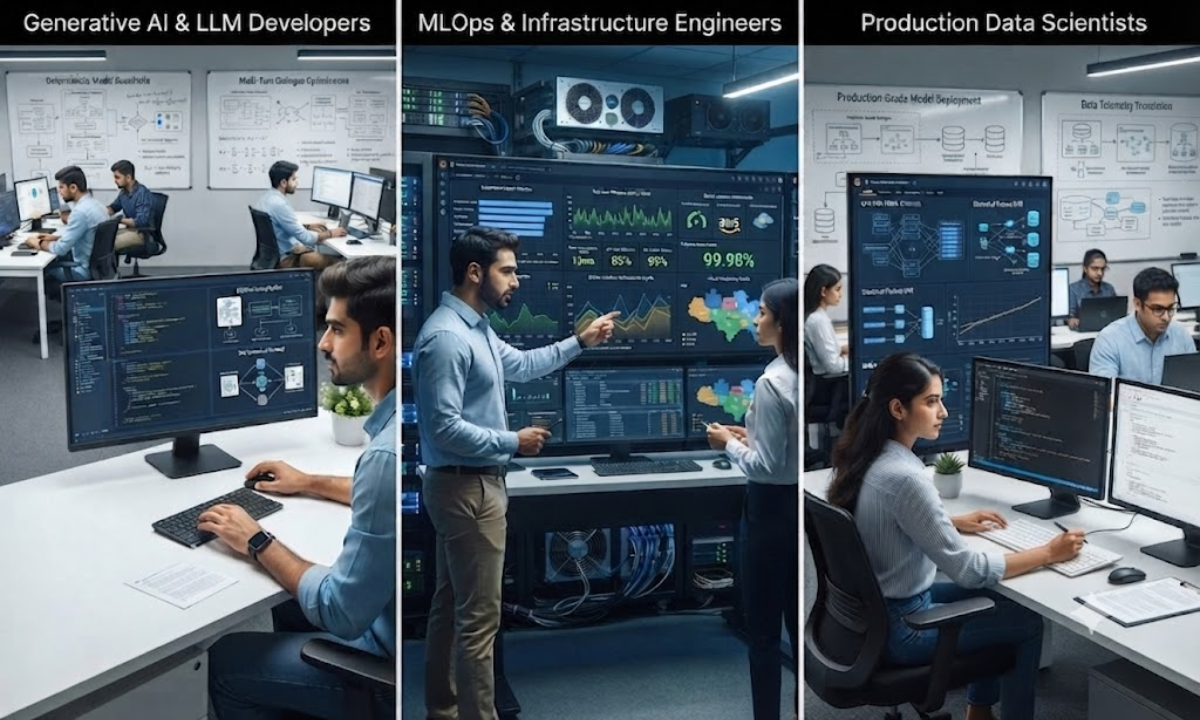
1. Generative AI & LLM Developers:
-
Compensation Brackets: Fresher packages start around ₹7–12 LPA, scaling rapidly to ₹14–22 LPA for mid-level professionals, and reaching up to ₹22–38+ LPA for senior specialists.
-
Operational Accountability: Responsible for fine-tuning open-source foundations, designing complex multi-turn RAG orchestration structures, and deploying guardrails to eliminate deterministic model hallucinations.
2. MLOps & Infrastructure Engineers:
-
Compensation Brackets: Entry positions command ₹8–13 LPA, mid-tier specialists clear ₹14–22 LPA, and senior infrastructure leads capture ₹22–35+ LPA.
-
Operational Accountability: Owning the automated integration and continuous deployment pipelines for statistical models. They manage scalable Docker and Kubernetes container layers, optimize cloud GPU node clusters, and deploy automated data logging infrastructures.
3. Production Data Scientists:
-
Compensation Brackets: Junior roles hover between ₹6–9 LPA, mid-level analytics specialists earn ₹10–18 LPA, while senior data architects command ₹18–30+ LPA.
-
Operational Accountability: Tracing multi-dimensional enterprise datasets, managing live data fabric schemas, eliminating statistical feature drift, and translating raw operational telemetry into production-grade mathematical models.
The geographical distribution of this talent war also highlights a clear regional premium. While tech hubs across the country are expanding their footprints, Bangalore consistently leads the market, offering a notable 15% to 20% salary premium over the national average.
This regional variance is driven by the sheer concentration of funded product tech startups, advanced AI labs, and high-density global development centers.
Ultimately, this data signals a clear operational lesson: organizations are not paying for abstract credentials or simple coding familiarity. They are paying for systemic problem-solving capacity. Those who master the execution layer can effectively dictate their terms in the modern technology market.
Structuring Your Learning Paradigm and Practical Portfolios over Paper

The entry-level hiring landscape has undergone a major correction.
Historically, collecting a baseline credential or a theoretical data science certification was enough to secure an initial technical interview with an HR talent coordinator.
Generalist credentials have lost their screening leverage. As automated assessment platforms and foundational coding tools can instantly generate boilerplate syntax, recruiters now filter out candidates who rely solely on passive, lecture-based qualifications.
To build a genuine competitive advantage, your educational roadmap must shift from a model of passive consumption to an active architecture of deployment. This is why selecting a production-aligned AI and machine learning course requires evaluating the direct hands-on infrastructure access the curriculum guarantees.
If a training program focuses entirely on theoretical math slides or isolated script execution within local notebooks, it fails to prepare you for modern, engineering-first hiring environments.
A production portfolio is defined not by the number of repositories you own, but by the architectural complexity and runtime operational stability of your deployments.
To land a premium engineering role, your portfolio must prove that you can move a statistical model completely out of an experimental notebook environment and deploy it securely as a live, production-grade cloud service.
The table below contrasts standard "toy" projects that signal a beginner level with the advanced architectural blueprints that attract top-tier technical recruiters:
|
Project Archetype |
The "Tutorial Trap" (Red Flags) |
Production-Scale Benchmark (High Leverage)
|
|---|---|---|
|
Predictive Analytics |
Re-running standard, public datasets (e.g., Titanic survival rates or Iris flower classifications). |
Architecting end-to-end credit scoring pipelines that stream data from live mock APIs and capture financial metric fluctuations. |
|
Natural Language Processing |
Write a simple, local Python script to perform basic sentiment analysis on isolated blocks of text. |
Building a multi-agent text parsing engine that dynamically extracts structured data from multi-format enterprise documentation while running real-time bias detection. |
|
Generative Architectures |
Making generic, hardcoded API requests directly to public foundational models without context boundaries. |
Engineering an advanced Retrieval-Augmented Generation (RAG) platform with multi-turn memory buffers and custom vector databases. |
|
System Operations (MLOps) |
Training a model locally on a desktop and evaluating it on static testing files. |
Packing an inference engine inside Docker containers, building automated CI/CD staging pipelines, and setting up automated alert triggers to catch real-world model drift. |
Core Project Packaging Rules
-
Eliminate Default Documentation: Replace standard, generic code readmes with a professional, structured breakdown.
Your documentation should explicitly outline the exact business problem, your chosen infrastructure topology, your data engineering methodology, and the concrete cost or latency optimizations your design achieved.
-
Prioritize Live Application Gateways: Do not expect non-technical HR managers to clone complex code repositories locally to evaluate your talent.
Deploy your systems as clean, interactive web applications using front-end frames or lightweight API endpoints hosted on accessible cloud platforms.
-
Demonstrate System Observability: Incorporate real-time logging, data lineage tracking, and performance metrics into your user interfaces.
Proving you know how to safely monitor token consumption, evaluate response guardrails, and secure database connections separates entry-level hobbyists from production-ready system architects.
Why Choose Apponix?
As a leading Training institute in Bangalore, Apponix Technologies provides a highly focused, production-aligned educational environment designed to replicate real-world enterprise engineering rooms:
-
Dedicated Cloud GPU Sandbox Access: Build, train, and deploy large-scale models directly within live AWS and Azure cloud environments rather than testing code on restricted local hardware.
-
Production-First Portfolio Engineering: Graduate with a robust portfolio of fully deployed, live multi-agent RAG platforms and MLOps pipelines instead of standard, generic tutorial code.
-
1-on-1 Architecture Mentorship: Learn directly from veteran, senior software architects and active data engineers who actively manage high-volume corporate infrastructure.
-
Enterprise Placement Network: Connect directly with leading Global Capability Centers (GCCs) and product tech startups through customized mock technical interviews and rigorous portfolio validation reviews.
Taking a structured data science course in Bangalore at Apponix bridges this gap, turning theoretical knowledge into the practical, production-grade engineering skills demanded by today’s top companies.
Conclusion
The transition into the advanced data economy requires shifting away from superficial coding shortcuts and committing to a deeper understanding of system topology. In 2026, the technology landscape does not lack people who can copy-paste baseline algorithms; it lacks system architects who can design secure, automated pipelines capable of handling massive data throughput.
The technological shifts of this year reward professionals who establish true operational authority over their technical stacks. Stop watching fragmented video tutorials and start architecting the autonomous data systems driving modern business.
Connect with a career advisor at Apponix today, select your specialized engineering track, and accelerate your path toward becoming an elite technology professional.
References:
1. https://www.geeksforgeeks.org/artificial-intelligence/what-is-artificial-intelligence-ai/
2. https://www.iso.org/artificial-intelligence

Apponix Academy
Apponix Academy