POPULAR COURSES
Master Programs





Table of contents:
|
1. What Is a Requirements Traceability Matrix? |
|
2. Why Is an RTM Important in Projects? |
|
3. Types of Requirements Traceability |
|
4. How to Create a Requirements Traceability Matrix |
|
5. Requirements Traceability Matrix Template With Example |
|
6. How to Use an RTM Throughout the Project Lifecycle |
|
7. Common RTM Mistakes to Avoid |
|
8. Best Practices for Effective Requirements Traceability |
|
9. Conclusion |
A project may have dozens of requirements, multiple stakeholders, and several rounds of testing. Without a clear tracking system, teams can miss important requirements, overlook changes, or deliver features that do not meet business needs. A Requirements Traceability Matrix (RTM) helps prevent these problems by connecting each requirement to its source, development activities, and test cases.
An RTM is useful in software development, business process improvement, system implementation, and other projects where teams must verify that requirements are met. It also helps business analysts, developers, testers, and project managers maintain a shared understanding of project scope.
This guide from Apponix Academy explains how to create a Requirements Traceability Matrix, what information to include, and how to use it throughout the project lifecycle.
What Is a Requirements Traceability Matrix?
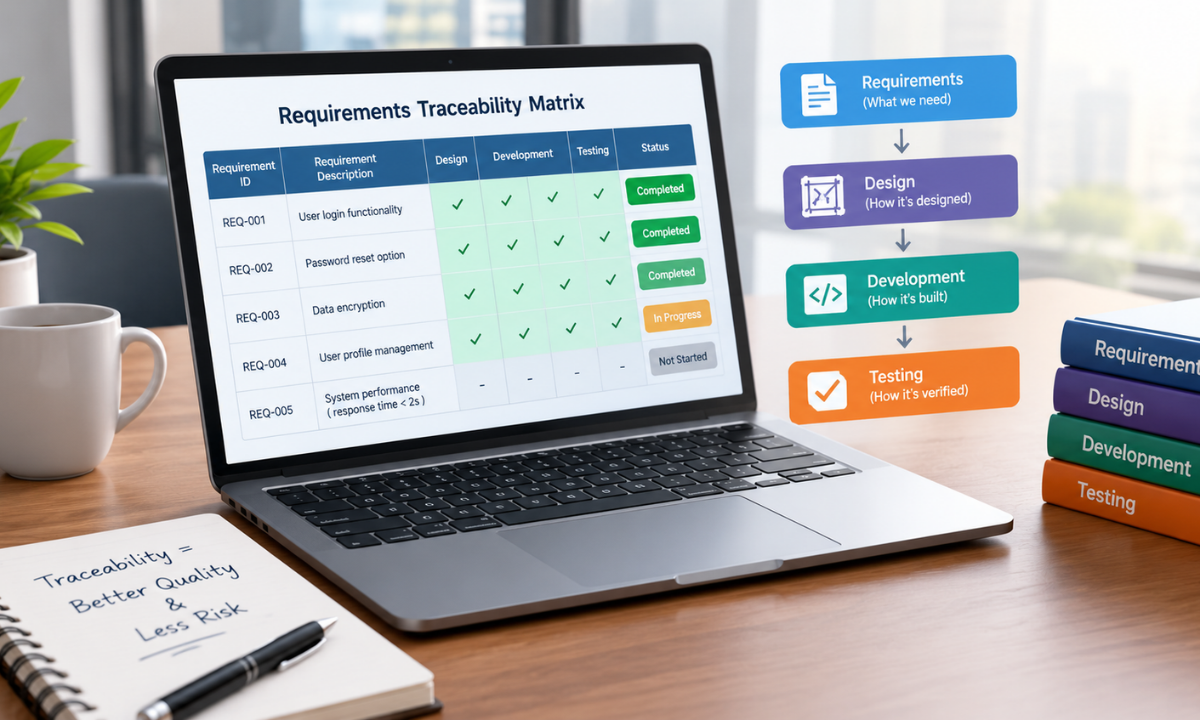
A Requirements Traceability Matrix is a document or tracking tool that links project requirements to their related deliverables and validation activities. It provides a structured way to check whether every approved requirement has been addressed.
For example, an online shopping application may include a requirement that customers must receive an order confirmation after completing a purchase. The RTM connects this requirement to its business source, the relevant functional specification, the development task, and the test case used to verify the feature.
This relationship is called requirements traceability. It allows the project team to follow a requirement from its origin to implementation and testing.
Business analysts are often responsible for documenting requirements and maintaining these connections. Understanding the role and responsibilities of a business analyst helps explain how requirement tracking supports communication between business stakeholders and technical teams.
Why Is an RTM Important in Projects?
An RTM supports requirement management and improves coordination across project teams.
1. Prevents missed requirements: It helps teams confirm that every approved requirement has a corresponding development or implementation activity.
2. Improves test coverage: Testers can identify requirements without test cases and check whether planned tests cover the expected functionality.
3. Supports change management: When a requirement changes, the team can identify affected features, documents, and test cases before approving the change.
4. Improves stakeholder communication: Business analysts, developers, testers, and business stakeholders can refer to the same tracking document.
5. Supports project audits: In projects with formal documentation and compliance needs, traceability provides evidence of how requirements were addressed and verified.
An RTM does not guarantee project success by itself. Its value depends on accurate documentation, regular updates, and clear ownership.
Types of Requirements Traceability
Teams can use different traceability approaches depending on project needs.
-
Forward traceability: Links requirements to design, development, and testing activities. It helps confirm that all requirements are implemented and tested.
-
Backward traceability: Links deliverables and test cases back to approved requirements. It helps identify features or work items that lack a valid business justification.
-
Bidirectional traceability: Supports both forward and backward tracking. It helps teams assess completeness and identify unnecessary or unapproved functionality.
Bidirectional traceability is particularly useful in projects with complex dependencies, frequent requirement changes, or strict testing expectations.
How to Create a Requirements Traceability Matrix
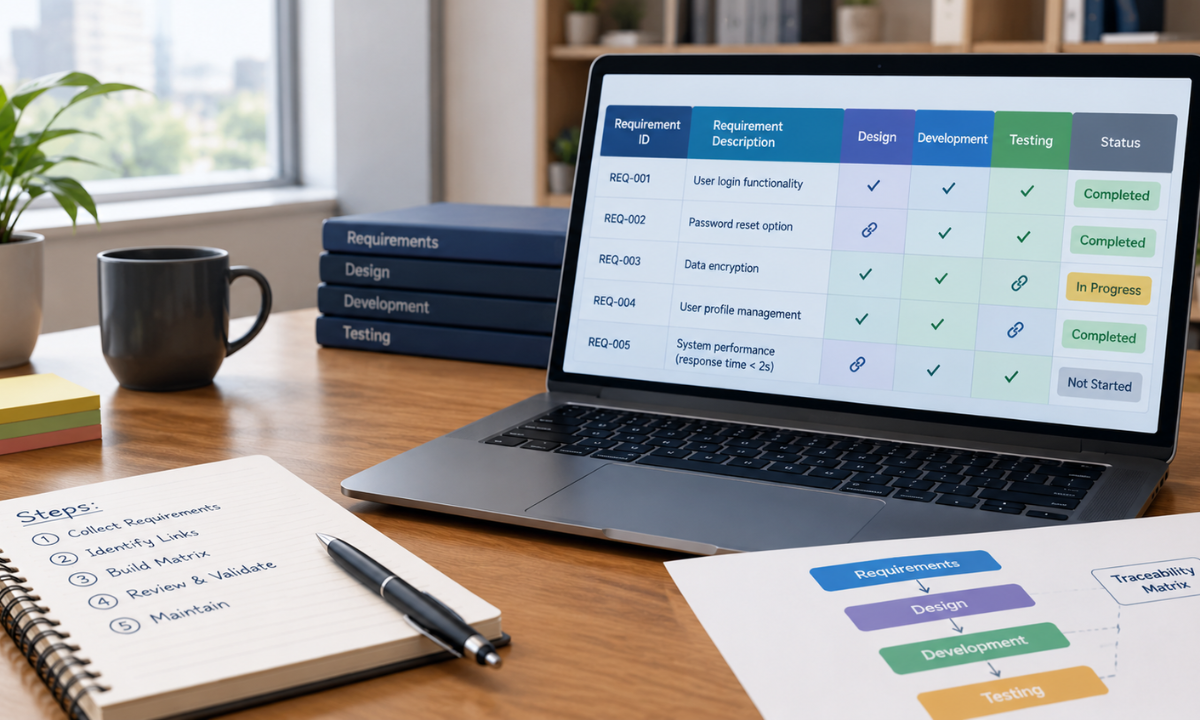
Creating an RTM involves more than preparing a spreadsheet. The team must first establish clear requirements and then link them to the appropriate project activities.
Step 1: Gather and Document Requirements
Collect requirements from stakeholder interviews, workshops, business documents, process analysis, and other approved sources.
Document each requirement clearly. Include functional requirements, non-functional requirements, business rules, and relevant regulatory needs where applicable.
Requirements may be documented in a Business Requirements Document (BRD), Functional Requirements Document (FRD), or Software Requirements Specification (SRS). Understanding the purpose of each document helps teams maintain consistent information. For more detail, see BRD vs FRD vs SRS: Key Differences With Practical Examples.
Step 2: Assign Unique Requirement IDs
Give every requirement a unique identifier, such as REQ-001, REQ-002, or REQ-003. These IDs make it easier to reference requirements across documents and tools.
Avoid changing an ID simply because the requirement description changes. Retain the identifier when the requirement represents the same item, and use version history to record approved changes. If a requirement is split or replaced, document the relationship between the old and new IDs.
Step 3: Identify the Requirement Source
Record where each requirement originated. Sources may include a business requirement document, a functional requirement document, a stakeholder interview, a user story, a business rule, or a compliance obligation.
Capturing the source helps teams understand why a requirement exists and who can clarify it when questions arise.
Step 4: Map Requirements to Deliverables
Connect each requirement to relevant design documents, user stories, development tasks, system components, or process changes.
In Agile projects, a requirement might link to an epic, a user story, and a development task. In traditional projects, it may connect to functional specifications and design documents.
User stories should also include clear conditions for completion. Read more about writing effective user stories and acceptance criteria to understand how requirements can be converted into testable expectations.
Step 5: Link Test Cases and Define Status
Assign one or more test case IDs to each requirement. Record whether the requirement is covered by testing and whether the test has passed, failed, or remains pending.
Some requirements may need several test cases to cover normal conditions, boundary values, exceptions, and non-functional expectations. A requirement without a linked test case should be reviewed rather than automatically marked complete.
Step 6: Review and Maintain the Matrix
Review the RTM during requirement validation, development, testing, and change approval. Update it whenever requirements, dependencies, test cases, or implementation status change.
Assign responsibility for maintaining the matrix so that it remains a reliable project record.
Requirements Traceability Matrix Template With Example
A spreadsheet is sufficient for many small and medium-sized projects. The following example shows how an RTM can track requirements for an online shopping application.
|
Requirement ID |
Requirement |
Source |
Development Reference |
Test Case ID |
Status |
|
REQ-001 |
Users can register with an email address |
BRD-01 |
DEV-101 |
TC-001 |
Passed |
|
REQ-002 |
Users can reset forgotten passwords |
US-02 |
DEV-102 |
TC-002, TC-003 |
In testing |
|
REQ-003 |
Customers receive order confirmation emails |
BRD-03 |
DEV-105 |
TC-004 |
Pending |
Illustrative example: The IDs and statuses are sample values.
For practical use, consider adding these columns:
-
Requirement description and priority
-
Requirement owner and approval status
-
Requirement version and change history
-
Related design document or system component
-
Test execution result and defect ID
-
Comments, dependencies, and review date
The matrix should contain enough detail to support tracking without becoming unnecessarily difficult to maintain.
How to Use an RTM Throughout the Project Lifecycle
An RTM is most useful when teams maintain it from requirement definition through project completion.
During requirement analysis: Use the matrix to confirm that each requirement has a clear source, an owner, and an agreed status.
During development: Check whether every approved requirement has a corresponding implementation task. Use the links to clarify scope and dependencies.
During software testing: Compare requirements with test cases and test results. Identify missing coverage, failed tests, and requirements that need further validation.
During User Acceptance Testing (UAT): Help business stakeholders verify that the delivered solution supports the agreed business needs. Record defects and unresolved requirements for follow-up.
During change management: Assess the impact of a proposed change on related requirements, documents, features, and test cases before updating the matrix.
At project closure: Review outstanding items and confirm which requirements have been implemented, tested, accepted, deferred, or formally excluded.
Common RTM Mistakes to Avoid
Even a well-designed matrix can become ineffective if teams do not maintain it properly.
-
Using unclear requirement descriptions: Write requirements that are specific enough to be reviewed and tested.
-
Leaving out requirement sources: Record the origin of each requirement to preserve business context.
-
Linking requirements to incomplete tests: Check whether test cases cover relevant conditions and expected results.
-
Ignoring approved changes: Update affected traceability links whenever the project scope changes.
-
Treating the matrix as a one-time document: Review it regularly instead of waiting until final testing.
-
Tracking unnecessary details: Include useful fields and remove duplicate information that does not improve traceability.
A strong understanding of requirements analysis also helps professionals prepare for practical assignments and interviews. Reviewing business analyst interview questions and answers can help reinforce concepts such as requirement gathering, documentation, stakeholder management, and change analysis.
Best Practices for Effective Requirements Traceability
Use a consistent requirement naming convention and agree on the matrix format before the project becomes complex. Keep requirement descriptions concise, establish clear ownership, and maintain a reliable version history.
For large projects, requirements management tools can reduce manual work by linking requirements with development tasks, defects, and test execution records. Smaller projects may work well with a shared spreadsheet, provided that access and updates are controlled.
The matrix should also reflect the project's delivery method. Agile teams can update traceability during backlog refinement and sprint reviews, while projects using a traditional lifecycle may maintain it through formal review and approval stages.
Business analysts play an important role in maintaining these relationships. They help clarify requirements, document stakeholder decisions, assess change impacts, and coordinate with development and testing teams. Professionals who want to build these capabilities can review the curriculum for the Business Analyst Course in Bangalore, which is relevant to learning about requirements documentation and business analysis practices.
Conclusion
A Requirements Traceability Matrix connects business requirements with their sources, implementation activities, and test cases. When maintained throughout the project lifecycle, it helps teams identify gaps, assess changes, improve test coverage, and verify that the delivered solution meets agreed expectations.
The most effective RTM is not necessarily the most complicated one. It is the one that provides clear links, accurate status information, and a dependable record of requirement changes from project initiation to closure.
Reference:
-
https://medium.com/@amaralisa321/a-guide-on-requirements-traceability-matrix-template-16d79912eb65
-
https://www.scribd.com/document/324930546/Requirement-Traceability-Matrix-RTM

Apponix Academy
Apponix Academy