POPULAR COURSES
Master Programs





Table of contents:
|
1. What Is a User Story? |
|
2. How to Write an Effective User Story |
|
3. What Are Acceptance Criteria? |
|
4. Common Formats for Writing Acceptance Criteria |
|
5. Best Practices for Writing Testable Acceptance Criteria |
|
6. Common User Story and Documentation Mistakes |
|
7. How Business Analysts Use User Stories in Agile Projects |
|
8. Conclusion |
User stories and acceptance criteria help teams understand what users need from a product and how to verify that the final solution meets those needs. They are important parts of Agile development, where business analysts, product owners, developers, and testers work together to deliver value.
Poorly written user stories can lead to unclear requirements, repeated discussions, development delays, and testing issues. Clear stories and measurable acceptance criteria help teams agree on the expected outcome before development begins.
This guide explains how to write effective user stories, define testable acceptance criteria, and avoid common documentation mistakes through practical examples.
What Is a User Story?
A user story is a short description of a feature or requirement written from the user's perspective. It explains who needs a feature, what they want to do, and why it matters.
Unlike detailed technical specifications, user stories focus on user needs and business value. They encourage teams to discuss requirements before deciding how to implement them.
A standard user story follows this format:
As a [type of user], I want [an action or feature], so that [a benefit].
For example:
As an online shopper, I want to track my order so that I know when my delivery will arrive.
This story identifies the user, the required functionality, and the expected benefit. The development team can use it as a starting point for discussions about order tracking, delivery updates, and the information displayed to customers.
How to Write an Effective User Story
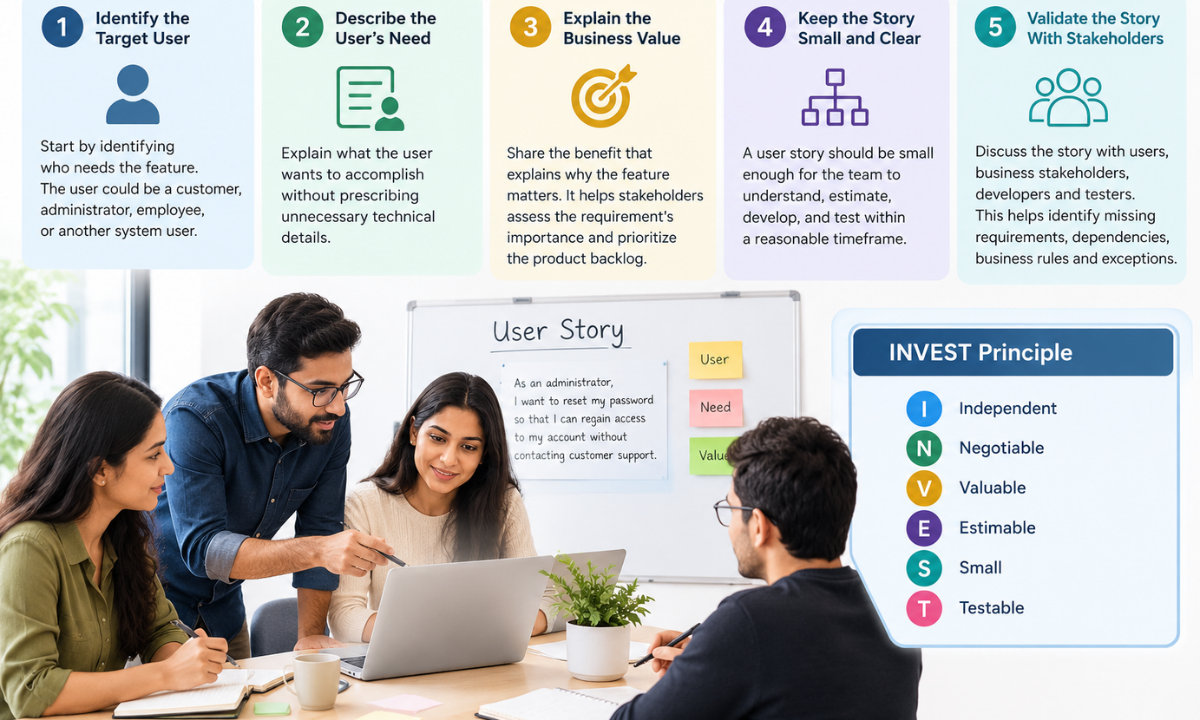
Writing a good user story requires a clear understanding of user needs, business goals, and the expected outcome.
1. Identify the Target User
Start by identifying who needs the feature. The user could be a customer, administrator, employee, or another system user.
For example, "As an administrator" is more specific than "As a user" when the feature involves managing account permissions.
2. Describe the User's Need
Explain what the user wants to accomplish without prescribing unnecessary technical details.
For example, "I want to reset my password" describes a user need. Specifying the exact database structure or backend process is usually unnecessary at this stage.
3. Explain the Business Value
The benefit explains why the feature matters. It helps stakeholders assess the requirement's importance and prioritize the product backlog.
For example, "so that I can regain access to my account without contacting customer support" explains the value of a password-reset feature.
4. Keep the Story Small and Clear
A user story should be small enough for the team to understand, estimate, develop, and test within a reasonable timeframe. Large stories may need to be divided into smaller stories based on user actions or business outcomes.
For example, an online booking feature could be divided into separate stories for searching available slots, booking an appointment, and cancelling a booking.
5. Validate the Story With Stakeholders
Discuss the story with users, business stakeholders, developers, and testers. These conversations help identify missing requirements, dependencies, business rules, and possible exceptions before development starts.
A useful way to remember the qualities of a good user story is the INVEST principle: Independent, Negotiable, Valuable, Estimable, Small, and Testable.
For a broader view of how these skills fit into the profession, read the complete career roadmap to become a business analyst.
What Are Acceptance Criteria?
Acceptance criteria are specific conditions that a user story must satisfy to be considered complete and acceptable. They define the expected system behaviour and help the team determine whether the requirement has been implemented correctly.
Acceptance criteria should be clear, measurable, and testable. They are different from general project objectives because they describe observable outcomes.
For example, consider this user story:
User story: As a registered customer, I want to reset my password so that I can regain access to my account.
Its acceptance criteria could include:
-
The customer can request a password reset using their registered email address.
-
The system displays a confirmation message after accepting a valid request.
-
The password-reset link expires after a defined period.
-
The customer can create a new password that meets the specified password rules.
-
The customer sees an appropriate error message when attempting to use an expired or invalid link.
These conditions help developers understand the required behaviour and allow testers to prepare relevant test cases.
Common Formats for Writing Acceptance Criteria
Two widely used formats are checklist-based criteria and Given-When-Then scenarios.
1. Checklist-Based Acceptance Criteria
This format uses a list of conditions that must be satisfied. It works well for straightforward features with clear requirements.
Example: Online Appointment Booking
User story: As a patient, I want to book an available appointment so that I can consult a doctor at a convenient time.
Acceptance criteria:
-
The patient can view available appointment slots.
-
The patient can select an available date and time.
-
The system prevents the same slot from being booked twice.
-
The patient receives a booking confirmation after successful completion.
-
The system displays an error if the selected slot is no longer available.
Each condition describes an outcome that can be verified during testing.
2. Given-When-Then Format
The Given-When-Then format, commonly associated with Behaviour-Driven Development (BDD), describes the initial situation, the user's action, and the expected result.
It follows this structure:
-
Given: The initial context or condition.
-
When: The action performed by the user.
-
Then: The expected outcome.
Example: Login Functionality
-
Given a registered user has entered valid login credentials,
-
When the user selects the login button,
-
Then the system grants access to the user's account.
An exception scenario can be documented separately:
-
Given a user enters an incorrect password,
-
When the user attempts to log in,
-
Then the system denies access and displays an appropriate error message.
This format makes expected behaviour easier to understand and supports the creation of manual or automated tests.
Best Practices for Writing Testable Acceptance Criteria
Effective acceptance criteria reduce confusion and help teams confirm whether a feature meets the business requirement.
Use specific language: Avoid vague terms such as "fast," "user-friendly," or "appropriate" unless they are supported by measurable definitions.
Cover positive and negative scenarios: Document what should happen when an action succeeds and what should happen when the input is invalid, a resource is unavailable, or a business rule is violated.
Include relevant business rules: If a discount applies only to orders above a minimum value, state that threshold clearly.
Define relevant non-functional expectations: Security, accessibility, performance, and reliability requirements may need explicit criteria or separate specifications.
Keep criteria focused on outcomes: Describe what the system must do rather than dictating implementation details unless a technical constraint is necessary.
Review criteria with the delivery team: Developers and testers can identify missing scenarios, unclear conditions, and assumptions that require stakeholder confirmation.
Practical exercises can help analysts apply these principles to realistic requirements. The article on why practical case studies matter in business analyst training explores how case-based learning helps develop requirements analysis and problem-solving skills.
Common User Story and Documentation Mistakes
Even experienced teams can create requirements that are difficult to implement or validate. The following mistakes should be avoided.
|
Common mistake |
Better approach |
|
Writing a story from the system's perspective instead of the user's |
Explain the user's need and the business benefit |
|
Combining several features into one story |
Split the requirement into smaller, valuable stories |
|
Using vague acceptance criteria |
Define observable and measurable outcomes |
|
Documenting only successful scenarios |
Include relevant errors, exceptions, and alternative paths |
|
Adding technical solutions before understanding the need |
Clarify the business requirement before discussing implementation |
|
Ignoring stakeholder feedback |
Review and refine stories collaboratively |
|
Changing requirements without updating documentation |
Maintain traceability and communicate approved changes |
Requirements documentation may also include business, functional, and system-level details. Understanding their differences helps analysts choose the right document for each purpose. Read BRD vs FRD vs SRS: Key Differences With Practical Examples for a related discussion. Verify the destination URL before publishing.
How Business Analysts Use User Stories in Agile Projects
Business analysts help translate business needs into requirements that technical teams can understand and implement. In Agile projects, they may work with product owners to refine user stories, clarify acceptance criteria, identify dependencies, and support backlog prioritization.
They also help stakeholders resolve conflicting expectations and ensure that the proposed functionality supports the intended business outcome. During testing, acceptance criteria provide a reference for reviewing whether the solution meets the agreed requirements.
Tools such as Jira and Confluence can support story management, collaboration, and documentation. However, the quality of the requirements depends on clear thinking, stakeholder communication, and effective analysis rather than the tool alone.
Business analysts also need to understand how requirements connect with business goals and solution design. Professionals preparing for interviews can also review top business analyst interview questions and answers to explore common topics related to requirements gathering, stakeholder communication, and problem-solving.
Conclusion
Effective user stories explain who needs a feature, what they want to achieve, and why it matters. Well-defined acceptance criteria turn those needs into conditions that developers can implement and testers can verify.
By using a consistent story format, writing measurable criteria, covering exception scenarios, and reviewing requirements with stakeholders, teams can reduce ambiguity and improve delivery quality.
These skills are important for professionals building their business analysis knowledge. A structured business analyst course in Bangalore can help learners understand requirements elicitation, Agile practices, documentation, and stakeholder collaboration through relevant concepts and practical exercises.
References:

Apponix Academy
Apponix Academy