POPULAR COURSES
Master Programs



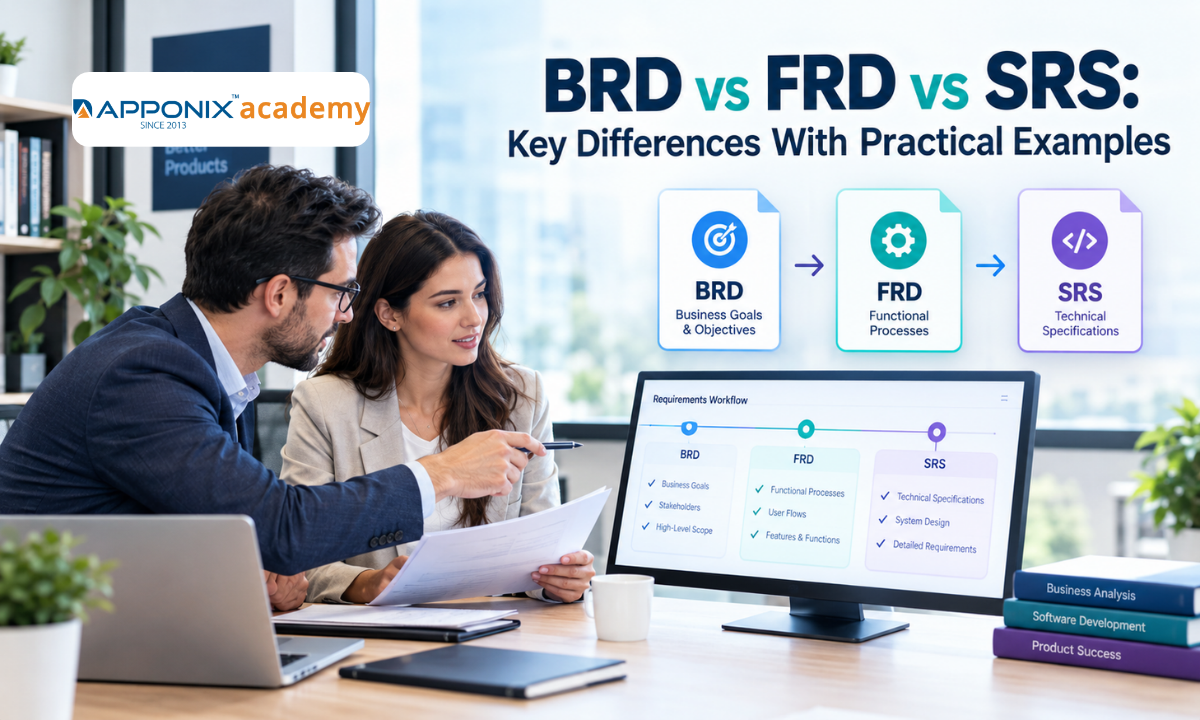
Table of contents:
|
1. What Is a BRD (Business Requirements Document)? |
|
2. What Is an FRD (Functional Requirements Document)? |
|
3. What Is an SRS (Software Requirements Specification)? |
|
4. BRD vs FRD vs SRS: Key Differences |
|
5. How BRD, FRD, and SRS Work Together |
|
6. Who Prepares BRD, FRD, and SRS Documents? |
|
7. When Should You Use Each Requirements Document? |
|
8. Common Mistakes in Requirements Documentation |
|
9. Conclusion |
Understanding business requirements, functional requirements, and software requirements is an important part of business analysis. BRD, FRD, and SRS documents help project teams define business needs, describe system behaviour, and guide software development.
For example, when a company plans to develop an online shopping application, it must identify the business goals, define the features users need, and document how the software should work. BRD, FRD, and SRS help organise these details at different levels.
This guide from Apponix Academy explains the differences between BRD, FRD, and SRS, their structures, key stakeholders, and practical use cases.
What Is a BRD (Business Requirements Document)?
A Business Requirements Document (BRD) explains the business problem, project objectives, and expected outcomes. It focuses on what the business wants to achieve and why the project is needed.
Business analysts prepare a BRD after discussions with stakeholders, such as business owners, department heads, clients, and end users. The document helps everyone agree on the project scope before detailed design and development begin.
Key Components of a BRD
A typical BRD includes:
-
Business objectives: The goals the project aims to achieve.
-
Project scope: The activities and features included in the project.
-
Stakeholder details: The people involved in or affected by the project.
-
Business requirements: The high-level needs the proposed solution must address.
-
Success criteria: The measures used to evaluate project outcomes.
-
Assumptions and constraints: The conditions, limitations, and dependencies that may affect delivery.
Practical Example of a BRD
Consider a retail company that wants to launch an online shopping platform. Its current sales depend mainly on physical stores, which limits its reach.
The BRD may state that the company wants to increase online sales, reach customers across multiple locations, and reduce manual order processing. It may also define business goals, such as improving order tracking and making product information available online.
At this stage, the BRD does not need to explain the technical design of the shopping cart or payment gateway. It focuses on the business problem and the outcomes the company expects.
What Is an FRD (Functional Requirements Document)?
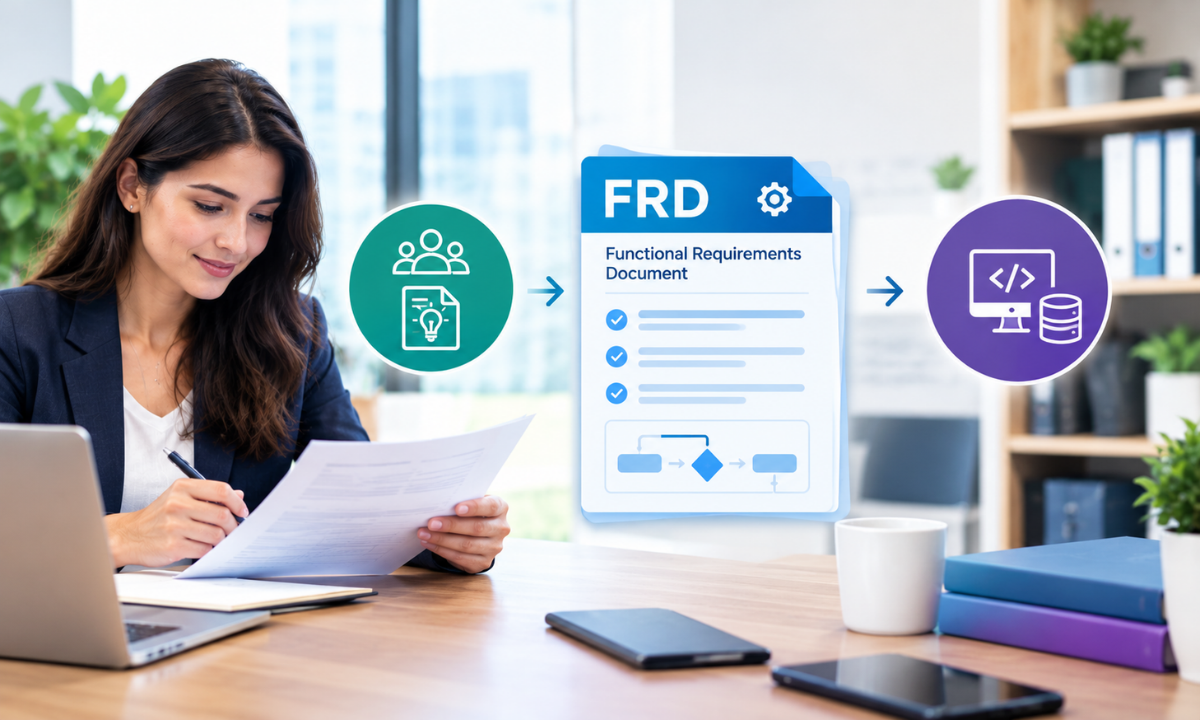
A Functional Requirements Document (FRD) describes the functions a system must perform to meet business requirements. It explains what the system should do in response to user actions, inputs, and business rules.
Business analysts develop the FRD by translating high-level business needs into clear, testable functional requirements. Developers, testers, designers, and product teams use it to understand the expected system behaviour.
Key Components of an FRD
An FRD commonly contains:
-
Functional requirements: Specific features and system operations.
-
User interactions: How users interact with the application.
-
Business rules: Conditions that govern system operations.
-
Process flows: The sequence of steps in a business process.
-
Use cases: Descriptions of how users achieve specific goals.
-
Acceptance criteria: Conditions used to determine whether a feature meets its requirements.
Practical Example of an FRD
For the online shopping platform, the FRD may describe how customers search for products, add items to a cart, apply discount codes, and place orders.
It could include a requirement such as: “The system shall allow registered customers to add available products to their shopping cart and update item quantities before checkout.”
Another requirement may specify that the system must display an error message when a customer enters an invalid discount code.
These requirements explain the expected functionality without necessarily defining the underlying technical architecture.
What Is an SRS (Software Requirements Specification)?
A Software Requirements Specification (SRS) documents the software system's functional and non-functional requirements, interfaces, constraints, and expected behaviour. It provides a structured reference for software design, development, testing, and validation.
An SRS may include business-derived functional requirements as well as technical and quality requirements. Its scope is often broader than a document focused only on functionality.
Key Components of an SRS
An SRS commonly includes:
-
System overview: The purpose, scope, and context of the software.
-
Functional requirements: The operations and services the software must provide.
-
Non-functional requirements: Performance, security, reliability, usability, and other quality expectations.
-
Interface requirements: Interactions with users, hardware, external systems, and APIs.
-
Data requirements: Data structures, validation rules, storage, and processing needs.
-
System constraints: Technology, regulatory, or operational limitations.
-
Verification criteria: Conditions used to confirm that requirements have been met.
Practical Example of an SRS
For the online shopping platform, the SRS may specify that the system must process product searches, maintain shopping carts, and integrate with an external payment gateway.
It may also define measurable quality requirements, such as a target response time under a specified workload, encrypted communication, and appropriate access controls for customer data.
These details help developers and testers verify not only whether the application works but also whether it meets the required performance and security standards.
BRD vs FRD vs SRS: Key Differences
Although BRD, FRD, and SRS support the same project, they differ in purpose, level of detail, and intended audience.
|
Comparison factor |
BRD |
FRD |
SRS |
|
Full form |
Business Requirements Document |
Functional Requirements Document |
Software Requirements Specification |
|
Main purpose |
Defines business needs and goals |
Defines required system functions |
Specifies software requirements |
|
Main question |
Why is the project needed? |
What should the system do? |
What must the software satisfy? |
|
Focus |
Business outcomes |
Features and business rules |
Functional and non-functional requirements |
|
Detail level |
High-level |
Detailed functional behaviour |
Detailed software specifications |
|
Primary audience |
Business stakeholders and project sponsors |
Business analysts, developers, and testers |
Developers, architects, testers, and technical teams |
|
Typical contents |
Objectives, scope, business needs, success measures |
Workflows, use cases, functional rules, acceptance criteria |
System requirements, interfaces, performance, security, constraints |
|
Main use |
Project planning and business approval |
Feature development and functional validation |
Software design, implementation, and verification |
The exact structure depends on the organisation, project methodology, and documentation standards. Some teams combine these documents, while others maintain them separately.
How BRD, FRD, and SRS Work Together
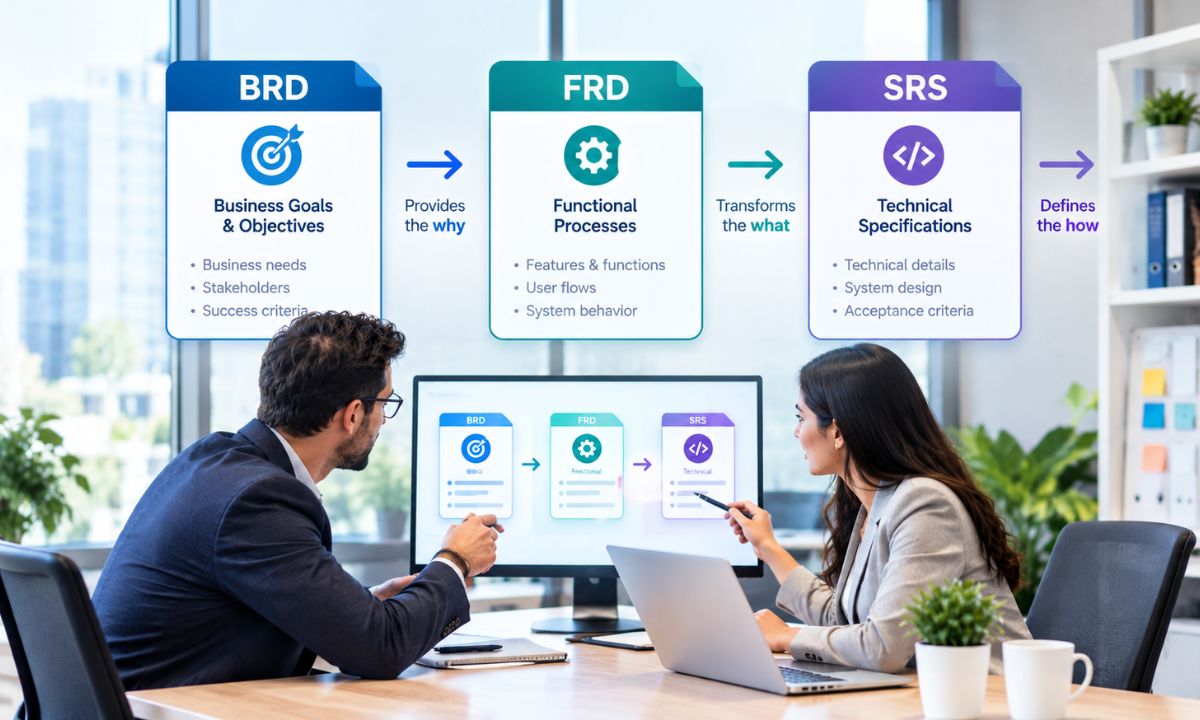
These documents form a connected requirements management process. Each document adds clarity to the project and helps teams maintain alignment between business goals and the final solution.
Consider the online shopping application example.
1. BRD - Define the business need
The company wants to increase online sales and reduce manual order processing.
2. FRD - Define system functionality
Customers must be able to browse products, add items to their carts, and place orders.
3. SRS - Specify software requirements
The software must define payment gateway interfaces, order validation, security controls, and performance expectations.
This sequence helps teams trace individual software requirements back to the original business objectives. It also reduces the risk of building features that do not address the actual business problem.
For a deeper understanding of how analysts identify and document these needs, read Apponix's guide to what business analysis is and why it is important.
Who Prepares BRD, FRD, and SRS Documents?
The people responsible for creating these documents vary by organisation. A business analyst often coordinates requirements documentation, but input from other stakeholders is essential.
-
BRD: Business analysts typically work with business owners, clients, and project sponsors to capture business goals and scope.
-
FRD: Business analysts collaborate with product owners, subject matter experts, developers, and testers to define expected functionality.
-
SRS: Business analysts, system analysts, software architects, and technical teams may contribute to the specification, depending on the project structure.
The business analyst also helps resolve conflicting requirements, validate assumptions, and maintain traceability as the project progresses.
Requirements gathering is a key part of this work. Techniques such as stakeholder interviews, workshops, document analysis, and process observation help analysts identify the right information before documenting it.
Apponix's article on how business analysts bridge the gap between technology and business explains how requirements documentation supports communication between business and technical teams.
When Should You Use Each Requirements Document?
Choosing the right document depends on the project's stage, complexity, and stakeholder needs.
Use a BRD when:
-
Starting a new project or business initiative.
-
Defining project scope and business objectives.
-
Seeking approval from business stakeholders.
-
Evaluating whether a proposed solution addresses a business problem.
Use an FRD when:
-
Converting business needs into system features.
-
Defining user interactions and business rules.
-
Clarifying expected system behaviour for developers.
-
Preparing functional test scenarios.
Use an SRS when:
-
Documenting detailed software requirements.
-
Defining performance, security, and interface expectations.
-
Supporting software development and system testing.
-
Establishing clear criteria for software verification.
In Agile projects, teams may use a combination of lightweight requirement documents, user stories, acceptance criteria, and a product backlog instead of maintaining three separate documents. The objective remains the same: ensure requirements are clear, testable, and aligned with business goals.
Common Mistakes in Requirements Documentation
Business analysts should avoid several common mistakes when preparing BRD, FRD, and SRS documents.
-
Mixing business goals with technical details: A BRD should explain the business need rather than describe implementation choices in detail.
-
Writing vague requirements: Statements such as “the application should be fast” need measurable criteria to support testing.
-
Ignoring non-functional requirements: Security, reliability, usability, and performance can affect whether a solution meets expectations.
-
Missing stakeholder approval: Requirements should be reviewed with relevant stakeholders to identify gaps and conflicting expectations.
-
Failing to manage changes: Teams should track requirement changes and assess their impact on scope, cost, and timelines.
Clear documentation reduces misunderstandings and helps project teams deliver solutions that meet business expectations.
Conclusion
BRD, FRD, and SRS documents serve different but connected purposes. A BRD defines business objectives, an FRD describes the functionality required to meet those objectives, and an SRS specifies the software requirements needed for implementation and verification.
Understanding these differences helps business analysts communicate effectively with stakeholders, developers, and testers. It also supports requirements traceability, project planning, and software quality.
For professionals developing these skills, a structured learning path covering requirements elicitation, documentation, process modelling, and stakeholder management can provide a useful foundation. The Business Analyst course in Bangalore outlines relevant topics, including BRD and FRD documentation, use cases, and requirements management.
Learning to prepare clear, consistent, and testable requirements is an essential step towards effective business analysis.
References:

Apponix Academy
Apponix Academy