POPULAR COURSES
Master Programs



Table of contents:
|
1. Why Practicing Java Programs is Essential for Beginners |
|
2. Building Your Foundation in Practical Java |
|
3. Categories of Basic Java Programs You Must Practice
|
|
4. Where to Practice Java Coding Effectively
|
|
5. Java Best Programming Practices Every Beginner Should Follow |
|
6. From Basic Practice to Professional Growth |
|
7. Why Structured Training Accelerates Learning |
|
8. Final Thoughts |
|
9. Frequently Asked Questions |
Learning Java is not about memorising syntax. It is about building logical thinking, structured problem-solving ability, and confidence in writing clean, scalable code. Mastering Basic Java Programs for Practice is the foundation that transforms a beginner into a competent developer.
At Apponix, we regularly observe that students who practise consistently outperform those who only attend theoretical sessions. Whether you are self-learning or enrolled in a Java Course In Bangalore, structured programming practice determines how industry-ready you become.
This comprehensive guide explains how to practise Java effectively, what types of programs to solve, how to improve coding standards, and how to move from beginner-level problems to professional growth.
Why Practicing Java Programs is Essential for Beginners

Programming is similar to mathematics or music. Understanding theory does not guarantee execution. Repeated implementation builds clarity and speed.
When learners work on Simple Java Programs for Practice for Beginners, they gradually strengthen core Java programming habits that shape long-term success. Regular coding not only improves technical knowledge but also builds confidence in applying concepts independently.
With consistent hands-on practice, beginners develop:
-
Logical reasoning ability – Breaking problems into smaller, manageable steps and finding systematic solutions.
-
Debugging discipline – Identifying errors, understanding why they occur, and fixing them patiently.
-
Structured thinking patterns – Writing organised, step-by-step code instead of random instructions.
-
Code readability awareness – Learning to write clean, understandable code with proper formatting and naming.
-
Interview problem-solving confidence – Gaining speed and clarity while solving common programming questions.
Without regular practice, Java concepts remain abstract. With daily coding, they become instinctive.
Building Your Foundation in Practical Java
Before jumping into advanced challenges, beginners need to build a strong conceptual base. A clear understanding of core topics makes coding smoother, more logical, and less intimidating.
Every successful Java developer starts by mastering the essential building blocks of the Java language. These core concepts create the foundation for writing efficient and scalable programs.
Key areas every learner should focus on include:
-
Data types and variables – Understanding how Java stores information and how values are declared, initialized, and modified.
-
Conditional statements – Learning how programs make decisions using if, else, and switch statements.
-
Loops – Repeating tasks efficiently using for, while, and do-while loops.
-
Methods – Organizing code into reusable blocks to improve structure and readability.
-
Arrays – Storing and managing multiple values of the same type in an ordered format.
-
Basic object-oriented principles – Grasping concepts like classes, objects, encapsulation, and abstraction that define Java’s core structure.
These fundamentals form the backbone of Practical Java and prepare students for more structured challenges.
Categories of Basic Java Programs You Must Practice
To build structured skills, it is important to approach Java programming in phases.
1. Input and Output-Based Programs
These programs help you understand how Java accepts user input and displays output. Since most applications rely on input and result processing, this is a crucial starting point for beginners.
In this stage, you will practise:
-
Using the Scanner class – Capturing user input from the keyboard.
-
Reading different data types – Accepting integers, decimals, and strings correctly.
-
Formatting outputs – Displaying results clearly using println() or printf().
-
Handling invalid inputs – Preventing errors caused by incorrect user entries.
Such exercises mark the beginning of every Java Program for Practice journey, building accuracy and confidence in coding.
2. Conditional Logic Programs
Conditional programs improve decision-making skills by teaching your code how to respond based on different conditions. They help you understand logical flow and execution branching clearly.
Typical exercises include:
-
Checking whether a number is even or odd – Using if-else statements to evaluate conditions.
-
Finding the largest among three numbers – Comparing values logically.
-
Determining leap years – Applying multiple conditions correctly.
-
Building a simple calculator – Performing operations based on user choice.
These exercises often appear as Practice Questions For Java Programming in academic and placement tests, strengthening logical thinking and clarity in coding.
3. Loop-Based Problems
Loops help automate repetitive tasks and improve program efficiency by reducing redundant code. They teach you how to control iteration and execute a block of code multiple times based on a condition.
Examples include:
-
Generating multiplication tables – Using for or while loops to repeat calculations systematically.
-
Printing Fibonacci sequences – Applying iterative logic to generate number patterns.
-
Identifying prime numbers – Running checks within loops to test divisibility.
-
Reversing digits – Repeatedly extracting and reconstructing numbers using loop logic.
Solving such programs enhances problem-solving ability and prepares learners for structured Java Problem-Solving Questions in interviews.
4. Pattern Printing Programs
Pattern programs improve nested loop understanding and strengthen spatial reasoning. They require careful control of rows, columns, and spacing, which helps beginners master loop structure and execution order.
Common examples:
-
Star pyramids – Printing structured star patterns using nested loops.
-
Number triangles – Arranging numbers in incremental or symmetrical formats.
-
Diamond patterns – Combining loops and spacing logic to form balanced shapes.
These may look simple, but they often challenge beginners significantly. However, once mastered, they greatly improve logical clarity and loop confidence.
5. Array-Based Programs
Arrays introduce structured data management by allowing you to store and process multiple values under a single variable name. They help learners understand indexing, iteration, and basic data handling techniques.
Exercises include:
-
Finding the maximum element – Traversing the array to compare and identify the largest value.
-
Sorting arrays – Arranging elements in ascending or descending order using simple algorithms.
-
Removing duplicates – Identifying repeated values and filtering them logically.
-
Linear search implementation – Scanning elements sequentially to find a specific value.
These problems frequently appear in Problem Java interview segments and strengthen data-handling confidence.
6. String Manipulation Exercises
String programs are heavily tested during technical interviews because they assess logical thinking and attention to detail. They help learners understand character handling, string methods, and pattern analysis.
Examples include:
-
Checking palindromes – Verifying whether a string reads the same forward and backwards.
-
Counting vowels – Iterating through characters to identify and count specific letters.
-
Validating anagrams – Comparing two strings to check if they contain the same characters in different orders.
-
Word frequency calculations – Counting how often each word appears in a sentence or paragraph.
These tasks build structured analytical thinking and are often included in Practice Questions for Java during assessments.
Where to Practice Java Coding Effectively
Students often ask, Where To Practice Java Coding after completing basic syntax lessons.
The answer depends on your learning stage.
1. Coding Platforms

Various online platforms offer structured challenges. These help learners test their logical thinking under time constraints.
Many beginners explore GeeksforGeeks Java Practice resources for categorised problem sets. Similarly, Geeks For Geeks Java Practice sections provide structured beginner-to-advanced challenges.
However, while self-learning platforms are useful, guided mentorship accelerates progress significantly.
2. Structured Classroom Practice
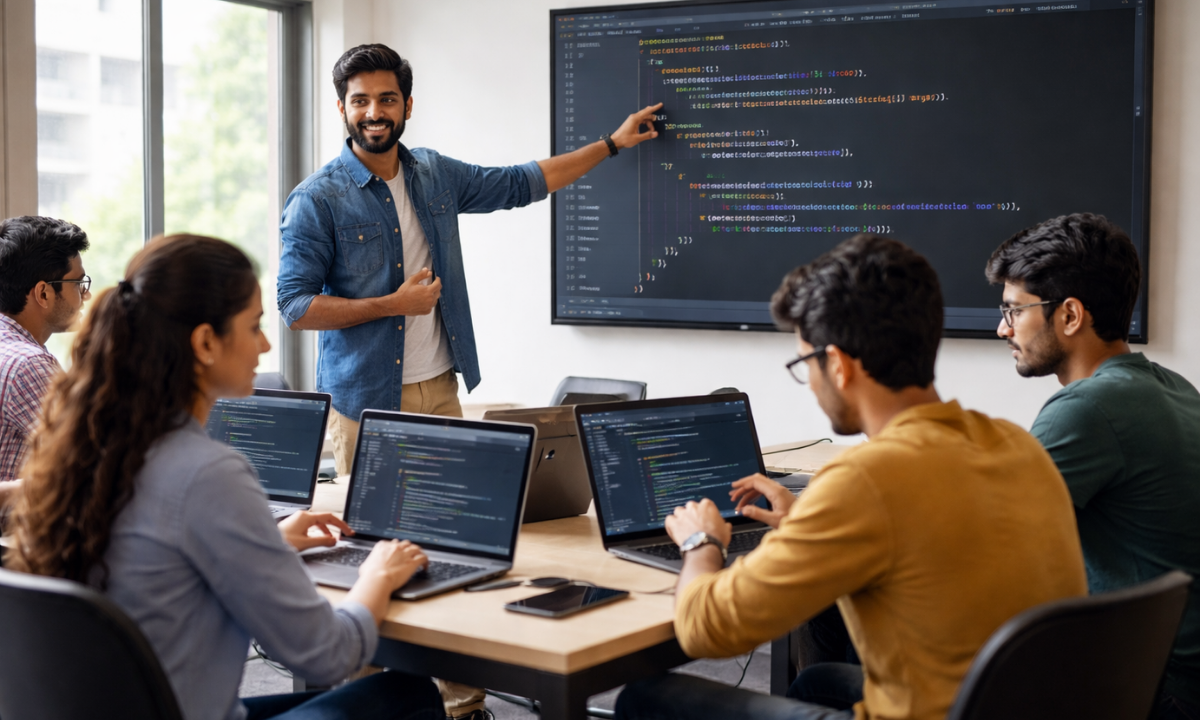
Enrolling in a Java Course In Bangalore at Apponix ensures:
-
Hands-on lab sessions
-
Guided debugging
-
Real-time project exposure
-
Structured placement preparation
Apponix integrates coding practice into every session, ensuring students learn by doing rather than passively listening.
Java Best Programming Practices Every Beginner Should Follow
Writing code is not enough. Writing clean, structured, and maintainable code is essential for long-term growth as a developer. Good practices make your programs easier to read, debug, and improve over time.
Java Best Programming Practices include:
-
Using meaningful variable names – Choosing descriptive names that clearly indicate the purpose of the variable.
-
Following consistent indentation – Maintaining proper spacing and formatting for better readability.
-
Writing modular methods – Breaking large programs into smaller, reusable methods.
-
Avoiding redundant code – Eliminating repetition by reusing logic wherever possible.
-
Adding proper comments – Explaining complex logic without over-commenting obvious code.
-
Handling exceptions responsibly – Managing runtime errors gracefully instead of letting programs crash.
Developing these habits early prevents technical debt later and prepares learners for professional environments. At Apponix, students are trained not only to solve problems but to write clean, industry-standard code.
From Basic Practice to Professional Growth
The journey does not stop at beginner programs.
Once comfortable with basic exercises, learners should move towards:
-
Mini projects (Banking system simulation, Library management system)
-
File handling programs
-
Database connectivity
-
REST API integration
At this stage, you transition from practising Java Programming to building real-world applications.
Why Structured Training Accelerates Learning
Self-learning is possible, but it often lacks direction, consistency, and feedback. Without proper guidance, learners may miss important concepts or struggle to connect theory with real-world application.
A guided Java Course In Bangalore at Apponix provides:
-
Industry-experienced trainers – Learning directly from professionals who understand current market expectations.
-
Placement-oriented curriculum – Covering topics aligned with academic exams and job interviews.
-
Practical assignments – Reinforcing concepts through hands-on coding exercises.
-
Real-time case studies – Understanding how Java is applied in real business scenarios.
-
Career guidance support – Assistance with resume building, interview preparation, and job readiness.
This structured approach bridges the gap between theory and practice, transforming learners into confident and job-ready professionals..
Final Thoughts
Mastering Basic Java Programs for Practice is not about solving random problems. It is about building structured logical strength, debugging discipline, and clean coding habits.
If you are serious about building a long-term programming career, structured training combined with consistent practice provides the strongest foundation.
At Apponix, our industry-aligned approach ensures that learners transition from writing basic programs to solving real-world development challenges with confidence.
Your journey from beginner to professional developer starts with one line of code. Practise it daily.
Frequently Asked Questions
What are Basic Java Programs For Practice?
Basic Java Programs for Practice are structured beginner-level coding exercises designed to help learners practically apply core Java concepts. These programs typically cover foundational topics such as variables, data types, conditional statements, loops, arrays, strings, and basic object-oriented programming principles.
For example, a beginner may start with writing a program to check whether a number is even or odd. From there, they progress to implementing Fibonacci sequences, pattern printing, palindrome checks, and array sorting.
The purpose of these exercises is not merely to write code that compiles, but to:
-
Develop logical thinking
-
Understand program flow
-
Improve debugging skills
-
Strengthen problem-solving ability
-
Build confidence for technical interviews
At Apponix, students are encouraged to practise structured exercises before moving to mini projects. This ensures clarity of fundamentals before tackling advanced application development.
Where to Practice Java Programming effectively?
There are several environments where learners can practise effectively, but the ideal choice depends on your learning stage.
Beginners may start by practising locally using an IDE such as Eclipse or IntelliJ. Writing code independently helps build debugging discipline and understanding of compiler behaviour.
Online coding platforms are also helpful for solving structured problems under time constraints. These platforms categorise questions by difficulty level and help learners gradually improve logical reasoning.
However, structured instructor-led lab environments provide additional advantages. In a guided setting like Apponix, learners benefit from:
-
Immediate feedback on mistakes
-
Real-time debugging assistance
-
Code quality review
-
Industry-standard coding guidance
-
Interview-oriented problem solving
While self-practice builds independence, structured training accelerates clarity and reduces confusion, especially for beginners transitioning from non-technical backgrounds.
How long does it take to master Java fundamentals?
The time required to master Java fundamentals depends on consistency, prior exposure to programming, and the learning approach.
For beginners with no programming background, developing strong foundational clarity typically takes three to four months with consistent daily practice of one to two hours. During this period, learners should focus on:
-
Writing structured programs daily
-
Revising core concepts weekly
-
Solving progressively complex exercises
-
Analysing and correcting mistakes
However, mastering fundamentals does not mean memorising syntax. It means being able to independently solve unseen logical problems without relying heavily on references.
For working professionals or career switchers, structured training programmes can shorten the learning curve significantly. With guided mentorship and project exposure, learners often gain confidence faster compared to purely self-driven study methods.
True mastery comes from repeated application, not passive reading.
Are coding platforms enough for placement preparation?
Coding platforms are highly effective for improving logical reasoning and speed. They expose learners to different patterns of problem-solving and help simulate technical interview scenarios.
However, placement preparation requires more than just solving isolated programming questions.
Employers evaluate candidates on:
-
Conceptual clarity
-
Clean coding standards
-
Object-oriented understanding
-
Real-world application building
-
Communication and explanation skills
While coding platforms strengthen logic, structured placement training provides:
-
Mock interview simulations
-
Resume optimisation
-
Project discussions
-
Scenario-based questioning practice
-
Technical communication development
At Apponix, placement preparation integrates coding practice with interview training and project presentation skills. This holistic approach ensures that learners are not only technically competent but also professionally prepared.
In summary, coding platforms are valuable tools, but guided mentorship significantly enhances placement success probability.
References
-
Oracle Java Documentation – https://docs.oracle.com/javase
-
Official Java Tutorials – https://dev.java
-
Programming Problem Archives – Various coding challenge platforms
-
Industry Coding Standards – Java Code Conventions Documentation

Apponix Academy
Apponix Academy