POPULAR COURSES
Master Programs

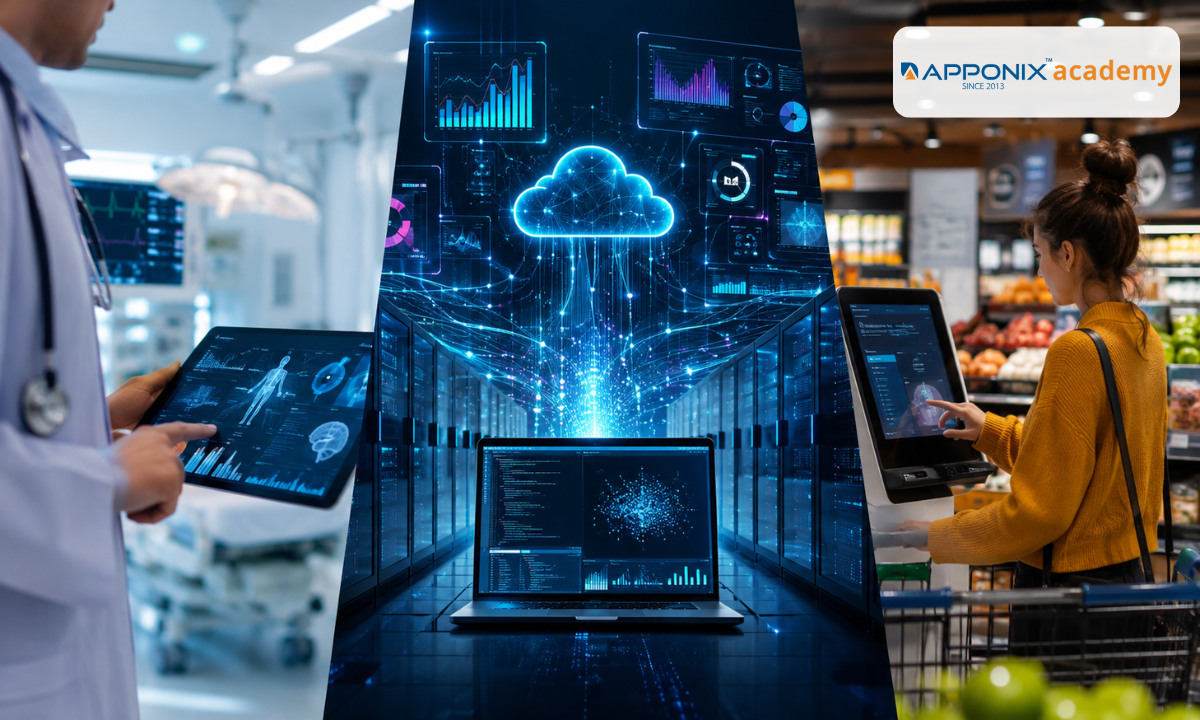
Table of contents:
|
1. Transforming Patient Care: Data Analytics in Healthcare
|
|
2. Mitigating Risk & Personalizing Finance: Data Analytics in Banking
|
|
3. Revolutionizing Customer Experience & Supply Chains: Data Analytics in Retail
|
|
4. Cross-Industry Technical Matrix & Tooling Stack
|
|
5. Why Choose Apponix Technologies for Your Data Analytics Career? |
|
6. Conclusion |
Leveraging advanced data analysis in healthcare, financial institutions, and global retail has shifted from a forward-looking strategy into the core operating engine of modern enterprise decision-making.
Enrolling in an industry-aligned Training course in Bangalore equips professionals with the quantitative tools, SQL data-warehousing skills, and predictive modeling capabilities required to drive this cross-sector transformation.
According to research from the International Data Corporation (IDC), global enterprise data creation exceeds 180 zettabytes, with healthcare, banking, and retail generating the vast majority of high-frequency transactional, sensor, and customer data.
Organizations across these three sectors are no longer merely storing raw logs; they deploy real-time analytics engines to solve complex, high-stakes operational challenges:
-
Healthcare: Institutions like the Mayo Clinic and Johns Hopkins leverage predictive triage algorithms to reduce 30-day patient readmission rates by up to 25%, processing petabytes of Electronic Health Records (EHR) to flag clinical deterioration before critical symptoms appear.
-
Banking: Global financial leaders like JPMorgan Chase deploy real-time fraud detection pipelines and automated document-parsing systems (such as their COiN platform), which process millions of credit transactions per second and eliminate over 360,000 hours of manual legal and compliance review annually.
-
Retail: Retail leaders like Walmart operate real-time analytics platforms capable of processing over 2.5 petabytes of unstructured customer data every hour optimizing dynamic pricing models, hyper-personalized recommendation streams, and supply chain allocation across thousands of fulfillment centers.
Across every major technology hub and global enterprise, the ability to translate chaotic data streams into predictive business intelligence has become the single most critical factor separating industry leaders from legacy operators.
Transforming Patient Care: Data Analytics in Healthcare

The healthcare sector generates massive volumes of high-dimensional clinical, genomic, and operational data. Historically, this information remained trapped in isolated electronic health record (EHR) databases and medical imaging archives. Today, modern clinical engineering transforms passive patient records into real-time predictive models that enable clinicians to intervene long before life-threatening complications develop.
Understanding the primary benefits of data analytics in healthcare requires looking beyond theoretical diagnostic improvements to evaluate concrete clinical outcomes across global hospital networks.
Core Applications Driving Clinical Analytics
-
Predictive Sepsis Detection & Inpatient Deterioration: Sepsis remains one of the leading causes of acute hospital mortality worldwide. Machine learning algorithms continuously analyze subtle velocity shifts in heart rate, oxygenation, and blood chemistry, flagging septic shock and respiratory failure up to 24 to 48 hours before overt clinical symptoms manifest.
-
30-Day Hospital Readmission Reduction: Unplanned hospital readmissions cost healthcare systems billions annually. Predictive models utilize Natural Language Processing (NLP) to scan unstructured discharge summaries, social determinants of health (SDOH), and historical medication adherence to identify vulnerable patients who require targeted post-discharge care management.
-
Genomic Sequencing & Precision Oncology: Data analytics engines match patient DNA sequencing profiles against clinical trial databases and mutation registries, allowing oncologists to bypass trial-and-error chemotherapy in favor of targeted molecular therapies.
-
Operational Capacity & ICU Staffing Optimization: Time-series forecasting algorithms predict daily emergency room admissions and bed turnover rates based on seasonal epidemiological trends, localized flu patterns, and weather anomalies.
Deploying these predictive tools fundamentally changes daily hospital workflows. For instance, UC San Diego Health integrated deep learning algorithms directly into their Epic EHR platform to evaluate hundreds of clinical variables simultaneously.
This real-time safety net automatically alerts rapid-response teams when a patient's risk score spikes, directly driving down mortality rates and preventing post-surgical complications.
Similarly, Mount Sinai Health System in New York implemented AI-driven discharge stability models that reduced 30-day readmissions by 20% while helping care managers prioritize follow-up resources for high-risk patients.
Turning reactive treatment cycles into proactive, data-driven preventative care, healthcare providers preserve hospital resources while significantly improving patient survival rates.
Mitigating Risk & Personalizing Finance: Data Analytics in Banking

Financial institutions process millions of transaction events per second across global payment networks.
In an ecosystem governed by strict regulatory compliance and sophisticated cyber threats, adopting data analytics in banking allows financial organizations to shift from reactive compliance reporting to real-time risk mitigation and hyper-personalized customer engagement.
The application of predictive analytics in banking spans critical operational functions, from dynamic credit scoring to real-time financial crime detection.
Core Applications Driving Financial Analytics
-
Real-Time Fraud Detection & AML Compliance: Traditional rule-based monitoring systems frequently trigger false positives, disrupting legitimate customer transactions and overburdening compliance teams. Machine learning algorithms analyze behavioral telemetry, geolocation anomalies, and transaction velocity in real time to detect fraudulent activity as it occurs.
-
Dynamic Credit Risk Scoring: Beyond traditional credit bureau scores, banks evaluate alternative data points including cash flow consistency, utility payment history, and digital footprint telemetry to construct accurate risk profiles for previously unbanked borrowers.
-
Customer Churn Prediction & Next-Best-Action: Predictive models analyze customer touchpoints to identify churn indicators 30 to 90 days before an account holder transfers assets to a competitor, enabling automated retention incentives.
-
Algorithmic Asset Management & Liquidity Forecasting: Investment banks deploy high-frequency quantitative models to forecast market volatility, optimize treasury liquidity reserves, and balance capital allocation under stress-testing frameworks.
Real-World Enterprise Impact in Banking
Global financial institutions demonstrate the quantifiable ROI of deploying modern data pipelines across daily banking operations:
-
HSBC's Dynamic Risk Assessment: Partnering with cloud platforms, HSBC developed an AI-driven financial crime detection network that screens billions of monthly transactions across millions of accounts. This predictive architecture identifies 2 to 4 times more financial crime patterns than legacy rule-based engines while slashing false positives by 60%, drastically reducing investigation delays for legitimate retail customers.
-
YES Bank's Targeted Behavioral Segmentation: By running predictive Recency, Frequency, and Monetary (RFM) modeling over customer debit card transaction data, YES Bank designed targeted personalized offers. The data-driven initiative increased average spending among targeted customer segments by 44%, resulting in a 27% overall growth across the portfolio.
-
Automated Credit Processing at Scale: Leading retail banks using automated machine learning for credit underwriting have reduced loan approval turnaround times from weeks to minutes while simultaneously lowering default rates across consumer lending portfolios.
Integrating real-time event streaming with predictive risk modeling allows modern banks to protect their capital reserves while delivering seamless, personalized experiences to digital-first consumers.
Revolutionizing Customer Experience & Supply Chains: Data Analytics in Retail

Modern omnichannel retail relies on real-time data ingestion across e-commerce platforms, point-of-sale (POS) terminals, and distribution networks to forecast demand and personalize shopping journeys.
Implementing data analytics in retail allows commercial enterprises to convert raw transaction logs into optimized supply chains and elevated customer lifetime value (CLV).
|
Operational Domain |
Primary Data Sources |
Core Analytical Model |
Business ROI & Enterprise Impact
|
|---|---|---|---|
|
Dynamic Pricing Engines |
Competitor web pricing, inventory levels, local demand signals |
Algorithmic elasticity & reinforcement learning |
2% to 5% increase in gross profit margins across product SKUs |
|
Demand & Inventory Forecasting |
Historical POS transactions, weather forecasts, promotional markdowns |
Time-series decomposition (Prophet, ARIMA, XGBoost) |
20% reduction in warehouse holding costs and out-of-stock events |
|
Hyper-Personalized Recommendations |
User clickstream telemetry, purchase history, search intent |
Collaborative filtering & matrix factorization |
Drives up to 35% of total e-commerce revenue on leading platforms |
|
Customer Churn & CLV Modeling |
Loyalty card transactions, engagement frequency, return logs |
Recency, Frequency, Monetary (RFM) & Survival Analysis |
15% to 25% improvement in repeat purchase retention rates |
Key Applications Transforming Retail Operations
1. Dynamic Pricing & Markdown Optimization
Retailers constantly adjust product pricing based on real-time supply and demand variations. Automated pricing engines evaluate competitor inventory shortages, local purchasing power, and website browsing intensity to update product prices dynamically without human intervention.
-
Algorithmic Repricing Pipelines: E-commerce platforms like Amazon modify product prices millions of times daily based on user intent signals, inventory velocity, and competitor price shifts.
-
Promotional Markdown Timing: Brick-and-mortar giants like Walmart utilize machine learning models to schedule localized promotional markdowns preceding major holiday events, maximizing inventory clearance while preserving profit margins.
By replacing rigid quarterly pricing schedules with automated, data-driven pricing models, retailers prevent inventory accumulation and maximize profitability across high-turnover consumer goods categories.
2. Personalized Recommendation Streams & Loyalty Programs
Modern consumers expect shopping experiences tailored to their individual preferences. Personalization engines analyze real-time browsing behaviors, basket composition, and past purchase history to deliver targeted product suggestions at checkout.
-
Cross-Selling & Upselling Engines: Predictive recommendation algorithms analyze customer affinity scores to display complementary items, driving up average order value (AOV) across digital storefronts.
-
Automated Loyalty Personalization: Starbucks leverages predictive analytics within its mobile application to deliver individualized reward offers based on past order times, localized weather conditions, and personal beverage choices.
These hyper-personalized touchpoints transform generic promotional blasts into relevant customer interactions, significantly boosting repeat purchase rates and long-term brand loyalty.
3. Real-Time Supply Chain Allocation & Fast-Fashion Logistics
Supply chain disruptions cause stockouts and excessive markdowns. Leading fashion brands deploy predictive demand models to track micro-trends across social media, tailoring manufacturing orders to match actual consumer demand.
-
Just-In-Time Inventory Routing: Fast-fashion leader Zara uses store-level POS telemetry to detect emerging local fashion trends, adjusting regional production runs within days to eliminate excess warehouse inventory.
-
Micro-Fulfillment Center Optimization: Major retail chains analyze neighborhood delivery volumes to position high-demand SKUs closer to urban centers, enabling rapid same-day order fulfillment.
Optimizing logistics networks through real-time demand signals minimizes store inventory holding costs while ensuring that high-demand products remain available across physical and digital sales channels.
Cross-Industry Technical Matrix & Tooling Stack

While business objectives differ between clinical diagnostics, financial fraud prevention, and retail demand forecasting, the underlying architecture of a modern data stack remains unified around distributed data lakehouses, automated ETL pipelines, and scalable business intelligence platforms.
Cross-Industry Enterprise Analytics Matrix
|
Technical Dimension |
Healthcare Sector |
Banking & FinTech |
Omnichannel Retail
|
|---|---|---|---|
|
Primary Data Types |
Unstructured EHR logs, DICOM medical images, streaming telemetry |
High-frequency ledger transactions, credit telemetry, market tick data |
Clickstream event logs, POS transactional records, supply chain metrics |
|
Storage & Lakehouse Architecture |
Databricks Delta Lake, AWS S3, Snowflake (HIPAA compliant) |
Snowflake Data Cloud, Databricks, PostgreSQL, Redshift |
Google BigQuery, Snowflake, Apache Iceberg lakehouses |
|
Core Processing & ML Frameworks |
PyTorch, OpenCV, Scikit-Learn, PySpark, Lifelines |
PySpark, XGBoost, TensorFlow, H2O.ai, SQL |
Pandas, NumPy, XGBoost, Prophet, LightGBM |
|
Transformation & Orchestration |
dbt (data build tool), Apache Airflow, Prefect |
Apache Airflow, Apache Kafka, dbt, Flink |
dbt, Apache Airflow, Dagster, AWS Glue |
|
Serving & Visualization Layer |
Tableau, Power BI, Epic MyChart APIs, FastAPI |
Power BI, Tableau, Streamlit, MicroStrategy |
Power BI, Looker, Tableau, Custom GraphQL APIs |
Key Pillars of the Enterprise Data Tooling Stack
1. Distributed Ingestion & Lakehouse Storage (Snowflake & Databricks): Ingesting high-throughput transactional streams into unified lakehouse architectures allows organizations to query structured SQL tables, semi-structured JSON, and unstructured data from a centralized repository.
Modern platforms like Snowflake and Databricks eliminate data silos between clinical health systems, banking compliance archives, and e-commerce platforms. Decoupling compute resources from storage enables enterprise engineering teams to scale query performance dynamically during peak workloads without incurring massive infrastructure costs.
2. Data Processing & Feature Engineering (PySpark, Pandas & Scikit-Learn): Converting raw data feeds into predictive features requires high-performance computational framework libraries capable of executing distributed transformations across massive datasets.
Data engineering teams rely on PySpark to execute distributed data wrangling across multi-terabyte log files, while data science teams leverage Pandas, NumPy, and Scikit-Learn to construct feature matrices for machine learning models. These toolkits allow analysts to handle missing values, encode categorical variables, and perform statistical normalizations efficiently.
3. Workflow Orchestration & Transformation (dbt & Apache Airflow): Scheduling complex data transformations and maintaining dependency graphs across daily batch pipelines requires robust orchestration engines. Tools like dbt (data build tool) allow analysts to write modular, version-controlled SQL transformations directly inside the data warehouse, while Apache Airflow manages end-to-end DAG (Directed Acyclic Graph) workflows.
This combination ensures that daily reporting tables and machine learning feature stores refresh automatically with strict data quality monitoring.
4. Serving & Business Intelligence Layer (Power BI, Tableau & FastAPI): Delivering actionable insights to executive leadership and end-user applications requires bridging complex analytical backend pipelines with intuitive dashboard interfaces.
Business intelligence platforms like Power BI and Tableau render real-time KPI metrics for operational managers, while microservice frameworks like FastAPI serve live model inference predictions directly to web and mobile software applications via RESTful APIs.
Why Choose Apponix Technologies for Your Data Analytics Career?
Transitioning into high-paying enterprise data roles requires hands-on experience with production-grade data pipelines across key growth industries like healthcare, fintech, and retail.
Enrolling in a comprehensive Data analytics course in Bangalore at Apponix Technologies provides the structured mentorship, real-world project sandboxes, and career support required to master modern analytical stacks and launch a rewarding software and data career.
Apponix delivers a project-driven learning experience designed to bridge the gap between basic spreadsheet formulas and enterprise data engineering:
-
40+ Hours of Domain-Specific Project Sandboxes: Gain hands-on experience manipulating messy healthcare EHR records, financial transaction logs, and retail clickstream datasets using SQL, Python, and Power BI.
-
Mentorship from Active Enterprise Leads: Learn directly from senior data engineers and analytics leads who bring real-world enterprise architectures into every interactive classroom session.
-
Portfolio Building & Resume Engineering: Construct recruiter-ready GitHub repositories featuring production-grade ETL pipelines and BI dashboards while optimizing your resume to clear ATS filters.
-
Mock Technical Interviews & SQL Live-Coding: Practice whiteboarding complex analytical queries, statistical modeling concepts, and systemic business problem-solving under real interview conditions.
-
Direct Placement Connections Across Bangalore GCCs: Leverage Apponix's established network of hiring partners across Bangalore's premier technology parks and Global Capability Centers (GCCs).
Combining rigorous domain-focused training with live project execution and dedicated career coaching, Apponix ensures you move beyond basic reporting to become a confident, job-ready analytics professional prepared to excel in technical hiring evaluations.
Conclusion
Launching a successful career in data analytics begins with mastering the core quantitative and technical tools that power enterprise decision-making today. Start by building a rock-solid foundation in advanced SQL queries, Python data wrangling libraries, and interactive visualization platforms like Power BI or Tableau. Focus on applying these technical capabilities to specific industry domains, whether modeling credit risk in banking, predicting patient readmissions in healthcare, or optimizing dynamic pricing in retail.
Packaging your domain-specific analyses into well-documented, public GitHub repositories clearly demonstrates your ability to translate raw transactional logs into measurable business value. By combining practical project execution with continuous learning and strategic career networking across Bangalore's thriving technology ecosystem, you position yourself to capture high-impact opportunities and lead the next wave of data-driven innovation.
Reference:
https://liet.in/blogs/data-science-careers-in-finance-healthcare-retail/
https://www.n-school.com/data-science-is-transforming-industries-worldwide/

Apponix Academy
Apponix Academy