POPULAR COURSES
Master Programs



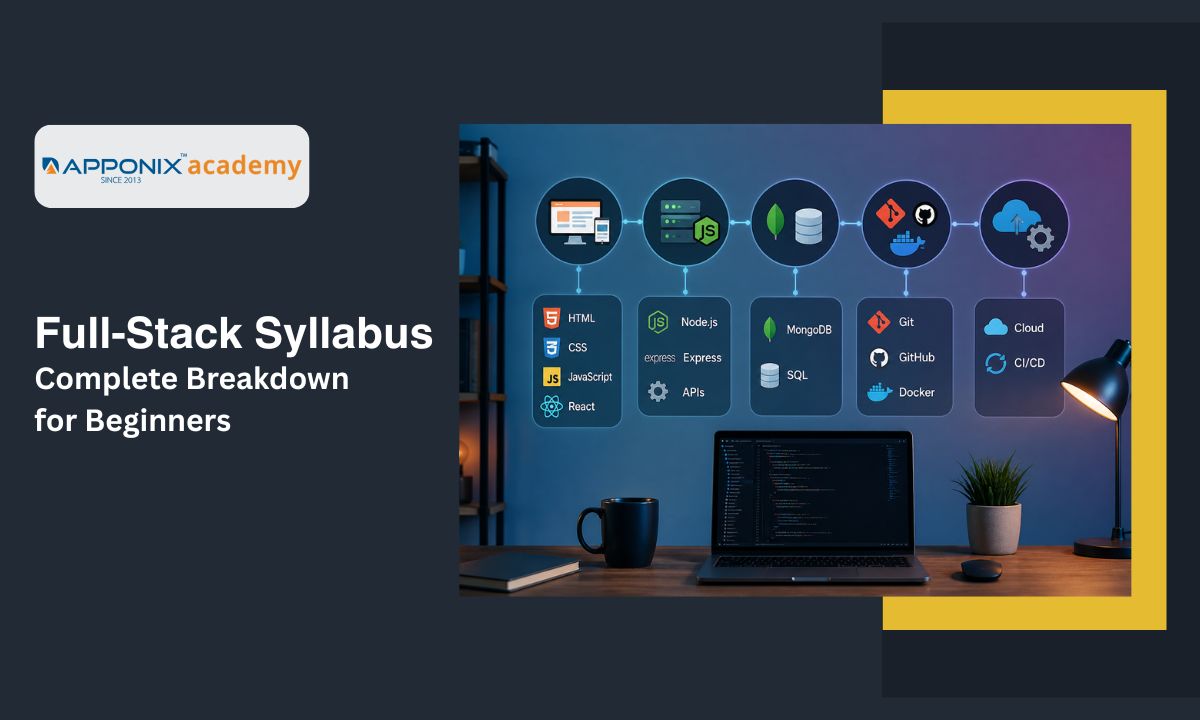
Table of contents:
|
1. Phase 1: Frontend Development (Building the Interface) |
|
2. Phase 2: Backend Engineering & Databases (The Core Logic)
|
|
3. Phase 3: Version Control and API Integration
|
|
4. Phase 4: Cloud Deployment and Hosting (The Final Frontier) |
|
5. Why Choose Apponix? Your Ultimate Training Ground |
|
6. Conclusion |
When ambitious candidates begin searching for a Full-stack developer course in Bangalore, they usually encounter a massive wall of confusing technical jargon. Most software academies simply hand over a dense list of programming languages and expect beginners to figure out how they connect.
However, at Apponix Academy, a premier Training Institute in Bangalore, our expert instructors know that a true engineering curriculum is not just a random collection of coding classes. A proper syllabus is a strategic career map.
The technology sector does not pay high salaries to people who have simply memorized the syntax of JavaScript or Java. Multinational corporations hire architects who can construct entire digital ecosystems. Before diving into the specific technologies covered in our master program, candidates must understand what a modern developer is actually expected to accomplish.
A corporate-ready syllabus must strictly address three operational realities:
-
The Blueprint of Architecture: A modern curriculum must teach you exactly how to build an application from the ground up, seamlessly connecting the visual user interface to the hidden server logic and the secure data vault.
-
Beyond Basic Coding: Writing functional code is only the baseline requirement. You must also master the exact utility tools that corporate engineering teams use to test software and collaborate safely without overwriting each other's work.
-
The Deployment Reality: Building a beautiful application that only functions on your personal laptop is entirely useless in the real world. A modern syllabus must teach you how to host your software on global cloud servers so millions of users can access it instantly.
This comprehensive guide will entirely demystify the learning process. We will break down the exact step-by-step syllabus required to transform a complete beginner into a highly paid, deployment-ready software engineer.
Phase 1: Frontend Development (Building the Interface)

The first phase of a professional syllabus focuses entirely on the client side. The frontend is the digital storefront of a company.
If an application takes too long to load or looks completely broken on a mobile phone, the customer will leave immediately, resulting in direct revenue loss. Therefore, corporate frontend development is not merely about making things look aesthetically pleasing. It is strictly about engineering a flawless, high-performance user experience across every possible device and browser.
A corporate-ready syllabus breaks frontend development into three highly structured learning modules:
1. The Structural Foundation: HTML5 and CSS3 Before writing complex logic, candidates must thoroughly understand how to construct a digital page from scratch.
-
HTML5: You will learn to build the rigid structural skeleton of the application. This includes semantic tagging for search engine optimization and integrating multimedia elements efficiently.
-
CSS3: You will learn to style the structural skeleton. A critical focus in this module is responsive design. You will master Flexbox and CSS Grid to ensure your application automatically resizes and functions perfectly, whether the user is on a massive desktop monitor or a small smartphone screen.
2. The Interactive Engine: JavaScript (ES6+) Static web pages are entirely obsolete in the modern corporate world. JavaScript is the primary programming language that brings the application to life.
-
Instead of just learning basic animations, a professional syllabus dives incredibly deep into core programming logic. You will learn how to manipulate the Document Object Model, handle user inputs securely, and write asynchronous code to fetch background data without freezing the user's browser.
3. The Enterprise Frameworks: React.js or Angular Multinational companies never build massive platforms like Netflix or Amazon using basic HTML and raw JavaScript. It takes far too much time, and the codebase quickly becomes impossible to manage. They rely heavily on powerful, scalable frameworks.
-
React.js: Developed by Meta, this is the current industry favorite. You will learn how to build isolated, reusable visual components. If a company wants to update their navigation bar, they update one single React component, and it automatically changes across thousands of individual web pages instantly.
To clarify the exact technical outcomes of this phase, here is a visual breakdown of the frontend module:
|
The Technology |
The Corporate Function |
The Specific Skills You Will Master |
|
HTML5 & CSS3 |
Cross-Device Compatibility |
Responsive web design, Bootstrap integration, and mobile-first architectural planning. |
|
JavaScript |
Dynamic User Interaction |
ES6+ syntax, asynchronous programming promises, and secure DOM manipulation. |
|
React.js / Angular |
Enterprise Scalability |
Component-based architecture, global state management, and single-page application routing. |
Once you can successfully build a beautiful, highly interactive visual interface, you must give that interface a functional brain. This leads directly to the hidden server architecture.
Phase 2: Backend Engineering & Databases (The Core Logic)

If the frontend is the beautiful digital storefront, the backend is the highly secure, bustling warehouse operating behind closed doors.
A visually stunning application is completely useless if it cannot securely process user logins, calculate complex shopping cart totals, or retrieve saved account preferences. Phase 2 of the syllabus transitions candidates from visual design into hardcore system architecture.
This critical phase is divided into two distinct technical categories: building the server logic and structuring the data vault.
1. Building the Server Logic (The Brain)
The server is the digital brain of your application. It receives requests from the user interface, processes the required mathematical or business logic, and decides what data needs to be sent back. Modern professional training typically offers two distinct pathways for backend architecture, depending on your exact career goals.
-
The MERN Pathway (Node.js): For candidates targeting agile startups and modern tech companies, the syllabus focuses on MERN (MongoDB, Express.js, React, Node.js).
This environment is incredibly popular because it allows developers to write the server logic using the same JavaScript language they used to build the frontend. It is fast, lightweight, and perfect for rapid application development.
-
The Enterprise Pathway (Java & Spring Boot): For students aiming to secure roles in multinational banks, healthcare networks, or massive telecommunications firms, mastering a highly structured full-stack Java syllabus is absolutely mandatory. Global enterprises cannot risk a server crash during a financial transaction.
You will learn core Java principles, object-oriented programming, and the powerful Spring Boot framework. This pathway prioritizes unbreakable security and the ability to process millions of complex transactions simultaneously.
2. Structuring the Data Vault (Database Management)
Once the server calculates the logic, it needs a permanent, secure place to store the results. Understanding how to organize massive amounts of corporate data is a highly lucrative skill. A comprehensive syllabus must cover both primary styles of modern database architecture.
-
Relational Databases (SQL): You will learn to use systems like MySQL or PostgreSQL. These databases store information in highly rigid, predictable tables (similar to incredibly complex Excel spreadsheets).
You will master writing SQL queries to retrieve specific data points, ensuring absolute data integrity. This is the mandatory standard for financial applications where every single decimal point must be perfectly tracked.
-
Non-Relational Databases (NoSQL): You will also master flexible systems like MongoDB. Instead of rigid tables, MongoDB stores data in dynamic documents.
If a social media company needs to suddenly add a new "pronouns" field to millions of user profiles overnight, NoSQL allows this massive structural change instantly without breaking the existing database.
To clarify how these backend technologies form a complete digital ecosystem, consider this architectural comparison:
|
Architectural Component |
The Agile Startup Ecosystem |
The Global Enterprise Ecosystem |
|
Primary Server Language |
JavaScript (Node.js) |
Java |
|
Core Routing Framework |
Express.js |
Spring Boot |
|
Preferred Database System |
MongoDB (Flexible NoSQL) |
MySQL / Oracle (Rigid SQL) |
|
The Corporate Advantage |
Extremely fast development cycles and a unified codebase. |
Unmatched system security and multi-threading stability. |
3. The Connection: RESTful APIs
The final step of Phase 2 is learning how to connect the frontend storefront to the backend warehouse. You will learn to build RESTful APIs. These act as secure digital messengers. When a user clicks "Submit Order" on the React frontend, the API securely sends that request to the Node or Java backend, waits for the server to process the payment, and then returns a "Success" message to the user's screen.
By the end of this phase, you are no longer just coding web pages; you are engineering fully functional software systems. However, writing the code is only half the battle in a professional environment.
Phase 3: Version Control and API Integration

A massive misconception among junior developers is that software engineering consists entirely of typing code in isolation. In reality, writing the code is only half the battle.
In a professional corporate environment, you will never build an application entirely on your own. You will be working simultaneously with dozens, or even hundreds, of other engineers.
Phase 3 of the syllabus transitions candidates from being solo coders to becoming corporate-ready team members. If you do not understand how to manage your code and securely test your system connections, a hiring manager will not let you anywhere near their live corporate servers. This phase focuses entirely on the mandatory developer utility belt.
1. Mastering Code Collaboration: Git and GitHub
Imagine fifty architects trying to draw on the same paper blueprint simultaneously. Without a strict tracking system, one developer would constantly overwrite and delete the work of another, causing the entire digital project to collapse.
The global tech industry prevents this chaos by relying entirely on Git and GitHub. A professional syllabus must train you to use these tools exactly as they are used in Fortune 500 companies.
-
Git (The Local Time Machine): Git is a version control software installed directly on your machine.
You will learn how to initialize repositories and track every single modification made to your codebase. If you build a new feature that accidentally breaks the application, Git allows you to instantly revert your code to the exact minute it was working perfectly.
-
GitHub (The Cloud Hub): While Git operates locally, GitHub is the secure cloud platform where the entire engineering team stores the master project. You will master the concepts of "Branching" and "Merging."
This allows you to download a safe copy of the main code, build your assigned feature in an isolated environment, and then submit a "Pull Request" to safely merge your new work into the live corporate application without overwriting another person's progress.
2. Verifying the Connection: Postman for API Testing
As covered in Phase 2, the frontend visual layer and the backend server must constantly communicate through RESTful APIs. A common, highly inefficient mistake made by amateur developers is building the entire React visual interface just to see if the Java or Node server is sending the correct data. This wastes critical corporate time.
Professional developers test the hidden server logic before the visual designers even start working. You will learn to do this using Postman.
-
Postman (The Testing Laboratory): Postman is a specialized software environment designed exclusively to test APIs. You will learn how to type a specific server request into Postman, click send, and instantly view the exact data the backend returns. If the server crashes or returns a security error, you diagnose and fix the backend code immediately.
To clearly understand how these critical utilities function in your daily workflow, consider this breakdown:
|
The Corporate Utility |
The Problem It Solves |
The Exact Skill You Will Master |
|
Git |
Developers permanently break software by accident. |
Initializing repositories, staging files, and committing code histories. |
|
GitHub |
Teams are overwriting each other's work files. |
Creating feature branches, resolving merge conflicts, and conducting code reviews. |
|
Postman |
Building visual interfaces for broken servers. |
Executing GET/POST requests, reading JSON responses, and API security testing. |
Mastering these tools, you prove to corporate recruiters that you are not just a student who knows how to code; you are a professional who knows how to work.
Once your code is written, successfully tested, and securely merged with your team, it is completely ready for the public. However, it still only exists on your local computers. The next step is taking that application and making it accessible to the entire world.
Phase 4: Cloud Deployment and Hosting (The Final Frontier)

Up to this point in the syllabus, you have built a beautiful visual interface, connected it to a secure server, and managed the codebase with your team. However, if your software only runs on your personal laptop, it is entirely useless to a corporation. Phase 4 is where you transition from writing code in a local environment to launching live, global products.
In the past, companies bought expensive physical servers and kept them in dedicated storage rooms. Today, the entire technology sector relies completely on cloud deployment. This process involves transferring your completed software onto massive, secure remote computers that run 24 hours a day, allowing anyone in the world to access your application instantly.
While there are several cloud providers available, a corporate-ready syllabus must focus heavily on AWS Fundamentals.
Amazon Web Services powers a massive portion of the global internet, from streaming giants like Netflix to modern banking applications. Knowing how to write code is a common skill, but knowing how to securely deploy that code to an AWS server is the exact capability that separates highly paid engineers from amateur developers.
A professional deployment module covers these critical architectural steps:
-
Virtual Server Provisioning (Amazon EC2): You will learn how to rent and configure a secure virtual computer in the cloud. This environment serves as the permanent home for your Node.js or Java backend server.
-
Static Asset Hosting (Amazon S3): You will discover the most cost-effective and efficient methods to host your React or Angular frontend files, ensuring lightning-fast load times for users across the globe.
-
Database Cloud Migration: Keeping your database on your local machine is highly insecure. You will learn to migrate your SQL or MongoDB data into dedicated, automated cloud database services that protect against data loss.
-
Continuous Integration and Delivery (CI/CD): A true professional syllabus teaches you how to automate the entire deployment pipeline. You will learn to link your GitHub repository directly to your AWS server. With this setup, every time your team approves a code update, the live production website updates automatically without any manual server maintenance.
You become a completely self-sufficient digital architect. You gain the ability to take an empty project file, build a complex application from scratch, and deploy it live to the global market entirely on your own.
Why Choose Apponix? Your Ultimate Training Ground
Looking at the complete, four-phase syllabus of a modern software engineer can feel incredibly intimidating. Attempting to master frontend frameworks, backend server logic, database management, version control, and AWS cloud deployment entirely on your own through generic online videos is nearly impossible. Most self-taught developers burn out because they lack structural guidance. This is exactly why Apponix Academy exists.
We do not just hand you a list of coding tutorials. We provide a highly structured, corporate-grade training environment designed specifically to turn complete beginners into highly paid professionals. When you choose our master program, you gain immediate access to these exclusive career advantages:
-
Real-World Corporate Projects: We do not believe in simple multiple-choice exams. Your final graduation requirement is a massive Capstone Project. You will build a fully functional, cloud-deployed enterprise application from scratch, giving you a powerful technical portfolio to show hiring managers.
-
100% Interview Guarantee: We completely remove the stress of the job hunt. Once you complete the syllabus, our dedicated placement cell provides a minimum of 10 to 20 guaranteed interviews with top-tier technology companies and multinational corporations.
-
Live Cloud Lab Access: You cannot learn AWS deployment by just reading a textbook. We provide unrestricted, hands-on access to live cloud servers so you can physically practice launching and maintaining your software in a real corporate environment.
-
Active Industry Instructors: You will not be taught by outdated academic professors. Our faculty consists exclusively of active, senior software architects who teach you the exact coding standards being used in the tech industry this very week.
Apponix bridges the massive gap between learning theoretical code and securing a highly paid corporate job. You focus entirely on mastering the syllabus, and we focus entirely on launching your career.
Conclusion
Becoming a full-stack developer is one of the most rewarding and lucrative career choices available in the modern global economy. The technology sector does not care about your past background; it only cares about your ability to build functional, scalable digital solutions. By mastering the comprehensive syllabus outlined above, you transform yourself from a standard technology consumer into a highly valued technology creator.
The demand for developers who can seamlessly connect a beautiful visual interface to a secure backend database and deploy it to the cloud has never been higher. Every single startup, bank, and logistics company in the world is actively searching for digital architects.
The blueprint is clear, and the exact time to start building your future is right now. Take immediate control of your professional trajectory. Contact Apponix Academy today to book a free demo class, consult with our expert career advisors, and begin your guaranteed pathway to becoming a highly paid software engineer.

Apponix Academy
Apponix Academy