POPULAR COURSES
Master Programs



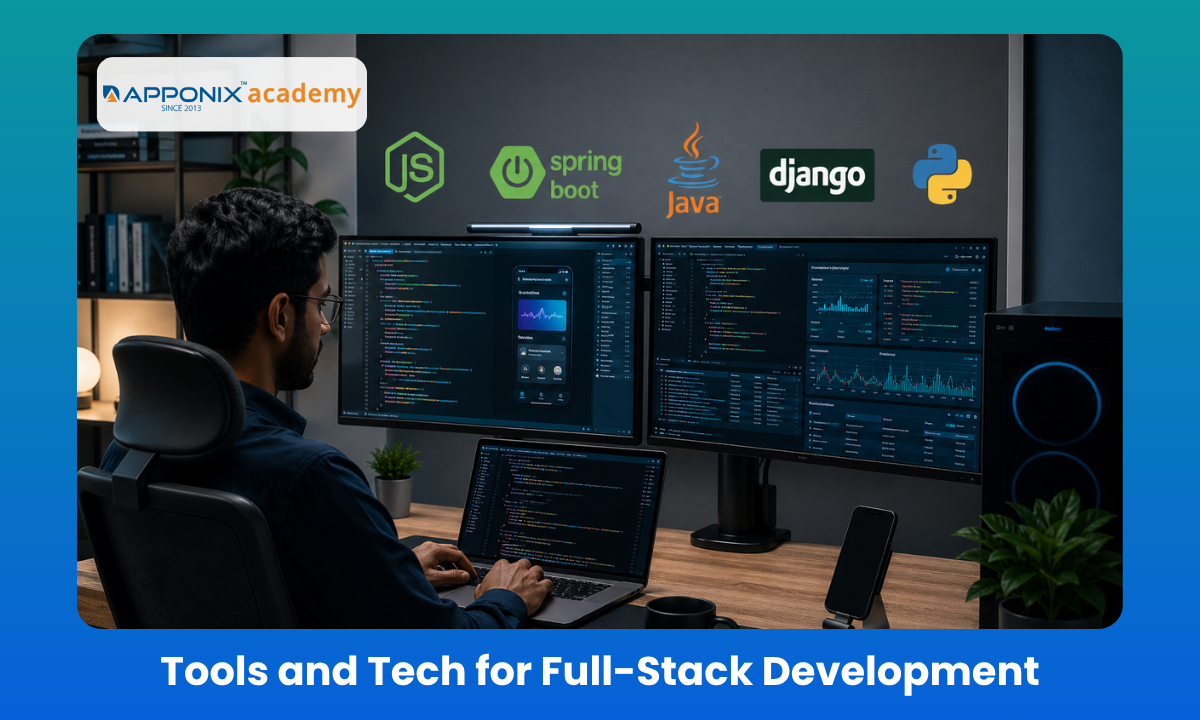
Table of contents:
|
1. What Is Full Stack Development? (The Big Picture) |
|
2. The Core Languages and Frameworks
|
|
3. Version Control and Testing |
|
4. Git/GitHub for version control |
|
5. Securing the Connection |
|
6. Essential Full Stack Developer Skills for 2026 |
|
7. Why Choose Apponix? The Job-Guaranteed Pathway |
|
8. Conclusion |
Consider the sheer complexity of booking a flight online today. Within seconds, a beautiful visual interface communicates with global servers, verifies secure banking transactions, and simultaneously updates massive international databases. Building these incredible digital ecosystems is the reality of modern engineering.
However, when ambitious candidates search for a full-stack developer course in Bangalore, they are frequently paralyzed by the technical prerequisites. At Apponix Academy, a leading Training Institute in Bangalore, our career counselors constantly meet aspiring professionals who are entirely overwhelmed by the sheer volume of programming languages, frameworks, and software tools listed on standard corporate job descriptions.
The internet is completely saturated with terrible advice telling beginners they must master fifty different technologies just to land a junior position.
This is a massive industry myth. The 2026 software landscape is not about memorizing every application ever created; it is about mastering a highly specific, curated ecosystem of tools that modern global corporations actually use.
Before diving into complex technical specifications, candidates must understand three fundamental realities of the modern development market:
-
The Myth of Total Mastery: No professional engineer knows every programming language. Corporate hiring managers do not want generalists; they want candidates with deep, specialized expertise in one specific technology stack (such as MERN or Java Full Stack) capable of solving actual business problems.
-
The Rise of the Utility Belt: Writing code represents only half the actual job. In the modern corporate environment, strict proficiency in non-coding utility software, specifically version control systems and API testing environments, is the actual deciding factor in senior technical interviews.
-
The Ecosystem Approach: The modern developer is no longer a lone programmer typing frantically in the dark. They are comprehensive system architects who leverage a connected chain of powerful tools to accelerate software deployment and ensure absolute system security.
This comprehensive guide will completely demystify the modern engineering toolkit. We will strip away the confusing industry jargon, clearly define the exact technologies currently powering the internet, and provide a realistic, highly actionable roadmap for building your personal technical arsenal.
What Is Full Stack Development? (The Big Picture)
Before attempting to memorize a massive list of software applications, candidates must first understand the fundamental architecture of the Internet. When a student asks exactly what full-stack development is, they are essentially asking how a complete digital product is built from the absolute ground up.
To understand this concept clearly, imagine a modern luxury restaurant. The dining room, with its beautiful lighting, comfortable seating, and elegant menus, represents the visual interface. The busy, hidden kitchen operating behind closed doors represents the server logic. Finally, the massive, secure pantry storing all the raw ingredients represents the database. A full-stack developer is a rare, highly valued professional who can design the dining room, manage the complex kitchen operations, and organize the massive pantry simultaneously.
Instead of building physical restaurants, these engineers build digital ecosystems. Every modern web application is divided strictly into three distinct technical layers.
Here is a structural breakdown of the complete development ecosystem:
|
The Technical Layer |
The Corporate Function |
The Developer's Primary Focus |
|
Frontend (The Client Side) |
This layer contains everything the user actually sees, clicks, and interacts with on their personal screen. |
Visual layout, intuitive user experience, and flawless mobile responsiveness across different devices. |
|
Backend (The Server Side) |
This acts as the hidden brain of the application. It receives commands from the user, authenticates passwords, and processes complex mathematical logic. |
System security, server stability, and building Application Programming Interfaces (APIs). |
|
Database (The Data Vault) |
This is the secure digital storage facility where all user profiles, financial transaction histories, and corporate records are permanently saved. |
Rapid data retrieval, structural integrity, and long-term information safety. |
The true value of this profession does not lie in just understanding one isolated area. The absolute core of this career is system integration.
A complete digital architect understands exactly how to make these three layers communicate flawlessly. The frontend must send secure requests to the backend. The backend must rapidly retrieve the correct information from the database. Finally, the backend must send that data back to the user's screen in a fraction of a second.
Once this three-part architecture is clear, the seemingly endless list of corporate tools begins to make perfect logical sense. Every single technology in the modern engineering ecosystem belongs strictly to one of these three layers or serves as a direct bridge between them.
The Core Languages and Frameworks
Now that the three-part architecture of a modern web application is clear, we must identify the specific tools engineers use to build each layer. A crucial piece of advice for any aspiring developer is to avoid attempting to learn everything simultaneously. The most successful professionals choose one specific "stack" (a unified collection of technologies) and master it entirely.
Here is the definitive guide to the full-stack development tools currently dominating the 2026 global enterprise market, separated strictly by their architectural layer:
Layer 1: The Frontend Technologies (Building the Visual Interface)
The frontend is built using three foundational languages, enhanced by powerful corporate frameworks.
-
The Big Three (The Absolute Basics):
-
HTML (HyperText Markup Language): The physical skeleton. It dictates where text, images, and buttons are placed on the screen.
-
CSS (Cascading Style Sheets): The interior design. It dictates the colors, fonts, and visual formatting of the HTML skeleton.
-
JavaScript (JS): The engine. It makes the webpage interactive, allowing dropdown menus to open and buttons to actually submit data.
-
The Corporate Frameworks (The Enterprise Standard): Writing pure JavaScript for a massive application like Netflix is entirely inefficient. Instead, developers use highly optimized frameworks to build interfaces faster.
-
React.js: Created by Meta (Facebook), this is the absolute industry leader. It allows developers to build reusable "components" (like a standard navigation bar) that can be instantly deployed across thousands of different web pages.
-
Angular: Created by Google, this is a highly rigid, heavily structured framework frequently used by massive financial institutions that prioritize extreme stability over rapid development.
Layer 2: The Backend Technologies (Building the Server Logic)
The backend is where candidates must make a critical career choice. While the frontend relies almost exclusively on JavaScript, the server can be built using several different programming languages.
-
Node.js (The JavaScript Backend): This is currently the most popular choice for startups and rapid development. Node.js allows engineers to write the backend server using the exact same JavaScript language they used for the frontend. This creates a unified "MERN Stack" (MongoDB, Express, React, Node), which is highly efficient for smaller teams.
-
Java & Spring Boot (The Enterprise Standard): For massive multinational corporations prioritizing absolute security and the ability to process millions of complex financial transactions simultaneously, Java remains the undisputed king.
-
Python & Django (The Innovator's Choice): Python is heavily favored by companies deeply integrated with artificial intelligence, data analytics, and machine learning, due to its incredible data processing capabilities.
Layer 3: The Database Technologies (Building the Data Vault)
Databases are categorized strictly by how they organize and store information.
-
Relational Databases (SQL): These systems store data in highly structured, rigid tables (like a massive Excel spreadsheet). Technologies like MySQL and PostgreSQL are mandatory for applications requiring strict data integrity, such as banking platforms tracking exact financial balances.
-
Non-Relational Databases (NoSQL): These systems store data in highly flexible document formats. Technologies like MongoDB are perfect for applications managing massive amounts of unpredictable data, such as social media platforms storing highly varied user profiles and image metadata.
Understanding these coding languages provides the foundation. However, simply knowing how to write code does not make someone a professional software engineer. In a corporate environment, how you manage and test that code is equally important.
Version Control and Testing
Knowing how to write HTML, React, and Node.js is only the baseline requirement for entering the tech industry. In a professional corporate environment, developers absolutely never work alone. Enterprise software teams consist of dozens, sometimes hundreds, of engineers writing code simultaneously. If these developers do not have a strict, standardized system to manage their files and test their connections, the entire digital project will collapse into chaos within days.
To survive technical interviews and thrive in a corporate role, candidates must master the non-coding software that keeps development teams organized. This is the developer's utility belt.
Git/GitHub for version control
Imagine five traditional architects trying to draw on the same paper blueprint at the same time. Without a tracking system, one person would constantly erase the work of another. To prevent this digital disaster, the global tech industry relies entirely on Git/GitHub for version control.
This system is divided into two distinct parts:
-
Git (The Local Time Machine): Git is a tracking software installed directly on a developer's computer. Every single time an engineer saves their work, Git takes a permanent, highly detailed snapshot of the code. If a developer builds a new feature that accidentally crashes the entire application, there is no need to panic. Git allows the engineer to instantly revert the codebase to the exact minute it was working perfectly.
-
GitHub (The Cloud Hub): While Git operates locally, GitHub is the cloud-based platform where the entire company stores the master project. It allows multiple developers to download the core software, work on their assigned features independently, and then safely merge their new code back into the main project without ever overwriting another person's progress.
Securing the Connection
As established in Section 2, the frontend visual layer must constantly communicate with the backend server. They speak to each other using an invisible bridge called an Application Programming Interface (API).
A common mistake junior developers make is building the entire visual website just to see if the server is sending the correct data. This is a massive waste of corporate time. Instead, professional engineers use Postman for API testing.
Postman is a specialized software tool designed specifically to test the backend logic before the visual frontend even exists. A developer can type a specific server request into Postman, click send, and instantly see exactly what data the backend returns. If the server crashes or sends the wrong information, the engineer diagnoses and fixes the backend code immediately. By using Postman, teams guarantee the server is 100% functional before the visual designers ever start their work.
To summarize how these utility tools drastically improve daily operations, consider this breakdown:
|
The Utility Tool |
The Corporate Problem It Solves |
The Practical Developer Benefit |
|
Git |
Developers accidentally break existing software when building new features. |
Provides an instant rollback feature for the entire project history. |
|
GitHub |
Remote engineering teams accidentally overwrite each other's files. |
Creates a highly secure, collaborative cloud environment for code merging. |
|
Postman |
Wasting hours building a frontend only to discover the backend server is broken. |
Allows instant verification of server data and security protocols. |
Understanding these utilities proves to hiring managers that a candidate is ready to work on a real team. However, tools alone do not build great software. A developer must possess specific problem-solving mindsets to truly succeed.
Essential Full Stack Developer Skills for 2026
Memorizing the exact syntax of React or Node.js is only the beginning of a successful IT career. The modern technology sector is filled with junior programmers who know how to write code but completely fail at building actual software. Corporate hiring managers are not searching for human encyclopedias; they are actively searching for digital architects who can solve complex business problems.
To bridge the gap between knowing a software tool and actually being a highly paid engineer, candidates must develop a specific set of non-technical mindsets. Here are the absolute core full-stack developer skills required to pass a senior technical interview in 2026:
-
System Architecture Understanding: A professional engineer does not just build a webpage. They understand exactly how data flows from the user's click, through the API bridge, into the server logic, down to the database vault, and back again.
If an application is running slowly, a skilled developer immediately knows which of the three layers is causing the bottleneck.
-
Advanced Debugging Logic: Writing code is easy. Fixing broken code is the actual job. True developers do not panic when a screen turns blank.
They use structured, logical elimination to trace the error back to its exact source, utilizing browser development tools and backend console logs efficiently.
-
Agile Methodology Mastery: In the corporate world, massive software projects are never built all at once. They are broken down into two-week cycles called "sprints."
Developers must know how to estimate their time, report daily progress in quick stand-up meetings, and adapt instantly when business requirements suddenly change.
-
Security-First Thinking: A beautiful application is completely useless if a hacker can easily steal user passwords.
Modern developers must inherently understand basic cybersecurity principles, including data encryption, secure login tokens, and protecting database queries from malicious attacks.
Mastering these overarching skills transforms a basic coder into a high-value engineering consultant. However, these specific mindsets cannot be learned by watching generic online video tutorials. They require guided, hands-on corporate experience.
Why Choose Apponix? The Job-Guaranteed Pathway
The transition from practicing basic coding exercises to deploying live corporate software is incredibly difficult to navigate alone. Self-taught developers frequently spend years stuck in "tutorial hell," constantly watching videos but never building a portfolio strong enough to secure an actual job. Apponix Academy exists to completely break this frustrating cycle.
We do not just teach the tools of the trade. We simulate the exact corporate environment you will experience on your first day of work. Our structured training framework directly addresses the biggest hurdles facing new developers today:
-
100% Interview Guarantee: We entirely remove the anxiety of the job hunt. Students who complete our comprehensive master programs receive 10 to 20 guaranteed interviews. We place your technical portfolio directly on the desks of top-tier hiring managers.
-
Active Corporate Instructors: You are not learning from outdated academic textbooks. Our faculty comprises active, senior software engineers who teach you the exact frameworks and coding standards that multinational companies are demanding this very month.
-
Unrestricted Practical Labs: You cannot learn system architecture by just reading about it. Apponix provides complete, unrestricted access to coding labs. You will build actual, functional applications from scratch, utilizing Git, Postman, React, and robust databases to create a portfolio that proves your capabilities.
-
Aggressive Affordability: World-class technical education must remain accessible. We provide highly flexible fee structures to ensure financial constraints never prevent an ambitious candidate from entering the IT sector.
Apponix eliminates the anxiety of post-graduation unemployment by providing an end-to-end, job-secured ecosystem. You focus entirely on mastering the technology stack, and we focus entirely on placing you in front of the right hiring managers.
Conclusion
The internet is expanding at a massive rate, and the global demand for developers who can build complete digital ecosystems has never been higher. Whether you want to build the next massive social media platform, design secure banking portals, or launch your own technology startup, mastering the full stack is your ultimate key to industry freedom.
The modern technology sector actively searches for dedicated builders. Global software companies desperately need skilled professionals who can construct beautiful visual interfaces, secure robust server environments, and intelligently bridge the gap between the two domains. The market demand is massive across the globe, and the ideal time to start building a foundational technical skillset is right now.
Take the very first strategic step toward a highly lucrative IT career today. Contact Apponix Academy to book a free demo class, consult with our expert career advisors, and begin your guaranteed pathway to becoming a highly paid software engineer.

Apponix Academy
Apponix Academy