POPULAR COURSES
Master Programs





Table of contents:
|
1. What Is Data Leakage in Machine Learning? |
|
2. Common Causes of Data Leakage
|
|
3. How to Prevent Data Leakage in a Machine Learning Workflow |
|
4. Example: Detecting Data Leakage Using Python |
|
5. Why Reliable Model Validation Matters |
|
6. Conclusion |
Machine learning models are only as reliable as the data used to train and evaluate them. A model may achieve 98% accuracy during testing but perform poorly when it encounters new data in the real world. One possible reason is data leakage in machine learning.
Data leakage occurs when a model gains access to information during training that would not be available when making actual predictions. This can lead to misleading evaluation results, poor generalisation, and unreliable business decisions. The problem often arises from incorrect data splitting, preprocessing mistakes, or the use of information from the future.
Understanding data leakage is essential when building predictive models for fraud detection, customer churn, sales forecasting, healthcare, and other applications. This guide explains the common causes of data leakage, practical examples, and proven methods to prevent it. If you want to build these skills through structured, hands-on practice, Apponix Technologies offers training that can help you get started.
What Is Data Leakage in Machine Learning?
Data leakage happens when information that should remain unavailable during model training or evaluation influences the learning process. As a result, the model appears to perform better than it actually can.
Consider a model designed to predict whether a customer will cancel a subscription. If the training dataset contains a record showing that the customer has already cancelled, the model may learn from information that would not be available at prediction time.
This creates an unrealistic performance score. Although the model may perform well during testing, it can fail when deployed.
Data leakage is different from ordinary overfitting. Overfitting occurs when a model learns training data too closely, including noise and irrelevant patterns. Data leakage occurs when the model receives information it should not have access to. Both problems can reduce performance on unseen data.
Common Causes of Data Leakage

Identifying the source of leakage is the first step towards building reliable machine learning models. The following are some common causes.
1. Train-Test Data Contamination
Train-test contamination occurs when information from the test dataset influences model training. A test set should represent unseen data and provide an independent measure of model performance.
For example, suppose a dataset contains 10,000 customer records. A data scientist splits the dataset into training and testing sets but accidentally uses test records while selecting features or tuning model parameters.
The test set is no longer independent. The model development process has indirectly benefited from information intended only for final evaluation.
How to prevent it:
-
Split the dataset before fitting preprocessing steps or training the model.
-
Keep the test set separate throughout model development.
-
Use a validation set or cross-validation for model selection and hyperparameter tuning.
-
Evaluate the final model on the test set only after development is complete.
For datasets containing multiple records from the same customer, patient, or device, consider group-based splitting. This prevents related records from appearing in both training and testing sets when that would create an unrealistic evaluation.
2. Preprocessing and Feature Engineering Mistakes
Data preprocessing prepares raw data for machine learning. However, preprocessing can introduce leakage when operations learn information from the entire dataset before the train-test split.
For example, a data scientist may calculate the average income across all records and use it to fill missing values. If this calculation includes the test set, information from the test data influences the training process.
Other risky operations include:
-
Scaling numerical features using the entire dataset.
-
Selecting features based on their relationship with the target across all records.
-
Applying dimensionality reduction, such as Principal Component Analysis (PCA), before splitting the data.
-
Performing oversampling on the complete dataset before creating training and test sets.
These mistakes can produce overly optimistic evaluation scores.
How to prevent it:
Split the data first. Fit imputation, scaling, feature selection, PCA, and resampling procedures using only the training data. Apply the fitted transformations to validation and test data without refitting them.
In Python, a Scikit-learn Pipeline helps keep preprocessing and model training in the correct order. It also ensures that each cross-validation fold learns its preprocessing parameters from that fold's training portion.
For more background, read Apponix's guide to data preprocessing techniques and steps.
3. Temporal Data Leakage
Temporal leakage occurs when information from the future is used to predict an event in the past. It is especially common in time series forecasting, financial modelling, demand prediction, and customer behaviour analysis.
Imagine a retailer building a model to forecast sales for the next month.
The dataset includes monthly sales, promotional activity, and inventory levels. If the model uses actual inventory figures recorded after the forecast date, it receives information that would not have been available when the prediction was made.
The model may perform well during evaluation but fail when used for real forecasting.
Temporal leakage can also occur when rolling averages, lag features, or target-related variables are calculated incorrectly.
How to prevent it:
-
Define the exact time when each prediction will be made.
-
Use only features available at that time.
-
Sort observations chronologically before splitting time-dependent data.
-
Use time-based validation instead of random splitting when the application requires future prediction.
-
Calculate lag features and rolling statistics using past observations only.
For example, a sales forecast for April may use January, February, and March sales, but it must not use actual April sales or information recorded after the forecast date.
4. Target Leakage
Target leakage occurs when a feature directly or indirectly reveals the outcome that the model is supposed to predict. It can happen when a dataset includes variables created after the target event.
Consider a hospital developing a model to predict whether a patient will require intensive care. A feature describing the treatment provided after the patient enters intensive care could reveal the outcome.
Similarly, a loan default model may accidentally include a field that is updated only after a borrower defaults.
Such features may show a strong relationship with the target, but they are unsuitable for making predictions before the event occurs.
How to prevent it:
-
Understand how each feature is generated and when it becomes available.
-
Check whether a feature is a direct result of the target event.
-
Remove variables that reveal future outcomes or contain post-event information.
-
Review feature importance alongside domain knowledge rather than relying on correlation alone.
A strong correlation with the target does not automatically make a feature useful or valid.
5. Duplicate Records and Improper Data Splitting
Duplicate records can also cause data leakage. If identical or nearly identical observations appear in both training and testing sets, the model may effectively encounter familiar examples during evaluation.
For instance, a fraud detection dataset may contain repeated transaction records. If duplicates are randomly divided between the two sets, the model's test performance may be higher than its ability to detect genuinely new fraud cases.
How to prevent it:
-
Identify and investigate duplicate records before splitting the data.
-
Group related observations when necessary.
-
Use customer-level, patient-level, or device-level splits when the intended task involves predicting outcomes for unseen entities.
-
Check whether repeated observations are legitimate or the result of data collection errors.
Removing duplicates without investigation is not always correct. Repeated transactions or visits may represent valid events, so the treatment should match the business problem.
How to Prevent Data Leakage in a Machine Learning Workflow
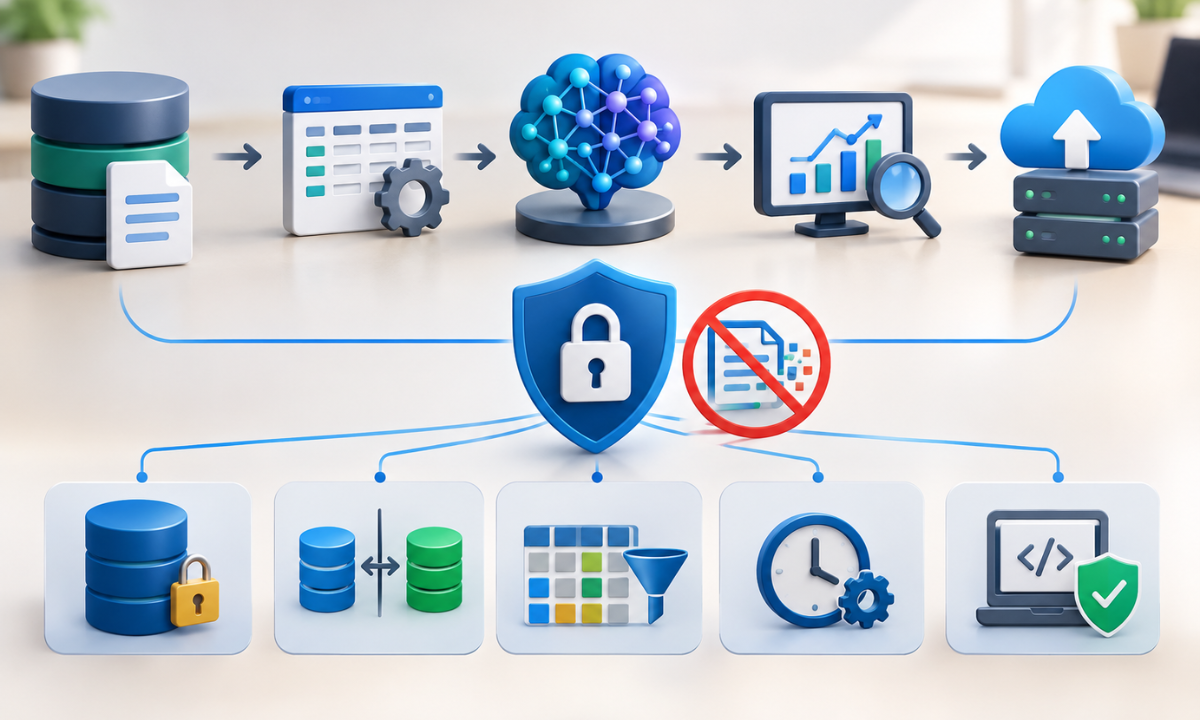
Preventing data leakage requires a consistent validation process. Use the following steps when building predictive models.
Step 1: Define the Prediction Objective
Clearly identify what the model must predict, when the prediction will happen, and which information will be available at that moment. This establishes the boundary between valid features and leaked information.
Step 2: Split the Dataset Correctly
Choose a suitable splitting method based on the dataset. Random splitting may work for independent observations, while time-based or group-based splitting is more suitable for temporal data or repeated observations from the same entity.
Step 3: Build a Preprocessing Pipeline
Keep data preparation, feature engineering, and model training within a controlled workflow. Fit transformations only on the relevant training portion and apply them to validation or test data without learning new parameters from those datasets.
Step 4: Use Reliable Validation Techniques
Cross-validation provides a more stable estimate of model performance when applied correctly. However, the splitting method must reflect the real prediction task. Use stratified cross-validation for suitable classification problems, group-based cross-validation for related observations, and time-series validation for forecasting.
Do not use the final test set repeatedly to compare models. Repeatedly adjusting a model based on test results can indirectly leak information from the test set into the development process.
Step 5: Audit Features and Evaluation Results
Review each feature's meaning, source, and timestamp. Investigate unusually high accuracy, near-perfect recall, or a sudden improvement after adding a variable. Compare training and validation scores, and confirm that the evaluation reflects the conditions expected in production.
Document the splitting strategy, preprocessing steps, feature selection decisions, and evaluation metrics so that the workflow can be reproduced.
Example: Detecting Data Leakage Using Python
The following Scikit-learn example shows how to keep preprocessing and model training together in a pipeline.
from sklearn.model_selection import train_test_split
from sklearn.pipeline import Pipeline
from sklearn.impute import SimpleImputer
from sklearn.preprocessing import StandardScaler
from sklearn.linear_model import LogisticRegression
from sklearn.metrics import accuracy_score
X_train, X_test, y_train, y_test = train_test_split(
X, y, test_size=0.2, random_state=42,
stratify=y
)
pipeline = Pipeline([
("imputer", SimpleImputer(strategy="median")),
("scaler", StandardScaler()),
("model", LogisticRegression(max_iter=1000))
])
pipeline.fit(X_train, y_train)
predictions = pipeline.predict(X_test)
print("Test accuracy:", accuracy_score(y_test, predictions))
Here, X represents the feature dataset and y represents the target variable. The imputer and scaler learn their parameters from the training data, while the test data remains separate until evaluation.
This example assumes that a random stratified split is suitable for the problem and that all selected features are valid at prediction time. For temporal data or related observations, use an appropriate time-based or group-based splitting strategy instead.
Why Reliable Model Validation Matters
A high evaluation score does not always indicate a reliable machine learning model. If data leakage is present, accuracy, precision, recall, and other performance metrics may give a false impression of model quality.
Reliable validation helps teams estimate how a model will perform on unseen data. It also supports better decisions about feature selection, algorithm choice, deployment, and ongoing monitoring.
These practices are important throughout the data science lifecycle, from data collection and exploratory data analysis to model development and deployment. Learning how to identify leakage, build preprocessing pipelines, and validate predictions is therefore an essential part of practical machine learning.
Professionals developing these skills can also explore Apponix's article on the importance of data cleaning and preprocessing to understand how data quality affects analysis and model reliability.
Conclusion
Data leakage is a common but preventable problem in machine learning. It can arise from train-test contamination, preprocessing mistakes, temporal leakage, target leakage, and improper handling of duplicate or related records.
The most effective prevention strategy is to establish clear prediction boundaries, split datasets correctly, fit preprocessing steps only on training data, and choose validation methods that reflect real-world conditions. Feature audits and independent testing further improve confidence in model performance.
For anyone building practical machine learning skills, understanding these principles is as important as selecting the right algorithm. A well-validated model may deliver more realistic results than a seemingly accurate model trained with flawed data practices.
Learners looking to develop these foundations can explore the Data Science Course in Bangalore, which covers Python, statistics, data preprocessing, and machine learning concepts relevant to real-world data projects.
Reference:
1)https://www.ibm.com/think/topics/data-leakage
2)https://medium.com/geekculture/preventing-data-leakage-in-machine-learning-a-guide-51445af9fbaf

Apponix Academy
Apponix Academy