POPULAR COURSES
Master Programs



Table of contents:
|
1. Conversational AI vs. Generative AI |
|
2. Core Features of Enterprise-Grade Conversational Bots |
|
3. High-Impact Enterprise Benefits |
|
4. Production-Ready Use Cases
|
|
5. Why Choose Apponix? Master AI from Theory to Deployment |
|
6. Conclusion |
The days of the frustratingly rigid, rule-based chat pop-up are officially over.
2026 is for forward-thinking enterprises that have abandoned static decision trees in favour of interfaces that can actually think, reason, and act. If your business is still relying on basic keyword matching to talk to users, your digital experience is broken.
The gold standard has shifted entirely to the deployment of a fully autonomous conversational AI chatbot capable of managing fluid, human-like dialogue. Mastering the engineering behind these next-generation interfaces is exactly why our comprehensive AI course in Bangalore focuses heavily on large language model orchestration rather than legacy coding frameworks.
To lead high-performing tech initiatives, you must move past basic definitions and understand how these modern digital agents are structurally architected.
Conversational AI vs. Generative AI
In the current tech landscape, executives frequently make the critical mistake of using industry buzzwords interchangeably.
To build enterprise-grade systems that actually move the needle, you must understand exactly where the boundaries lie. The most common point of confusion sits at the intersection of conversational AI vs generative AI.
While they are frequently deployed inside the exact same application, they perform fundamentally different jobs within your technology stack.
Think of the distinction as the difference between a disciplined project manager and an improvisational creative writer:
-
Conversational AI manages the interaction: It is a goal-driven architecture built to handle structural dialogue, map user intent, maintain context across multi-turn exchanges, and guide a user from an initial query to a specific business outcome.
It relies heavily on Natural Language Understanding (NLU) and dialogue management to extract critical entities such as names, dates, or booking numbers, ensuring a business process is completed correctly without veering off track.
-
Generative AI powers the content: It is an improvisational engine driven by probabilistic prediction. When given a prompt, its sole purpose is to synthesise highly plausible, original, and polished text based on its massive training patterns.
It does not inherently understand company guardrails, required form fields, or backend database dependencies; its job is fluent expression, not system execution.
The reason the market confuses them is that the elite enterprise platforms of 2026 fuse both layers into a singular, highly efficient pipeline. Modern, high-performing conversational AI chatbots use structured conversational logic to act as the rigid interface layer, identifying whether an incoming user wants a refund, a product recommendation, or an account update.
Once the necessary details are securely gathered and validated against backend enterprise systems, the conversational layer passes the raw data to a generative AI model to wrap the outcome in a perfectly personalised, natural human response.
Deploying pure generative AI to handle a strict transactional database check will inevitably result in hallucinated information or broken logic.
Conversely, relying entirely on legacy conversational code results in a mechanical, repetitive robot that alienates customers. Real enterprise capability comes from orchestrating both layers simultaneously.
Core Features of Enterprise-Grade Conversational Bots
Building a solution that can truly withstand high-volume commercial demands requires moving far beyond basic text parsing.
Early iterations, such as Bard the conversational AI chatbot, served as vital proof-of-concept experiments that demonstrated the raw potential of Large Language Model (LLM) dialogue interfaces. However, modern business environments demand robust, integrated multi-agent frameworks capable of secure, contextual reasoning.
When evaluating production-ready platforms, elite frameworks are defined by five core structural capabilities:
-
Contextual Memory Preservation: Legacy bots treat every message as an isolated event. An enterprise bot maintains context across multiple turns of a conversation, understanding that if a user says "cancel it" after discussing a subscription, "it" refers directly to that active subscription.
-
Dynamic Intent Recognition: Instead of checking for hard-coded phrases, the system interprets conversational meaning. Whether a user types "I want my money back" or "My package never arrived, adjust my balance," the bot maps both inputs accurately to a single financial refund protocol.
-
Enterprise-Grade Knowledge Grounding: Through pipelines like Retrieval-Augmented Generation (RAG), systems are restricted to answering strictly from verified internal documentation, databases, and policy PDFs. This completely isolates the bot from generating unverified or hallucinated information.
-
Granular Access Control: Integrated role-based access security guarantees that the system checks a user's corporate or account clearance before exposing proprietary data or executing administrative changes.
-
Bi-Directional API Execution: The system doesn’t just answer questions; it takes action. It securely communicates with CRM, ERP, and payment platforms to modify shipping addresses, unlock user credentials, or update account tiers on the fly.
While tools like the standalone ChatGPT AI chatbot introduced the public to natural language generation, deploying AI at scale requires combining that expressiveness with strict structural governance, deep system integration, and unbreakable security boundaries.
High-Impact Enterprise Benefits
Implementing an advanced AI chatbot for customer service is no longer a speculative IT experiment; it is a fundamental driver of operational efficiency and customer retention. When an enterprise replaces fragmented support channels with a unified conversational layer, the impact is immediately visible across its core business metrics.

Image Credits: Getty Images
Deploying an integrated digital agent delivers massive, measurable returns across four distinct areas of operation:
|
Operational Metric |
Legacy Support Model |
Conversational AI Agent Model |
|
First Response Time |
Hours to days, depending on queue volume, ticket backlogs, and office hours. |
Instantaneous (under 30 seconds) response delivery, operational 24/7/365 across all global time zones. |
|
Tier-1 Deflection Rate |
0% - Everything requires manual triage, human routing, and human agent review. |
55% - 70% autonomous resolution of repetitive inquiries (e.g., order tracking, policy queries). |
|
Escalation Handle Time |
Human agents must read through fragmented message logs and piece context together manually. |
35% – 45% reduction in handle time via auto-generated summaries and context packages sent to the agent. |
|
Infrastructure Scalability |
Inelastic. Handling traffic spikes or seasonal surges requires expensive, temporary hiring cycles. |
Elastically scalable. A single instance handles thousands of concurrent threads without latency degradation. |
The goal of an automated support ecosystem is not the absolute replacement of human staff.
Rather, it is about offloading the massive volume of predictable, mundane queries so your high-value engineering and support teams can focus entirely on complex, nuanced customer challenges that truly require human empathy and deep analytical problem-solving.
Production-Ready Use Cases
In 2026, the implementation of digital conversational systems has evolved past simple text interfaces. The modern enterprise model has shifted from reactive Q&A platforms to proactive, conversational AI use cases integrated directly into core systems of record.
AI agents do not simply guide users to links; they communicate fluently with enterprise databases, cross-reference data points, and execute complex business logic autonomously.
The standard for high-leverage business execution is best observed across four core functional domains:
1. E-Commerce and Guided Product Discovery
Legacy retail systems relied heavily on rigid search filters (e.g., sorting strictly by price, size, or color). Modern conversational architectures allow for conversational product discovery.
A user can input a complex, open-ended prompt such as: "I need to find a durable, weather-resistant hiking jacket for a winter trip to northern Europe, suitable for layering, under ₹15,000."
The system doesn't just return generic search hits. It evaluates the semantic intent, pulls matching records from the inventory database via a Retrieval-Augmented Generation (RAG) pipeline, compares technical specifications, and surfaces highly targeted recommendations alongside an interactive checkout button.
2. Financial Services and Transactional Governance
Within retail banking and financial services, conversational engines act as the primary operational interface for account management and security verification.
|
Financial Vector |
Legacy Chatbot Action |
2026 Conversational Agent Action |
|
Fraud Verification |
Sends a generic SMS link requiring the user to navigate an external portal to lock their card. |
Intercepts a suspicious charge, initiates an interactive session with the user, validates their identity via real-time biometric checks, and updates the card status directly within the core banking architecture. |
|
Loan Pre-Qualification |
Links the user to a static application form. |
Conducts an interactive financial interview, collects income inputs, references credit endpoints via secure APIs, and delivers an instant eligibility score. |
3. IT Helpdesk and Internal Employee Experience
Internal operations often deliver the fastest, most measurable return on investment (ROI) for enterprise automation. Instead of burdening systems administrators with mundane access resets, conversational systems act as the intelligent front door to corporate infrastructure.
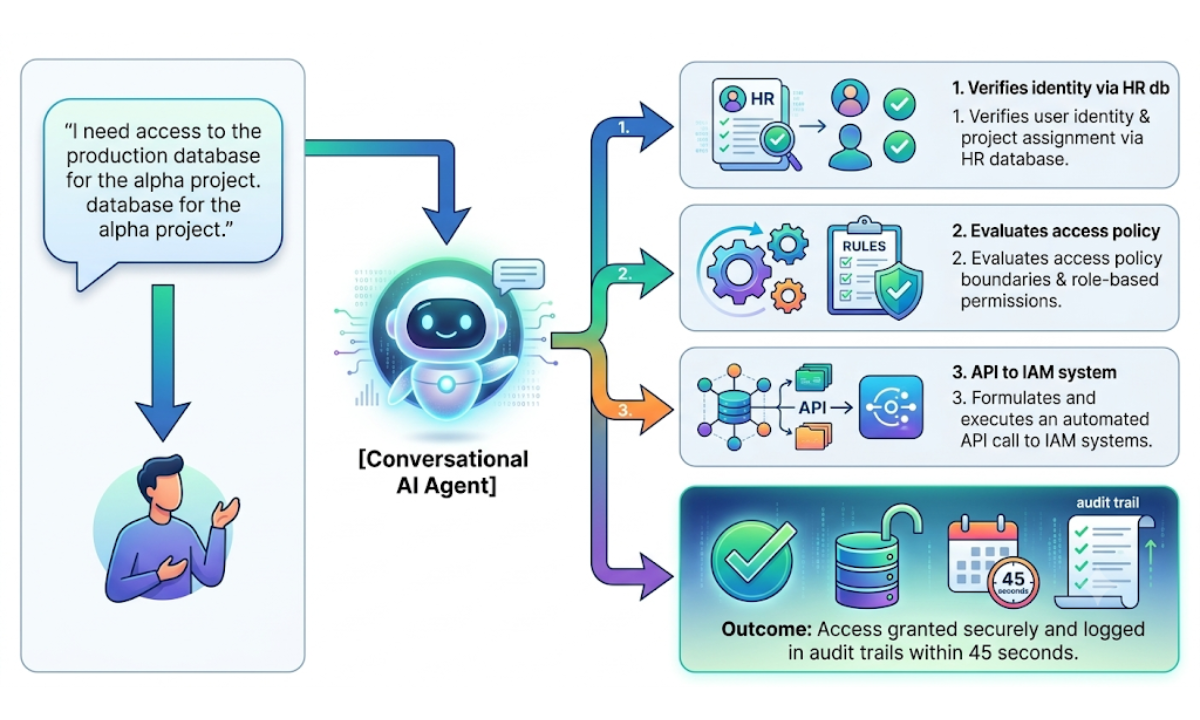
Image Credits: Hand-drawn, Re-imagined with AI
This automated loop seamlessly processes high-frequency internal requests such as password overrides, database access provisioning, and software troubleshooting steps, reducing overall IT ticket backlogs by up to 70%.
4. Proactive Supply Chain and Logistics Actions
The most consequential paradigm shift in modern systems design is the transition from reactive responses to proactive business triggers. Advanced conversational agents continuously monitor background enterprise workflows rather than waiting for a user to open a chat window.
For example, if an inventory tracking model detects a delay in a raw material shipment, a conversational supply chain agent can automatically intercept the alert, calculate the downstream assembly line impact, query alternate regional suppliers for pricing, and present an optimized backup procurement order directly to the logistics manager for a one-click approval.
Why Choose Apponix? Master AI from Theory to Deployment
Reading about Large Language Models, RAG architectures, and agentic workflows is highly informative, but it will not secure an elite machine learning position. Tech enterprises do not pay for conceptual awareness; they pay for the immediate ability to build neural networks, fine-tune models, and architect production-grade AI systems under pressure. If you cannot independently design a vector database pipeline or deploy a fine-tuned agent to an enterprise cloud ecosystem, you are not ready for a senior role.
This execution gap is exactly why ambitious tech professionals choose Apponix Technologies. As India's leading Training Institute in Bangalore, our entire curriculum is engineered to strip away generic coding tutorials and focus entirely on enterprise-grade engineering.
Here is why our AI training ecosystem stands completely unmatched:
-
100% Practical AI Labs: We bypass static slideshows and basic theoretical assignments. You will spend over 50 hours inside fully operational sandbox environments building your own custom conversational pipelines, fine-tuning open-source models, and managing advanced vector databases like Pinecone or Milvus.
-
Mentorship Under Industry Veterans: Learn directly from active Senior AI Researchers, Lead Data Scientists, and Machine Learning Architects who bring their daily enterprise challenges and production-tested solutions directly into the classroom.
-
Cutting-Edge 2026 Curriculum: Our training is continuously updated to reflect real-time shifts in the industry. You will master advanced paradigms like LangChain orchestration, multi-agent frameworks, semantic routing, and security guardrails that protect commercial systems from vulnerabilities.
We eliminate the friction of job hunting. Apponix delivers a comprehensive career acceleration ecosystem complete with professional AI-focused resume optimization, intensive technical mock interviews, and direct placement pipelines into top-tier global tech enterprises.
Conclusion
The trajectory of modern business software is undeniable: the future belongs entirely to applications that can reason, adapt, and execute autonomously. The era of static, click-based user interfaces is rapidly drawing to a close, replaced by highly intelligent, language-driven interfaces.
Relying on baseline, legacy web development skills directly caps your career trajectory and restricts you to maintaining outdated architectures. Conversational AI and machine learning engineering are the definitive skill sets that unlock the upper echelons of the technology sector, allowing you to design the cognitive engines powering global businesses.
Step out of the cycle of surface-level tutorials and fragmented video playlists. Connect with Apponix Technologies today, master the end-to-end execution of enterprise AI, and transform your career into a high-impact, highly compensated engineering asset.
Reference:
1. https://www.twilio.com/en-us/blog/what-is-conversational-ai
2. https://www.beconversive.com/blog/what-is-a-conversational-chatbot

Apponix Academy
Apponix Academy