POPULAR COURSES
Master Programs



Table of contents:
|
1. Which Ethical Hacking Certification Is Best for Your Career Stage? |
|
2. What Does Certification Recognition Mean in India? |
|
3. Comparison of the Top Ethical Hacking Certifications in India |
|
4. Certified Ethical Hacker (CEH) |
|
5. OffSec Certified Professional (OSCP/OSCP+) |
|
6. CompTIA PenTest+ |
|
7. eJPT |
|
8. GIAC Penetration Tester (GPEN) |
|
9. Computer Hacking Forensic Investigator (CHFI) |
|
10. Certified Information Systems Security Professional (CISSP) |
|
11. How to Choose the Right Ethical Hacking Certification? |
|
12. How to Prepare for an Ethical Hacking Career in Bangalore? |
|
13. Do Ethical Hacking Certifications Guarantee a Job in India? |
|
14. Skills to Learn Before or Alongside Certification |
|
15. Career Opportunities After Ethical Hacking Certification |
|
16. Frequently Asked Questions |
The most recognized ethical hacking certifications in India include CEH, OSCP, CompTIA PenTest+, eJPT, GPEN, and CHFI. CEH is a popular starting point for beginners and career switchers, while OSCP is better suited to candidates pursuing hands-on penetration testing roles.
Cybersecurity has become central to business operations as Indian organisations increasingly depend on digital platforms, cloud infrastructure, online transactions, and connected systems. Banks, fintech companies, IT service providers, e-commerce businesses, and technology companies need professionals who can identify security weaknesses and help protect digital assets.
Ethical hacking certifications can help aspiring cybersecurity professionals demonstrate knowledge, validate technical skills, and strengthen job applications. However, choosing the right certification involves more than comparing brand names. Your decision should reflect your current technical knowledge, career goals, practical experience, and budget.
This guide compares leading ethical hacking certifications in India, explains their eligibility requirements and career applications, and helps you choose the learning pathway that best matches your goals.
Which Ethical Hacking Certification Is Best for Your Career Stage?
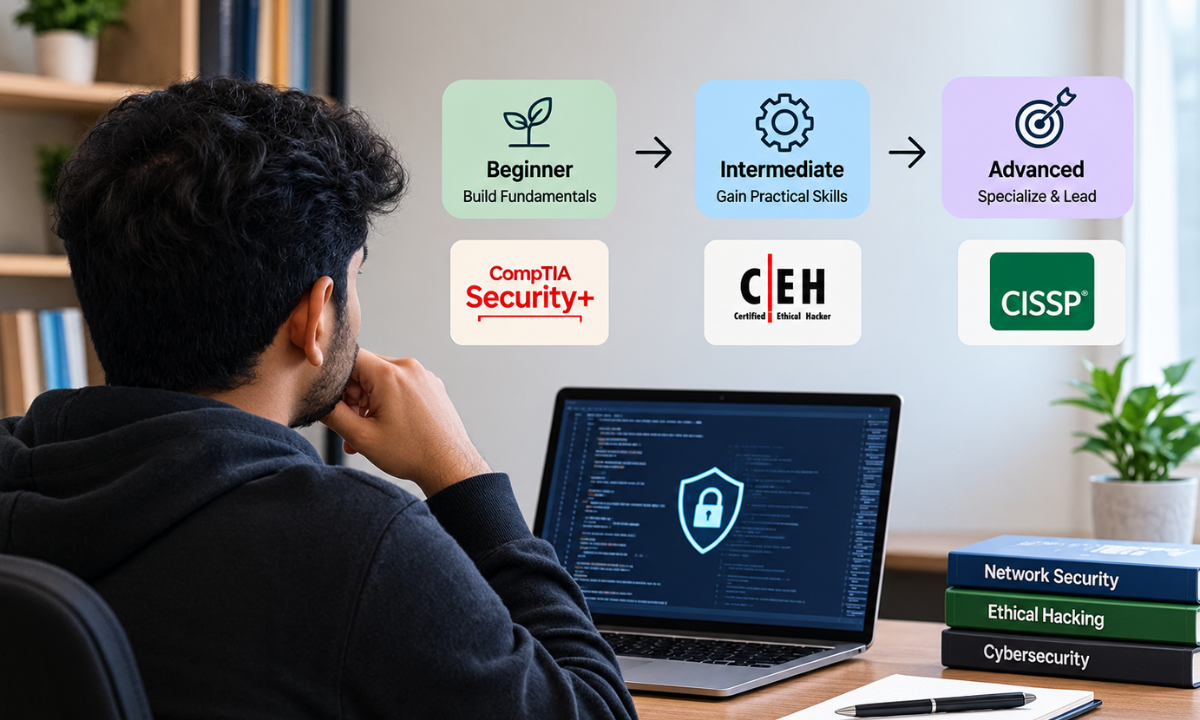
The right certification depends on your current skills and the cybersecurity role you want to pursue.
|
Career stage or goal |
Certification options |
Why consider them? |
|
Absolute beginner |
CompTIA Security+, eJPT |
Build foundational security knowledge or gain initial practical experience. |
|
Entry-level ethical hacker |
CEH, eJPT |
Develop an understanding of ethical hacking methods and security testing. |
|
Aspiring penetration tester |
OSCP, CompTIA PenTest+ |
Build penetration testing knowledge and practical assessment skills. |
|
Network security specialist |
GPEN, CEH |
Explore network-focused security testing and attack methodologies. |
|
Digital forensics professional |
CHFI |
Learn about digital evidence and forensic investigation. |
|
Experienced security professional |
CISSP, OSCP |
Pursue security leadership or advanced offensive security, depending on your career direction. |
These certifications serve different purposes. CEH provides broad coverage of ethical hacking concepts, while OSCP emphasises practical penetration testing. CISSP, meanwhile, is associated with broader information security responsibilities, including governance, architecture, and management.
What Does Certification Recognition Mean in India?
A certification demonstrates that a candidate has completed a defined assessment or certification process offered by a particular organisation. Its value depends on the provider, the skills assessed, and how employers interpret the credential.
It is important to distinguish industry recognition from government recognition. A certification may be valued by Indian recruiters, multinational companies, cybersecurity consultancies, and international employers without being a government-mandated qualification.
Employers may consider certifications when hiring for positions involving:
-
Vulnerability assessment and penetration testing
-
Security operations and incident response
-
Network and application security
-
Cybersecurity consulting
-
Digital forensics and investigation
-
Red team operations and security research
However, certification recognition does not guarantee selection. Recruiters may also assess educational qualifications, IT experience, practical labs, technical interviews, communication skills, and the ability to document security findings.
For Indian candidates, the more useful question is which certification aligns with the requirements of their target roles and whether the associated learning will help them perform the job.
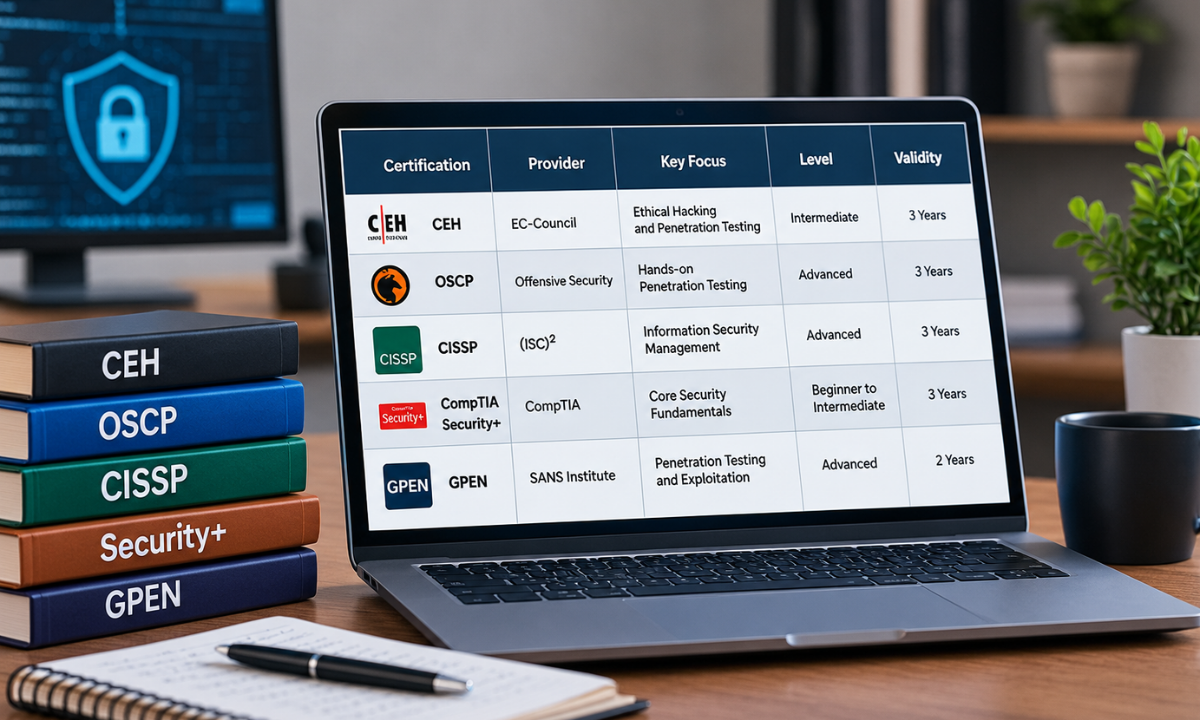
Comparison of the Top Ethical Hacking Certifications in India
|
Certification |
Provider |
Best suited for |
General difficulty |
Assessment approach |
|
Certified Ethical Hacker (CEH) |
EC-Council |
Beginners and career switchers |
Intermediate |
Knowledge-based exam, with a separate practical option |
|
OffSec Certified Professional (OSCP/OSCP+) |
OffSec |
Aspiring penetration testers |
Advanced |
Hands-on practical examination |
|
CompTIA PenTest+ |
CompTIA |
Entry-to-mid-level penetration testing candidates |
Intermediate |
Multiple-choice and performance-based questions |
|
eJPT |
INE Security |
Beginners seeking practical experience |
Beginner to intermediate |
Practical, lab-based assessment |
|
GIAC Penetration Tester (GPEN) |
GIAC |
Network penetration testing professionals |
Advanced |
Proctored examination |
|
Computer Hacking Forensic Investigator (CHFI) |
EC-Council |
Digital forensics and investigation candidates |
Intermediate |
Certification examination |
|
Certified Information Systems Security Professional (CISSP) |
ISC2 |
Experienced security professionals |
Advanced |
Certification examination |
Difficulty is relative and varies according to your technical background. Examination formats, eligibility conditions, prices, and certification policies may also change. Check the provider's current requirements before enrolling.
1. Certified Ethical Hacker (CEH)
The Certified Ethical Hacker certification from EC-Council is a widely recognized credential in the ethical hacking field. It introduces candidates to common attack techniques, security weaknesses, and methodologies used to assess system security.
Who should consider CEH?
CEH may suit graduates exploring cybersecurity, IT support professionals moving into security, network administrators interested in ethical hacking, and career switchers seeking structured training. It can also be relevant when employers specifically request the credential.
What does CEH cover?
The certification introduces topics such as reconnaissance, network scanning, vulnerability identification, system attacks, web application security, and defensive considerations. The exact syllabus depends on the applicable examination version. Because CEH covers a broad range of topics, learners benefit most when they combine certification preparation with guided labs, vulnerability-assessment practice, and technical report-writing exercises.
EC-Council provides two eligibility routes for the CEH examination. Candidates can complete official training or apply through the experience-based route, which requires evidence of at least two years of information security experience and compliance with the provider's application requirements.
Candidates who want to demonstrate practical ability can also explore CEH Practical as a separate option.
Advantages and Limitations
Advantages
-
Widely recognized credential in the ethical hacking field
-
Structured introduction to ethical hacking concepts
-
Suitable for learners who prefer a guided learning pathway
-
Can complement existing networking or IT support experience
Limitations
-
Passing a knowledge-based examination alone does not establish advanced practical penetration testing ability.
-
Training and examination expenses should be compared with your budget.
-
Candidates still need practical labs and technical interview preparation.
Is CEH worth it in India?
CEH may be a reasonable investment if your target employers value it and you want structured exposure to ethical hacking. Review relevant job descriptions to determine whether employers require CEH, prefer it, or accept equivalent practical experience.
2. OffSec Certified Professional (OSCP/OSCP+)
OSCP is designed for candidates who want to develop practical penetration testing skills. Its training pathway emphasises hands-on work rather than relying exclusively on theoretical knowledge.
Who should consider OSCP?
OSCP is generally better suited to candidates who already understand networking, Linux, basic scripting, and core security concepts. Beginners can work towards it, but preparation may be considerably more challenging without these foundations.
Skills and assessment focus
The practical training and assessment pathway covers activities such as:
-
Enumerating systems and services
-
Identifying exploitable vulnerabilities
-
Exploiting weaknesses in authorised environments
-
Performing privilege escalation
-
Documenting technical findings
-
Preparing a penetration testing report
Candidates must be comfortable troubleshooting unfamiliar problems and explaining their methods.
Advantages and Limitations
Advantages
-
Strong emphasis on practical penetration testing
-
Useful preparation for offensive security work
-
Encourages independent problem-solving and technical documentation
Limitations
-
Requires substantial preparation and practical labs.
-
May be challenging for candidates without IT fundamentals.
-
Training and examination costs can be significant.
-
A certification alone cannot substitute for professional experience.
OSCP+ has a three-year validity period under OffSec's certification policy, while the original OSCP does not expire. Confirm the current terms directly with OffSec before enrolling.
Is OSCP worth it in India?
OSCP is worth considering if you specifically want to pursue penetration testing or offensive security roles. If you are new to cybersecurity, strengthen your networking and operating system knowledge first.
3. CompTIA PenTest+
CompTIA PenTest+ is a vendor-neutral certification focused on penetration testing and vulnerability assessment. Its coverage extends across the planning, execution, analysis, and reporting stages of security testing.
Who should consider PenTest+?
This certification may suit IT professionals who understand basic security concepts and want to move into penetration testing. It can also help candidates who prefer a structured, vendor-neutral qualification.
What skills does it cover?
Depending on the examination version, the syllabus addresses:
-
Planning and scoping penetration tests
-
Information gathering and vulnerability identification
-
Security assessment techniques
-
Exploitation and post-exploitation concepts
-
Reporting findings and recommending remediation
The examination combines multiple-choice questions with performance-based questions.
Advantages and limitations
PenTest+ provides broad coverage of penetration testing processes and is not tied to one specific technology vendor. However, passing the examination does not automatically demonstrate the depth of practical skill required for an advanced penetration testing position.
Is PenTest+ worth it in India?
Consider PenTest+ if it aligns with the roles you are targeting and you want a structured qualification covering multiple stages of a penetration test. Compare its syllabus with CEH and OSCP before selecting a pathway.
4. eJPT
The Junior Penetration Tester certification, commonly known as eJPT, is offered by INE Security. It is intended for learners who want to develop an entry-level understanding of penetration testing through practical exercises.
Who should consider eJPT?
eJPT may be appropriate for students with basic networking knowledge, fresh graduates exploring offensive security, IT professionals learning penetration testing, and beginners who want practical experience before attempting an advanced certification.
Skills and practical learning
The certification pathway introduces practical activities involving information gathering, network assessment, vulnerability identification, and exploitation in controlled environments.
For beginners, this approach can help connect theoretical concepts with the process of investigating and testing a system.
Advantages and limitations
Advantages
-
Practical orientation for entry-level learners
-
Useful for building confidence in security laboratories
-
Can provide a foundation for further penetration testing study
Limitations
-
It is not a substitute for broader IT and networking fundamentals.
-
Employers may have different certification preferences.
-
Additional practice is necessary to progress towards more demanding penetration testing roles.
Is eJPT worth it in India?
If you are a beginner who learns best by practising in controlled labs, eJPT is worth evaluating. It can serve as an initial milestone before pursuing CEH, PenTest+, or OSCP, depending on your goals.
5. GIAC Penetration Tester (GPEN)
GPEN is offered by GIAC and focuses on penetration testing methodologies and techniques, particularly in network security assessments.
Who should consider GPEN?
GPEN may be relevant to security professionals who already have a foundation in cybersecurity and want to specialise in network penetration testing.
Key areas of focus
Its subject areas include penetration testing methodologies, reconnaissance, exploitation techniques, and the assessment of network security weaknesses. Review the current examination objectives to understand the specific topics covered.
Advantages and limitations
GPEN provides a specialised credential for professionals working towards advanced security assessment responsibilities. However, its overall cost can be considerably higher than some alternative certifications, particularly when associated training is included.
Is GPEN worth it in India?
Consider GPEN if your employer values GIAC credentials, your intended role aligns with its syllabus, or your organisation is funding your professional development. Self-funded candidates should compare the total cost with the likely benefits for their target roles.
6. Computer Hacking Forensic Investigator (CHFI)
CHFI is an EC-Council certification focused on computer forensics and digital investigations. Although it relates to cybersecurity, its primary purpose differs from that of a penetration testing certification.
Who should consider CHFI?
CHFI may suit candidates interested in digital forensics, cybercrime investigation, incident investigation, digital evidence handling, and forensic analysis.
What does CHFI cover?
The certification focuses on forensic investigation concepts and methods used to examine digital evidence. Depending on the applicable syllabus, these may include evidence preservation, examination of digital artefacts, investigative procedures, and forensic reporting.
Advantages and limitations
CHFI can support a candidate's understanding of digital investigations. However, it should not be treated as an equivalent replacement for a hands-on penetration testing qualification.
Is CHFI worth it in India?
CHFI is worth evaluating if you are interested in digital forensics, investigation, or evidence analysis. If your goal is to test applications and networks for vulnerabilities, a penetration testing certification may be more relevant.
7. Certified Information Systems Security Professional (CISSP)
CISSP is an information security certification offered by ISC2. It is primarily associated with experienced professionals working across security architecture, risk management, governance, and broader security leadership.
Who should consider CISSP?
CISSP is more suitable for experienced cybersecurity professionals seeking roles such as security architect, security manager, or other senior information security positions. It is not generally the first certification an aspiring ethical hacker should pursue.
How does CISSP differ from ethical hacking certifications?
Whereas OSCP and PenTest+ focus on penetration testing, CISSP covers a broader range of security domains. These include security and risk management, asset security, security architecture, network security, identity and access management, security assessment, operations, and software development security.
CISSP also has professional experience requirements for certification. Review the current ISC2 eligibility and endorsement rules before applying.
Is CISSP worth it in India?
CISSP may be valuable for experienced professionals seeking wider security responsibilities or leadership opportunities. If your immediate objective is to become a penetration tester, prioritise the practical skills and credentials relevant to that career path.
How to Choose the Right Ethical Hacking Certification?
The most effective way to select a certification is to start with your current skills and the job you want to pursue.
If you are a student or absolute beginner
Start with networking fundamentals, operating systems, and basic security concepts. CompTIA Security+ can help build a broad security foundation, while eJPT can provide an initial practical introduction to penetration testing.
You do not need to collect multiple certifications immediately. Build a strong technical foundation and use hands-on exercises to understand how systems work.
If you are a fresher or career switcher
CEH may be worth considering if you want structured ethical hacking training and your target employers value the credential. PenTest+ is another option if its vendor-neutral approach better matches your objectives.
Before enrolling, review job postings for entry-level cybersecurity positions in India. Note the qualifications employers request and distinguish between mandatory requirements and preferred credentials.
If you already work in IT or networking
Your existing experience can help you progress towards more specialised security roles. If you understand Linux, networking, and basic scripting, you may be ready to explore practical penetration testing training.
OSCP may be a suitable long-term goal if you want to specialise in offensive security. PenTest+ may offer a more structured alternative, depending on your technical background and learning preferences.
If you want to specialise in digital forensics
Choose a learning pathway that covers evidence handling, investigative methods, and forensic analysis. CHFI may be relevant to this direction, whereas a pure penetration testing credential may not address your primary learning requirements.
If you want a senior cybersecurity role
Experienced professionals should consider whether they need deeper technical specialisation or broader security management knowledge. OSCP supports a different career direction from CISSP, so choose according to the responsibilities you want to undertake.
How to Prepare for an Ethical Hacking Career in Bangalore?
Selecting a certification is only one part of becoming an ethical hacking professional. Learners also need to understand networking, operating systems, security tools, vulnerability assessment, and the legal boundaries of security testing.
If you are a student, recent graduate, or working professional in Bangalore, compare training options based on their curriculum, practical exercises, instructor support, and career preparation.
A useful training programme should help you connect theory with practice. For example, learning network scanning is more valuable when you can interpret the results, identify potential security weaknesses, and explain how those weaknesses could be addressed.
Before choosing a course, evaluate the following:
-
Practical lab work: Check whether the programme includes guided exercises in authorised testing environments.
-
Tools and technologies: Review whether the curriculum introduces relevant tools such as Kali Linux, Nmap, Metasploit, Wireshark, and web application testing tools.
-
Foundational knowledge: Confirm that the course covers networking, operating systems, and essential cybersecurity concepts.
-
Projects and reporting: Look for opportunities to document findings, assess vulnerabilities, and prepare technical reports.
-
Certification guidance: Check whether the programme helps learners understand relevant certification pathways and examination requirements.
-
Career preparation: Review the availability of resume support, mock interviews, and placement assistance where offered.
If you are comparing structured training options in Bangalore, explore Apponix Academy’s ethical hacking course in Bangalore. The programme includes hands-on lab exercises, real-time projects, CEH certification guidance, resume preparation, interview training, and placement-oriented support. Review the syllabus, training format, and career-support options to determine whether it matches your current experience and professional goals.
Do Ethical Hacking Certifications Guarantee a Job in India?
No. An ethical hacking certification does not guarantee a job, a particular salary, or selection by an employer.
Certifications can strengthen your CV by demonstrating structured learning and helping you meet certain recruitment criteria. However, cybersecurity hiring teams often want evidence that candidates can apply what they know.
For example, an aspiring penetration tester may be asked to explain how they identified a vulnerability, validated its impact, and recommended a fix. A candidate who has memorised definitions but lacks practical experience may struggle with these questions.
To improve your employability, develop a portfolio that demonstrates your skills.
Build a practical cybersecurity portfolio
-
Create a home lab: Use intentionally vulnerable applications and authorised practice environments to learn safely.
-
Document lab exercises: Record the objective, methodology, observations, findings, and remediation steps for each exercise.
-
Practise on recognised platforms: Use legal training environments and capture-the-flag exercises to strengthen problem-solving skills.
-
Maintain a project portfolio: Publish suitable write-ups or scripts on GitHub, ensuring you do not expose confidential data or unauthorised security findings.
-
Learn report writing: Practise explaining technical vulnerabilities in language that developers and non-technical stakeholders can understand.
-
Prepare for interviews: Be ready to explain networking, operating systems, common vulnerabilities, and the limitations of your testing methods.
Candidates interested in bug bounty programmes should also understand programme scope, disclosure requirements, and responsible reporting practices.
Skills to Learn Before or Alongside Certification
Certifications become more useful when supported by practical technical knowledge. The following skills provide a foundation for ethical hacking and penetration testing.
|
Skill area |
What you should understand |
Why it matters |
|
Networking |
TCP/IP, DNS, HTTP/HTTPS, firewalls, VPNs |
Helps you understand how devices and services communicate. |
|
Linux and Windows |
Users, permissions, processes, services, and logs |
Supports system assessment and troubleshooting. |
|
Scripting |
Python, Bash, or PowerShell fundamentals |
Helps automate repetitive tasks and analyse results. |
|
Web technologies |
Requests, responses, sessions, authentication, and APIs |
Supports web application security testing. |
|
Vulnerability assessment |
Scanning, validation, prioritisation, and remediation |
Helps distinguish meaningful risks from false positives. |
|
Privilege escalation |
Permission weaknesses and configuration issues |
Helps assess the impact of vulnerabilities in authorised environments. |
|
Technical reporting |
Evidence, risk descriptions, impact, and fixes |
Makes findings useful to the organisation responsible for security. |
|
Legal and ethical practice |
Authorisation, scope, data handling, and disclosure |
Keeps security testing within approved boundaries. |
You do not need to master every subject before beginning a course. Learning the fundamentals alongside certification preparation makes it easier to understand technical concepts and solve practical problems.
Career Opportunities After Ethical Hacking Certification
Ethical hacking and cybersecurity certifications can support applications for several roles, depending on your technical background and practical experience.
|
Career role |
Primary responsibilities |
Relevant learning direction |
|
SOC Analyst |
Monitoring alerts, investigating suspicious activity, and escalating incidents |
Security fundamentals and security operations |
|
Vulnerability Analyst |
Identifying, validating, and prioritising security weaknesses |
Vulnerability assessment and remediation |
|
Penetration Tester |
Testing authorised systems and reporting exploitable weaknesses |
Practical penetration testing |
|
Security Consultant |
Assessing security controls and recommending improvements |
Security assessment and consulting |
|
Red Team Associate |
Simulating authorised adversarial activity |
Offensive security and practical testing |
|
Application Security Engineer |
Identifying and helping remediate software security issues |
Web security and secure development |
|
Incident Responder |
Investigating and responding to security incidents |
Incident response and forensic investigation |
|
Cybersecurity Trainer |
Teaching security concepts and practical techniques |
Technical expertise and communication |
|
Bug Bounty Researcher |
Finding and responsibly reporting vulnerabilities within approved programme scopes |
Web security and vulnerability research |
These are possible career directions, not guaranteed outcomes of earning a particular certification. Entry requirements vary by employer, and some positions require relevant work experience or additional technical knowledge.
Frequently Asked Questions
1. Which ethical hacking certification is best for beginners in India?
eJPT is worth considering if you want an initial practical introduction to penetration testing. CompTIA Security+ can help build broader security fundamentals, while CEH may suit learners who prefer structured ethical hacking training. Your choice should depend on your existing knowledge and career goals.
2. Is CEH recognised in India?
CEH is an established ethical hacking certification and may be valued by Indian employers, including organisations that list it in their cybersecurity job requirements. Recognition varies between employers, so check whether your target roles require or prefer the credential.
3. Is OSCP better than CEH?
Neither certification is universally better. CEH provides broad coverage of ethical hacking concepts, while OSCP focuses more heavily on practical penetration testing. CEH may suit candidates seeking a structured introduction, whereas OSCP is generally more appropriate for learners pursuing hands-on offensive security roles.
4. Can I get an ethical hacking job with only a certification?
A certification can strengthen your application, but it does not guarantee employment. Employers may also evaluate networking knowledge, operating system skills, practical labs, projects, communication, and technical interview performance. Build demonstrable skills alongside certification preparation.
5. What is the cost of CEH certification in India?
The cost depends on the training route, examination arrangement, study materials, and whether you choose an additional practical assessment. Fees and taxes may change. Check EC-Council's current pricing and eligibility requirements before budgeting for the certification.
6. Do I need coding skills for ethical hacking?
You do not need to be an advanced programmer to begin learning ethical hacking. However, basic Python, Bash, or PowerShell skills are useful for automation and troubleshooting. Understanding HTML, JavaScript, SQL, and web application behaviour can also help with application security testing.
7. Is ethical hacking legal in India?
Ethical hacking is legitimate when testing is performed with appropriate authorisation and within the approved scope. Accessing systems without permission, exceeding authorised access, or misusing information can create legal consequences. Always obtain explicit permission before testing any system, including websites and networks.
8. Which certification is best for government or enterprise cybersecurity jobs?
There is no single certification that is best for every government or enterprise role. Requirements depend on the organisation, job description, and recruitment rules. Review the official eligibility criteria and determine whether the position requires a specific qualification, work experience, or other credentials.
9. How long does it take to become an ethical hacker?
The timeline depends on your starting point, study schedule, and practical experience. Someone with networking and Linux knowledge may progress faster than an absolute beginner. Focus on building a strong foundation, practising regularly, and developing a portfolio rather than relying on a fixed completion timeline.
10. Are free ethical hacking courses worth it?
Yes. Free courses and authorised practice laboratories can help you understand the fundamentals before investing in a paid certification. Check the course syllabus, instructor credibility, practical exercises, and update history. Free learning can provide a useful foundation, although it may not include a recognised certification examination.
Conclusion
Choose a Certification That Matches Your Career Goals
The best ethical hacking certification in India depends on your experience, preferred specialisation, and target job role. CEH can provide a structured introduction to ethical hacking, eJPT offers a practical starting point, and OSCP is worth considering for candidates pursuing hands-on penetration testing. PenTest+, GPEN, CHFI, and CISSP serve different technical or professional objectives.
Before spending money on a certification, compare the syllabus, eligibility requirements, total cost, examination format, and recognition among your target employers. Most importantly, combine certification preparation with practical lab work, technical documentation, and interview practice.
If you are starting your cybersecurity journey in Bangalore, identify your current skill level and target role before selecting a training programme. The right combination of foundational knowledge, guided labs, real-world projects, and certification preparation can help you build a stronger basis for long-term career growth.
To explore structured learning, practical exercises, and career preparation, visit Apponix Academy’s , ethical hacking course in Bangalore. Review the syllabus, training formats, and support options to determine whether the programme fits your learning requirements.
The goal is to develop skills you can demonstrate to employers.
Reference:
1)https://medium.com/@yashikasharma2894/exploring-essential-ethical-hacking-certifications-for-cybersecurity-professionals-300b9a7bf623
2)https://www.hackerone.com/knowledge-center/why-you-need-ethical-hacker-certification-and-7-options-consider

Apponix Academy
Apponix Academy