POPULAR COURSES
Master Programs



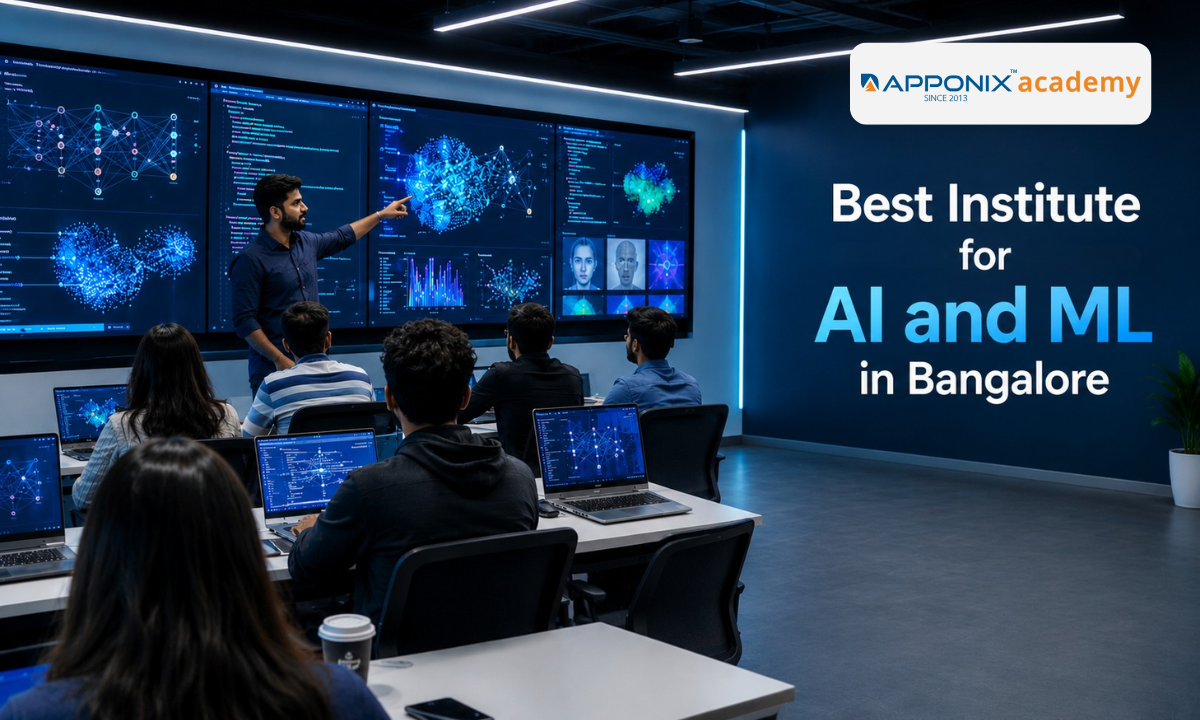
Table of contents:
|
1. Modern Industry-Aligned Curriculum & Toolstack Mastery
|
|
2. Mentor Pedigree, Beginner Onboarding & Certifications
|
|
3. High-Performance GPU Infrastructure & Production MLOps
|
|
4. Placement Infrastructure, Ecosystem & High ROI
|
|
5. Why Choose Apponix Technologies for Your AI & ML Journey? |
|
6. Conclusion |
Bangalore’s transformation into Asia’s central artificial intelligence hub has created an unprecedented demand for skilled machine learning engineers, AI researchers, and data scientists.
Identifying the Best Institute for AI and ML in Bangalore is a crucial decision for software developers, tech professionals, and graduates aiming to build production-grade intelligent systems. Enrolling in a comprehensive AI Course in Bangalore equips you with the practical engineering skills, GPU lab infrastructure, and algorithmic mastery needed to thrive in today's competitive job market.
While self-paced video tutorials and static online modules offer basic theoretical knowledge, they rarely prepare learners for the complexities of enterprise deployment. Modern AI development requires deep mathematical foundations, custom deep learning model tuning, handling high-dimensional vector embeddings, and managing MLOps pipelines.
A structured, project-driven training institute bridges this gap, transforming abstract concepts into job-ready technical muscle memory.
Modern Industry-Aligned Curriculum & Toolstack Mastery
Reason 1: A Future-Proof Curriculum Covering GenAI, Transformers, and RAG
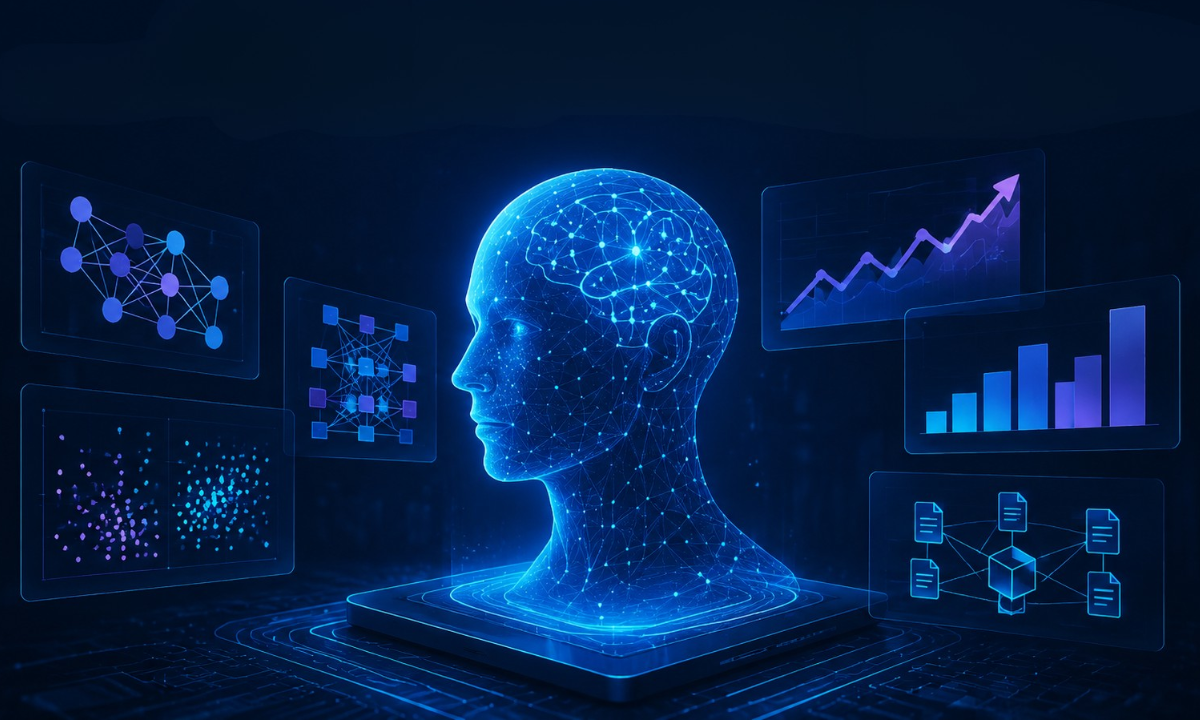
Evaluating syllabus depth is the most crucial step when selecting the Best AI Training Institute in Bangalore. The field of artificial intelligence moves at an extraordinary pace; programs that still focus exclusively on classical statistical models without integrating transformer architectures, Large Language Models (LLMs), and Retrieval-Augmented Generation (RAG) leave students ill-equipped for modern product engineering roles.
A production-oriented curriculum spans the entire intelligent systems lifecycle:
-
Foundational Mathematics & Classical Machine Learning: Linear algebra, multivariable calculus, probability distributions, supervised regression/classification, decision trees, ensemble methods (XGBoost, Random Forests), and unsupervised clustering.
-
Deep Learning & Neural Architectures: Multilayer perceptrons, backpropagation, Convolutional Neural Networks (CNNs) for computer vision, Recurrent Neural Networks (RNNs/LSTMs), and attention mechanisms.
-
Generative AI & LLM Engineering: Transformer architecture breakdowns, fine-tuning pre-trained models (LoRA/QLoRA), prompt engineering, vector database indexing (ChromaDB, Pinecone), and agentic workflows using LangChain or LlamaIndex.
Mastering these progressive modules ensures candidates can transition seamlessly from statistical data analysis to deploying cutting-edge generative AI agents in enterprise environments.
Reason 2: Deep Toolstack Mastery Across the AI/ML Ecosystem
Enrolling in a leading Machine Learning Training Institute in Bangalore guarantees that you spend your time writing real production code rather than studying theoretical slide decks.
Top-tier institutes train students on the exact tools, libraries, and frameworks used by AI research labs and engineering teams at major tech enterprises.
|
Curriculum Domain |
Legacy / Surface-Level Approach |
Modern Industry-Standard Toolstack
|
|---|---|---|
|
Data Manipulation & Math |
Pure Python loops and basic spreadsheets |
NumPy, Pandas, Polars, and SciPy for high-performance computing |
|
Classical ML & Pipelines |
Standalone algorithms without pipelines |
Scikit-Learn pipelines, LightGBM, XGBoost, and Optuna hyperparameter tuning |
|
Deep Learning & Neural Nets |
High-level API abstractions only |
PyTorch, TensorFlow, and Keras with custom CUDA tensor operations |
|
Generative AI & LLMs |
Basic API calls to third-party endpoints |
Hugging Face Transformers, LangChain, LlamaIndex, vLLM, and Vector DBs |
Gaining hands-on fluency across this modern software stack gives you the technical confidence to build, optimize, and deploy end-to-end intelligent applications independently.
Mentor Pedigree, Beginner Onboarding & Certifications
Reason 3: Guidance from Active AI Researchers & Industry Data Scientists
Artificial intelligence is an experimental science. Models frequently fail due to vanishing gradients, over-fitting, hyperparameter drift, or subtle data leakage. Learning from instructors who only possess theoretical textbook knowledge limits your ability to solve complex production challenges.
Leading institutes pair students with active AI researchers, lead data scientists, and senior MLOps engineers. These mentors share real-world engineering experiences such as fine-tuning custom embeddings for domain-specific applications, handling sparse datasets, and managing cost-efficient cloud inference.
Reason 4: Structured Onboarding Tailored for Beginners and Non-Coders
A major hurdle for many aspiring professionals is overcoming the fear of advanced mathematics and programming. Whether you come from a non-technical background, business analytics, or legacy IT, enrolling in a dedicated AI Course for Beginners in Bangalore offers a structured, step-by-step pathway into the field.
-
Mathematical Foundations without the Jargon: Rebuilding confidence in linear algebra, matrix operations, calculus derivatives, and probability using intuitive geometric visualizations.
-
Python Programming Bootcamp: Transitioning from basic syntax to object-oriented programming, data structures, and efficient vector operations using NumPy and Pandas.
-
Gradual Complexity Escalation: Progressing naturally from simple linear regression models to multi-layer neural networks and transformer-based architectures.
A well-structured onboarding framework demystifies complex algorithms, ensuring that learners from all professional backgrounds develop strong technical confidence before attempting advanced deep learning modules.
Reason 5: Industry-Recognized, Vendor-Aligned Credentials
While hands-on project work is essential, earning a reputable credential helps your resume stand out to corporate recruiters and automated applicant tracking systems (ATS).
|
Certification Track |
Issuing Body |
Primary Technical Focus
|
|---|---|---|
|
AWS Certified AI Practitioner / Specialty |
Amazon Web Services |
AWS SageMaker, Bedrock, and Cloud AI Infrastructure |
|
TensorFlow Developer Certificate |
Google / TensorFlow |
Computer Vision, NLP, and Neural Network Design |
|
Databricks Certified Machine Learning Associate |
Databricks |
Feature Engineering, MLflow, and Distributed Training |
Enrolling in a high-caliber AI and ML Certification Course Bangin alore gives candidates a clear preparation path toward these vendor-aligned exams, pairing theoretical concepts with exam-focused practice. Validating your skills with vendor-aligned credentials provides proof of your technical capabilities during corporate hiring rounds.
High-Performance GPU Infrastructure & Production MLOps
Reason 6: Dedicated Access to High-Performance GPU Compute & Cloud Labs

Training deep neural networks, transformer models, and computer vision algorithms on standard consumer laptops is virtually impossible. As models grow into hundreds of millions or billions of parameters, consumer hardware quickly bottlenecks due to VRAM limits and severe thermal throttling.
A premier Artificial Intelligence Institute in Bangalore solves this hardware bottleneck by providing students with direct access to high-performance cloud compute environments and GPU-accelerated lab infrastructure:
-
GPU-Accelerated Cluster Access: Direct access to NVIDIA Tensor Core GPUs (such as T4, V100, or A100 instances) to execute compute-heavy PyTorch training runs and custom CUDA tensor operations without hardware constraints.
-
Enterprise Cloud ML Platforms: Hands-on experience configuring cloud-native machine learning environments on platforms like AWS SageMaker, Google Cloud Vertex AI, and Azure ML Studio.
-
Distributed Training Workflows: Learning how to scale model training across multi-GPU nodes using PyTorch Distributed Data Parallel (DDP) and Ray for enterprise datasets.
Gaining direct operational exposure to cloud GPU infrastructure ensures that you can train, fine-tune, and evaluate heavy deep learning models efficiently without being limited by local machine hardware boundaries.
Reason 7: End-to-End MLOps Training & Real-World Model Deployment
In enterprise software engineering, building a machine learning model in an isolated Jupyter Notebook accounts for less than 20% of the actual work. The true commercial value lies in translating trained model artifacts into scalable, resilient web services that process live API requests with low latency.
To prepare you for modern product teams, top-tier institutes integrate complete Machine Learning Operations (MLOps) practices directly into the training workflow:
-
API Development & Model Serving: Packaging scikit-learn, PyTorch, and Hugging Face models into high-performance RESTful microservices using FastAPI, complete with asynchronous request handling and validation.
-
Containerization & Microservices: Wrapping model artifacts, environment dependencies, and inference code into lightweight Docker containers for seamless orchestration across cloud environments.
-
Experiment Tracking & Versioning: Utilizing industry tools like MLflow, DVC (Data Version Control), and Weights & Biases to track hyperparameter iterations, log metrics, and version training datasets.
-
Continuous Monitoring & Drift Detection: Setting up automated CI/CD pipelines for ML models, tracking data drift, monitoring inference latency, and establishing automated retraining triggers.
Mastering these production deployment strategies transforms you from an academic model builder into a full-stack AI engineer capable of maintaining live, self-healing model pipelines in enterprise software settings.
Placement Infrastructure, Ecosystem & High ROI
Reason 8: End-to-End Placement Support and Rigorous Interview Coaching
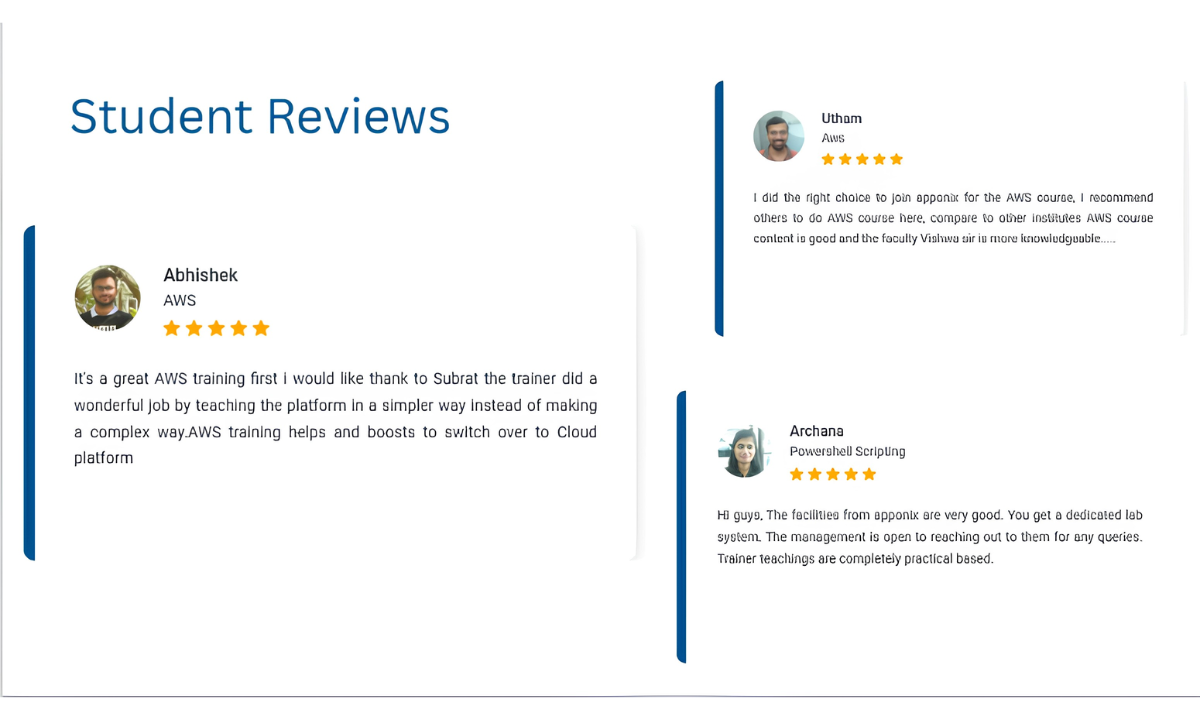
Acquiring deep technical knowledge is only half the battle; navigating corporate recruitment pipelines requires strategic preparation. Choosing an accredited program offering AI and ML Training with Placement in Bangalore ensures that you receive dedicated career support designed to help you clear every stage of the technical hiring process.
A production-grade placement pipeline typically includes:
-
Technical Resume Optimization: Restructuring project descriptions to emphasize model performance metrics, cloud infrastructure, latency benchmarks, and specific framework versions to pass ATS screening.
-
Public Portfolio Audits: Reviewing public GitHub repositories to ensure clean modular code, comprehensive documentation, unit tests, and Dockerized deployment scripts.
-
Mock Technical & System Design Interviews: Conducting simulated whiteboarding sessions led by active tech leads to challenge your understanding of model trade-offs, vector search optimizations, and scalable deployment architectures.
-
Direct Corporate Referrals: Partnering directly with enterprise hiring managers, product firms, and technology consultancies looking for vetted AI talent.
This structured career assistance eliminates the guesswork from job hunting, allowing you to present a polished, production-ready portfolio directly to engineering decision-makers.
Reason 9: Direct Access to Bangalore’s Thriving AI Startup & Enterprise Ecosystem
Studying in India's technology capital provides networking and career advantages that remote or isolated learning environments simply cannot match. Bangalore hosts thousands of AI-first startups, tech unicorns, and multinational Global Capability Centers (GCCs) concentrated along major tech corridors like Outer Ring Road, Whitefield, and Electronic City.
Leading training institutes actively leverage this location advantage to benefit their students:
-
Industry Guest Lectures: Interactive sessions with guest speakers, senior data scientists, and AI founders sharing insights on live production challenges.
-
Hackathons & Innovation Sprints: Collaborative coding events where students build real-time AI prototypes to solve actual industry problem statements under tight deadlines.
-
Local Tech Community Integration: Direct exposure to local AI meetups, open-source contributor groups, and developer conferences hosted across the city.
Immersing yourself in this collaborative tech environment expands your professional network, opening doors to unadvertised hiring referrals, co-founder opportunities, and direct industry mentorship.
Reason 10: High Career ROI and Rapid Salary Acceleration
Upskilling in artificial intelligence and machine learning delivers one of the highest returns on educational investment in the modern technology sector. As enterprises across fintech, healthcare, e-commerce, and SaaS race to integrate predictive models and generative AI agents, specialized engineers command significant salary premiums compared to traditional software roles.
Compensation expectations across experience tiers in Bangalore reflect this strong market demand:
-
Entry-Level Engineers (0 to 2 Years Experience): Base packages range from ₹6 LPA to ₹12 LPA, with higher offers extended to candidates who demonstrate strong PyTorch, MLOps, and LLM fine-tuning skills.
-
Mid-Level Specialists (3 to 6 Years Experience): Autonomous engineers capable of managing end-to-end model training, vector indexing, and cloud deployment earn between ₹14 LPA and ₹26 LPA.
-
Senior AI Leads & Architects (7+ Years Experience): Lead engineers managing multi-GPU cluster training runs, enterprise AI governance, and cross-functional teams command packages from ₹28 LPA to ₹50+ LPA.
Investing in a project-driven training program offers a rapid payback period, paving the way for sustained salary growth and long-term career resilience in an increasingly automated global economy.
Why Choose Apponix Technologies for Your AI & ML Journey?
Choosing the right educational partner is the single most important decision when transitioning into artificial intelligence and machine learning. Apponix Technologies has established itself as the best institute for artificial intelligence and machine learning in Bangalore by combining deep theoretical rigor with production-grade engineering practices and direct career support.
When you enroll in our AI & ML program, you gain access to an end-to-end learning environment engineered for immediate workplace readiness:
-
100% Practical GPU Lab Environment: Train, fine-tune, and deploy deep learning models and generative AI agents using dedicated cloud GPU infrastructure and modern MLOps pipelines.
-
Mentorship from Senior AI Engineers: Learn directly from active data scientists and AI architects who bring real-world production experience, model optimization techniques, and deployment workflows into every class.
-
Production-Grade GitHub Portfolio: Build and showcase modular, fully documented open-source repositories featuring custom PyTorch pipelines, Docker containers, FastAPI model endpoints, and LangChain agents.
-
Targeted Placement & Resume Support: Benefit from 1-on-1 resume optimization, mock technical whiteboarding rounds, and direct interview referrals across top tech enterprises, GCCs, and AI startups.
Our structured curriculum transforms complex mathematical concepts into practical engineering skills. As a leading Training institute in Bangalore, Apponix Technologies equips you with the expertise to build custom computer vision models, fine-tune large language models, orchestrate automated retraining pipelines, and develop the technical capabilities required to clear high-stakes technical interviews.
Conclusion
As artificial intelligence continues to reshape every industry, acquiring production-grade machine learning skills offers an unmatched pathway to career growth and long-term professional stability. By prioritizing modern curriculum coverage, hands-on GPU lab access, expert mentorship, and genuine placement pipelines, you position yourself at the forefront of the global AI transformation.
Before making your final enrollment decision, use this quick 5-point audit checklist to evaluate any training program:
-
Curriculum Audit: Does the program cover modern generative AI, transformer architectures, vector databases, and MLOps deployment alongside classical ML algorithms?
-
Hardware Infrastructure: Do you receive dedicated access to high-performance cloud GPUs for training deep neural networks and large-scale models?
-
Faculty Experience: Are the instructors active corporate data scientists and AI engineers who maintain live production pipelines?
-
Portfolio Complexity: Will you graduate with verifiable public GitHub repositories showcasing clean code, modular structure, Docker containerization, and unit tests?
-
Placement Transparency: Does the institute offer dedicated resume engineering, mock architecture rounds, and direct hiring partner referrals?
Rigorously evaluating your training options ensures that your educational investment translates into job-ready technical confidence. Taking systematic action today allows you to master modern AI engineering frameworks and command top-tier compensation packages in India's technology capital.
Reference:
https://www.cloudthat.com/resources/blog/5-reasons-why-you-should-study-artificial-intelligence-and-machine-learning
https://www.upes.ac.in/blog/computer-science/careers-in-artificial-intelligence-and-machine-learning

Apponix Academy
Apponix Academy