POPULAR COURSES
Master Programs




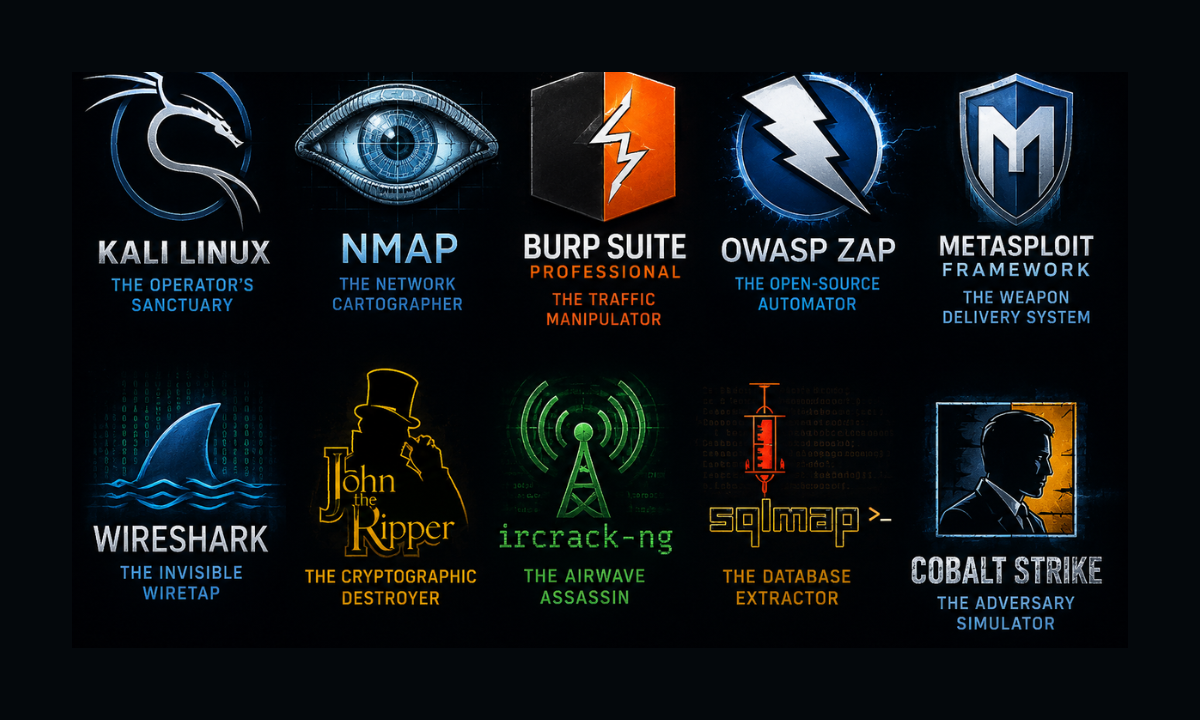
Table of contents:
|
1. The Foundation & The Scout
|
|
2. Dominating the Web Layer
|
|
3. Exploitation & Sniffing
|
|
4. Brute Force & Wireless Warfare
|
|
5. Database Hijacking & Red Teaming
|
|
6. Why Choose Apponix? |
|
7. Conclusion |
Your terminal is your weapon, and your software choices dictate whether you successfully compromise a target or trigger an enterprise alarm. If you are preparing to step onto the digital battlefield by enrolling in a premium Cyber security course in Bangalore, you must quickly realize that corporate hiring managers do not care about your theoretical knowledge. They care about your tool execution.
If you walk into an engineering interview at a top-tier tech firm and can only talk about hacking conceptually, you will be rejected before you can open your laptop. You need to know how these applications manipulate raw network packets, intercept application layers, and bypass modern security defenses.
To help you cut through the generic documentation and marketing noise, we are bypassing the textbook definitions to analyze the top 10 penetration testing tools ruling the industry in 2026. This is the exact software stack you need to master to transition from an amateur script-kiddie to a highly deployable offensive consultant.
The Foundation & The Scout
[SYSTEM INITIALIZATION]
▉▉▉▉▉▉▉▉▉▉▉▉▉▉▉▉ 100%
STATUS: ACTIVE
TARGET: MAPPING ENTERPRISE PERIMETER
Before you even think about launching an exploit payload or pivoting through an internal network, you need an environment to work from and an accurate map of your target. Let's look at the first two heavy-hitters in any offensive operator's terminal.
1. Kali Linux // The Operator's Sanctuary
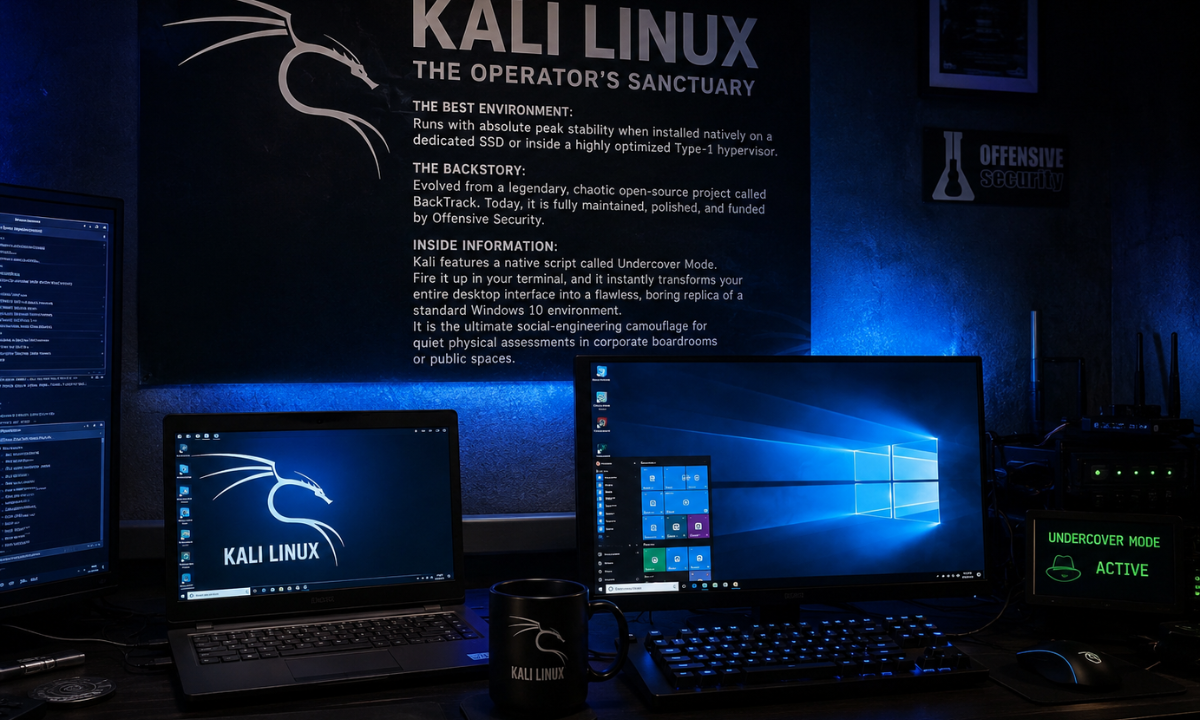
Kali Linux isn't just an operating system; it’s a pre-configured digital armory. If you're trying to conduct high-level security assessments out of a standard Windows command prompt, you're bringing a knife to a laser fight.
-
The Best Environment: Runs with absolute peak stability when installed natively on a dedicated SSD or inside a highly optimized Type-1 hypervisor.
-
The Backstory: Evolved from a legendary, chaotic open-source project called BackTrack. Today, it is fully maintained, polished, and funded by Offensive Security.
Inside Information: Kali features a native script called Undercover Mode. Fire it up in your terminal, and it instantly transforms your entire desktop interface into a flawless, boring replica of a standard Windows 10 environment. It is the ultimate social-engineering camouflage for quiet physical assessments in corporate boardrooms or public spaces.
2. Nmap // The Network Cartographer

You cannot attack a target you cannot see. Nmap (Network Mapper) is the undisputed king of reconnaissance and Network mapping. It behaves like a digital radar system, sending custom, raw data packets directly to a target subnet and analyzing the minute behavioral quirks of the responses.
|
$ nmap -sS -sV -O 192.168.1.1 [+] SYN Stealth Scan Initiated... [+] Port 22/tcp [OPEN] --> OpenSSH 8.2p1 (Ubuntu Linux) [+] Port 80/tcp [OPEN] --> Apache httpd 2.4.41 [+] Port 443/tcp [OPEN] --> OpenSSL 1.1.1d |
-
The Best Environment: Natively executed via the Linux CLI wrapper for high-speed multi-threading.
-
The Legacy: This tool is so culturally iconic that it has its own IMDb page. It was famously used by Trinity in The Matrix Reloaded to run a legitimate SSH exploit against a power grid, and has appeared in everything from Mr. Robot to Die Hard 4.
Instead of banging your head against a closed port, an elite analyst uses Nmap's banner-grabbing engines to pinpoint the exact version of the software running on a remote server. If it returns an outdated service with a known public vulnerability, Nmap has officially handed you your initial access vector on a silver platter.
Dominating the Web Layer
The vast majority of modern enterprise breaches do not happen over complex network routing layers; they happen right at the application layer. Corporate websites, cloud APIs, and web portals are exposed to the public $24/7$. If you are looking to secure a high-paying role as an application security analyst, these next two web penetration testing tools are your mandatory daily drivers.
3. Burp Suite Professional // The Traffic Manipulator
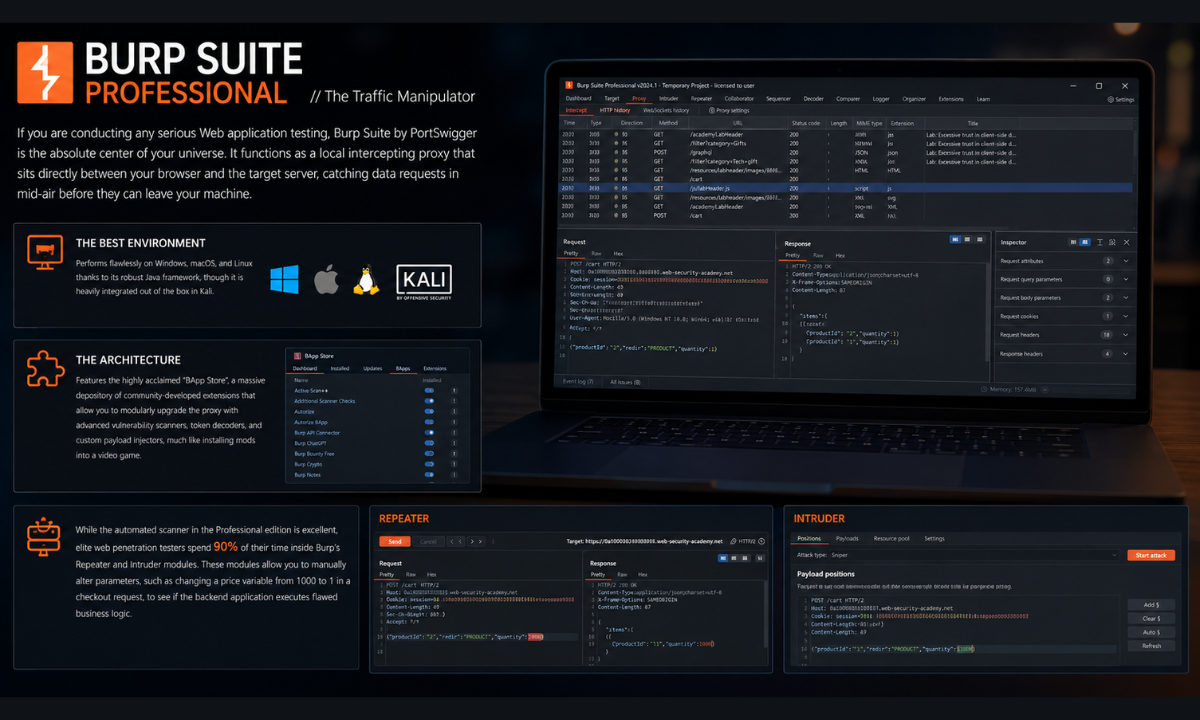
If you are conducting any serious Web application testing, Burp Suite by PortSwigger is the absolute center of your universe. It functions as a local intercepting proxy that sits directly between your browser and the target server, catching data requests in mid-air before they can leave your machine.
-
The Best Environment: Performs flawlessly on Windows, macOS, and Linux thanks to its robust Java framework, though it is heavily integrated out of the box in Kali.
-
The Architecture: Features the highly acclaimed "BApp Store", a massive depository of community-developed extensions that allow you to modularly upgrade the proxy with advanced vulnerability scanners, token decoders, and custom payload injectors, much like installing mods into a video game.
While the automated scanner in the Professional edition is excellent, elite web penetration testers spend $90\%$ of their time inside Burp's Repeater and Intruder modules. These modules allow you to manually alter parameters, such as changing a price variable from 1000 to 1 in a checkout request, to see if the backend application executes flawed business logic.
4. OWASP ZAP // The Open-Source Automator
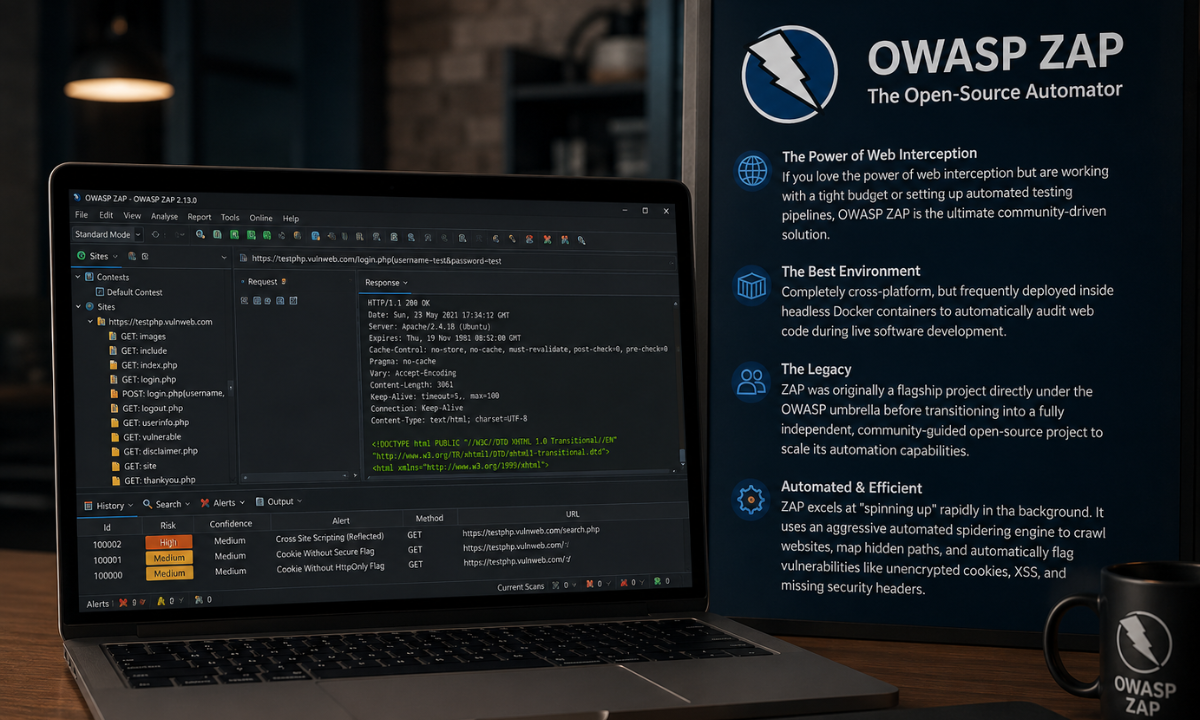
If you love the power of web interception but are working with a tight budget or setting up automated testing pipelines, the OWASP Zed Attack Proxy (ZAP) is the ultimate community-driven solution. It is widely considered one of the most popular free security tools in the global open-source marketplace.
-
The Best Environment: Completely cross-platform, but frequently deployed inside headless Docker containers to automatically audit web code during live software development.
-
The Legacy: ZAP was originally a flagship project directly under the OWASP (Open World Wide Application Security Project) umbrella before transitioning into a fully independent, community-guided open-source project to scale its automation capabilities.
Unlike other heavy software suites that require massive machine resources, ZAP excels at "spinning up" rapidly in the background. It utilizes an aggressive automated spidering engine that crawls through a target website, maps out hidden paths, and automatically flags low-hanging fruit like unencrypted cookies, cross-site scripting vulnerabilities, and missing security headers without requiring tedious manual configuration.
Exploitation & Sniffing
► TACTICAL SHIFT: RECONNAISSANCE TO COMPROMISE
► ENGAGEMENT STATUS: LETHAL
► OBJECTIVE: OBTAIN REMOTE EXECUTION & TRAFFIC CAPTURE
Finding an open door is meaningless if you don't actually walk through it. Once you have mapped the network and identified the vulnerabilities on the web layer, the assessment shifts from passive observation to active, hostile exploitation. This is where theory ends, and you actually take ownership of the target.
5. Metasploit Framework // The Weapon Delivery System
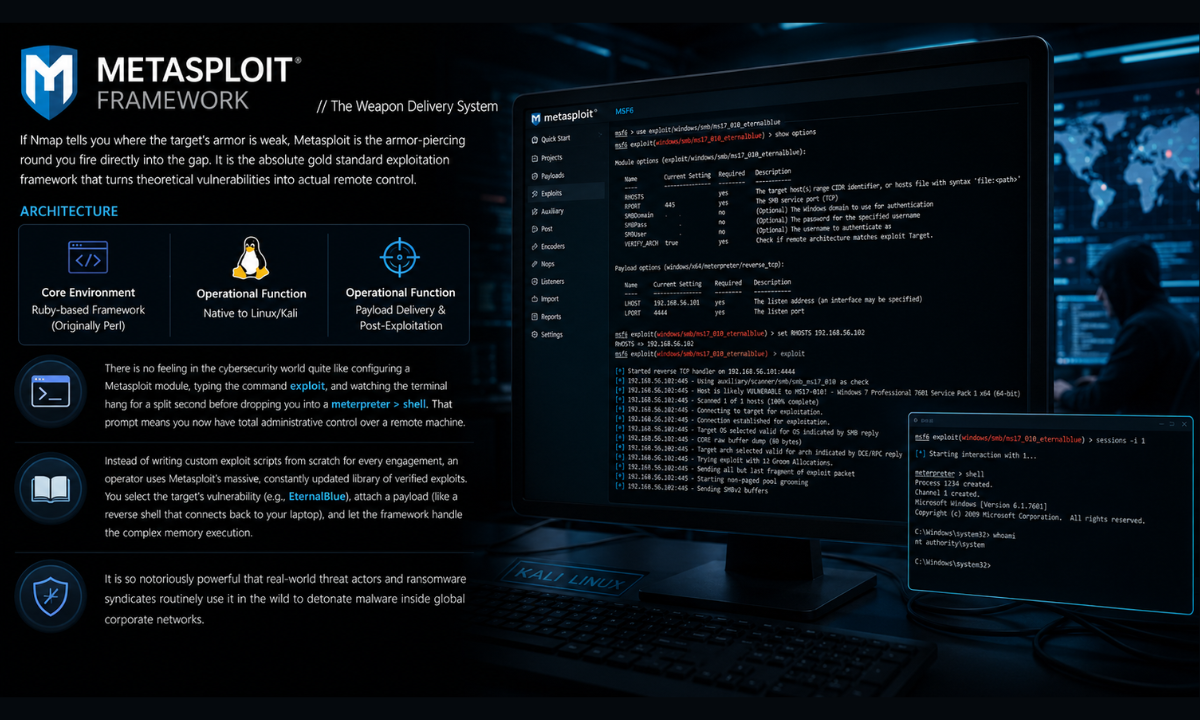
If Nmap tells you where the target's armor is weak, Metasploit is the armor-piercing round you fire directly into the gap. It is the absolute gold standard exploitation framework that turns theoretical vulnerabilities into actual remote control.
|
Architecture |
Core Environment |
Operational Function |
|
Ruby-based Framework (Originally Perl) |
Native to Linux/Kali |
Payload Delivery & Post-Exploitation |
There is no feeling in the cybersecurity world quite like configuring a Metasploit module, typing the command exploit, and watching the terminal hang for a split second before dropping you into a meterpreter > shell. That prompt means you now have total administrative control over a remote machine.
Instead of writing custom exploit scripts from scratch for every engagement, an operator uses Metasploit’s massive, constantly updated library of verified exploits. You select the target's vulnerability (e.g., EternalBlue), attach a payload (like a reverse shell that connects back to your laptop), and let the framework handle the complex memory execution.
It is so notoriously powerful that real-world threat actors and ransomware syndicates routinely use it in the wild to detonate malware inside global corporate networks.
6. Wireshark // The Invisible Wiretap

While Metasploit is loud and destructive, Wireshark is completely silent. It doesn't attack; it listens. It is the world’s foremost microscopic network protocol analyzer, and it allows you to see the literal matrix of data flowing through the airwaves and Ethernet cables around you.
The Operator's Reality: Imagine sitting in a corporate lobby. To a normal person, the Wi-Fi network is just an invisible connection. To an analyst running Wireshark in "promiscuous mode," the air is flooded with thousands of color-coded data packets. Every image someone loads, every website they visit, and every database query they run flies across your screen in real time.
When a company fails to properly encrypt its internal traffic, still relying on outdated protocols like HTTP, Telnet, or FTP, Wireshark becomes a devastating weapon. It simply reaches into the river of network traffic and pulls out administrator passwords, session cookies, and sensitive documents in completely readable, plain text.
It is entirely cross-platform, running flawlessly on Windows, macOS, and Linux. Mastering its complex filter syntax (knowing how to instantly isolate a single TCP handshake out of two million captured packets) is what separates an amateur from a senior network analyst.
Brute Force & Wireless Warfare
Once you have established a foothold or intercepted encrypted data from a corporate system, you inevitably hit a wall: encryption.
Whether it is a hashed administrator password sitting in a database dump or a secure Wi-Fi gateway blocking your physical red-team assessment, you need tools that can shatter authentication barriers. This section covers two legendary tools that handle raw brute force and wireless exploitation.
7. John the Ripper // The Cryptographic Destroyer

When you pull a list of passwords out of a compromised enterprise database, they are rarely stored in plain text. They are stored as cryptographic hashes (like SHA-256 or bcrypt). To turn those useless strings of random characters back into readable login credentials, you deploy [suspicious link removed].
-
Primary Hunting Ground: Best executed inside a high-performance Linux environment leveraging GPU acceleration.
-
The Operational Concept: It takes millions of words from a custom dictionary file, hashes each one instantly, and compares the result to the stolen target hash until it finds a perfect match.
What makes John the Ripper an absolute masterpiece is its native 'Rules' engine. Real humans don't just use "password123"; they use "P@ssword123!". John doesn't just guess blindly.
You can configure a single rule that instructs the software to automatically capitalize the first letter, swap 'a' for '@', change 'e' to '3', and append the current year to every single word in a standard dictionary list, massively multiplying your chances of a successful crack during a time-sensitive engagement.
8. Aircrack-ng // The Airwave Assassin

Physical security assessments frequently require you to breach a corporate perimeter from the parking lot. If an enterprise has its internal corporate Wi-Fi network misconfigured, Aircrack-ng is the suite of tools used to capture that traffic right out of the air and dismantle its encryption keys.
-
Primary Hunting Ground: Requires a specialized Linux environment (like Kali) paired with a dedicated external wireless USB card capable of entering packet injection and monitor modes.
Unlike standard network tools that only look at data meant for your computer, Aircrack-ng forces your wireless hardware to sniff every single packet bouncing around the room.
During an active assessment, you use the suite to de-authenticate a legitimate corporate laptop from the office router. As that laptop automatically reconnects, Aircrack-ng snatches the cryptographic "4-way handshake" out of the airwaves.
Once that handshake file is saved to your local machine, you use the suite's cracking utilities to run high-speed dictionary attacks against it offline. If the network password is weak, you will have complete access to the internal corporate LAN before you ever step foot inside the physical building.
Database Hijacking & Red Teaming
Once an external perimeter is breached, the mission shifts from simply gaining access to extracting high-value assets and establishing permanent, hidden control over the entire corporate domain. These final two applications represent the apex of data extraction and adversary simulation.
9. SQLmap // The Database Extractor

If a web application has a vulnerability in how it communicates with its backend database, SQLmap is the open-source wrecking ball you use to completely tear it open. It automates the incredibly complex process of detecting and exploiting SQL injection flaws.
-
The Best Environment: Completely cross-platform since it is written in Python, but naturally thrives inside any Linux terminal.
-
The Operational Concept: Manual SQL injection is an art form that can take hours of guessing database table structures blind. SQLmap automates this by firing thousands of highly tailored queries a minute. Once it confirms an injection point, a single --dump command will command the target server to package its entire database, including plaintext passwords, credit card hashes, and administrator emails and download it directly to your local machine.
Inside Information: SQLmap is not just for stealing data. If the target server is severely misconfigured, you can use the --os-shell flag.
This forces the database to write a malicious script onto the web server's underlying operating system, giving you a full command prompt to execute system-level commands, completely bypassing the web application entirely.
10. Cobalt Strike // The Adversary Simulator

While every tool on this list so far is used for specific technical tasks, Cobalt Strike is the overarching command center for elite Red Team operations. It is not an open-source tool for beginners; it is a premium, commercial adversary simulation framework designed to mimic the exact tactics of Advanced Persistent Threats (APTs) and state-sponsored hackers.
-
The Best Environment: The Team Server runs on a secure Linux machine in the cloud, while operators connect via the Java-based graphical client from their own secure workstations.
-
The Legacy: It is the industry gold standard for post-exploitation. It is so notoriously effective at evading antivirus and maintaining hidden access that real-world ransomware syndicates actively hunt for cracked versions of it to manage their illegal global campaigns.
Cobalt Strike’s absolute superpower is its "Beacon" payload. Once you drop a Beacon onto a compromised corporate workstation, it does not hold a loud, continuous connection back to you. Instead, it goes to sleep. It uses Malleable C2 profiles to disguise its check-ins as normal, harmless web traffic, like a user browsing a generic news site or checking DNS records. When it wakes up, it asks your command server if there are any new tasks.
You can instruct it to capture screenshots, log keystrokes, pivot to the domain controller, or inject malicious code directly into the memory of legitimate Windows processes, completely blinding the company's internal Blue Team defenders.
Why Choose Apponix?
Reading about penetration testing tools on a screen is one thing; configuring them inside a live, high-stakes terminal environment to breach a simulated corporate network is another entirely. You cannot build true muscle memory or professional confidence by skimming software manuals or watching passive video playlists. If you want to walk into a technical interview at an elite tech firm and command respect, you must be able to prove you can execute these tools flawlessly on day one.
This is where Apponix Academy completely rewrites the script. As a premier Training Institute in Bangalore, we strip away the generic academic fluff to focus on raw, aggressive operational competence.
Choosing our advanced Cyber security course in Bangalore gives you a distinct advantage over generic applicants:
-
Purely Practical Sandbox Labs: You don't just stare at slides. You get hands-on access to isolated exploitation environments where you will actively deploy SQLmap, configure Burp Suite intercept proxies, and execute Metasploit payloads.
-
Frontline Instruction: Learn the operational habits, terminal shortcuts, and defense-evasion strategies directly from seasoned offensive security consultants with years of corporate experience.
Backed by real-time partnerships with recruitment engines like Talentsarena.com, we actively align your physical portfolio with open roles across Bangalore's most competitive tech hubs.
Conclusion
The digital landscape of 2026 leaves no room for passive security strategies. The multi-million dollar liabilities associated with modern data breaches have forced companies to move completely away from generic IT support and focus heavily on proactive, offensive talent.
Mastering the top 10 penetration testing tools is your definitive gateway into this bulletproof, high-visibility tier of cybersecurity consulting. The engineering frameworks are live, the corporate demand is at an all-time high, and the tools are waiting in your terminal. Take the initiative, master the arsenal at Apponix, and turn yourself into the high-value asset global enterprises are desperately looking to hire.
Reference:
https://www.kali.org/
https://portswigger.net/burp

Apponix Academy
Apponix Academy