POPULAR COURSES
Master Programs




Table of content:
|
1. Module vs. Module: Which SAP Specialization Pays Best?
|
|
2. Experience-Based Career Trajectory & Salary Breakdown
|
|
3. The Essential 2026 Skill Matrix: Core vs. Advanced Cloud Frameworks
|
|
4. Top Employers Shaping the Bangalore Enterprise Ecosystem
|
|
5. Why Choose Apponix? |
|
6. Conclusion |
Bangalore's enterprise technology landscape is currently experiencing one of its most significant architectural shifts. As global corporations rush to modernize their legacy operations before upcoming global support deadlines, the sheer volume of SAP consultant jobs in Bangalore has reached an unprecedented peak.
While some software professionals choose to focus on infrastructure deployment by enrolling in an advanced SAP course in Bangalore at Apponix, thousands of other engineering, finance, and supply chain professionals are leveraging their domain expertise to step into high-paying consulting careers within the SAP ecosystem.
This massive wave of hiring is driven by a very specific catalyst: the upcoming 2027 mainstream support cutoff for legacy SAP ECC environments.
With nearly 18 months remaining before this deadline, mid-2026 has become the final safe on-ramp for global enterprises to execute their multi-year digital transformations. Companies are migrating their entire data landscapes to cloud-native platforms like SAP S/4HANA and the SAP Business Technology Platform (BTP).
This shift has fundamentally changed the nature of corporate IT; businesses are no longer looking for passive system administrators who simply maintain databases. They are actively headhunting strategic consultants who can re-engineer business processes from scratch.
In this comprehensive 2026 guide, we will analyze the exact data driving the Bangalore SAP recruitment market. We will compare functional and technical career paths side-by-side, analyze local salary benchmarks across experience levels, and provide you with a structured blueprint to capitalize on this massive enterprise talent bottleneck.
Let's break down where the highest career leverage sits.
Module vs. Module: Which SAP Specialization Pays Best?

The SAP ecosystem is vast, and your earning potential in the Bangalore market depends heavily on the specific module you choose to specialize in. Employers looking to fill SAP jobs look for consultants who can step directly into specific functional or technical problem domains. As every corporate department uses a different facet of the software, modules are divided into distinct career tracks, each with its own demand profile and salary leverage.
To help you evaluate where your professional or educational background fits best, let's look at a comparative matrix of the top-tier modules dominating the local recruitment market in 2026.
The 2026 SAP Module Matrix
|
SAP Module |
Primary Domain Focus |
Core Target Audience |
2026 Demand Index
|
|---|---|---|---|
|
SAP S/4HANA Finance (FICO) |
Corporate accounting, cost controlling, ledger asset management, and financial compliance. |
Commerce graduates, Chartered Accountants, BBA/MBA Finance professionals. |
Very High (Driven by active enterprise financial ledger cloud migrations). |
|
SAP Materials Management (MM) |
Supply chain mechanics, automated procurement, inventory oversight, and vendor valuation. |
Operations managers, logistics professionals, and mechanical/industrial engineers. |
High (Massive expansion across local retail and manufacturing hubs). |
|
SAP ABAP on S/4HANA |
Custom code development, Restful Application Programming (RAP), and database schema extensions. |
Computer Science engineers, Python/Java coders, and core software developers. |
Moderate to High (Shifting rapidly away from legacy ECC code to cloud extensions). |
|
SAP BTP / Cloud Architecture |
Cross-platform API integrations, extension layers, and global database infrastructure deployment. |
Senior full-stack engineers, cloud architects, and integration leads. |
Exceptional (The fastest-growing niche for advanced system integrators). |
Understanding Local Operational Demand

The clear division between functional and technical tracks means you can select an optimized career path based on your natural aptitude:
-
The S/4HANA Cloud Urgency: As companies rush to meet cloud migration deadlines, S/4HANA specialized roles (especially in FICO and cloud integration) are pulling in the highest immediate premiums.
-
Supply Chain Resilience: There has been a notable surge in SAP MM jobs in Bangalore across the region's massive e-commerce and electronics manufacturing sectors. Companies are willing to pay top-tier compensation packages for consultants who can map warehouse operations perfectly to automated supply chains.
-
The Evolution of Technical Customization: Traditional technical development is evolving. If you choose the coding path via ABAP, the market in 2026 rewards those who learn to write clean extensions on the business technology platform rather than trying to modify core standard code structures.
Choosing your module isn't just about picking the highest baseline number; it's about aligning the system logic with the type of work you naturally enjoy doing every day.
Experience-Based Career Trajectory & Salary Breakdown
Climbing the corporate ladder within the SAP ecosystem is a highly structured process. Unlike generalized IT pathways where roles can sometimes be ambiguous, SAP consulting relies on a clearly defined progression of technical ownership and client accountability. As you gain experience, your daily tasks shift away from simple operational data entry toward high-level architectural design.
When calculating your potential compensation, the SAP consultant salary in Bangalore stand out as some of the highest in the country, thanks to the high concentration of multinational consulting and Global Capability Centers (GCCs) in the region.
The Bangalore SAP Compensation Hierarchy (2026 Metrics)
|
Career Stage |
Typical Experience |
Average Annual Salary Range |
Core Operational Accountability
|
|---|---|---|---|
|
Associate / Junior Consultant |
0 to 3 Years |
₹4,50,000 – ₹7,50,000 |
Assisting with system configuration, executing baseline unit testing, and building functional specification documents. |
|
Consultant / Consultant Specialist |
3 to 6 Years |
₹8,00,000 – ₹14,00,000 |
Leading business blueprinting workshops, managing end-to-end module settings, and directly troubleshooting user issues. |
|
Senior Consultant |
6 to 10 Years |
₹15,00,000 – ₹24,00,000 |
Designing custom solution architectures, managing complex multi-module integrations, and directing small engineering teams. |
|
Principal Consultant / Lead Architect |
10+ Years |
₹25,00,000 – ₹45,00,000+ |
Steering global digital transformation rollouts, aligning with executive stakeholders, and minimizing enterprise deployment risks. |
Understanding the Stages of Growth
1. The Foundational Tier (0-3 Years)
As a fresh graduate or an industry switcher entering an entry-level position, your focus is on learning how standard business processes map directly to database tables. You spend your time shadow-testing configurations under the guidance of senior team members. At this stage, your technical baseline matters more than your industry authority.
2. The Autonomous Specialist Tier (3-6 Years)
By your third year, you are expected to own specific business workflows completely. If a client needs to re-engineer their entire vendor evaluation system, you are the one responsible for analyzing their requirements, building the system logic, and ensuring the automated data matches their real-world expectations.
3. The Leadership and Architecture Tier (6+ Years)
As you cross into leadership territory, a senior SAP consultant salary scales significantly as your responsibilities transition from standard system configurations to high-level architecture management.
You are no longer just looking at a single module; you are orchestrating how massive software ecosystems interact smoothly without causing data corruption or operational delays. At the principal level, your value is tied entirely to your ability to manage multi-million-dollar corporate transition risks smoothly.
The Essential 2026 Skill Matrix: Core vs. Advanced Cloud Frameworks

The criteria for passing a technical interview have fundamentally evolved. Historically, securing a position within the domain of SAP careers in Bangalore meant showing that you memorized specialized transaction codes (T-codes) or knew how to navigate traditional menu paths. In 2026, automation, embedded artificial intelligence, and cloud-native systems will have made basic data entry skills obsolete.
Modern enterprise architecture is built entirely upon a single, non-negotiable principle: the Clean Core Strategy. Companies no longer tolerate developers modifying the base layer of the ERP software. Instead, all modern customizations must be built completely external to the main platform. This shift separates traditional professionals from highly compensated transformation architects.
To stand out in the current competitive market, your technical toolkit must be split between foundational domain rules and modern extensibility structures.
The 2026 Talent Matrix: Foundational vs. Next-Gen Competencies
|
Competency Layer |
Legacy Technical Approach |
Modern Cloud Expectation (2026 Standard)
|
|---|---|---|
|
System Modification |
Modifying core standard tables directly via custom source code. |
Building decoupled, side-by-side applications using SAP BTP. |
|
Integration Architecture |
Relying on batch data file processing or direct database queries. |
Using live API protocols via the SAP Integration Suite. |
|
User Experience (UX) |
Utilizing classic, grey desktop terminal menus (GUI). |
Designing clean, adaptive, responsive web applications via SAP Fiori. |
|
Development Style |
Procedural programming via standard old-school ABAP tools. |
Cloud-optimized development using the RESTful Application Programming (RAP) model. |
The Core Modern Growth Accelerators
1. Decoupled Extensibility (SAP BTP)
As organizations transition their data infrastructure to cloud networks via initiatives like RISE with SAP, the ability to customize platforms safely without breaking standard code paths is critical.
Understanding how to deploy application extensions using the Cloud Application Programming (CAP) model or low-code frameworks ensures that enterprise software can receive weekly cloud updates smoothly without crashing your customized business flows.
2. AI-Ready Process Data Models
The rise of digital assistance layers such as SAP's context-aware generative AI assistant, Joule, demands perfectly clean data foundations. AI engines require standardized data models and clean process flows to automate complex logistics tasks effectively. If an enterprise architecture contains decades of undocumented, custom-coded workarounds, the underlying AI models cannot ingest the information cleanly.
Consultants who know how to prune legacy systems and build AI-optimized master data architectures command the highest premium in the modern hiring market.
Top Employers Shaping the Bangalore Enterprise Ecosystem
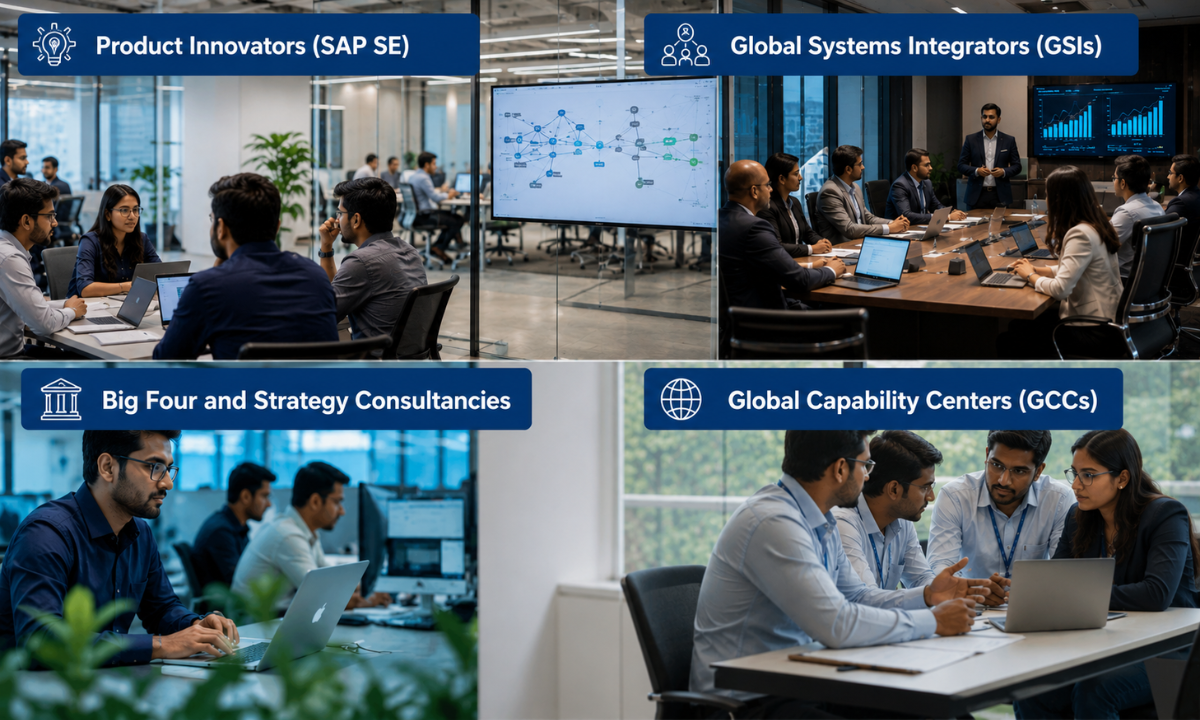
The sheer concentration of capital and technical infrastructure has turned Bangalore into the primary global hub for enterprise software deployments. If you are tracking down SAP jobs in Bangalore, you will find that the hiring market is not a monolith.
Instead, the ecosystem is divided into four distinct tiers of employers, each offering unique career vectors, work cultures, and structural focus areas.
Understanding who these employers are and what they value during the 2026 recruitment cycle allows you to tailor your resume and specialization strategy directly to their corporate needs.
Tier 1: The Product Innovators (SAP SE)
At the apex of the local market is the product creator itself. SAP Labs India maintains its second-largest global campus in Whitefield, Bangalore.
-
The Focus: Rather than configuring pre-existing systems for third-party clients, teams inside the product tier are responsible for designing, building, and refining the underlying software layers.
-
What They Hire For: This tier relies heavily on advanced system architects, data platform engineers, and core cloud developers. In 2026, their focus is centered entirely on embedding context-aware artificial intelligence layers (like Joule) directly into standard cloud ERP frameworks and expanding the capabilities of the business technology platform.
Tier 2: Global Systems Integrators (GSIs)
This layer contains the massive technology consultancies that manage large-scale technical migrations for global companies, including companies like Accenture, Capgemini, Tata Consultancy Services (TCS), Infosys, and Wipro.
-
The Focus: Systems integrators are the workhorses of the ecosystem. They secure mega-contracts to move legacy computing architectures over to unified cloud networks.
-
What They Hire For: They maintain a continuous demand for both functional and technical consultants across all experience levels. Working within a GSI provides rapid exposure to a wide range of industries, making it an exceptional training ground for early-career professionals to observe how different global supply chains and financial ledgers operate in the real world.
Tier 3: The Big Four and Strategy Consultancies
Comprising Deloitte, EY, PwC, and KPMG, the Big Four approach enterprise software through the lens of organizational finance, business strategy, and corporate compliance.
-
The Focus: These firms are usually brought into an enterprise long before any software code is written. They handle the macro-level "blueprint" phase of a project, advising corporate leadership on how to restructure their operating models to achieve maximum efficiency.
-
What They Hire For: They look for functional experts who possess a blend of corporate domain authority and deep system knowledge, such as seasoned Chartered Accountants or MBA operations specialists who can sit down with client executives and translate complex financial rules into structured configurations.
Tier 4: Global Capability Centers (GCCs)
The most disruptive growth sector in Bangalore's 2026 job market belongs to Global Capability Centers. Huge multinational entities across sectors such as Mercedes-Benz, Caterpillar, Bosch, and massive global retail giants now operate their own dedicated technical nerve centers out of Bangalore.
-
The Focus: Rather than outsourcing their systems to third-party tech vendors, these global brands are building specialized, internal teams to own and iterate on their global digital architecture.
-
What They Hire For: Moving away from historical mass-hiring models, 2026 GCC recruitment is intensely focused on niche capability-driven hiring. They are seeking highly specialized consultants who can drive internal innovation, maintain full product roadmaps, and secure their global cloud infrastructure without relying on external agencies.
Why Choose Apponix?
If you are ready to bridge the gap between classroom concepts and live system deployment, Apponix stands out as the premier Training Institute in Bangalore to fast-track your professional transition:
-
Live S/4HANA Cloud Sandbox Access: Move past static slideshows. You will get direct, hands-on access to authentic SAP cloud servers to configure real financial ledgers, materials management workflows, and custom application extensions.
-
Production-Model Project Lifecycles: Our curriculum mirrors actual corporate timelines, ensuring you gain practical experience conducting the exact AS-IS analysis, blueprint designs, and system verification testing required by global consultancies.
-
Active Enterprise Mentorship: Learn side-by-side with seasoned industry specialists who actively manage enterprise systems and bring real-world troubleshooting insights into the classroom.
We eliminate the friction of your career pivot through customised technical mock interviews, comprehensive portfolio development, and direct recruitment pathways into top-tier multinational organisations.
Conclusion
The enterprise job market in 2026 makes one thing incredibly clear: the massive talent gap created by the global cloud-migration wave represents a generational opportunity for career acceleration. However, landing these highly competitive advisory roles requires moving past simple textbook definitions and proving you can navigate complex corporate configurations under pressure.
The ongoing shift toward cloud infrastructure means that the most lucrative job opportunities belong to those who act decisively. Do not let the talent bottleneck pass you by. Connect with Apponix today, select the specialized module that fits your professional background, and turn your career aspirations into a high-paying SAP consulting reality.

Apponix Academy
Apponix Academy