POPULAR COURSES
Master Programs




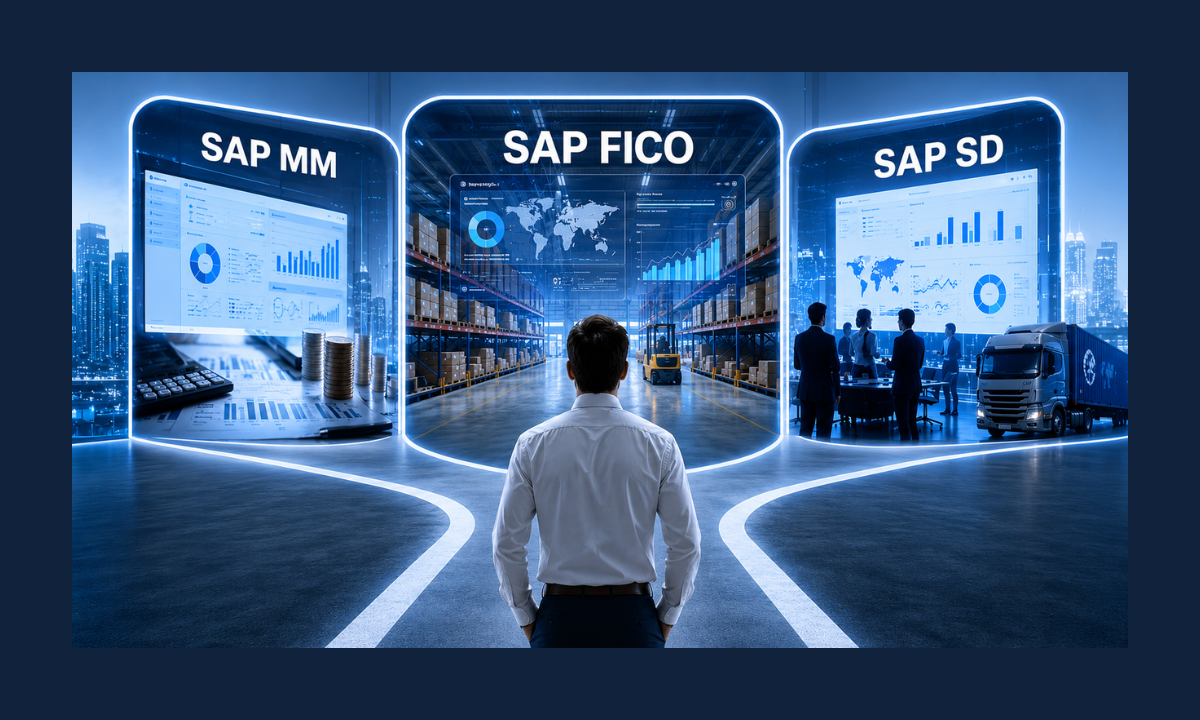
Table of contents:
|
1. SAP FICO |
|
2. Components Of The SAP FICO |
|
3. SAP MM (Material Management)
|
|
4. SAP SD
|
|
5. The 2026 Supply Demand Analysis (The Career Matrix)
|
|
6. Why Choose Apponix? |
|
7. Conclusion |
The modern tech sector has conditioned freshers to believe a massive lie that to secure a high-paying IT job in Bangalore, you must spend twelve hours a day writing complex lines of Java, Python, or C++. As a result, thousands of graduates throw themselves into the brutal coding rat race, competing against automated AI code generators and thousands of overqualified engineers for entry-level developer roles.
But there is a massive backdoor into the elite tier of the IT industry that requires absolutely zero programming skills, which can be learned easily with a SAP course in Bangalore.
Global enterprises do not run on custom code alone; they run on SAP (Systems, Applications, and Products). When a multi-billion dollar corporation manages its global finances, tracks its massive manufacturing supply chains, or processes international sales orders, they use SAP enterprise software. As these systems control the literal lifeblood of a company, the professionals who configure them are among the highest-paid consultants in the world.
If you want to bypass the entry-level developer grind and step straight into the tech corridors of Whitefield or Electronic City, you need to understand the big three enterprise modules: SAP FICO vs SAP MM vs SAP SD.
These modules represent the three major pillars of corporate survival. Choosing the right one does not depend on your ability to code; it depends entirely on aligning your university background with what global corporations are actively desperate to hire right now.
SAP FICO

If your academic background is rooted in commerce, business, or finance, global corporations are already running on software designed for your exact skill set. You do not need to pivot to learning coding languages to enter the IT sector. Instead, you need to master SAP FICO (Financial Accounting and Controlling), the absolute financial powerhouse of the enterprise world.
Every massive multinational corporation operating in Bangalore’s tech hubs must track every single rupee, dollar, and euro moving through their systems. SAP FICO is the central software matrix that automates corporate accounting, generates tax balances, and produces real-time profit analysis for executive boardrooms.
Components Of The SAP FICO

To dominate a technical interview for an entry-level FICO role, you need to master two distinct core components:
-
SAP FI (Financial Accounting) - External Reporting: This is the public face of corporate finance. You will configure ledgers that automatically manage accounts payable (what the company owes vendors), accounts receivable (what clients owe the company), and asset accounting. It ensures the company remains legally compliant with global financial laws.
-
SAP CO (Controlling) - Internal Analytics: This is the internal brain of the company. You will learn to map out cost centers, track profit margins on specific corporate products, and run deep internal audits. It gives executive management the exact data they need to cut costs and maximize profitability.
Why FICO Consultants Are Bulletproof Against Layoffs
The Corporate Reality: When the economy slows down, tech companies might pause new software applications, but they can never stop tracking their money, filing taxes, or managing corporate budgets. Because SAP FICO consultants control the financial ledger, they are historically the last professionals affected by corporate restructuring.
The Ideal Freshers Match: If your resume contains a B.Com, M.Com, BBA, or MBA in Finance, mastering SAP FICO acts as an immediate career accelerator. It takes your standard academic knowledge of debit and credit rules and upgrades it into an elite IT consultancy asset that Bangalore tech employers aggressively hunt for.
SAP MM (Material Management)

While SAP FICO manages the financial lifeblood, SAP MM (Material Management) runs the literal physical engine of an enterprise. Think of any massive manufacturing giant, e-commerce powerhouse, or automotive corporation operating out of Bangalore. These companies handle millions of tons of raw materials, spare parts, and finished goods every single day. If their supply chain breaks down for even an hour, they lose millions.
SAP MM is the critical logistics framework that ensures a company never runs out of stock, never overpays a supplier, and maintains a perfectly streamlined inventory.
The Core Operational Pillars of Material Management

When you configure an enterprise SAP MM module, you are mastering the physical movement of assets through two main business workflows:
-
Procurement (The Procure-to-Pay Cycle): You will manage how a company buys materials. This involves creating purchase requisitions, sending out requests for quotations (RFQs) to global vendors, evaluating the best prices, and issuing official purchase orders.
-
Inventory Management: Once the goods arrive at a massive warehouse, you track exactly where they are stored. You will configure systems to handle goods receipts, manage physical stock transfers between different warehouse locations, and trigger automatic alerts when inventory drops below safety levels.
The Ultimate Coding Alternative for Engineers
The Structural Advantage is that thousands of mechanical, electrical, civil, and production engineers graduate every year and immediately feel forced to learn coding just to get a job in the Bangalore IT sector.
SAP MM completely breaks this loop. It takes your existing understanding of manufacturing, operations, and logistics, and maps it directly onto high-paying enterprise IT consulting.
If your background includes a B.E., B.Tech (especially Mechanical, Production, or Industrial Engineering), an MBA in Supply Chain Management, or a B.Sc in Logistics, SAP MM is your perfect entry pass. It transforms your knowledge of physical operations into a highly technical, non-coding IT role that global supply chains are constantly fighting to hire.
SAP SD

If SAP FICO tracks the money and SAP MM manages the materials, SAP SD (Sales and Distribution) is the high-octane engine that actually forces revenue into the enterprise. A company can have perfect financial records and warehouses bursting with stock, but if it cannot sell its products, ship them to customers, and generate invoices, the entire operation collapses.
SAP SD controls the absolute frontline of business operations. It maps out how products move from corporate inventories directly into the hands of global clients, managing pricing matrixes, shipping routes, and customer billing variables simultaneously.
The Order-to-Cash (O2C) Cycle
In the corporate world, an SAP SD consultant is the master of the O2C cycle. This isn't just an administrative checklist; it is a high-speed digital relay race that triggers every single time a customer places an order:
|
[Customer Order] ➔ [Availability Check] ➔ [Shipping & Picking] ➔ [Billing & Invoicing] ➔ [FICO Integration] |
1. Sales Order Creation: The moment a client buys a fleet of vehicles or a massive batch of microchips, SAP SD instantly logs the transaction, automatically applies bulk discounts, and calculates regional taxes.
2. Availability Check (The MM Handshake): The system immediately communicates with the warehouse (SAP MM) to verify that the items are physically in stock and locks them so no other client can buy them.
3. Outbound Delivery & Picking: The software prints out picking lists for warehouse robots or workers, schedules freight carriers, and calculates the fastest shipping route out of the Bangalore distribution hubs.
4. Billing & Revenue Realization: Once the goods cross the border or leave the loading dock, SAP SD auto-generates the official commercial invoice and seamlessly hands the data over to the finance team (SAP FICO) to close the loop.
If you possess a BBA, an MBA in Marketing or International Business, or any degree combined with an aggressive, problem-solving personality, SAP SD is your golden ticket. It is an incredibly dynamic, high-visibility role where your configuration work directly impacts the company’s daily revenue performance.
The 2026 Supply Demand Analysis (The Career Matrix)
Choosing between SAP FICO vs SAP MM vs SAP SD is not a matter of finding which module is objectively "best." Instead, it is about identifying which module offers the highest leverage for your specific educational background and career goals.
To succeed as a fresher in the highly competitive Bangalore IT market, you must treat your skill acquisition as a strategic business decision based on a cold, data-driven supply and demand analysis.
If you enter a module where the market is already flooded with generic applicants, you will face low starting salaries and brutal interview pipelines. However, if you select one of the specialized SAP modules that perfectly align with your university degree, corporate hiring managers will actively seek you out to fill their open consulting roles.
The Ultimate Bangalore Freshers Career Matrix
To give you an absolute, unfair advantage over other job seekers, here is the direct breakdown of how the big three modules stack up across Bangalore’s major tech corridors (including Whitefield, Electronic City, and Manyata Tech Park).
|
Comparison Metric |
SAP FICO (Finance & Controlling) |
SAP MM (Material Management) |
SAP SD (Sales & Distribution) |
|
Core Corporate Focus |
Corporate ledger tracking, tax compliance, and internal profit auditing. |
Material management, supplier procurement, and warehouse inventory control. |
Customer order processing, shipping logistics, and invoicing workflows. |
|
Ideal Educational Match |
B.Com, M.Com, CA, BBA Finance, or MBA in Finance. |
B.E. / B.Tech (Mechanical, Civil, Production), or MBA in Supply Chain. |
BBA, MBA in Marketing, International Business, or any B.Com graduate with an interest in sales. |
|
Bangalore Market Demand |
Extremely High & Constant (Every enterprise requires financial tracking). |
Very High (Driven heavily by manufacturing, automotive, and retail MNCs). |
High & Growth-Oriented (Fueled by global e-commerce and distribution hubs). |
|
Core Technical Hurdles |
Understanding complex taxation, asset accounting, and currency variations. |
Mastering movement types, physical inventory counts, and vendor evaluation rules. |
Navigating complex pricing matrixes, multi-tier discount structures, and shipping routes. |
|
Key Cross-Module Integration |
Integrates directly with MM and SD to receive automated billing data. |
Connects with FICO for material valuation and SD for inventory stock picking. |
Integrates with MM for product availability checks and FICO for final customer invoicing. |
How to Choose Your Path: The Direct Match Checklist
To ensure you make the right investment when enrolling in an SAP course in Bangalore, review these three final decision parameters:
-
Choose SAP FICO if: You love working with numbers, balance sheets, and structural financial data, and you want a career that remains entirely resilient during economic recessions.
-
Choose SAP MM if: You have an engineering background or an operational mindset, you understand how physical goods move through factories, and you want to manage massive corporate supply chains.
-
Choose SAP SD if: You possess excellent communication skills, thrive in high-energy business environments, and want to control the digital systems that directly generate corporate revenue.
Why Choose Apponix?
Reading a supply and demand matrix is useless if you do not have the technical environment to actually build the skills.
You cannot learn enterprise SAP configuration by reading generic PDF manuals or watching outdated tutorials. To convince corporate hiring managers in Electronic City or Whitefield that you are ready to manage their massive financial ledgers or global supply chains, you need undeniable, hands-on server experience.
This is where Apponix Academy completely separates you from the competition. As the premier Training Institute in Bangalore, we have reverse-engineered our curriculum based entirely on what top-tier MNCs are demanding right now.
When you enroll in the ultimate SAP course in Bangalore at Apponix, you are not just getting a certificate; you are gaining a full corporate launchpad.
-
100% Practical Server Access: We provide 24/7 access to live SAP environments, allowing you to configure realistic business scenarios, execute procure-to-pay cycles, and run actual financial reports.
-
Veteran Industry Instructors: You learn directly from active consultants who have implemented SAP across global enterprises, completely bypassing academic theory for frontline tactical knowledge.
-
The Placement Guarantee Engine: With major branches strategically located across Bangalore (including Rajajinagar, Marathahalli, and Banaswadi), our dedicated placement cell actively pushes your resume to our established network of corporate recruiters.
Stop competing for entry-level coding jobs that are slowly being erased by automation. Choose your strategic SAP module, build the exact skills the market is desperate to hire, and let Apponix fast-track your entry into Bangalore's elite consulting sector.
Conclusion
The highest-paying roles in the IT industry are not reserved solely for software developers; they are held by the professionals who control the core enterprise systems that keep businesses alive.
The battle between SAP FICO vs SAP MM vs SAP SD is not about finding the superior software, but rather identifying the perfect strategic match for your specific educational background. By aligning your commerce, engineering, or business degree with the correct SAP module, you bypass the brutal coding rat race and step directly into a lucrative, highly secure consulting career. The demand across Bangalore's corporate sector is massive, the roadmap is clear, and the decision on which path to take is entirely in your hands.
Reference:
https://www.sap.com/about/careers.html
https://learning.sap.com/

Apponix Academy
Apponix Academy