POPULAR COURSES
Master Programs



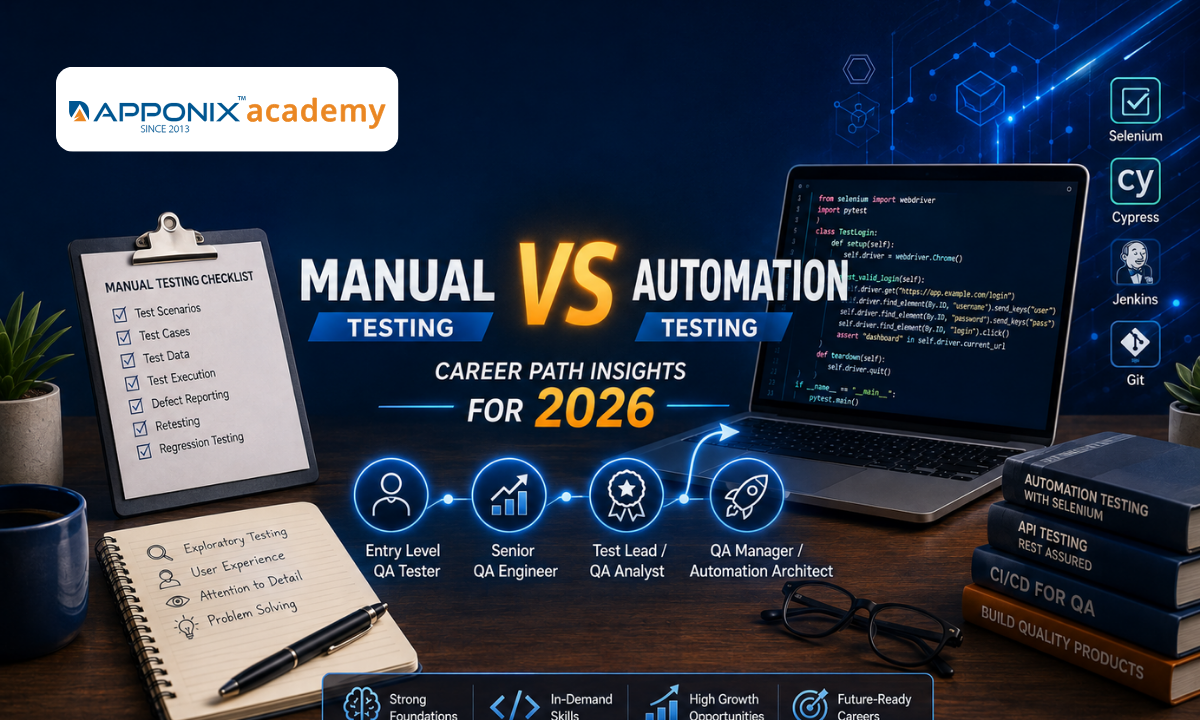
Table of contents:
|
1. Core Differences & Market Demand in 2026: When Each Method Wins
|
|
2. In-Demand Tool Stacks & Technical Competencies for 2026
|
|
3. Compensation Benchmarks & Career Opportunities in India
|
|
4. Step-by-Step Transition Roadmap: From Manual QA to SDET
|
| 5. Why Choose Apponix Technologies for Software Testing Mastery? |
| 6. Conclusion |
When choosing a path in quality assurance, evaluating manual vs automation testing is the most crucial decision defining your daily technical work, job security, and salary growth. Enrolling with a top-rated training institute in Bangalore equips aspiring QA professionals with the hands-on frameworks and testing logic needed to succeed in modern development teams.
Whether you are a non-tech graduate starting fresh or a working tester looking to transition into an SDET role, taking a structured Software testing course in Bangalore bridges the gap between manual test case design and scalable code-driven test automation.
Software delivery cycles operate on rapid continuous integration (CI/CD) pipelines and frequent releases. In this environment, the traditional QA debate has evolved into a complementary relationship:
-
Manual Testing as the Thinking Engine: Manual testing remains essential for user experience (UX) evaluation, exploratory defect hunting, and validating complex edge cases where human intuition is irreplaceable.
-
Automation Testing as the Scaling Engine: Automation handles repetitive regression suites, cross-browser validation, and microservices API testing across every code commit in minutes.
Modern engineering teams rarely look for pure executioners who only follow rigid test scripts. Instead, the highest-earning quality engineers treat manual testing principles as the foundation for designing smart, automated testing frameworks.
This guide breaks down current market demand, modern toolchains, salary benchmarks across India, and a clear transition roadmap to help you build a resilient testing career.
Core Differences & Market Demand in 2026: When Each Method Wins
Understanding the shift in Manual testing vs automation demand requires looking past binary comparisons. In modern Agile and DevOps environments, manual and automated approaches serve distinct phases of product quality.
Automation handles structured verification at high velocity, while manual testing delivers context-aware investigation where human judgment is critical.
Manual vs. Automation Testing Comparison Matrix
|
Evaluation Dimension |
Manual Testing |
Automation Testing
|
|---|---|---|
|
Primary Objective |
Human UX validation, exploratory bug hunting, and business logic verification. |
High-speed regression verification, CI/CD pipeline gating, and data-driven load checks. |
|
Execution Speed |
Dependent on human pace; slower for large, repetitive test suites. |
High execution speed; runs parallel tests across browsers and devices in minutes. |
|
Initial Investment & Setup |
Low setup time; requires test case documentation and immediate execution. |
High initial setup effort; requires writing modular code, frameworks, and test data fixtures. |
|
Repetitive Execution Cost |
Increases linearly with team size and release frequency. |
Decreases per run once the framework is stabilized and integrated into CI/CD. |
|
Defect Discovery Focus |
Uncovers unexpected UX flaws, edge-case logic gaps, and usability friction. |
Catches breaking changes, broken API contracts, and regressions in existing functionality. |
|
Technical Skill Requirement |
Domain knowledge, analytical test design, and bug tracking tools (Jira). |
Programming proficiency (Java/Python/JS), framework design (POM, BDD), and CI/CD tooling. |
When Manual Testing Wins
-
Exploratory & Ad-Hoc Testing: Exploratory testing relies on active curiosity, risk assessment, and unexpected user journeys that automated test scripts cannot anticipate.
-
User Experience (UX) & Usability Evaluation: While scripts can verify that a checkout button responds with an HTTP status, only human testers can determine if visual layouts cause confusion or user drop-off.
-
Early-Stage Features & Rapid MVPs: In newly developed modules where UI elements and business requirements shift daily, writing automation scripts introduces excessive maintenance overhead.
When Automation Testing Wins
-
Continuous Regression in CI/CD Pipelines: Automated regression suites validate that new feature deployments do not break existing production workflows across every code commit.
-
Cross-Browser and Cross-Device Matrix Testing: Automated frameworks execute identical test suites simultaneously across Chrome, Firefox, Safari, Edge, Android, and iOS in headless cloud environments.
-
API & Backend Data-Driven Verification: Scripts test thousands of API payload combinations, validate database state transitions, and verify microservice contracts faster than manual inspection.
Understanding these operational differences clarifies why relying solely on manual test execution creates career plateaus, whereas combining solid test case design with automation scripting positions you for resilient, high-growth engineering roles.
In-Demand Tool Stacks & Technical Competencies for 2026

Achieving rapid Automation testing career growth 2026 requires mastering modern, production-grade toolchains rather than outdated record-and-playback utilities. Modern software architectures rely heavily on microservices, single-page applications, and cloud-native release pipelines, meaning quality engineers must automate across multiple layers of the testing pyramid.
Modern Test Automation Tool Stack by Layer
|
Testing Layer |
Industry-Standard Tools & Frameworks |
Primary Function in Production
|
|---|---|---|
|
Web UI Automation |
Playwright, Selenium 4, Cypress |
End-to-end user journey simulation, multi-browser verification, and responsive design checks. |
|
API & Microservices |
Postman, REST Assured, Karate, Supertest |
Validating REST/GraphQL endpoints, status codes, payload contracts, and database states. |
|
Mobile App Testing |
Appium, Maestro |
Native and hybrid iOS/Android mobile application testing across real devices and emulators. |
|
CI/CD & Build Tools |
Jenkins, GitHub Actions, GitLab CI, Maven |
Triggering automated test suites on code commits and blocking builds when critical tests fail. |
|
Test Runners & BDD |
TestNG, JUnit 5, Pytest, Cucumber |
Structuring test execution, generating clear HTML reports, and enabling business-readable tests. |
Core Competencies Employers Look For
-
Modern Web UI Frameworks (Playwright & Selenium 4): While Selenium remains an enterprise staple with wide language support, Playwright has grown rapidly due to its native multi-browser architecture (Chromium, Firefox, WebKit), fast execution speed, and built-in auto-waiting that reduces test flakiness.
-
API & Backend Contract Testing (REST Assured & Postman): Because UI testing can be slow to execute, engineering teams run a substantial portion of their automated checks at the API layer, validating JSON responses, status codes, and authentication tokens before UI rendering occurs.
-
Behavior-Driven Development (BDD with Cucumber): Writing test scenarios in structured plain English using Gherkin syntax (Given-When-Then) bridges the communication gap between business analysts, developers, and QA engineers.
-
Design Patterns & CI/CD Integration: Modern testers structure automation code using modular design patterns like the Page Object Model (POM) and connect test execution directly to GitHub Actions or Jenkins pipelines for automated continuous delivery.
-
AI-Assisted Test Maintenance: QA teams increasingly integrate AI-driven visual regression and self-healing locators into their workflows, minimizing the manual hours spent maintaining fragile scripts when application interfaces change.
Developing hands-on skills across these core toolchains ensures you do not just write basic test scripts, but build maintainable, enterprise-ready test automation suites that engineering teams depend on for daily production releases.
Compensation Benchmarks & Career Opportunities in India
The salary gap between purely manual software testers and automation-focused engineers in India has widened significantly.
While manual testing provides a reliable entry point into tech, analyzing modern Automation testing salary trends demonstrates that learning framework design, scripting, and CI/CD pipelines directly multiplies your earning potential across Indian tech hubs like Bengaluru, Pune, and Hyderabad.
Expanding your testing toolkit opens up diverse Testing career opportunities in India, ranging from standard IT consulting firms to high-paying Global Capability Centers (GCCs) and product unicorns.
Comparative QA Salary Matrix across Experience Tiers in India
|
Experience Level & Tier |
Manual QA Engineer (CTC) |
Automation QA Engineer (CTC) |
SDET / Test Architect (CTC) |
Primary Value Drivers
|
|---|---|---|---|---|
|
Entry / Fresher (0 – 2 Years) |
₹3.2 LPA – ₹5.0 LPA |
₹4.5 LPA – ₹8.5 LPA |
₹8.0 LPA – ₹14.0 LPA |
Core test case design, basic scripting (Java/Python), API testing with Postman. |
|
Mid-Level (3 – 6 Years) |
₹5.5 LPA – ₹9.0 LPA |
₹10.0 LPA – ₹18.0 LPA |
₹16.0 LPA – ₹26.0 LPA |
Framework design (POM, BDD), Playwright/Selenium 4, REST Assured, CI/CD integration. |
|
Senior (7 – 10 Years) |
₹9.5 LPA – ₹14.0 LPA |
₹19.0 LPA – ₹28.0 LPA |
₹27.0 LPA – ₹42.0 LPA |
Multi-layer test architecture, pipeline orchestration, performance testing, team leadership. |
|
Lead / Architect (10+ Years) |
₹14.0 LPA – ₹20.0 LPA |
₹28.0 LPA – ₹40.0 LPA |
₹42.0 LPA – ₹60.0 LPA+ |
Enterprise QA strategy, test infrastructure engineering, AI-driven quality governance. |
Major Factors Driving QA Compensation Growth
-
The Product Company & GCC Multiplier: Global Capability Centers and venture-backed SaaS startups in Bengaluru and Hyderabad routinely pay 40% to 70% higher packages than traditional IT service companies for the same years of experience. These high-paying firms expect candidates to take full ownership of test architecture rather than merely running static test scripts.
-
The SDET and Tooling Premium: Knowing modern tools like Playwright and REST Assured provides a noticeable pay advantage over legacy Selenium-only profiles. Engineers who write clean code, handle complex API mocks, and prevent flaky test runs command top-tier compensation brackets during technical salary negotiations.
-
Continuous Integration & Pipeline Ownership: QA professionals who know how to embed automated test suites into Jenkins, GitLab CI, or GitHub Actions pipelines become indispensable to DevOps teams, allowing them to bypass traditional annual appraisal limits when changing roles.
Transitioning from manual execution to automation engineering does not just increase your base salary it insulates your career against automation displacement and establishes a direct trajectory toward high-impact SDET and engineering leadership positions.
Step-by-Step Transition Roadmap: From Manual QA to SDET
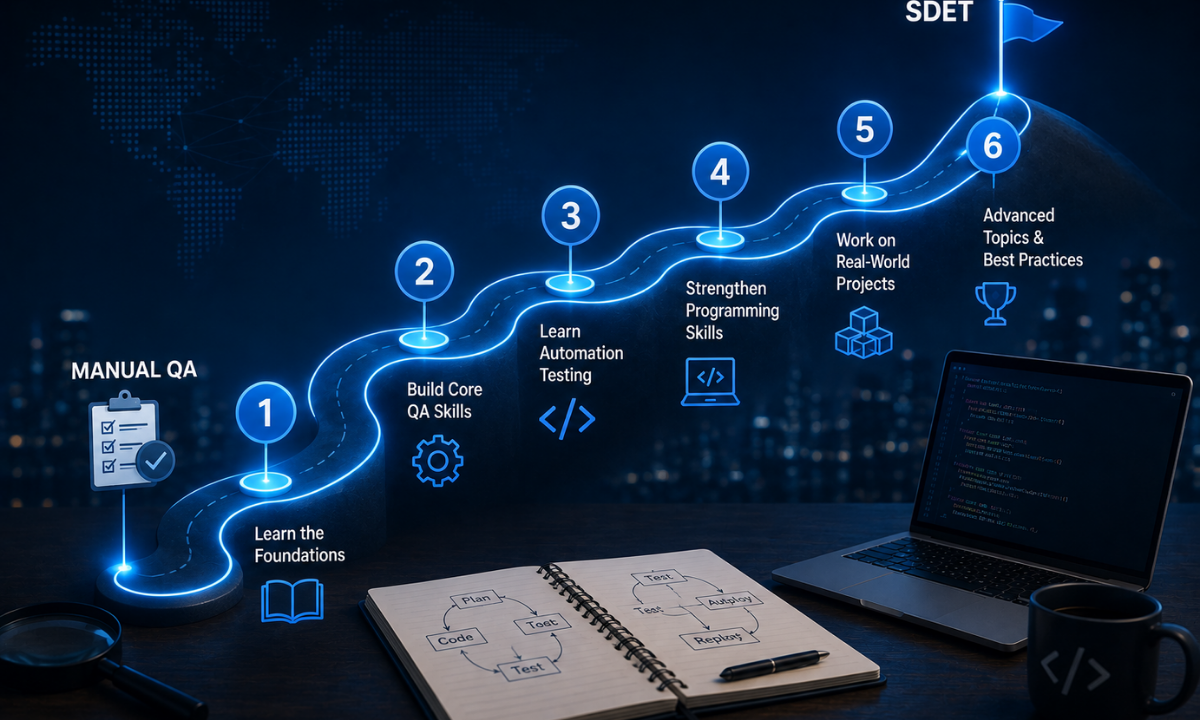
For working testers and non-programming graduates, the Best career path in software testing is not achieved by attempting to master ten different tools simultaneously.
Instead, it requires following a structured, milestone-driven progression from foundational coding concepts to scalable framework architecture and continuous delivery pipelines.
The 4-Stage Transition Pipeline
|
Stage 1: Core Programming |
Stage 2: Web UI Frameworks |
Stage 3: API & Database |
Stage 4: CI/CD & AI-QA
|
|---|---|---|---|
|
Java / Python / JS, OOP, Collections, File I/O |
Page Object Model (POM), Playwright, Selenium 4, BDD |
REST Assured, Postman, SQL assertions, Contract testing |
GitHub Actions, Jenkins, Docker, AI visual regression |
Stage 1: Core Programming & Problem-Solving Fundamentals
The biggest barrier manual testers face is coding anxiety. Conquering this step involves mastering one language deeply (Java or TypeScript/Python) rather than dabbling in several.
-
Variables, Data Types, and Collections: Learn how to store test data using lists, maps, sets, and arrays to handle multi-parameter user inputs dynamically.
-
Object-Oriented Programming (OOP): Master classes, encapsulation, inheritance, and polymorphism, which form the building blocks of clean automation frameworks.
-
Exception Handling & File I/O: Write defensive code that reads test data from external JSON or Excel files and catches runtime errors gracefully without halting test suites.
Developing confidence in fundamental programming concepts allows you to write custom validation logic instead of simply copying code snippets from online tutorials.
Stage 2: UI Automation Framework Design & Page Object Model (POM)
Once you understand basic coding logic, move on to browser automation and learn to structure scripts into reusable design patterns.
-
Locator Strategies & Dynamic Synchronization: Master robust CSS and XPath selectors and implement explicit waits to avoid flaky test failures caused by slow-loading web elements.
-
Page Object Model (POM) Implementation: Separate web page elements from test verification logic, ensuring that UI redesigns only require updating a single page class.
-
Test Runners & Reporting Integration: Use TestNG, JUnit 5, or Pytest to run tests in parallel, group regression suites, and generate clean HTML execution logs for stakeholders.
Designing a modular UI automation framework from scratch gives you a concrete, reviewable project to showcase to technical hiring panels.
Stage 3: API Testing, Database Assertions & Contract Validation
Modern SDET roles require testing beyond the browser interface, verifying business logic directly through backend service endpoints.
-
RESTful API Automation (Postman & REST Assured): Automate GET, POST, PUT, and DELETE requests, validating status codes, response times, and header configurations.
-
Schema & Payload Assertion: Validate nested JSON response structures and verify data integrity across microservices using library assertions.
-
SQL Database Verification: Write SQL queries (SELECT, JOIN, WHERE) to confirm that actions performed through web interfaces or APIs update database records accurately.
Automating backend tests creates fast, reliable regression suites that catch breaking service changes before they affect user-facing interfaces.
Stage 4: CI/CD Pipeline Automation & AI-Assisted Testing
The final phase transforms an automation scripter into a full-fledged quality engineering professional who owns release gates.
-
Continuous Testing with CI/CD Tools: Configure GitHub Actions or Jenkins to run automated regression suites on every pull request and prevent broken builds from reaching staging.
-
Cross-Browser Cloud Execution: Run headless test runs in parallel using Docker containers or cloud execution platforms to shorten feedback loops.
-
AI-Driven Quality Engineering: Use AI tools for smart test data generation, automated root-cause failure triage, and self-healing test locators to minimize maintenance overhead.
Completing all four stages transitions your professional identity from a manual executor to an engineering partner who actively shapes software quality and deployment reliability.
Why Choose Apponix Technologies for Software Testing Mastery?
Building a successful career in quality engineering requires moving beyond basic test definitions to write, debug, and execute live automation scripts. Apponix Technologies provides a practical, industry-aligned learning ecosystem designed to help freshers and manual testers build production-grade test automation skills without coding anxiety.
Guided by experienced QA leads, students master core programming fundamentals, build modular frameworks from scratch, and integrate test suites directly into modern deployment pipelines.
-
Custom Framework Design from Scratch: Build robust Page Object Model (POM) and Behavior-Driven Development (BDD Cucumber) frameworks using Java, Python, or JavaScript, ensuring you understand the underlying architecture rather than just editing pre-built templates.
-
End-to-End API & Database Automation: Learn how to test RESTful APIs using Postman and REST Assured, validate JSON payloads, and run SQL queries to ensure total backend data integrity.
-
1-on-1 Mentorship from Senior QA Architects: Receive personalized code reviews and debugging support from working software testing professionals who design enterprise test suites daily.
-
GitHub Portfolio & Resume Engineering: Build a publicly accessible GitHub portfolio featuring functional automation frameworks, automated API test suites, and CI/CD configuration files that prove your technical skills to hiring managers.
Gain access to active hiring drives across top IT consulting firms, fast-growing startups, and Global Capability Centers (GCCs) in Bengaluru, supported by structured mock technical interviews.
Conclusion
The debate between manual and automation testing is not about one method replacing the other, but about knowing how to use both effectively. Manual testing gives you the analytical mindset needed to understand user journeys and identify subtle edge-case risks, while automation provides the scale, speed, and reliability required by modern engineering teams.
Combining solid test design with modern framework scripting and CI/CD integration protects your career against industry shifts and establishes a clear path toward high-impact SDET and quality leadership roles.
Reference:
https://www.testometer.co.in/blogs/details/Future-of-Software-Testing

Apponix Academy
Apponix Academy