POPULAR COURSES
Master Programs




Table of contents:
|
1. Introduction |
|
2. What Does a Penetration Tester Do? |
|
3. Essential Technical Skills for a Penetration Tester |
|
4. Essential Professional Skills for Penetration Testers |
|
5. Skills Beginners Should Learn First |
|
6. How to Build and Demonstrate Practical Skills |
|
7. Advanced Skills and Specialisations |
|
8. The Role of Certifications in a Penetration Testing Career |
|
9. Frequently Asked Questions |
|
10. Conclusion |
Introduction
The essential skills for a penetration tester include networking, Linux and Windows administration, web application security, scripting, vulnerability validation, and report writing. Analytical thinking, communication, and ethical responsibility are equally important.
As businesses rely on networks, cloud infrastructure, and web applications, protecting sensitive information becomes a major priority. Penetration testers help organisations identify and validate security weaknesses through controlled, authorised testing.
This guide explains the technical and professional skills beginners should develop, which foundations to learn first, and how to demonstrate their abilities through practical projects.
What Does a Penetration Tester Do?

A penetration tester evaluates an organisation's security by simulating realistic attack scenarios within an explicitly authorised scope. The objective is to identify exploitable weaknesses and help the organisation strengthen its defences.
Typical responsibilities include:
-
Defining the scope: Understanding which systems, applications, networks, and testing methods are authorised.
-
Reconnaissance and enumeration: Collecting relevant information about the target environment.
-
Identifying vulnerabilities: Examining configurations, software, access controls, and network services for security weaknesses.
-
Validating findings: Safely determining whether a suspected vulnerability is genuine and assessing its potential impact.
-
Documenting results: Recording evidence, risk levels, affected assets, and recommended remediation.
-
Retesting fixes: Checking whether the teams responsible for remediation have successfully addressed reported vulnerabilities.
A penetration tester does more than find weaknesses. The role involves helping organisations understand their exposure and make informed security improvements. Testing must remain within the agreed scope, with appropriate permission and safeguards for sensitive data.
Essential Technical Skills for a Penetration Tester
1. Networking Fundamentals
Networking is one of the most important foundations of penetration testing. Testers need to understand how devices communicate, how data travels between systems, and where security controls operate.
Important concepts include IP addressing, TCP and UDP, DNS, HTTP and HTTPS, ports, routing, subnetting, firewalls, and common network protocols. Knowledge of the TCP/IP model also helps testers understand how communication problems and security weaknesses can arise.
For example, recognising an unexpectedly exposed service can help a tester investigate whether it is necessary, properly configured, and adequately protected.
How to develop this skill:
Learn networking fundamentals before relying heavily on scanning tools. Practise interpreting packet captures and examining traffic in an authorised lab using Wireshark.
2. Linux and Windows Operating Systems
Operating system knowledge helps penetration testers understand permissions, processes, services, file systems, user accounts, and security configurations. Linux is particularly relevant because many security tools run in Linux environments.
Aspiring testers should become comfortable with terminal commands, file permissions, package management, process inspection, shell operations, and basic system administration. Kali Linux is a commonly used distribution for security testing. Understanding Linux beyond its preinstalled tools is more valuable than simply learning a collection of commands.
Windows knowledge is equally important because organisations frequently use Windows endpoints, servers, and enterprise identity systems. Testers should understand user privileges, services, event logs, authentication, and security policies.
How to develop this skill:
Set up virtual machines, practise administrative tasks, examine system logs, and learn how to identify insecure configurations in systems you own or are authorised to test.
3. Web Application Security
Web applications handle logins, payments, customer information, business transactions, and other sensitive data. Their security is therefore a significant area of penetration testing.
Testers should understand HTTP requests and responses, cookies, sessions, authentication, authorisation, input validation, and database interactions. They should also understand application programming interfaces (APIs), which allow software systems to exchange data. Recognise common vulnerabilities such as broken access control, injection flaws, security misconfigurations, and weaknesses in session management.
For instance, an application may allow a user to access another user's information because it does not properly verify permissions. A penetration tester investigates this behaviour, establishes the potential impact, and recommends an appropriate fix.
How to develop this skill:
Study recognised web security guidance, such as the OWASP Top 10, and use deliberately vulnerable training applications to practise web application security testing in a controlled environment.
4. Programming and Scripting
Does penetration testing require coding? Not every entry-level task requires advanced programming, but coding knowledge can significantly improve a tester's efficiency and problem-solving ability.
Python is a useful starting point for automating repetitive tasks, processing scan results, analysing files, making HTTP requests, and working with APIs. Basic knowledge of Bash helps with Linux automation, while PowerShell is useful for Windows administration and security investigations.
JavaScript, SQL, and an understanding of common web development technologies are also valuable when testing web applications. Beginners should focus on reading code, understanding variables, loops, functions, conditions, and error handling before attempting complex scripts.
The goal is to understand what a script does, identify its limitations, and adapt it safely to an authorised testing task.
5. Reconnaissance and Enumeration
Reconnaissance involves collecting information about a target, while enumeration identifies available services, resources, and other relevant details. Within the authorised testing scope, penetration testers may examine DNS records, exposed services, application technologies, and system configurations.
Tools such as Nmap support network discovery, while other utilities help analyse DNS records and identify web technologies. Testers must interpret results carefully because automated tools can produce incomplete or inaccurate findings.
Effective reconnaissance requires a methodical approach, with all activities limited to explicitly authorised systems and agreed testing boundaries.
6. Vulnerability Assessment and Validation
Identifying a possible vulnerability is only part of the job. Penetration testers must determine whether it is real, reproducible, and relevant to the organisation's risk.
This requires an understanding of vulnerability types, security configurations, patch management, authentication mechanisms, and the difference between theoretical weaknesses and demonstrated security impact.
Automated scanners can identify potential problems, but they may also generate reported issues that are not genuine vulnerabilities called false positives. Skilled testers validate findings using controlled methods, collect sufficient evidence, and avoid unnecessary disruption.
They should also understand vulnerability severity and business impact. A weakness affecting a public-facing application that stores sensitive customer data may require a different response from a low-risk issue in an isolated test environment.
7. Familiarity with Penetration Testing Tools
Penetration testing tools support discovery, inspection, validation, and reporting. However, knowing when and why to use a tool is more important than memorising its commands.
Beginners can start with:
-
Nmap: Network discovery and service identification.
-
Wireshark: Network traffic capture and analysis.
-
Burp Suite: Inspection and testing of web application traffic.
-
Metasploit Framework: Controlled security testing and exploit validation.
-
Kali Linux: A Linux distribution containing numerous security testing utilities.
However, tool output is not proof of a vulnerability. Penetration testers must interpret results in context, verify findings through safe and reproducible tests, distinguish genuine vulnerabilities from false positives, and assess the potential business impact. They should also document supporting evidence and recommend appropriate remediation rather than relying solely on automated scan results.
8. Windows and Active Directory Security
Active Directory is Microsoft’s directory service for managing users, computers, and access to resources in Windows domain environments. Understanding its security model can help penetration testers assess enterprise environments.
Relevant concepts include domain users and groups, authentication, access permissions, Group Policy, service accounts, and privilege management. Testers should also understand how excessive permissions, weak configurations, and poorly managed credentials can increase security risk.
Beginners can learn these concepts by building a small virtual lab and examining how identity and access controls work. Advanced testing should follow a clearly authorised scope and avoid exposing real credentials or disrupting production systems.
Essential Professional Skills for Penetration Testers
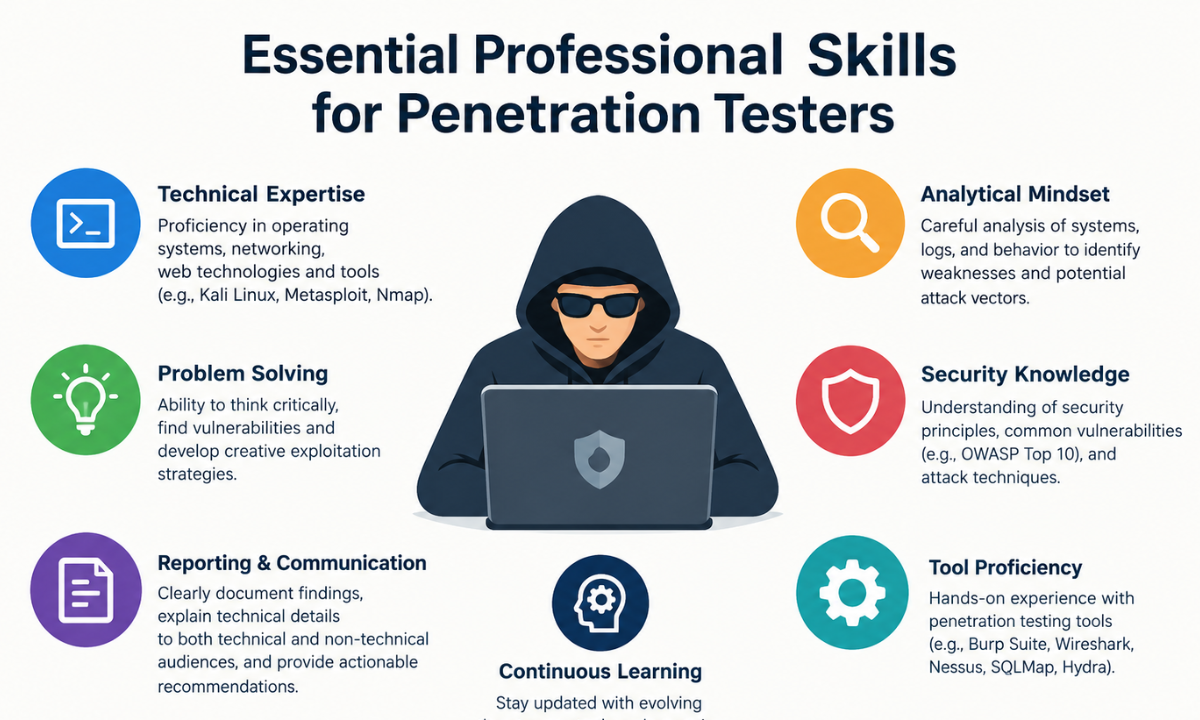
Technical knowledge alone does not make someone an effective penetration tester. Professional skills are necessary to turn technical observations into actionable security improvements.
Analytical Thinking and Problem-Solving
Testers must connect evidence, investigate unexpected behaviour, and consider multiple explanations for a potential vulnerability. A structured approach helps them distinguish genuine security issues from ordinary system behaviour.
Report Writing and Documentation
Writing clear penetration testing reports is a core professional skill. Reports should explain the finding, affected asset, reproduction steps, supporting evidence, potential impact, severity, and recommended remediation.
Clear documentation allows developers, system administrators, and security managers to understand what needs to change. Reports should avoid unnecessary jargon and protect sensitive information.
Communication and Collaboration
Penetration testers often work with developers, IT administrators, compliance teams, and security analysts. They need to explain technical issues in language appropriate to each audience, discuss remediation options, and respond constructively to questions.
Attention to Detail and Time Management
Testing engagements have deadlines and defined scopes. Careful note-taking, evidence management, prioritisation, and consistent testing procedures help prevent missed findings and incomplete reports.
Ethics and Confidentiality
Ethical responsibility is fundamental to penetration testing. Professionals must obtain explicit authorisation, respect scope limitations, protect confidential information, and stop when testing could cause unexpected harm. They should never access systems without permission or misuse information discovered during an engagement.
Skills Beginners Should Learn First
If you are new to cybersecurity, learning every tool and technique at once can be overwhelming. A structured learning path makes it easier to understand concepts and apply them progressively.
Beginners can follow this practical learning sequence:
-
Learn networking and security basics: Understand IP addresses, ports, protocols, firewalls, authentication, and common cyber threats.
-
Build operating system knowledge: Practise Linux commands and learn Windows administration, permissions, and system logs.
-
Understand web technologies: Learn how browsers, servers, databases, APIs, and authentication mechanisms work.
-
Start basic scripting: Use Python to automate simple tasks and process security-related information.
-
Practise in authorised labs: Use simulated environments to explore vulnerabilities and test security controls safely.
-
Learn documentation: Record your methods, observations, evidence, and remediation recommendations.
These foundational skills prepare you for more advanced topics, including enterprise security testing, cloud environments, and exploit analysis.
How to Build and Demonstrate Practical Skills
Employers need evidence that candidates can apply their knowledge to realistic problems. Beginners can demonstrate their abilities through structured practice, documented projects, and a portfolio of security work.
Practise in authorised environments
Use cybersecurity training labs, capture-the-flag exercises, and deliberately vulnerable applications. These environments allow you to investigate weaknesses without risking real systems or violating access restrictions.
Document your projects
Choose manageable projects, such as analysing network traffic, assessing a vulnerable test application, or reviewing the security configuration of a virtual machine. Document the objective, testing methodology, observations, limitations, and recommended improvements.
Create sample penetration testing reports
Prepare a professional report for each substantial project. Include an executive summary, scope, methodology, findings, severity, supporting evidence, and remediation steps. Clearly identify the work as a lab exercise where applicable.
Build a technical portfolio
Maintain a portfolio containing original scripts, lab write-ups, security checklists, and sample reports. Remove credentials, personal information, and sensitive data before publishing anything. Never publish confidential client information, credentials, or engagement details without explicit permission. Follow applicable disclosure agreements and responsible disclosure processes.
A strong portfolio demonstrates your ability to investigate problems, explain findings, and recommend practical solutions. These qualities can support applications for entry-level security testing and vulnerability assessment roles.
|
Skill |
Practice activity |
Portfolio evidence |
|
Networking |
Analyse traffic from your own lab |
Annotated packet-capture summary |
|
Linux |
Review permissions on a virtual machine |
Configuration review and recommendations |
|
Web security |
Assess a deliberately vulnerable application |
Lab finding with evidence and remediation |
|
Scripting |
Process sample scan results |
Documented script with sample output |
|
Reporting |
Summarise a lab assessment |
Executive summary and technical findings |
Advanced Skills and Specialisations
After developing a strong foundation, penetration testers can explore specialist areas based on their interests and career goals.
-
Cloud security testing: Understand cloud identity and access management, storage permissions, network configurations, and security monitoring across cloud platforms.
-
Mobile application security: Examine Android and iOS applications, API communication, local data storage, authentication, and application permissions.
-
Reverse engineering: Analyse compiled programs and application behaviour to understand functionality, identify weaknesses, and investigate suspicious software.
-
Exploit development: Develop a deeper understanding of memory management, debugging, vulnerability mechanics, and exploit mitigation. This area generally requires stronger programming and operating system knowledge.
Other possible areas include wireless security, API security, enterprise network testing, and secure code review. You do not need to master every specialisation to begin a penetration testing career. Start with core skills, gain practical experience, and develop deeper expertise over time.
The Role of Certifications in a Penetration Testing Career
Certifications can help demonstrate structured learning and familiarity with established security concepts. However, a certificate alone does not prove that someone can conduct a reliable penetration test.
When choosing a certification, consider your current experience, the syllabus, practical assessment requirements, recognition among relevant employers, and overall cost. Entry-level cybersecurity credentials can help establish foundational knowledge, while practical penetration testing certifications may be more suitable after you have developed the necessary technical skills.
Combine certification preparation with lab practice, project documentation, and report writing. This approach helps you build both theoretical understanding and practical competence. For a detailed comparison of certification options, read our guide to the top ethical hacking certifications recognised in India.
Frequently Asked Questions
1. What skills does a beginner penetration tester need?
Beginners should understand networking, Linux and Windows fundamentals, web application security, basic scripting, vulnerability assessment, and common testing tools. Analytical thinking, documentation, and ethical responsibility are equally important.
2. Does penetration testing require coding?
Advanced coding is not essential for every entry-level task, but basic programming is highly beneficial. Python, Bash, and PowerShell help automate repetitive activities, analyse results, and investigate system behaviour. Learning SQL and JavaScript can also support web application testing.
3. Is Linux necessary for penetration testing?
Linux is not the only operating system used for penetration testing, but it is highly valuable. Many security tools run on Linux distributions such as Kali Linux. Understanding commands, permissions, processes, and system administration is more useful than simply memorising tool commands.
4. Which penetration testing tools should beginners learn?
Start with Nmap for network discovery, Wireshark for traffic analysis, and Burp Suite for web application testing. Kali Linux provides access to numerous security utilities. Learn each tool in an authorised environment and understand how to validate its findings.
5. How can beginners demonstrate their skills?
Beginners can complete authorised lab exercises, participate in capture-the-flag challenges, develop simple security scripts, and publish original technical write-ups. Sample penetration testing reports are particularly useful because they demonstrate both technical understanding and professional communication.
6. What should I learn first for penetration testing?
Start with networking fundamentals and basic cybersecurity concepts. Then learn Linux and Windows administration, followed by web technologies, scripting, and vulnerability assessment. Progress to penetration testing tools and practical exercises once you understand the underlying concepts.
7. How can beginners practise penetration testing safely?
Use dedicated training platforms, virtual machines, and deliberately vulnerable applications designed for security practice. Test only systems you own or have explicit permission to assess. Follow the platform's rules, avoid unauthorised scanning, and document your activities.
8. Are certifications enough to start a penetration testing career?
Certifications can support your job applications, but practical skills are essential. Employers may also evaluate your technical fundamentals, problem-solving ability, project experience, reporting skills, and understanding of security ethics. Combine recognised credentials with hands-on practice and a well-documented portfolio.
Conclusion
Building a career in penetration testing requires a structured learning approach, consistent practice, and a commitment to responsible security testing. Beginners should focus on understanding core concepts before progressing to complex techniques, practise in authorised environments, and document their work to demonstrate practical competence.
As experience grows, hands-on projects and continued learning can help aspiring professionals prepare for real-world security challenges. If you want guided training to develop these capabilities, explore the Ethical Hacking Course in Bangalore offered by Apponix Academy. Review the curriculum and practical training opportunities to determine whether the programme aligns with your career goals.
Reference:
1)https://www.wiz.io/academy/cloud-careers/how-to-become-a-penetration-tester
2)https://www.ziprecruiter.com/e/Penetration-Testing-Hour-What-are-the-key-skills-and-qualifications-needed-to-thrive-as-a-Penetration-Tester-and-why-are-they-important

Apponix Academy
Apponix Academy