POPULAR COURSES
Master Programs





Table of contents:
|
1. The Overall Salary Picture in 2026 |
|
2. Salary by Experience Level |
|
3. Salary by Role and Specialisation |
|
4. Bangalore Specifically - Why It Pays More |
|
5. Skills That Move the Needle on Salary |
|
6. Industry-Wise Salary Differences |
|
7. The Data Science Career Ladder
|
|
8. What This Means If You Are Considering Upskilling |
|
9. Conclusion |
|
10. Frequently Asked Questions |
A few years ago, data science was considered a niche specialisation. Today, it is one of the most in-demand and well-compensated career tracks in India, and the gap between available talent and industry demand is only growing wider.
According to NASSCOM, India is expected to face a shortage of over 230,000 data science professionals by 2026. That shortage translates directly into stronger salaries, faster promotions, and significantly more bargaining power for professionals who have the right skills.
Whether you are a student mapping out your career path or a working professional evaluating whether upskilling is worth the time and investment, the salary data in this blog will give you a clear, honest picture of what data science pays in India in 2026, broken down by experience, role, city, and specialisation.
If you are currently considering a data science course in Bangalore, what follows will show you exactly what becomes achievable on the other side of that decision.
The Overall Salary Picture in 2026
According to Ambition Box, Glassdoor, and Naukri reports, the average data science salary in India ranges between ₹8.2 LPA and ₹12.6 LPA, depending on industry, skills, and location.
The Analytics India Magazine Salary Study places the median salary for data and analytics professionals in India at ₹15.1 LPA.
These averages, however, cover an extremely wide range. A fresher joining their first data analyst role and a senior ML engineer at a product company both fall within these numbers, which is why breaking it down by experience level tells a far more useful story.
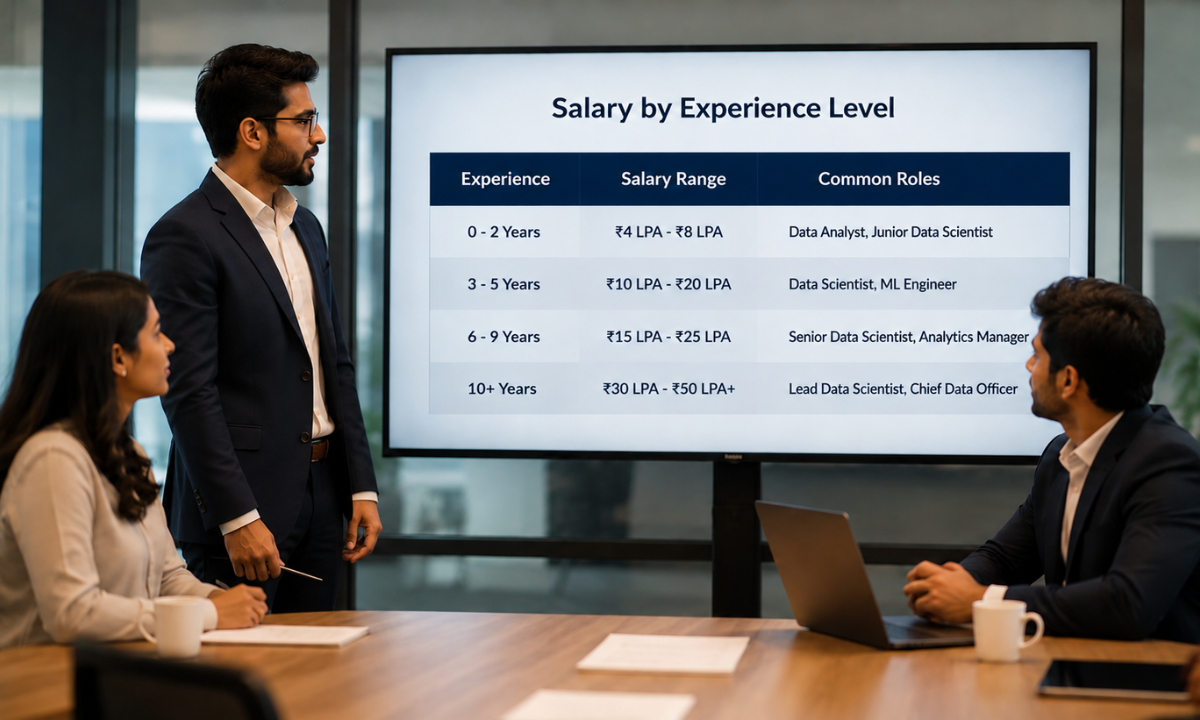
Salary by Experience Level
|
Experience |
Salary Range |
Common Roles |
|
0 - 2 Years |
₹4 LPA -₹8 LPA |
Data Analyst, Junior Data Scientist |
|
3 -5 Years |
₹10 LPA - ₹20 LPA |
Data Scientist, ML Engineer |
|
6 - 9 Years |
₹15 LPA - ₹25 LPA |
Senior Data Scientist, Analytics Manager |
|
10+ Years |
₹30 LPA - ₹50 LPA+ |
Lead Data Scientist, Chief Data Officer |
According to Glassdoor, entry-level roles typically pay between ₹6 LPA and ₹14 LPA, mid-level professionals with 4 to 6 years of experience earn between ₹10 LPA and ₹20 LPA, and senior data scientists can reach ₹20 LPA to ₹30 LPA and above.
To put this in perspective, consider a software developer with four years of experience currently earning ₹9 LPA. With a structured transition into data science, backed by a strong project portfolio and the right upskilling, that same professional can realistically target roles in the ₹14 LPA to ₹18 LPA range within 12 to 18 months. That is not an exceptional case; it is a pattern seen consistently among professionals who make the switch with proper preparation.
Salary by Role and Specialisation
Data science is not a single job title. It is a broad ecosystem of roles, each carrying different responsibilities and salary expectations.
|
Role |
Average Annual Salary |
|
Data Analyst |
₹4 LPA - ₹8 LPA |
|
Data Scientist |
₹12 LPA - ₹20 LPA |
|
Machine Learning Engineer |
₹10 LPA - ₹18 LPA |
|
AI / GenAI Specialist |
₹18 LPA - ₹35 LPA |
|
Data Architect |
₹25 LPA - ₹35 LPA |
|
Head of Data Science |
₹60 LPA - ₹1 Crore+ |
The salary gap between a generalist data scientist and an AI-specialised professional is currently 25 to 40 percent and widening. Skills in Generative AI, LLMs, and MLOps are the primary drivers of that premium in 2026.
Data Architects command an average salary of ₹28.5 LPA, given their responsibility for designing and managing an organisation's entire data infrastructure.
Bangalore Specifically - Why It Pays More
Bangalore deserves its own section because the numbers here are meaningfully different from the national average and directly relevant to anyone evaluating a data science course in Bangalore.
According to Glassdoor, the average data scientist salary in Bangalore is ₹18 LPA, approximately 15 percent higher than the national average. The typical pay range sits between ₹11 LPA at the 25th percentile and ₹27 LPA at the 75th percentile, with top earners reporting up to ₹34 LPA.
Indeed reports the average data scientist salary in Bengaluru at ₹12.88 LPA, based on 347 reported salaries with companies like Allstate, Honeywell, and Amazon among active hirers in the city.
Bangalore's data science ecosystem is driven by global tech giants like Google, Amazon, Microsoft, and IBM, all of which have significant operations and R&D centres in the city alongside homegrown product companies like Flipkart and Swiggy that are fundamentally data-driven businesses.
For professionals based in Bangalore or willing to relocate, this concentration of high-quality employers means more opportunities, more competitive offers, and faster career progression compared to most other Indian cities. Completing your training at a reputable training institute in Bangalore puts you directly inside that ecosystem from day one.
Skills That Move the Needle on Salary

Technical skills are the single most controllable factor in determining where you land within any salary band.
Core skills that establish your baseline:
-
Python and SQL
-
Statistics and probability
-
Data visualization - Tableau, Power BI
Advanced skills that push you into higher brackets:
-
Deep learning and neural networks
-
Natural Language Processing and Large Language Models
-
Generative AI and Prompt Engineering
-
MLOps and model deployment
-
Cloud platforms - AWS, Azure, GCP
Deep learning, MLOps, NLP, LLMs, and cloud AI services are the most sought-after skills in 2026, commonly boosting salaries by ₹3 LPA to ₹10 LPA above baseline compensation.
For professionals already working in adjacent roles in software development, business intelligence, or analytics, adding two or three of these advanced skills can produce a significant salary jump without requiring a complete career restart.
Industry-Wise Salary Differences
|
Industry |
Salary Potential |
|
BFSI (Banking, Financial Services, Insurance) |
High - risk modelling, fraud detection, product analytics |
|
E-commerce and Retail |
High-recommendation engines, demand forecasting |
|
Healthcare and Pharma |
Growing - diagnostics, drug discovery, patient analytics |
|
IT Services (TCS, Infosys, Wipro) |
Moderate - structured growth, strong learning programs |
|
Startups and Product Companies |
Variable - higher upside with equity and faster progression |
TCS and Infosys offer base salaries in the range of ₹8 LPA to ₹12 LPA, but prioritise comprehensive professional development programs and structured advancement pathways. Product-based companies and fintech firms typically offer higher base salaries alongside performance bonuses and stock options.
The Data Science Career Ladder
Every data science career follows a recognisable path from foundational analytical roles to senior leadership positions. Understanding where each stage sits and what it pays helps you plan your next move with clarity.
Stage 1: Data Analyst | 0–2 Years | ₹4 LPA – ₹8 LPA
The starting point for most. You work with structured data, build reports, and develop core skills in Python, SQL, and visualisation. This stage is about building the foundation on which everything else rests.
Stage 2: Data Scientist | 3–5 Years | ₹10 LPA – ₹20 LPA
You move from describing data to predicting from it. Machine learning models, business problem-solving, and the beginning of a specialisation in NLP, computer vision, or predictive analytics.
Stage 3: Senior Data Scientist / Analytics Manager | 6–9 Years | ₹15 LPA – ₹25 LPA
You lead projects, mentor teams, and your work directly influences business decisions. Specialisation deepens, and compensation reflects seniority.
Stage 4: Lead / Principal Data Scientist | 10+ Years | ₹30 LPA – ₹50 LPA+
You own the data strategy. You build teams, define direction, and operate at the intersection of technology and business leadership.
Stage 5: Head of Data Science / Chief Data Officer | ₹60 LPA – ₹1 Crore+
The top of the ladder. Reserved for professionals who combine deep technical expertise with strong leadership and a proven track record of impact at scale.
What This Means If You Are Considering Upskilling
The salary data across every source points to the same conclusion - data science offers strong, sustained earning potential at every stage of a career. The entry point is competitive, the mid-level bracket is well-compensated, and specialisation in high-demand areas like AI and GenAI creates earning potential that few other technology career tracks can match in 2026.
Switching companies every two to three years typically results in salary increases of 30 to 50 percent, compared to 8 to 15 percent through internal increments alone. Building a strong portfolio and developing visible expertise in a specialised area accelerates this trajectory considerably.
Conclusion
Data science salaries in India in 2026 reflect a field in strong, sustained demand. Entry-level roles offer a competitive starting point, mid-level professionals with the right skill stack are well-compensated, and those who specialise in AI, GenAI, and MLOps command salaries that rank among the highest in the technology sector.
Bangalore, in particular, offers salaries 15 percent above the national average with access to some of the most sought-after employers in the country. For anyone serious about building a career in data science, the city and the numbers both make a compelling case.
Understanding where you are on this ladder and what it takes to move to the next stage is the first step. The second is finding the right data science course in Bangalore that actually prepares you for that next level, not just the one you're currently at.
At Apponix, the most trusted training institute in Bangalore for data science, our curriculum is built around this exact progression, giving you the skills, projects, and placement support to move faster up the ladder than you would on your own.
Frequently Asked Questions
What is the average data science salary in India in 2026?
The average data science salary in India ranges between ₹8.2 LPA and ₹15 LPA depending on experience, skills, and location, according to Glassdoor, Naukri, and the Analytics India Magazine Salary Study.
What is the data science salary in Bangalore specifically?
According to Glassdoor, the average data scientist salary in Bangalore is ₹18 LPA, around 15 percent higher than the national average. The typical range sits between ₹11 LPA and ₹27 LPA, with top earners reaching ₹34 LPA.
Which skills increase data science salary the most in 2026?
Generative AI, Large Language Models, MLOps, NLP, and cloud platforms are the skills most consistently linked to salary premiums, often adding ₹3 LPA to ₹10 LPA above baseline compensation.
Is data science a good career choice for working professionals in India?
Yes. The demand for data science professionals significantly exceeds supply, salaries are strong across all experience levels, and specialisation creates earning potential that few other technology tracks can match.
Which is the best data science course in Bangalore?
Apponix offers a comprehensive, industry-aligned data science course in Bangalore - covering Python, statistics, machine learning, and real-world projects taught by working professionals with full placement assistance.
Why should I choose a training institute in Bangalore for data science?
Bangalore is India's technology capital with the highest concentration of data-driven companies. Training here puts you inside that ecosystem from day one - with access to better opportunities, stronger networks, and employers who actively hire from institutes in the city.

Apponix Academy
Apponix Academy