POPULAR COURSES
Master Programs




Table of contents:
|
1. The Evolving DevOps Skill Stack: From CI/CD to GitOps & DevSecOps
|
|
2. Placement Ecosystem, Real-World Labs & Production Projects
|
|
3. Industry-Recognized Cloud & DevOps Certifications That Matter
|
|
4. Salary Benchmarks, Career Growth & DevOps Course Fee Analysis
|
|
5. Why Choose Apponix Technologies for DevOps Training? |
|
6. Conclusion |
The global tech industry has reached a decisive turning point where rapid software delivery, cloud-native scalability, and operational resilience dictate commercial success.
Pursuing professional DevOps training in Bangalore offers tech professionals and software engineers a future-proof path into high-paying infrastructure roles across India's premier technology hub. Enrolling in an industry-aligned DevOps course in Bangalore equips aspiring cloud engineers with the automated toolchain fluency, container orchestration mastery, and continuous integration pipeline skills required to bridge the gap between development teams and enterprise operations.
Modern enterprise software architecture has fundamentally shifted away from monolithic deployments and team-by-team manual toolchain configurations.
Today's engineering organizations operate in high-velocity, multi-cloud environments driven by platform engineering, GitOps workflows, automated security controls, and AI-assisted CI/CD pipelines.
As companies across Bangalore’s tech corridors, from fast-growing SaaS startups to global capability centers (GCCs), accelerate their digital transformations, the demand for skilled DevOps engineers, Site Reliability Engineers (SREs), and Cloud Infrastructure Architects has never been higher.
Modern DevOps is no longer just about writing basic deployment scripts; it is a strategic discipline that directly dictates time-to-market, system stability, and enterprise cloud efficiency.
The Evolving DevOps Skill Stack: From CI/CD to GitOps & DevSecOps

Mastering modern DevOps in 2026 requires going far beyond basic shell scripting or manual server administration. Enterprise engineering teams demand a unified, end-to-end toolchain that automates every phase of the software delivery lifecycle from initial code commit to production monitoring and continuous security scanning.
Enrolling in the best DevOps institute in Bangalore ensures that learners gain practical, hands-on experience with the exact software stack, cloud platforms, and orchestration engines used by top tech firms.
Core Pillars of the 2026 DevOps Toolchain
A modern, production-grade DevOps engineering stack consists of six interconnected functional layers:
-
Source Code Management & Version Control: Utilizing Git alongside platforms like GitHub and GitLab as the foundational single source of truth for application code and configuration files.
-
Continuous Integration & Automated Delivery (CI/CD): Building event-driven, automated pipelines using GitHub Actions, GitLab CI, or Jenkins to execute automated testing, linting, and artifact packaging.
-
Containerization & Cloud-Native Orchestration: Packaging microservices into lightweight Docker containers and orchestrating them at scale across production clusters using Kubernetes (EKS, GKE, or AKS).
-
Infrastructure as Code (IaC) & Configuration Management: Provisioning multi-cloud environments declaratively using HashiCorp Terraform and automating server configurations using Ansible.
-
GitOps & Declarative Cluster Delivery: Using tools like Argo CD to continuously reconcile cluster states directly with version-controlled Git repositories, preventing configuration drift and enabling instant rollbacks.
-
DevSecOps & Shift-Left Security: Embedding vulnerability scanners like Trivy, static code analysis with SonarQube, and secret management into early pipeline stages.
Modern DevOps Toolstack Matrix
|
Pipeline Phase |
Primary Industry Tools |
Production Role & Engineering Value
|
|---|---|---|
|
Version Control & Collaboration |
Git, GitHub, GitLab |
Managing code repositories, pull request workflows, and release branching strategies. |
|
Containerization & Runtimes |
Docker, containerd |
Isolate application dependencies into portable, lightweight runtime containers. |
|
Cluster Orchestration |
Kubernetes, Helm, Amazon EKS |
Auto-scaling, self-healing, service discovery, and rolling updates across clusters. |
|
Infrastructure Provisioning |
Terraform, OpenTofu |
Declarative, multi-cloud infrastructure setup with automated state management. |
|
Continuous Delivery & GitOps |
GitHub Actions, Argo CD |
Automated building, testing, container registry push, and automated cluster sync. |
|
Security & Observability |
SonarQube, Trivy, Prometheus, Grafana |
Static code analysis, container vulnerability scanning, real-time metrics, and alert routing. |
Understanding how these individual components interlock into a continuous delivery engine is what transforms an IT professional into a production-ready DevOps engineer.
Placement Ecosystem, Real-World Labs & Production Projects
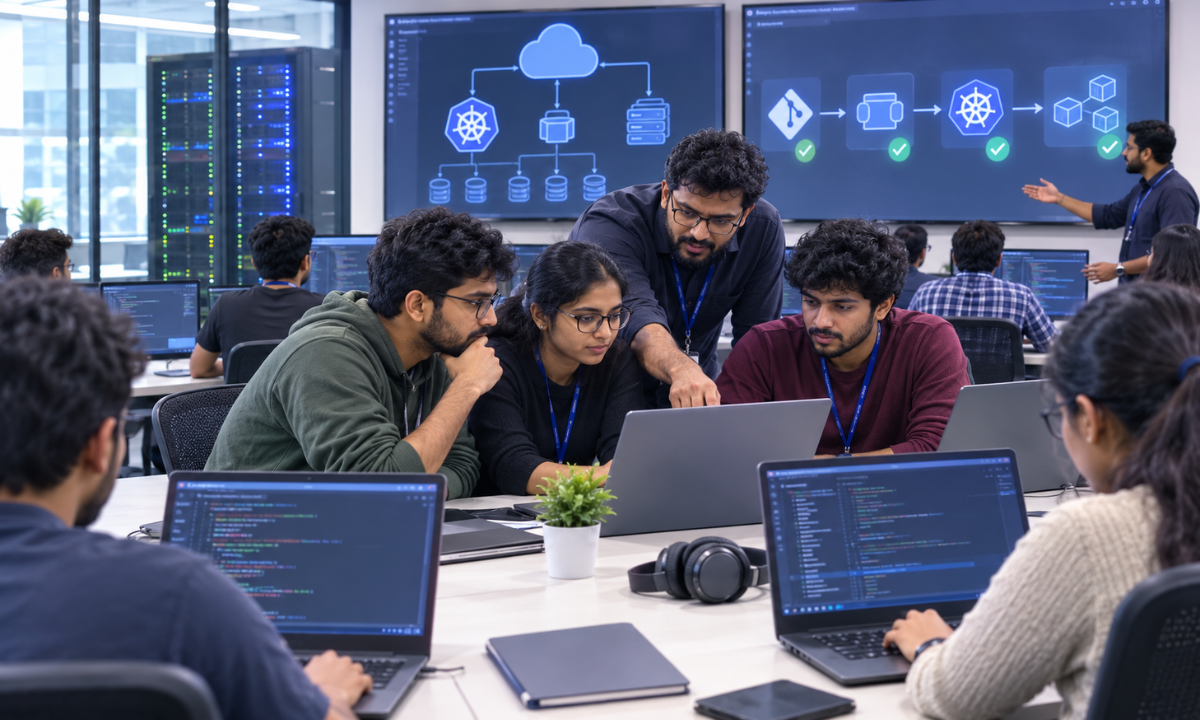
Enterprise recruitment teams evaluate candidates on their ability to solve live infrastructure problems rather than their capacity to memorize CLI syntax.
During technical interviews, candidates are tested on real-world scenarios such as debugging a crashing Kubernetes pod, resolving a state lock conflict in Terraform, or optimizing a slow multi-stage Docker build.
Enrolling in comprehensive DevOps training in Bangalore with placement bridges the gap between theoretical tool knowledge and production-grade engineering execution.
Hands-On Production Projects
To stand out in competitive hiring rounds, learners must build and document end-to-end deployment pipelines that reflect enterprise standards:
-
Production Project 1: Automated GitOps Microservices Pipeline
-
Architecture: Building a multi-stage CI/CD pipeline using GitHub Actions and Argo CD to continuously deploy a microservices application onto an Amazon EKS cluster.
-
Key Competencies: Helm charts, automated container scanning with Trivy, zero-downtime rolling updates, and GitOps state reconciliation.
-
Production Project 2: Multi-Cloud Infrastructure as Code (IaC)
-
Architecture: Provisioning an isolated AWS VPC complete with public/private subnets, load balancers, IAM roles, and managed database instances using Terraform.
-
Key Competencies: Terraform module design, remote state management, S3 backend locking with DynamoDB, and security compliance.
-
Production Project 3: Full-Stack Observability & Incident Response
-
Architecture: Instrumenting cluster monitoring using Prometheus and Grafana, integrated with Alertmanager for automated Slack notification routing.
-
Key Competencies: Metrics scraping, custom PromQL queries, dashboard creation, and log aggregation.
The End-to-End Placement Acceleration Engine
A strong placement program provides structural support to convert technical fluency into confirmed corporate offers:
[Technical Toolchain Mastery] ➡ [Live Cloud Range Projects] ➡ [ATS Resume Engineering] ➡ [Mock Architecture Interviews] ➡ [Direct Hiring Connects]
-
ATS-Optimized Resume Engineering: Tailoring candidate profiles with industry-standard DevOps metrics, cloud platform tags, and GitHub project write-ups to ensure high recruiter pass-through rates.
-
Scenario-Based Architecture Preparation: Conducting structured mock interviews focused on incident response, system design, and live troubleshooting scenarios.
-
Direct Enterprise Hiring Connections: Connecting candidates directly with recruitment leads across software firms, consulting agencies, and Global Capability Centers (GCCs).
Industry-Recognized Cloud & DevOps Certifications That Matter
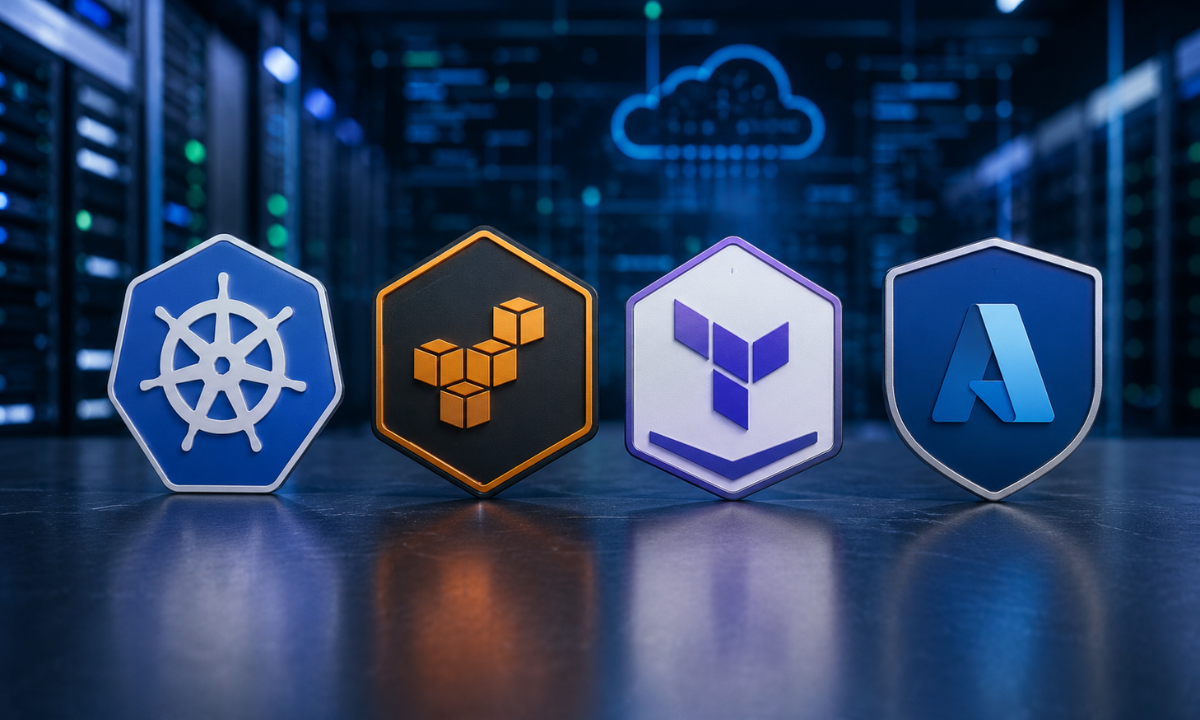
In the recruitment market, vendor-aligned credentials serve as an objective benchmark of an engineer's technical muscle memory.
However, enterprise hiring managers draw a clear line between theoretical, multiple-choice exams and performance-based, practical certifications that test live troubleshooting under pressure.
Earning a recognized DevOps certification in Bangalore provides verifiable proof of your ability to manage containerized microservices, build resilient continuous delivery pipelines, and provision multi-cloud environments, helping your profile bypass automated ATS filters and stand out to technical screeners.
High-Value Credentials Driving 2026 Enterprise Hiring
-
Certified Kubernetes Administrator (CKA): Issued by the Cloud Native Computing Foundation (CNCF), this performance-based exam requires candidates to solve real-world cluster setup, networking, storage, and troubleshooting tasks in a live terminal.
-
AWS Certified DevOps Engineer – Professional: Validates advanced expertise in automating deployments, monitoring applications, and managing scalable, secure infrastructure across Amazon Web Services.
-
HashiCorp Certified: Terraform Associate: Confirms core competencies in Infrastructure as Code (IaC) principles, state file management, module design, and automated multi-cloud provisioning.
-
Microsoft Certified: DevOps Engineer Expert (AZ-400): Demonstrates mastery in integrating processes, security, and Azure DevOps tools to automate software delivery pipelines for enterprise workloads.
High-Impact Certification Comparison Matrix
|
Certification Title |
Issuing Body |
Primary Focus & Domain Validation |
Exam Format & Level
|
|---|---|---|---|
|
Certified Kubernetes Administrator (CKA) |
CNCF / Linux Foundation |
Cluster architecture, pod networking, storage, and live troubleshooting |
100% Performance-Based Hands-On Lab |
|
AWS Certified DevOps Engineer - Professional |
Amazon Web Services |
Automated CI/CD pipelines, cloud governance, and monitoring |
Advanced Scenario-Based Assessment |
|
HashiCorp Certified: Terraform Associate |
HashiCorp |
Multi-cloud Infrastructure as Code (IaC) & state management |
Multiple Choice & Practical Concepts |
|
Azure DevOps Engineer Expert (AZ-400) |
Microsoft |
Azure Pipelines, continuous delivery, and artifact security |
Scenario & Case Study Based |
Pro Tip: While certifications earn you interview invitations, modern technical interviewers evaluate your public GitHub repositories, deployed infrastructure projects, and system design clarity above all else.
Salary Benchmarks, Career Growth & DevOps Course Fee Analysis

Bangalore remains the benchmark for cloud and infrastructure compensation across India.
As major product unicorns, SaaS platforms, and Global Capability Centres (GCCs) compete aggressively for talent to run resilient production clusters, skilled DevOps professionals command a distinct salary premium.
Compensation Breakdown by Experience Tier
As engineers transition from basic CI/CD script execution to complex multi-cloud architecture design and zero-downtime cluster orchestration, compensation grows exponentially.
|
Experience Level |
Typical Infrastructure Roles |
Average Salary Range (Bangalore) |
Key Skill Differentiators
|
|---|---|---|---|
|
Entry-Level (0 to 2 Years) |
Associate DevOps Engineer, Junior Cloud Admin |
₹5.5 LPA – ₹9 LPA |
Shell scripting, Docker containerization, basic Git workflows, Linux admin |
|
Mid-Level (3 to 6 Years) |
DevOps Engineer, SRE, Platform Engineer |
₹14 LPA – ₹28 LPA |
Kubernetes orchestration, Terraform IaC, Argo CD, observability setups |
|
Senior Level (7+ Years) |
Lead DevOps Architect, Principal SRE, Head of Infrastructure |
₹32 LPA – ₹65+ LPA |
Multi-cloud architecture, enterprise security governance, team leadership |
Market Reality: Candidates transitioning from traditional software testing or sysadmin backgrounds who can demonstrate hands-on Kubernetes troubleshooting and Terraform state locking frequently command offers at the higher end of their respective salary tiers.
Understanding DevOps Course Fees & Value Factors
When evaluating training programs, understanding DevOps course fees in Bangalore requires looking beyond the sticker price to assess the true return on investment (ROI). Across the city, course pricing typically ranges between ₹25,000 and ₹60,000, depending on program depth, lab infrastructure, and placement support models.
[Basic Theory Programs: ₹15,000 - ₹25,000] ➡ [Project & Cloud-Lab Programs: ₹25,000 - ₹55,000] ➡ [Long-Term Bootcamps: ₹60,000+]
Essential Factors That Justify Your Investment:
-
Dedicated Cloud Range Access: Does the institute provide live AWS/Azure credits and dedicated lab environments for running Kubernetes clusters, or do they rely solely on local desktop setups?
-
Instructor Profile: Are modules led by active cloud architects who handle production deployments, or by generalist academic trainers?
-
Real-World Project Depth: Does the program include production-grade scenarios (e.g., GitOps, DevSecOps pipelines) or only basic "Hello World" exercises?
-
Placement Acceleration: Are there structured mock interviews, 1-on-1 ATS resume reviews, and direct hiring referrals?
Factoring in live cloud access, mock interview coaching, and corporate placement connections ensures you select a program that delivers tangible career transformation rather than surface-level theory.
Why Choose Apponix Technologies for DevOps Training?
Transitioning into cloud automation and platform engineering requires more than watching video tutorials; it demands configuring live cloud infrastructure, writing production Terraform manifests, and managing Kubernetes clusters under expert guidance. Apponix Technologies has established itself as a premier Training Institute in Bangalore, delivering a hands-on, project-centric curriculum designed to turn aspiring engineers into workplace-ready DevOps specialists.
When you train with Apponix, you gain access to an intensive, career-focused learning environment:
-
Real-World Cloud Range & Project Labs: Execute automated CI/CD deployments, configure multi-stage Docker builds, and set up Kubernetes ingress controllers across live AWS and Azure environments.
-
Active Industry Practitioners: Learn directly from cloud architects who bring real-world infrastructure migration experience, GitOps workflows, and incident management strategies into every session.
-
Production-Grade Portfolio Creation: Build a public GitHub repository featuring Terraform modules, Helm charts, and automated pipelines to showcase your technical capabilities to hiring managers.
-
End-to-End Career Acceleration Engine: Receive 1-on-1 resume engineering, mock technical architecture interviews, and guaranteed interview referrals through an extensive corporate placement network.
Combining deep technical rigor with real-world cloud labs and corporate placement connections, Apponix provides the structured mentorship needed to launch a successful career in cloud infrastructure.
Conclusion
The software industry in 2026 continues to accelerate its shift toward cloud-native automation, GitOps, and platform engineering. By mastering container orchestration, Infrastructure as Code, and continuous integration pipelines, you position yourself at the center of the modern technology economy.
To launch your professional transformation, follow this practical 4-step execution roadmap:
-
Build Strong Systems & Scripting Fundamentals: Master Linux system administration, shell scripting, Git version control workflows, and core networking protocols.
-
Master the Core Automation Toolchain: Gain hands-on fluency with Docker containerization, Jenkins or GitHub Actions pipelines, and Terraform infrastructure provisioning.
-
Advance to Cloud-Native & GitOps Workflows: Deploy managed Kubernetes clusters (AWS EKS), implement GitOps using Argo CD, and set up end-to-end observability with Prometheus and Grafana.
-
Build a Public Portfolio & Prepare for Interviews: Document your production pipeline projects on GitHub, refine your resume for ATS screening, and practice scenario-based architecture interviews.
Taking decisive action today equips you with the technical capability, hands-on confidence, and portfolio needed to thrive in modern engineering teams and command top-tier compensation packages.
Reference:
https://bostoninstituteofanalytics.org/cloud-computing-and-devops/

Apponix Academy
Apponix Academy