POPULAR COURSES
Master Programs




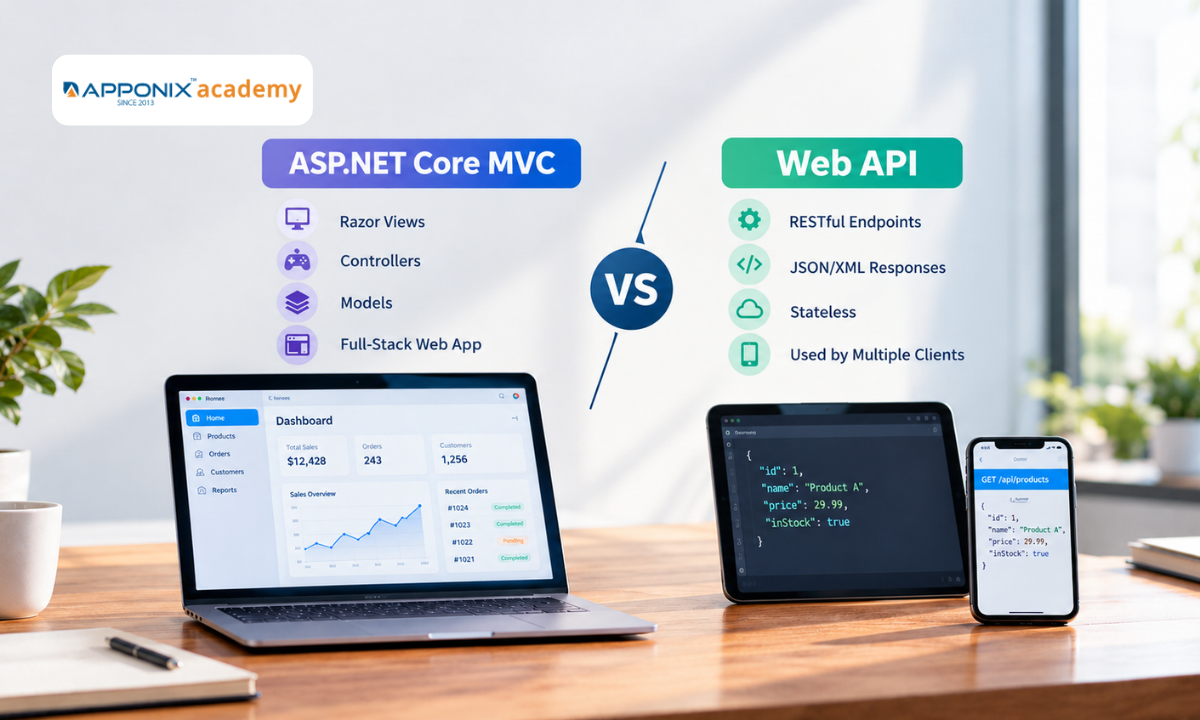
Table of contents:
|
1. What Is ASP.NET Core MVC? |
|
2. ASP.NET Core MVC vs Web API: Key Differences |
|
3. How Request Handling Works in MVC and Web API
|
|
4. When Should You Use ASP.NET Core MVC? |
|
5. When Should You Use ASP.NET Core Web API? |
|
6. Can ASP.NET Core MVC and Web API Be Used Together? |
|
7. Skills Required to Work with MVC and Web API |
|
8. Conclusion |
ASP.NET Core MVC and ASP.NET Core Web API are two approaches to building web applications using the .NET platform. MVC is commonly used to create web applications that return HTML pages, while Web API is designed to provide data to websites, mobile apps, and other systems. Both support routing, dependency injection, middleware, and application services. The right choice depends on how your application delivers information, handles user requests, and connects with other systems.
In this guide, we cover the key differences between ASP.NET Core MVC and Web API, their architecture, request-handling processes, common use cases, and the advantages of using each approach. You will also learn when to use them separately or together to build efficient and maintainable web applications.
What Is ASP.NET Core MVC?
ASP.NET Core MVC is a web development framework based on the Model-View-Controller architectural pattern. It separates an application into three components: Model, View, and Controller. This separation makes application code easier to organise, test, and maintain.
The Model represents application data and business rules. The View defines the user interface, usually through Razor templates that generate HTML. The Controller receives incoming requests, processes the required actions, and returns a response.
For example, an e-commerce website may use MVC to display product listings, show product details, manage shopping cart pages, and render order summaries. When a user opens a product page, the controller retrieves the relevant information and passes it to a view, which generates the HTML displayed in the browser.
MVC is suitable for applications where server-side rendering and page-based navigation are important. Developers can also use JavaScript to add interactive features without changing the overall architecture.
What Is ASP.NET Core Web API?
ASP.NET Core Web API is used to build HTTP endpoints that allow applications to exchange data. Instead of generating complete HTML pages, an API usually returns structured data in formats such as JSON.
A Web API commonly serves as the backend for a React, Angular, or Vue application, a mobile application, or another system that needs access to application data. It can also connect separate services within a larger software solution.
For example, an online shopping application may use an API to retrieve product details, check inventory, process orders, and display customer information. The frontend sends an HTTP request to an endpoint, and the API returns the requested data or an appropriate error response.
ASP.NET Core Web API supports HTTP methods such as GET, POST, PUT, PATCH, and DELETE. Developers can use these methods to retrieve, create, update, and delete resources.
Web APIs are particularly useful when the same backend must support multiple clients. They also help teams separate frontend development from backend business logic.
ASP.NET Core MVC vs Web API: Key Differences
Although both approaches use ASP.NET Core, they differ in how they handle requests and deliver responses. The following comparison highlights their main differences.
|
Feature |
ASP.NET Core MVC |
ASP.NET Core Web API |
|
Primary purpose |
Build web applications with server-rendered pages |
Build HTTP endpoints for data exchange |
|
Typical response |
HTML views, redirects, or other action results |
JSON data, status codes, or other HTTP responses |
|
User interface |
Often rendered on the server using Razor views |
Usually provided by a separate frontend |
|
Request handling |
Controllers and actions process requests and return views or other results |
Controllers or minimal API handlers process requests and return data |
|
Client applications |
Primarily browser-based web applications |
Web frontends, mobile apps, and external services |
|
Common use cases |
Admin panels, portals, content-driven websites |
REST APIs, mobile backends, and service integrations |
|
Frontend dependency |
Can include the presentation layer within the application |
Commonly supports a separate presentation layer |
|
Testing |
Supports controller, integration, and UI testing |
Supports endpoint, integration, and contract testing |
One important point is that these approaches are not completely separate technologies. ASP.NET Core MVC and Web API share much of the same underlying infrastructure. ASP.NET Core MVC controllers can also handle API requests, and an application can combine server-rendered views with API endpoints.
For additional context on application architecture, see top software development frameworks for web, mobile, and enterprise applications.
How Request Handling Works in MVC and Web API
Understanding the request lifecycle makes the differences easier to identify. Both approaches use the ASP.NET Core request pipeline, but the response they produce often differs.
Request Handling in ASP.NET Core MVC
-
A user opens a URL or submits a form in a browser.
-
Middleware processes the incoming request, and routing identifies the appropriate controller and action.
-
The controller validates input and calls the required services or data-access components.
-
The application retrieves or updates data, often using Entity Framework Core or another data-access method.
-
The controller returns a Razor view or another action result, and the server sends the response to the browser.
For example, a student management portal may use an MVC controller to retrieve student details and display them in a formatted table. The server generates the HTML before returning the page.
Request Handling in ASP.NET Core Web API
-
A client sends an HTTP request to an API endpoint.
-
Middleware and routing direct the request to the appropriate controller action or minimal API handler.
-
The endpoint validates the request and calls application services to perform the required operation.
-
The application retrieves or updates data and converts the result into a suitable response format.
-
The API returns a response with an HTTP status code and, where applicable, a JSON payload.
For instance, a mobile application can request student details from /api/students/101. The API may return a JSON object containing the student's ID, name, and course.
Both approaches benefit from clear separation between controllers, business logic, and data access. This structure improves maintainability and makes it easier to test individual components.
When Should You Use ASP.NET Core MVC?
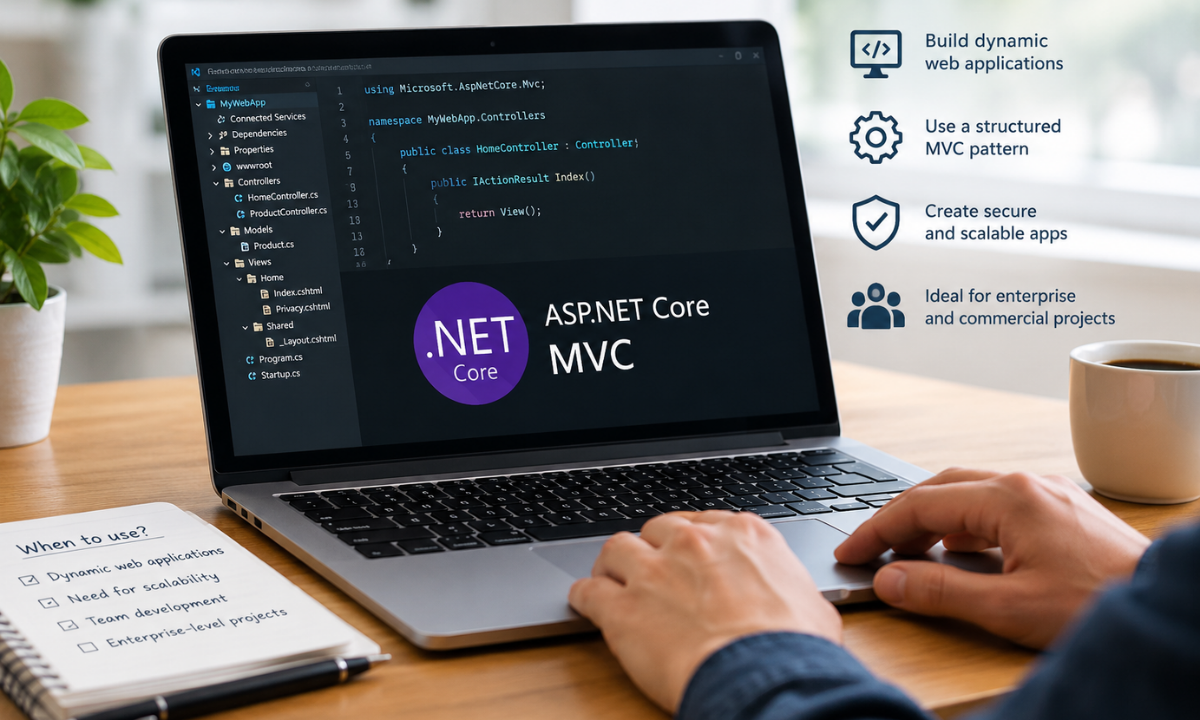
ASP.NET Core MVC is a good choice when the application needs server-rendered pages and a structured way to manage user interactions.
Common use cases include:
-
Content-driven websites: Websites that display articles, product details, or service information.
-
Admin dashboards: Internal systems that present reports, tables, and management forms.
-
Business portals: Applications for employee records, customer information, and workflow management.
-
Form-based applications: Systems that collect information, validate submissions, and display confirmation pages.
-
Database-driven websites: Applications that retrieve records and present them through server-generated HTML.
MVC can simplify development when the server controls both application logic and page rendering. Razor views also allow developers to reuse layouts, partial views, and shared UI components.
However, if several independent clients need the same backend data, a dedicated API layer may provide a more flexible design.
When Should You Use ASP.NET Core Web API?
ASP.NET Core Web API is suitable when application data must be accessed through HTTP endpoints rather than delivered as complete HTML pages.
Common use cases include:
-
Single-page applications: React, Angular, and Vue applications can retrieve data from API endpoints without reloading the entire page.
-
Mobile applications: Android and iOS apps can use the same backend services.
-
Third-party integrations: External systems can exchange information with an application through documented endpoints.
-
Microservices: Separate services can communicate through defined API contracts.
-
Cloud-based applications: APIs can provide backend functionality to multiple clients and services.
Web APIs also support versioning strategies, authentication, authorization, and structured error responses. These features help developers manage applications as their requirements grow.
API design requires careful attention to endpoint naming, HTTP status codes, input validation, access control, and documentation. Returning JSON alone does not make an API secure or well-designed.
To learn more about protecting application endpoints, see What Is API Security? Best Practices and Threats.
Can ASP.NET Core MVC and Web API Be Used Together?
Yes. Many applications combine MVC and Web API within the same ASP.NET Core project. This approach is useful when an application needs server-rendered pages as well as endpoints that provide data to other clients.
Consider an employee management system. MVC can render the login page, employee directory, and administrative dashboard. Web API endpoints can supply employee records to a mobile app or support dynamic updates on the dashboard.
Both components can share business services, validation rules, database access, and authentication mechanisms. This reduces duplicated logic and helps maintain consistent application behaviour.
However, combining both approaches requires clear boundaries. Developers should separate presentation logic from business rules and avoid duplicating the same operations across controllers. The architecture should reflect the application's actual requirements rather than adding complexity without a clear benefit.
For an example of how different application layers fit together, explore Tools and technologies used in full-stack development.
Skills Required to Work with MVC and Web API
Developers working with ASP.NET Core MVC and Web API need a strong understanding of C# and the .NET ecosystem. Knowledge of the following areas helps them build reliable web applications.
-
C# programming: Classes, interfaces, inheritance, exception handling, and asynchronous programming.
-
ASP.NET Core fundamentals: Middleware, routing, dependency injection, configuration, and application hosting.
-
MVC architecture: Controllers, models, Razor views, model binding, and validation.
-
RESTful API development: HTTP methods, resource-based endpoints, status codes, and JSON serialization.
-
Database integration: SQL Server, Entity Framework Core, LINQ, and CRUD operations.
-
Security: Authentication, authorization, input validation, and protection against common web vulnerabilities.
-
Testing and debugging: Unit testing, integration testing, API testing tools, and error diagnosis.
Practical projects help developers understand how these concepts work together. Building a product management application, for example, can provide experience with database operations, MVC views, API endpoints, and validation.
Learners who want to develop these skills can join Apponix's .NET training in Bangalore, which covers practical programming and application development topics.
Conclusion
ASP.NET Core MVC and Web API serve different purposes within web development. MVC is well suited to applications that generate HTML pages on the server, while Web API is designed to expose application functionality and data through HTTP endpoints. Both can share the same application infrastructure and work together when a project requires server-rendered pages and API-based communication.
The best choice depends on the user interface, client requirements, integration needs, and long-term maintenance goals. Understanding these differences helps developers select an appropriate architecture and build applications that are easier to test, extend, and maintain.
Learning ASP.NET Core, C#, database integration, MVC, and Web API through practical projects provides a solid foundation for .NET application development.
Reference:
1)https://medium.com/@tholaday777/asp-net-web-api-vs-mvc-and-wcf-and-other-details-7ea9aa8f39d1
2)https://www.slideshare.net/slideshow/difference-between-aspnet-web-api-and-aspnet-mvc/31700295

Apponix Academy
Apponix Academy