POPULAR COURSES
Master Programs




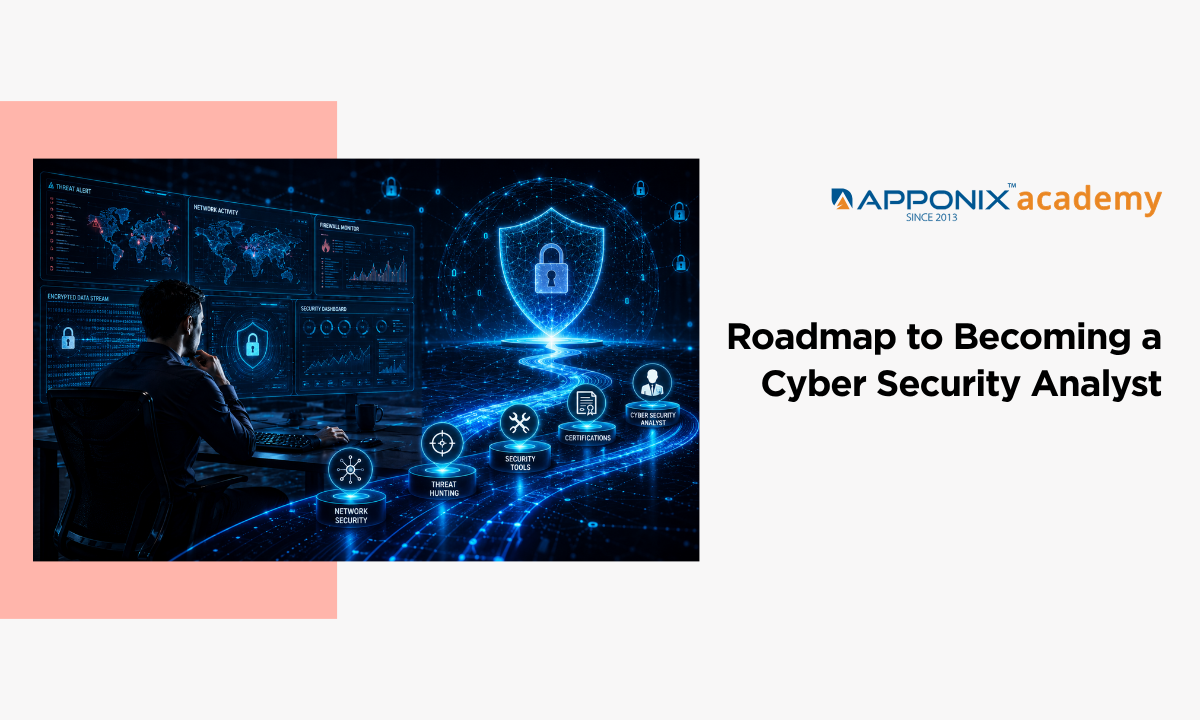
Table of contents:
|
1. Pillar 1: The Core Infrastructure of Mastering Network Security
|
|
2. Pillar 2: The Frontline Defense of Identifying Threats in Real Time
|
|
3. The Technical Arsenal Weaponizing Corporate Tools |
|
4. The Ultimate Leverage Your Cyber Security Certification Path |
|
5. Why Choose Apponix? Your Fast Track to Placement |
|
6. Conclusion |
The modern tech industry is currently undergoing a brutal transformation.
Automated artificial intelligence systems are systematically wiping out traditional help desk roles and basic software development jobs, leaving thousands of generic IT workers completely stranded. However, this massive global shift toward decentralized cloud infrastructure has simultaneously created an unprecedented corporate vulnerability.
Global enterprises are actively losing billions of dollars to highly organized ransomware syndicates and state-sponsored hacking groups.
Companies are no longer looking for generic computer science graduates. They are desperately hunting for specialized digital warriors with the best Cybersecurity course in Bangalore who can actually protect their massive financial databases from devastating external breaches.
As a direct result of this digital bleeding, elite security defenders are now the most heavily recruited and aggressively compensated professionals in the entire corporate sector.
Navigating this aggressive job market requires far more than just watching disjointed online tutorials or reading outdated networking textbooks. To completely bypass automated resume filters and capture these premium salary packages, you must execute a precise cybersecurity analyst roadmap.
This structured career blueprint is your ultimate guide to hacking the corporate matrix, permanently transforming you from a disposable IT worker into an untouchable enterprise asset.
Pillar 1: The Core Infrastructure of Mastering Network Security

You cannot defend a fortress if you do not know where the doors are located. When you strip away all the confusing corporate jargon, Network security is incredibly simple to understand.
Imagine a massive multi-million dollar company as a giant digital castle. Inside this castle sit all their valuable treasures, like customer credit cards and secret passwords. As a security analyst, your job is to stand on the high walls and stop the digital robbers from breaking in.
Most beginner courses waste months forcing you to memorize thick, boring textbooks. They completely miss the point. To actually secure the perimeter, you only need to understand four basic mechanisms of how the castle operates.
The Digital Castle Anatomy Explained Simply
-
TCP and IP are the Information Highways: Think of this as the road system leading up to the castle. Every single piece of internet data is just a car driving on these roads. If you understand how normal traffic flows, you will immediately spot a suspicious vehicle trying to speed past the checkpoints.
-
Enterprise Firewalls are the Giant Iron Gates: Firewalls are exactly like massive security bouncers standing at the front doors. They check the ID of every single person trying to enter. You must learn how to program these guards to automatically recognize and block known criminals.
-
Corporate VPNs are the Secret Underground Tunnels: Sometimes, employees working from home need to enter the castle without being ambushed by spies on the main road. A Virtual Private Network is simply a secure, invisible tunnel that lets safe data travel underground.
-
Linux Command Line is the Guard Language: To properly control the castle defenses, you cannot just point and click with a standard computer mouse. You must learn Linux, which is the secret underlying control language that all elite security systems use to communicate.
The corporate hiring managers do not care if you can recite textbook definitions of the OSI model. They only want to know if you can actually lock the digital doors. By mastering these incredibly simple core foundations, you build an unbreakable structural knowledge, perfectly positioning yourself to spot a cyber attack long before it ever breaches the walls.
Pillar 2: The Frontline Defense of Identifying Threats in Real Time

Once you understand how the corporate network is built, you are ready to step onto the actual battlefield. Being a Cybersecurity Analyst is not about sitting back and waiting for an alarm to go off. It is an aggressive, highly proactive role.
You are a digital detective constantly hunting for microscopic anomalies in a massive ocean of data. When a global hacking syndicate attempts to breach a financial database, they do not announce themselves. They sneak in through disguised emails, silent background downloads and compromised employee passwords.
To successfully identify these threats in real time, you must develop a ruthless analytical mindset and master the core techniques of threat hunting. Here is exactly what the frontline defense looks like in action.
The Four Cores of Real-Time Threat Hunting
A modern security analyst constantly scans four primary areas of the corporate network to detect active intrusions.
-
The Phishing Filters (Email Interception)
Hackers know that the weakest link in any corporate security system is the human employee. Analysts constantly hunt for highly sophisticated fake emails designed to steal executive login credentials. You will learn to strip apart an email and analyze hidden header data to prove it came from a malicious server.
-
The Traffic Analyzers (Network Sniffing)
Think of this as monitoring the digital highway from a helicopter. You are looking for cars driving the wrong way or unauthorized data suddenly leaving the corporate network at 3:00 AM. By analyzing data packets, you can spot a hacker trying to quietly smuggle sensitive files out the back door.
-
The Malware Sandbox (Endpoint Monitoring)
When a suspicious file is downloaded, you do not just delete it. Elite analysts isolate the file in a secure, locked digital room called a sandbox. You then intentionally detonate the virus in this safe environment to study exactly how it behaves and what parts of the network it was trying to destroy.
-
The Identity Checkpoints (Access Logs)
If an employee based in New York suddenly tries to log into the corporate server from a completely unrecognized IP address in Eastern Europe within ten minutes of their last login, the system flags it. Analysts investigate these impossible travel logs to instantly identify stolen passwords.
A Day in the Trenches: The Incident Response Lifecycle
When a threat is successfully identified the analyst immediately triggers a ruthless protocol to neutralize it. This is not a slow administrative process; it is a high-speed digital emergency response.
Phase A: The Initial Detection: Your dashboard flashes red. An employee just clicked a malicious link, downloading a silent ransomware script.
Phase B: The Immediate Containment: You do not wait for permission. You instantly isolate that specific computer from the entire corporate network, effectively trapping the virus in a single room before it can spread to the main database.
Phase C: The Total Eradication: You systematically hunt down the malicious code, delete the unauthorized hidden files and completely rewrite the infected system registries.
Phase D: The Strategic Recovery: You safely reconnect the cleaned machine, force a mandatory password reset and permanently block the hacker's IP address across the entire company firewall.
This is exactly why generic IT workers are losing their jobs while security analysts are seeing their salaries skyrocket.
Identifying threats requires extreme critical thinking, rapid problem solving and the technical confidence to pull the plug on a cyberattack the absolute second it begins. You are the only thing standing between a thriving corporation and total financial ruin.
The Technical Arsenal Weaponizing Corporate Tools

To survive a technical cybersecurity interview, you must prove that you can operate the exact software used in modern corporate Security Operations Centres (SOC). Hiring managers will completely ignore candidates who only understand the theory of hacking. They want to see hands-on mastery of tracking, analyzing and neutralizing live threats using industry standard tools.
You must build a highly functional technical arsenal. Here is the direct breakdown of the core software categories you need to master to become a deployable analyst.
The Mandatory Security Software Stack
-
SIEM Platforms (The Central Command): Security Information and Event Management (SIEM) tools like Splunk and IBM QRadar are the absolute heart of any SOC. These platforms collect billions of data logs from every computer server and router in a company and aggregate them into a single dashboard.
You must learn how to write precise search queries to filter through millions of normal events to find a single malicious login attempt.
-
Packet Analyzers (The Digital Microscope) Wireshark: is the industry standard tool for deep packet inspection. When a network breach occurs, you use Wireshark to intercept live data traffic moving through the air or cables.
It allows you to peel open data packets to read the exact malicious code a hacker is trying to inject into your server.
-
Vulnerability Scanners (The Scout): Before a hacker finds a weakness in your company's defense you must find it first.
Tools like Nessus automatically scan thousands of corporate computers to find outdated software, unpatched bugs or weak passwords. As an analyst, you use these reports to lock down vulnerabilities before they can be exploited.
-
Endpoint Detection and Response (The Watchman): EDR tools like CrowdStrike Falcon or Microsoft Defender for Endpoint are installed directly on every employee's laptop. They use advanced behavioral tracking to monitor system memory and file changes, instantly killing any unauthorized execution of ransomware.
The Tool Mastery Checklist
To ensure your skills align perfectly with the current corporate infrastructure, ensure you can execute these four practical tasks before applying for roles.
-
Log Analysis: Run search filters in Splunk to track an IP address across multiple server databases.
-
Traffic Decryption: Capture a PCAP file in Wireshark and extract a hidden malicious file from the stream.
-
Automation Scripting: Write basic Python or Bash scripts to automatically parse text logs and flag failed login attempts.
-
Firewall Configuration: Establish strict rules inside enterprise firewalls to block traffic from specific high-risk countries.
Mastering these specific applications transitions you from a theoretical student into an enterprise-ready professional. When you can confidently discuss log aggregation packet analysis and endpoint containment during an interview, corporate employers will immediately recognize you as an asset who can protect their infrastructure from day one.
The Ultimate Leverage Your Cyber Security Certification Path

Corporate HR departments receive thousands of resumes every single week. They do not have the time to read your cover letter or evaluate your personal passion for coding.
They use automated Applicant Tracking Systems (ATS) that ruthlessly scan applications for specific verifiable keywords. If your resume does not contain industry-recognised certifications, the software automatically deletes your application before a human manager ever sees it.
To successfully hack this hiring matrix, you must acquire specific globally recognized credentials. Think of these certifications as VIP passes that completely bypass the corporate bouncers and place you directly in front of the hiring managers.
The Strategic Certification Hierarchy
Do not waste time collecting random online badges. You must follow a precise strategic roadmap that proves continuous escalating mastery to potential employers.
|
Certification Tier |
The Target Credential |
The Corporate Value |
Average 2026 Salary Impact |
|
The Baseline Pass |
CompTIA Security+ |
The absolute mandatory foundation. It proves to HR software that you understand core enterprise vulnerabilities, network infrastructure and basic cryptographic protocols. Many government contracts strictly require this. |
Entry Level Benchmark |
|
The Offensive Edge |
Proves you can actively think like a cybercriminal. You demonstrate the ability to legally penetrate corporate networks to expose deep, hidden vulnerabilities before malicious actors find them. |
+ 20% Premium |
|
|
The Defensive Master |
CompTIA CySA+ |
Shows you have evolved from basic IT support into a specialized threat hunter. You prove mastery in continuous network monitoring, behavioral analytics and aggressive incident response. |
+ 30% Premium |
|
The Gold Standard |
CISSP |
The ultimate endgame credential for senior leadership and Security Architects. It requires years of verifiable experience and completely guarantees your status as an elite enterprise defender. |
Elite Executive Tier |
Your 90 Day Credential Checklist
If you want to secure a high-paying analyst role, you must treat your certification preparation like a full-time job. Use this aggressive checklist to structure your attack plan.
-
Week 1 to 4: Master the OSI model TCP/IP fundamentals and basic Linux command line execution.
-
Week 5 to 8: Execute highly practical lab simulations, setting up enterprise firewalls and monitoring mock network traffic.
-
Week 9 to 11: Drill aggressive scenario-based practice exams focusing heavily on incident response and risk management logic.
-
Week 12: Sit for the CompTIA Security+ exam to secure your baseline corporate entry pass.
Acquiring that first major certification permanently separates you from generic IT applicants. It is the undeniable proof that you possess the specialized aggressive mindset required to protect multi-million dollar corporate infrastructures.
Why Choose Apponix? Your Fast Track to Placement
Knowing the roadmap is only half the battle; executing it before the market shifts is what separates successful professionals from those left behind.
You can try to learn these complex tools independently, but navigating broken online tutorials and unguided labs often leads to frustration and wasted months. To break into the industry rapidly, you need an accelerator that converts theoretical knowledge into an absolute corporate asset.
This is exactly why ambitious tech professionals choose Apponix Academy. As the premier Training Institute in Bangalore, we have completely engineered our curriculum to align with modern enterprise demands. We skip the outdated academic fluff and throw you directly into real-world tactical environments.
-
100% Practical, Hands-On Labs: You will spend your time actively configuring enterprise firewalls, running live log queries in Splunk, and breaking down real data packets in Wireshark through our 24/7 accessible remote sandbox.
-
Mentorship from Active Industry Veterans: Learn directly from seasoned cybersecurity professionals who possess over 6 years of frontline corporate defense experience.
-
Guaranteed Interview Schedules: We don't just teach you; we place you. Through our official partnerships with major job portals like Talentsarena.com, we secure direct technical interview line-ups for our graduates.
Stop watching from the sidelines while data vulnerabilities grow and the demand for elite defenders skyrockets. Secure your place in our specialized Cybersecurity course in Bangalore today, take command of your technical training, and permanently fast-track your journey into a high-paying corporate security role.
Conclusion
The path to becoming a successful cybersecurity analyst boils down to a single choice: taking action before the tech landscape shifts without you. By mastering network security, learning the essential software stack and locking down industry certifications, you build a bulletproof career that automated AI tools simply cannot replace.
The corporate world is actively hunting for its next generation of digital defenders. The roadmap is completely laid out in front of you, and your journey to an elite tech career starts the exact moment you decide to take the first step.
References:
1. https://www.comptia.org/certifications/cybersecurity-analyst
2. https://www.nist.gov/cyberframework

Apponix Academy
Apponix Academy