POPULAR COURSES
Master Programs





Table of contents:
|
1. The Core Domains: What Does a Security Expert Do |
|
2. The Unmatched Demand and Career Scope |
|
3. The Financial Reward: How Much Does It Pay |
|
4. Essential Skills and Qualifications |
|
5. Why Choose Apponix? |
|
6. Conclusion |
India is undergoing a massive digital explosion.
With over a billion digital identities driving financial transactions every single day and thousands of corporations migrating their entire infrastructure to the cloud, the country has unknowingly built a massive playground for sophisticated cybercriminals.
This rapid technological shift has completely transformed digital defense from a basic backend support task into a critical boardroom priority.
Every single time a hospital network is held hostage by ransomware or a financial institution suffers a massive data breach, the immediate demand for trained security experts skyrockets.
Corporations and government agencies are heavily investing billions to secure their digital borders against advanced threat actors and complex financial fraud. This unprecedented corporate panic has created a severe national talent shortage, making a cybersecurity career in India one of the most lucrative and future-proof professional paths available today.
If you are looking to enter a tech domain where your technical skills are treated as absolute business necessities rather than expendable assets, the digital battlefield is exactly where you need to be.
The Core Domains: What Does a Security Expert Do

Before diving into salaries or specific qualifications, it is important to understand what the day-to-day job actually looks like.
The digital defense industry is not just a single role. It is a highly specialized ecosystem made up of distinct operational layers. Mastering the 5 types of cybersecurity is the absolute foundation for anyone looking to build a sustainable and highly paid tech career.
Here are the foundational pillars of the industry
-
Network Defense: This is the front line. Security engineers actively monitor corporate firewalls and configure intrusion detection systems to instantly block unauthorized external traffic from breaching internal servers.
-
Cloud Infrastructure Protection: With almost every modern business migrating to AWS or Azure securing cloud environments has become paramount. This involves enforcing strict identity access protocols and continuously encrypting sensitive databases hosted off-site.
-
Application Security: Developers rely on security analysts to relentlessly test their source code before a new web or mobile application goes live. This ensures no hidden vulnerabilities exist that hackers could exploit later.
-
Offensive Ethical Hacking: Often referred to as penetration testing, this involves legally attacking a company's own infrastructure to expose hidden weak points before malicious actors can find them.
-
Incident Response: When a data breach inevitably occurs, these rapid response teams immediately lock down compromised systems, recover corrupted data, and systematically hunt down the origin of the attack.
Specializing in one of these critical domains, you transition from being a general IT worker into a highly sought-after digital specialist capable of protecting millions of dollars in corporate assets.
The Unmatched Demand and Career Scope
The digital defense sector is currently experiencing a hiring crisis, but this crisis is exclusively on the employer's side. While traditional software development roles are facing heavy saturation and widespread layoffs, the cybersecurity workforce is desperately attempting to scale.
Recent global workforce studies indicate a staggering shortage of nearly 4.8 million professionals globally, with India alone facing a talent deficit of over 1 million unfilled roles. In fact, industry reports suggest that nearly 68% of Indian corporate security teams are currently operating understaffed.
This massive talent vacuum translates into an unprecedented volume of cybersecurity career opportunities for those willing to acquire the right practical skills. The demand is no longer restricted to specialized IT firms; it has aggressively expanded across every major economic pillar:
-
Banking and Fintech: The rapid shift to digital payments and the enforcement of the Digital Personal Data Protection (DPDP) Act have forced financial institutions to mass-hire cloud security engineers and fraud detection analysts to secure billions of daily transactions.
-
Healthcare Infrastructure: Medical networks currently house the most sensitive personal data available. With ransomware attacks targeting hospital grids at an all-time high, the sector is aggressively recruiting incident responders and network defenders.
-
Government and Defense: National security is now heavily reliant on digital infrastructure. Government agencies are aggressively expanding their cyber warfare and threat intelligence divisions to protect critical national grids from state-sponsored attacks.
Unlike generic coding jobs that can be easily outsourced or automated by AI, digital security requires critical human intuition and complex problem-solving. The severe shortage of qualified defenders makes this field virtually recession-proof, providing unparalleled job security for those who step up to fill the gap.
The Financial Reward: How Much Does It Pay
The basic law of supply and demand heavily dictates the financial landscape of the tech industry. Because the national talent shortage is so incredibly severe, corporations are constantly forced into aggressive bidding wars to attract top-tier talent.
This intense market competition guarantees that cybersecurity jobs pay significantly higher on average than traditional software development or generic system administration roles.
Companies clearly understand that investing heavily in a highly skilled security team is infinitely cheaper than paying millions in regulatory fines and lost customer trust after a massive data breach.
For beginners who are hesitant about making a career transition, the immediate financial outlook is highly motivating. The typical cybersecurity jobs for freshers salary in India currently ranges between 4 Lakhs to 7 Lakhs per annum, depending entirely on practical skills rather than mere theoretical degrees.
Unlike traditional IT roles, where salary stagnation is a common frustration, security professionals experience rapid and aggressive financial growth as they acquire hands-on experience with advanced threat mitigation.
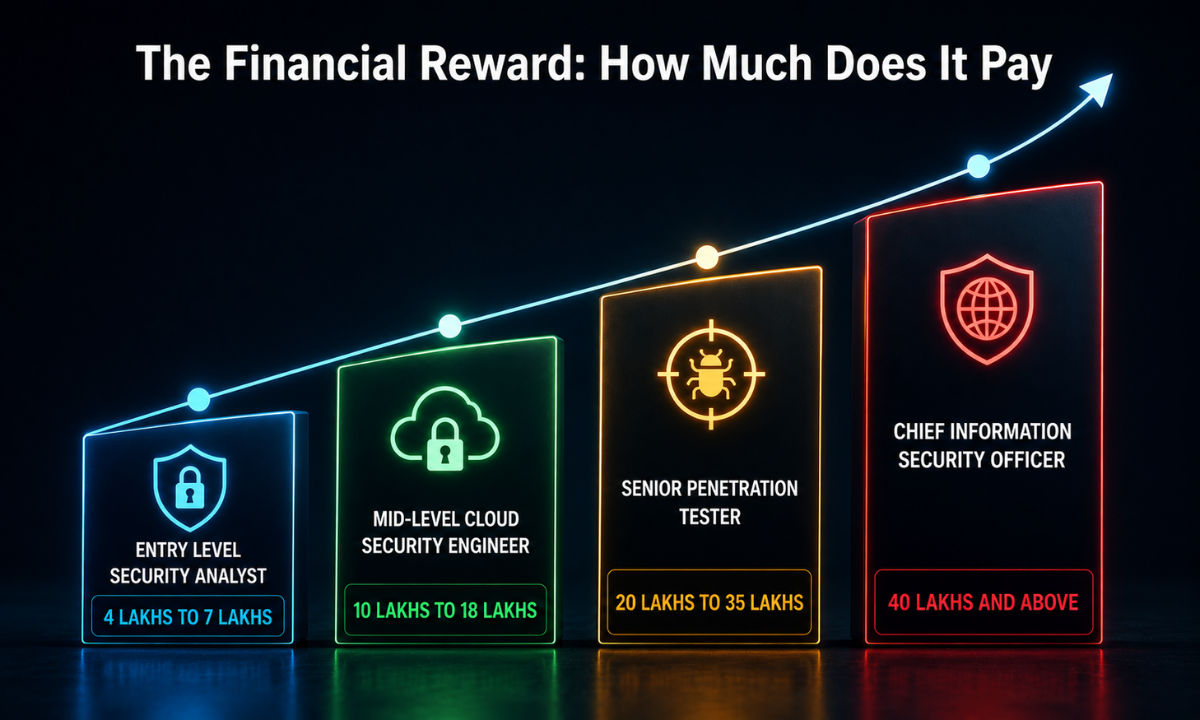
Here is a realistic breakdown of the financial progression within the Indian digital defense market
|
Career Stage and Role |
Average Annual Compensation |
Key Drivers for Rapid Salary Growth |
|
Entry Level Security Analyst |
4 Lakhs to 7 Lakhs |
Earning recognized industry certifications and demonstrating practical hands-on lab experience. |
|
Mid-Level Cloud Security Engineer |
10 Lakhs to 18 Lakhs |
Mastering enterprise cloud architecture protection and managing rapid incident response protocols. |
|
Senior Penetration Tester |
20 Lakhs to 35 Lakhs |
Discovering complex zero-day vulnerabilities and leading advanced offensive red team operations. |
|
Chief Information Security Officer |
40 Lakhs and Above |
Directing enterprise-wide defense strategies and managing global corporate risk compliance. |
This rapid financial acceleration proves that entering the security domain is not just a standard job switch. It is a highly strategic financial move that guarantees long-term wealth generation, unmatched corporate leverage, and absolute career stability in a volatile tech market.
Essential Skills and Qualifications

Transitioning into the digital defense sector does not require a traditional four-year computer science degree. Hiring managers in this field heavily prioritize proven practical capability over theoretical academic credentials.
To secure a high-paying role, you must systematically acquire a specific set of highly technical hands-on competencies. Meeting the strict cybersecurity job requirements means proving you can actually defend a live corporate network under pressure.
To become highly employable in the current market, you must master these foundational and advanced skills
-
Network Architecture and Protocols: You must intimately understand how data travels across the Internet. Mastering the OSI model, TCP/IP configurations, and deep packet inspection using tools like Wireshark is the absolute baseline for identifying malicious traffic.
-
Operating System Mastery: Hackers do not use standard consumer interfaces. You must become highly proficient in navigating Linux command lines, specifically utilizing penetration testing distributions like Kali Linux to execute advanced security scripts.
-
Cloud Security Posture: With modern infrastructure hosted entirely offsite, mastering identity and access management (IAM) protocols for enterprise platforms like AWS, Azure, and Google Cloud is a critical requirement for almost all mid-level roles.
-
Security Information and Event Management (SIEM): Analysts spend their days monitoring enterprise dashboards. Hands-on experience configuring and analyzing real -time alerts using platforms like Splunk or IBM QRadar is non-negotiable.
-
Scripting and Automation: While you do not need to be a full-stack developer, the ability to write custom Python or Bash scripts to automate repetitive threat hunting tasks significantly elevates your market value.
Beyond raw technical execution, elite security professionals possess an incredibly strong analytical mindset. You must be able to reverse engineer complex problems, think exactly like a malicious attacker, and clearly communicate complex technical risks to non-technical corporate executives.
Why Choose Apponix?
Knowing the immense potential of the digital defense market is entirely different from actually securing a highly paid role within it.
Most beginners fail not because they lack theoretical knowledge, but because they completely lack the hands-on practical experience that modern hiring managers demand. This is exactly where Apponix Technologies bridges the gap. We do not just teach theory; we systematically engineer you into an industry-ready professional capable of defending live corporate networks.
When you enroll in our comprehensive cybersecurity course in Bangalore, you are immediately exposed to real-world threat simulations. Our curriculum is deeply rooted in 100% practical based learning where you actively utilize industry-standard tools like Kali Linux, Wireshark, and Metasploit. We ensure that every candidate builds a strong portfolio by completing live mini hacking projects and incident response simulations.
Beyond world-class technical training, Apponix provides an ironclad commitment to your career trajectory. Our program features an unmatched placement assistance model.
We provide dedicated resume building, intensive mock HR interviews, and guaranteed interview arrangements with our vast network of corporate hiring partners. We completely remove the anxiety of the job hunt, allowing you to focus entirely on mastering your defensive skills.
Conclusion
The digital landscape is evolving at a breakneck pace, and the window of opportunity to establish yourself as a highly paid security professional has never been wider. Every single day that you delay your transition into this dynamic field is another day of missed financial growth and unparalleled career stability. The massive gap between the skyrocketing corporate demand and the severe shortage of skilled defenders presents an unprecedented advantage for ambitious individuals who are ready to take immediate action.
Stop letting a lack of practical experience hold you back from a highly lucrative tech career. By partnering with a premier Training institute in Bangalore, you gain the exact hands-on mentorship and industry connections required to confidently step into the digital battlefield. Make the strategic choice to secure your financial future today and transform yourself into the highly specialized digital asset that top-tier corporations are desperately searching for.

Apponix Academy
Apponix Academy