POPULAR COURSES
Master Programs



Table of contents:
|
1. The Multi-Trillion-Dollar Blind Spot and Why Accessibility Testing Dominates 2026
|
|
2. Decoding the Legal Playbook: WCAG vs. ADA |
|
3. Manual vs. Automated Audits
|
|
4. The Modern Accessibility Testing Toolkit |
|
5. Why Ambitious QA Engineers Choose Apponix Technologies? |
|
6. Conclusion |
Shipping a product that runs flawlessly under ideal conditions but locks out millions of alternative users is a critical architectural failure.
If a digital asset is structurally unusable for individuals with visual, auditory, physical, or cognitive impairments, your quality assurance pipeline is incomplete. Understanding exactly what accessibility testing is in software testing has shifted from an occasional compliance afterthought into a board-level infrastructure mandate.
Bridging this technical execution gap is precisely why our premier Software testing course in Bangalore focuses heavily on behavioral engineering, assistive technology interactions, and strict compliance frameworks rather than simple, basic functional scripts.
To lead high-value quality engineering initiatives, you must move past superficial design principles and treat inclusive engineering as a core non-functional requirement.
The Multi-Trillion-Dollar Blind Spot and Why Accessibility Testing Dominates 2026
When engineering teams look at their target audience profiles, they frequently ignore a staggering demographic reality.
According to data from the World Health Organization, over 1.3 billion people globally live with some form of significant disability. This demographic commands an annual disposable spending power scaling past $13 trillion. If your platform introduces digital friction that blocks these users, they do not file a support ticket; they immediately bounce to a competitor.
The current state of web software reveals a massive disparity between corporate awareness and actual production quality. The data proves that relying entirely on traditional automated pipelines or developer "best efforts" leaves platforms highly vulnerable.
The 2026 Digital Accessibility Crisis
The annual WebAIM Million analysis evaluated the homepages of the top one million most visited, most influential websites.
The metrics show an alarming regression in baseline web compliance due to runaway codebase complexity:
|
Performance Metric |
State of the Web Baseline |
The Engineering Reality |
|
Systemic Failure Rate |
95.9% of all evaluated homepages |
Nearly every dominant public web application contains active, detectable WCAG violations. |
|
Average Error Density |
56.1 distinct errors per single homepage |
Users utilizing assistive tech face an average of 56 hidden barriers on a single landing page. |
|
Codebase Complexity |
1,437 elements per page (22.5% increase YoY) |
Exploding page weight and heavy script layers are creating a compounding, non-linear surge in user friction. |
The ARIA Paradox: One of the most damning technical findings in the latest engineering audits highlights that pages heavily utilizing ARIA attributes contain an average of 59.1 errors, whereas pages built without any ARIA attributes average just 42 errors.
This statistical delta proves that layering accessibility tags onto a fundamentally broken, non-semantic HTML layout actually causes 17 more structural barriers per page, rather than fixing them.
Integrating rigorous Accessibility Testing into the core software lifecycle is the only programmatic mechanism to dismantle these patterns.
It ensures that semantic components are mapped correctly to the operating system's underlying accessibility tree, transforming your digital products from exclusive silos into universally accessible ecosystems.
Decoding the Legal Playbook: WCAG vs. ADA
To build a sustainable architecture for your product, you must understand that digital accessibility is no longer a localized design trend; it is a strict legal barrier enforced by global regulatory bodies.
When we look at Accessibility Testing in Software Testing, the core playbook is governed by two primary forces: technical standards and legislative mandates.
-
WCAG Compliance (The Technical Framework): The Web Content Accessibility Guidelines (WCAG) represent the definitive global benchmark engineered by the World Wide Web Consortium (W3C). In the current 2026 tech environment, while the exploratory WCAG 3.0 draft is being refined for long-term outcome-based grading, WCAG 2.1 and 2.2 Level AA remain the strict normative benchmarks for modern software deployment.
-
ADA Compliance (The Enforcement Mechanism): The Americans with Disabilities Act (ADA) acts as the legislative hammer. The legal landscape shifted decisively following recent updates by the U.S. Department of Justice (DOJ), which explicitly tied ADA Title II compliance directly to the WCAG 2.1 Level AA standard for public digital platforms. Failing these benchmarks is no longer just poor user experience; it is an active corporate liability.
To ensure your code meets these overlapping mandates, your QA pipeline must rigorously test against the four core foundational pillars of the POUR model:
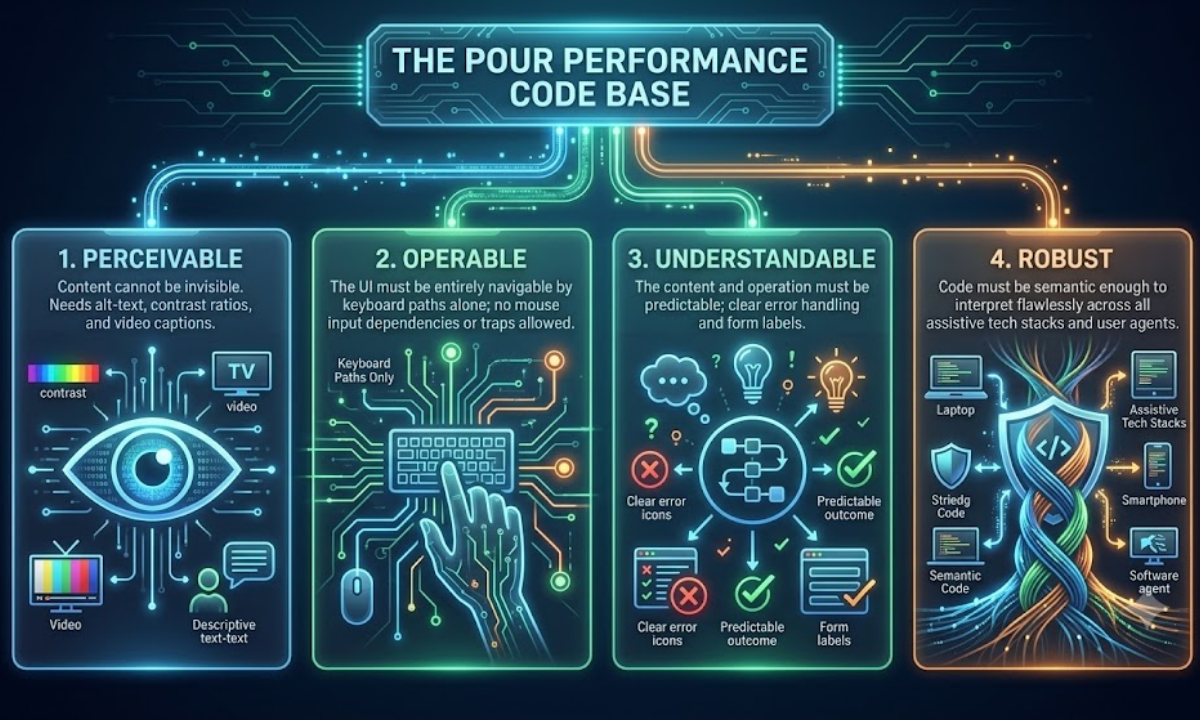
Image Credits: Hand-drawn, re-imagined with AI
Manual vs. Automated Audits
Architecting a bulletproof strategy for Web Accessibility Testing requires dismantling a dangerous industry myth: you cannot automate your way to 100% compliance. While continuous integration (CI) pipelines use automated linters to intercept obvious syntax regressions, true validation requires a balanced, dual-engine approach executed via a comprehensive Accessibility Audit.
A resilient testing lifecycle segments coverage across two distinct execution engines:
Automated Accessibility Testing
This engine acts as your first line of defense, scanning massive codebases programmatically during code compilation or staging deployments. Automated scripts are exceptional at verifying explicit, binary, rule-based elements.
-
What it catches: Missing alt tags on static images, text color contrast ratios falling below the 4.5:1 minimum threshold, broken ID attributes, and absent document language attributes.
-
The Bottleneck: Automation caps out at catching roughly 30% to 40% of total real-world accessibility barriers. A scanner can easily verify that an <img> tag has alternative text, but it cannot judge whether that text accurately describes the image context or says something useless like alt="screenshot_2026_final.png".
Manual Accessibility Testing
This engine targets the nuanced, interpretive layer of the software experience. It requires human QA specialists to put away the mouse and interact with the software using the exact workflows of users with disabilities.
-
What it validates: Keyboard focus traps (getting stuck inside a modal menu with no way to Tab out), dynamic screen reader announcement priorities (ARIA live-regions handling real-time form updates), and the cognitive readability of error prevention screens.
Operational Matrix: Balancing the Audit Stack
|
Audit Layer |
Testing Velocity |
Core Diagnostic Focus |
Recommended Tooling Strategy |
|
Automated Verification |
Instantaneous; integrates directly into Git hooks and CI/CD pipelines. |
Syntax verification, structural contrast calculations, static HTML tag auditing. |
Run programmatic suites like Axe-core, Pa11y, or Google Lighthouse during daily builds. |
|
Manual Verification |
Deliberate: conducted during sprint-end testing or major release gates. |
Interactive user experience, complex forms, tab order logic, and assistive navigation. |
Execute user journeys natively using NVDA (Windows), VoiceOver (macOS/iOS), and TalkBack. |
The Architectural Rule of Thumb: Automated testing proves the presence of explicit errors; manual testing proves the usability of the actual interface. If your QA department is only looking at automated dashboard scores, your system is heavily exposed to legal and functional failures.
The Modern Accessibility Testing Toolkit
To execute an inclusive verification strategy, a QA engineer must possess a deep familiarity with specialized validation software. The global testing market does not rely on a single utility; instead, it leverages a combination of browser-native engines, automation packages, and hardware simulators to guarantee cross-platform compliance.
The matrix below illustrates the core industry standard Accessibility Testing Tools currently deployed across modern Agile and DevOps environments:
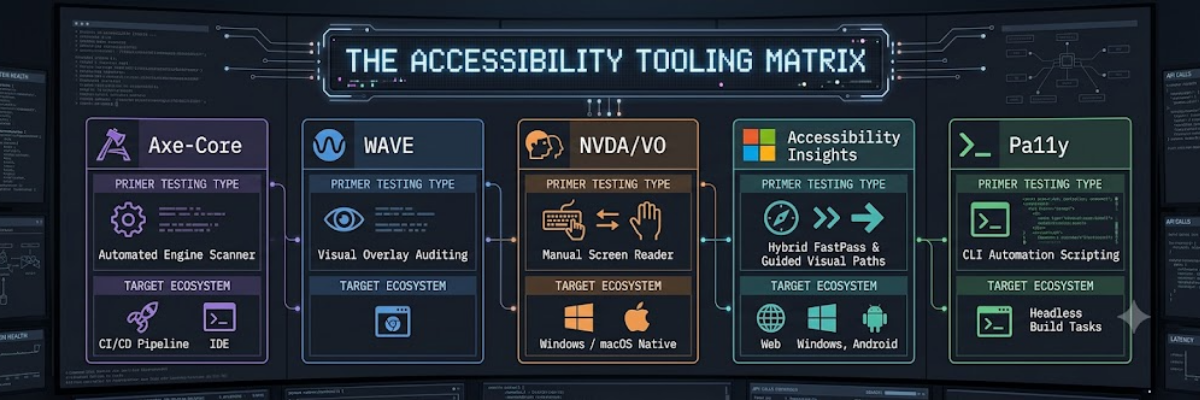
Image Credits: Hand-drawn, re-imagined with AI
-
Axe-Core (Deque Systems): The absolute industry gold standard. It is the programmatic open-source rule engine that runs beneath nearly every major accessibility scanner on earth. It integrates smoothly into developer IDEs and Git automated hooks to catch syntax errors during code compilation.
-
WAVE Evaluation Tool: Engineered by WebAIM, this extension applies a clear visual overlay directly onto live web pages. It injects colorful contextual icons directly over active layout elements, instantly flagging broken heading orders, contrast drops, or missing image attributes without requiring you to comb through raw code.
-
NVDA & Apple VoiceOver: These are the primary assistive screen reader platforms used to conduct deep manual user path validation. Testing with active screen readers is the only scientific method to confirm that dynamic UI changes and multi-layered forms are being announced out loud with logical verbal structures.
-
Accessibility Insights (Microsoft): A powerful open-source tool that maps out keyboard execution flows visually. Its unique "Tab Stops" visualization automatically draws sequential lines across the screen to track exactly where a user's focus lands, instantly exposing interactive focus traps or illogical page paths.
-
Pa11y: A lightweight, command-line interface utility built specifically for test automation engineers. It crawls web layouts via headless browser instances, outputting clean JSON compliance profiles directly into automated reporting servers on every code check-in.
Why Ambitious QA Engineers Choose Apponix Technologies?
The global technology landscape is shifting rapidly, and standard manual testing professionals who only understand basic click-through scripts are facing declining industry demand. The modern enterprise market actively commands elite specialists who can design integrated automation pipelines, analyze semantic structures, and safeguard applications against devastating legal liabilities.
If you are ready to upgrade your engineering capabilities, Apponix Technologies is here to bridge that execution gap. As the premier Training Institute in Bangalore, we abandon superficial text tutorials to deliver a rigorous, hands-on professional accelerator.
Our unique training advantages include:
-
Production-Ready Sandbox Labs: You will not simply memorize software testing definitions. Our students spend hours inside live sandboxes writing custom automation frameworks, integrating Axe-core engines into CI pipelines, and executing professional accessibility audits on enterprise-scale architectures.
-
Direct Expert Mentorship: Our courses are led entirely by active Senior Quality Assurance Architects and principal systems engineers who bring real-world production challenges and modern corporate compliance frameworks directly into the classroom.
-
Comprehensive Automation Mastery: We ensure you master the complete software testing lifecycle, scaling from foundational exploratory manual testing to advanced web, API, mobile app automation, and cloud-based performance evaluation.
We systematically eliminate the stress of career transitions with an aggressive career development ecosystem, offering professional resume optimization, extensive mock interview sessions, and direct placement channels into top-tier tech firms.
Conclusion
Quality assurance is fundamentally about ensuring a digital asset behaves exactly as intended for every individual who interacts with it. A platform that systematically isolates or ignores a massive global demographic is not a complete or reliable piece of software. Mastering accessibility compliance is the definitive differentiator that elevates a standard tester into a high-leverage Quality Engineer.
Do not allow your skills to remain confined to predictable regression scripts. Connect with Apponix Technologies today, enroll in our advanced Software testing course in Bangalore, and unlock the architectural capabilities that will make your engineering assets indispensable to the global enterprise market.
Reference:
1. https://www.geeksforgeeks.org/software-testing/accessibility-testing-software-testing/
2. https://www.accelq.com/blog/accessibility-testing/

Apponix Academy
Apponix Academy