POPULAR COURSES
Master Programs



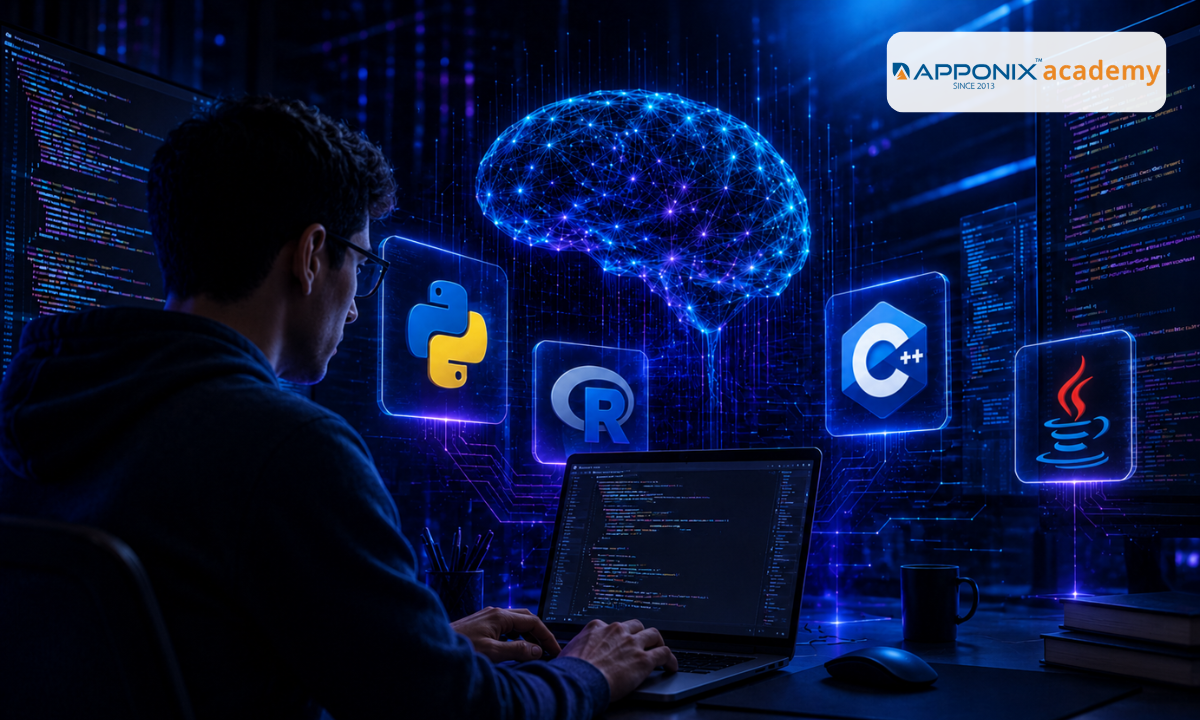
Table of contents:
|
1. The Big Question of Humans vs. Machine |
|
2. The Undisputed King: Python |
|
3. The Specialists: C++, Java, and Data Champions
|
|
4. Why Choose Apponix? Master the AI Ecosystem |
|
5. Conclusion |
The year 2026 has witnessed a massive shift from simply discussing artificial intelligence to actively building it. For any aspiring engineer seeking an AI Course in Bangalore, the path forward is often obscured by technical jargon and endless options. At Apponix Academy, a premier Training Institute in Bangalore, we recognize that the difference between an amateur and a professional architect lies in their choice of tools.
While many believe that AI operates through a form of digital magic, every groundbreaking innovation is built upon a foundation of structured, high-performance logic.
Choosing the right technology stack is not merely a technical preference; it is a strategic career decision. The specific code you write determines how fast your neural networks process data, how securely your models interact with users, and how easily you can scale your projects to a global audience.
To stay competitive in this rapidly evolving market, you must master the top programming languages for artificial intelligence that the industry currently demands.
This comprehensive guide is designed to act as your technical roadmap. We will strip away the hype and provide a clear, data-driven analysis of the programming ecosystem. In this blog, we will cover:
-
The Reality of Modern Coding: We will address the ongoing debate about automation and clarify whether human-written code remains the cornerstone of the industry.
-
The Dominance of Python: We will explore why one specific language remains the undisputed leader for research, prototyping, and high-level machine learning.
-
The Speed of Compiled Languages: We will look at heavy-duty languages such as C++ and Java that power the most demanding real-time AI applications.
-
Specialized Mathematical Tools: We will detail the specific utility of languages designed for heavy statistical analysis and data visualization.
-
Strategic Career Growth: We will reveal how professional training can bridge the gap between knowing a language and building a profitable corporate career.
The future is being written in code, and those who master the right languages will be the ones who define it.
The Big Question of Humans vs. Machine
With the explosive rise of sophisticated code-generation tools and autonomous agents in 2026, many newcomers to the tech industry are pausing to ask a fundamental question: Does AI require coding anymore? It is a logical concern.
If an AI can write a function or debug a script in milliseconds, is there still a seat at the table for a human programmer?
The reality of the corporate world is that AI has changed the nature of coding, not eliminated the necessity of it. While Large Language Models (LLMs) are exceptional at generating "boilerplate" code or solving isolated mathematical problems, they lack the high-level architectural foresight required to build a secure, scalable, and ethically sound enterprise system.
An AI might give you the bricks, but it cannot design the skyscraper. The modern engineer has transitioned from being a "manual laborer" of code to being a "Digital Architect." To clarify the relationship between human engineers and automated tools, consider this breakdown of responsibilities:
|
The Task |
The Role of AI Tools |
The Role of the Human Engineer |
|
Code Generation |
Rapidly produces syntax and basic logic structures. |
Reviews for security vulnerabilities and architectural alignment. |
|
System Design |
Suggests common patterns based on existing data. |
Decides the overall data flow and multi-platform integration strategy. |
|
Debugging |
Identifies syntax errors and common logical flaws. |
Solves complex "edge cases" and ensures business-specific logic is met. |
|
Model Training |
Automates the hyperparameter tuning process. |
Selects the data sets and ensures the model is free from bias. |
To understand why the answer to "Does AI require coding?" is a resounding yes, we must look at the three pillars of modern AI development that machines cannot yet navigate alone:
-
Logic and Architecture: An AI does not understand "why" a specific database structure is chosen over another for a particular business use case. Human developers must understand the core logic of programming to ensure the AI's output fits into a larger, functional ecosystem.
-
Security and Compliance: AI-generated code is notorious for occasionally including outdated libraries or security loopholes. A professional developer must be able to read, audit, and rewrite code to protect sensitive corporate data.
-
Creative Problem Solving: Innovation rarely comes from repeating the past. Since AI is trained on existing data, it excels at repetition. Human engineers are required to invent entirely new ways of utilizing technology to solve problems that have never been solved before.
In short, the "coding" of 2026 is less about memorizing syntax and more about mastering logic, structure, and algorithmic thinking. You are no longer just a coder; you are a director of digital intelligence. To lead this revolution, however, you must first learn the "language" that the machines speak.
The Undisputed King: Python

If you were to survey every major tech firm and research lab globally, one name would consistently appear at the very top of their stack: Python. While the list of top programming languages for artificial intelligence is growing, Python remains the undisputed king for both beginners and senior architects. It is the language that turned AI from a complex academic pursuit into a practical, industrial tool.
The reason for Python's dominance isn't just about the code itself; it's about the massive, high-performance ecosystem built around it. In 2026, Python will act as the "glue" that connects powerful hardware to sophisticated software.
Why Python Dominates the 2026 AI Landscape:
-
Human-Centric Syntax: Python is famous for being "readable." It allows developers to focus on solving the logic of an AI model rather than fighting with complex semicolon placements or memory management. This speed of development is crucial when a company needs to prototype a new idea in days rather than months.
-
The Library Powerhouse: Python’s true strength lies in its specialized libraries. For instance, tools like OpenCV and MediaPipe have made it the industry standard for computer vision and real-time body tracking applications. Whether you are building a vehicle security system or a physical measurement app, these libraries provide the "eyes" for your AI.
-
The Gateway to Deep Learning: When it comes to building neural networks, Python is non-negotiable. Frameworks like TensorFlow and PyTorch are designed specifically for deep learning. These libraries allow developers to train massive models that can recognize speech, translate languages instantly, and even generate hyper-realistic videos with minimal lines of code.
The Architectural Advantage: Python's flexibility allows it to integrate seamlessly with higher-performance languages like C++. This means you can write your high-level strategy in Python while the heavy mathematical "lifting" happens at lightning speed in the background.
Python’s Role in the "Intelligence Life Cycle":
-
Data Preprocessing: Cleaning and organizing raw data using libraries like Pandas.
-
Model Prototyping: Quickly testing different neural network architectures.
-
Deployment: Using lightweight frameworks to push the AI model to the cloud or local devices.
By mastering Python, you aren't just learning a language; you are gaining access to the largest repository of AI knowledge on the planet. However, while Python is perfect for the "brains" of an AI, sometimes the industry requires tools that offer more mathematical precision or raw execution speed.
The Specialists: C++, Java, and Data Champions
While Python is universally recognized as the undisputed leader for prototyping and building high-level logic, deploying those AI models into the chaotic real world requires different architectural strengths.
If you are building a system that must operate inside a high-speed vehicle, secure a global banking network, or process millions of medical records, you must transition from prototyping languages to high-performance execution languages.
To dominate the 2026 tech market, professional digital architects must understand how to leverage these specific "Specialist" languages based on the exact corporate environment they are operating in.
1. C++: The Engine of Edge AI and Robotics

Python might provide the intelligence, but C++ provides the raw, unadulterated speed. In the modern era of "Edge Computing," AI models are no longer just sitting in massive cloud servers; they are being deployed directly onto local hardware.
When you are developing advanced electronics prototypes or running intensive computer vision libraries to track physical movements in real-time, high latency is completely unacceptable. If an autonomous drone or a vehicle security system takes even one extra second to process an image, the system fails.
C++ is a compiled, low-level language that allows developers to manage system memory manually and squeeze every ounce of processing power out of the hardware. Today, massive AI inference engines like NVIDIA's TensorRT rely entirely on C++ to execute complex models instantly on embedded devices.
2. Java: The Enterprise Backbone

If C++ is built for hardware speed, Java is built for massive corporate scale. Java remains a staple in Fortune 500 companies because of its legendary stability, security, and ability to handle "Big Data" ecosystems.
When multinational corporations build AI-driven fraud detection systems or enterprise-level recommendation engines, they frequently use Java. It integrates flawlessly with heavy data-processing frameworks, ensuring that an AI application will not crash even when millions of users interact with it simultaneously across different operating systems.
3. The Statistical Powerhouse: R

To train a highly accurate AI, you first need to understand the underlying mathematics of the data. This is where R programming becomes an invaluable asset. While general-purpose languages can handle basic math, R was built by statisticians, for statisticians.
In 2026, R remains the absolute gold standard for heavy data visualization, predictive analytics, and biostatistics. Whether a pharmaceutical company is analyzing clinical trial data or a tech firm is analyzing user sentiment for advanced natural language processing applications, R allows data scientists to write incredibly complex statistical formulas in just a few lines of code.
The 2026 AI Deployment Matrix
To clearly visualize when to use which tool, refer to this professional deployment breakdown:
|
The Programming Language |
The Primary AI Use Case |
The Corporate Value |
|
C++ |
Robotics, Autonomous Vehicles, Real-Time Computer Vision. |
Provides zero-latency execution and direct hardware-level control. |
|
Java |
Enterprise Systems, Fraud Detection, Global Web Apps. |
Ensures massive scalability, memory security, and cross-platform stability. |
|
R |
Statistical Modeling, Data Mining, Bioinformatics. |
Delivers publication-quality data visualization and highly complex statistical analysis. |
Mastering these specialist languages, you elevate yourself from a basic software user to an elite systems architect capable of building the digital infrastructure of the future.
Why Choose Apponix? Master the AI Ecosystem
Understanding the theoretical differences between Python and C++ is a great start, but in the competitive 2026 job market, companies don't hire you for what you know; they hire you for what you can build. While many platforms offer generic tutorials, Apponix Academy provides a high-octane, corporate-ready AI Course in Bangalore designed to turn you into a self-sufficient developer.
When you choose Apponix, you gain access to a professional ecosystem that includes:
-
Project-Based Learning: You won't just read about deep learning; you will build, train, and deploy your own neural networks. From image processing to predictive modeling, your portfolio will speak louder than your resume.
-
Specialized Domain Training: Our experts guide you through the intricacies of natural language processing and R programming, ensuring you have the mathematical precision required for top-tier data science roles.
-
The 100% Interview Guarantee: We bridge the gap between training and employment. Our dedicated placement cell ensures you get face-to-time with major tech firms, allowing you to showcase your skills and secure a premium package.
-
Industry-Active Mentors: You learn from senior architects who are currently building AI solutions in the corporate world, ensuring you stay ahead of 2026's rapidly shifting technical standards.
As a premier Training Institute in Bangalore, we bypass the fluff and focus on the technical heavy lifting. We don't just teach you syntax; we teach you how to architect intelligence. Whether your interest lies in building a sophisticated computer vision system for a vehicle or a complex Body Analyser using AI APIs, our curriculum is built for real-world applications.
Conclusion
The technological landscape is moving faster than ever, but one thing remains certain: the foundation of every magic AI interaction is a set of well-crafted, logical instructions. While the tools of the trade are evolving, the answer to the question "Does AI require coding?" remains a definitive yes for anyone who wants to lead this revolution rather than just watch it.
Mastering the top programming languages for artificial intelligence is your ticket to a career that is both financially rewarding and intellectually stimulating. By combining the readability of Python with the speed of C++ and the statistical power of R, you become the kind of versatile digital architect that the modern world is desperate to hire.
The era of artificial intelligence isn't coming; it’s already here. The only question left is whether you will be the one writing the code that defines the next decade. Don't wait for the future to happen; if you build it. Contact Apponix Academy today to book your free demo class and start your journey toward becoming a master of the AI ecosystem.

Apponix Academy
Apponix Academy