POPULAR COURSES
Master Programs



Table of contents:
|
1. The Physical vs. Virtual Lab Paradigm: Evaluating Offline Learning Infrastructure
|
|
2. Micro-Location Dynamics: Marathahalli IT Corridor vs. BTM Tech Belt
|
|
3. The 2026 Enterprise DevOps Syllabus: What Your Course Must Cover
|
|
4. The Classroom Advantage: In-Person Mentorship, Whiteboarding & Debugging Drills
|
|
5. Why Choose Apponix Technologies for DevOps Training? |
|
6. Conclusion |
Finding the right technical academy in Bangalore often comes down to choosing an ecosystem that mirrors the energy of the modern tech industry. Pursuing hands-on DevOps training in Marathahalli puts aspiring cloud engineers directly along the Outer Ring Road tech corridor, surrounded by Global Capability Centers (GCCs) and enterprise IT parks.
Partnering with a leading Training Institute in Bangalore provides the structured guidance, dedicated physical lab infrastructure, and placement support needed to transition into high-growth infrastructure roles.
The geography of Bangalore's IT landscape plays a major role in how technology professionals learn, network, and advance their careers. Over the last decade, Marathahalli and BTM Layout have emerged as the two primary epicenters for offline technical upskilling in the city, each catering to distinct demographics within the engineering community.
Marathahalli sits at the crossroads of major commercial technology hubs connecting Whitefield, Sarjapur Road, and the Outer Ring Road (ORR) belt. This strategic position places learners within minutes of major tech parks like Embassy TechVillage, Prestige TechPark, and RMZ Ecoworld. For working professionals employed in nearby MNCs, attending evening or weekend batches in Marathahalli minimizes commute friction and makes balancing full-time work with intensive lab hours manageable.
Conversely, BTM Layout offers unmatched accessibility for fresh graduates, job seekers, and early-stage startup engineers. Positioned between Koramangala, HSR Layout, Silk Board, and Electronic City, BTM Layout has developed a dense ecosystem of peer study groups, residential options, and recruitment consultancies.
Whether your goal is to transition from traditional software testing into cloud automation or to build production-grade Kubernetes pipelines from scratch, learning within these active tech hubs grounds your education in the real-world demands of Bangalore's engineering market.
The Physical vs. Virtual Lab Paradigm: Evaluating Offline Learning Infrastructure
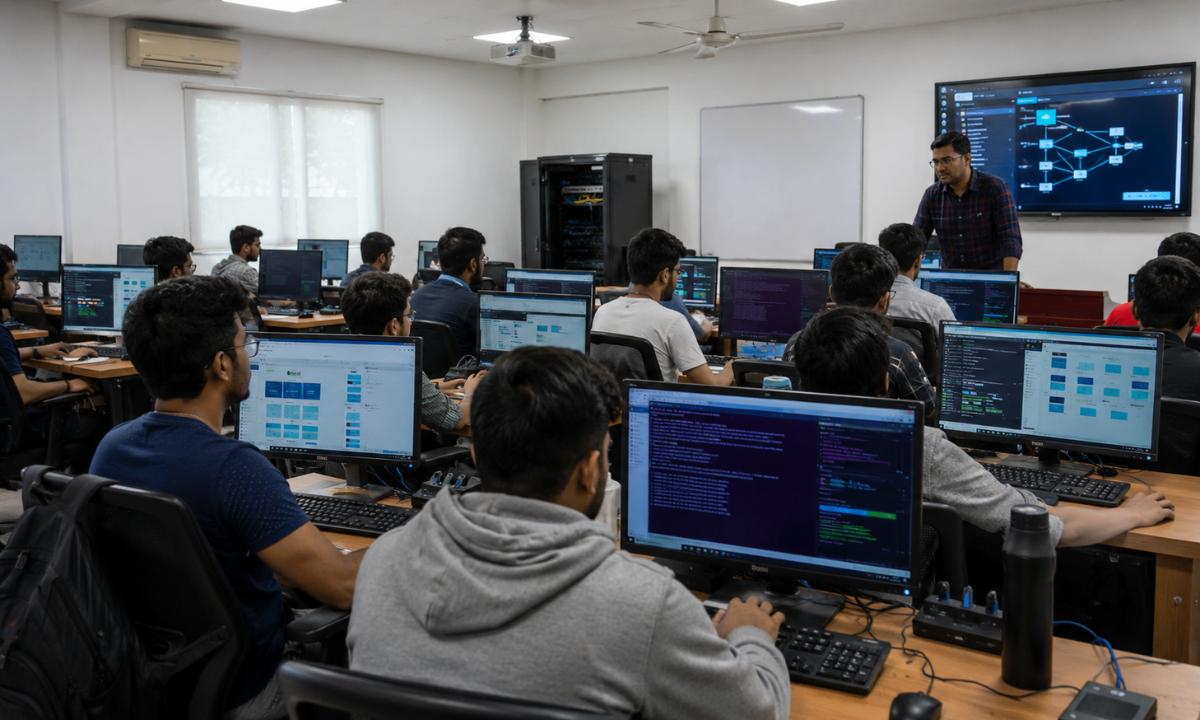
When learning infrastructure engineering, there is a fundamental difference between watching an instructor deploy a cluster on a shared cloud account and building that infrastructure yourself under live supervision. While pre-recorded online videos offer convenience, they often fail when students encounter complex environment errors such as broken CNI network plugins, permission-denied errors in Docker daemons, or Terraform state file locks.
Choosing structured Offline DevOps classes in Bangalore provides access to high-performance local hardware and dedicated cloud-range labs, creating a tactile learning environment where technical mistakes become immediate learning opportunities.
1. Bare-Metal & Local Virtual Machine Provisioning
Before orchestrating cloud instances on AWS, Azure, or Google Cloud, an enterprise-grade engineer must understand the underlying virtualization and hypervisor layers:
-
Hypervisor Mechanics & Hardware Allocation: Configuring local virtual machines using Type-2 hypervisors (such as VirtualBox or VMware Workstation) to allocate CPU cores, RAM, and virtual disk controllers manually.
-
Linux Kernel & Systemd Management: Interacting directly with the Linux kernel, configuring /etc/fstab mounts, managing system services via systemctl, and troubleshooting boot-level errors without cloud provider safety nets.
-
Local Multi-Node Cluster Creation: Building local multi-node Kubernetes clusters using tools like K3s, Minikube, or Kind across connected lab machines to understand control plane and worker node communication intimately.
Grasping these low-level virtualization concepts builds the foundational mental model required to troubleshoot complex cloud infrastructure when managed control planes behave unexpectedly.
2. Physical Network Debugging & Port-Forwarding Drills
Cloud providers often abstract networking complexities behind simple console clicks. In a dedicated physical lab environment, students inspect and configure network paths step-by-step:
-
Subnetting & CIDR Block Architecture: Calculating Classless Inter-Domain Routing (CIDR) blocks, creating custom routing tables, and configuring NAT gateways on local equipment before applying them in Terraform manifests.
-
Ingress Routing & Service Mesh Traffic: Debugging port binding conflicts, configuring NGINX ingress controllers, and setting up reverse proxies to route traffic from local host IP addresses to isolated container ports.
-
Packet Inspection & Firewall Rules: Utilizing CLI utilities like netstat, tcpdump, traceroute, and iptables to trace dropped packets and diagnose security group misconfigurations in real time.
Practicing network troubleshooting directly on lab hardware demystifies packet flow, making multi-cloud VPC peering and complex microservice service-discovery straightforward to design and maintain.
3. Real-Time Mentor Intervention vs. Asynchronous Ticket Queues
The most significant bottleneck in self-paced learning is the delay between encountering a critical error and receiving an answer. In a physical classroom setup, this feedback loop is reduced from days to seconds:
-
Instant Pair-Debugging: When a Kubernetes pod gets stuck in CrashLoopBackOff or a Terraform application fails due to circular dependencies, an on-site instructor can review the terminal logs over your shoulder immediately.
-
Live Whiteboard Architectural Mapping: Translating abstract pipeline failures into visual diagrams on a whiteboard helps students conceptualize data flow, secret injection, and environment variable passing.
-
Shared Error Analysis: When one student encounters an obscure bug during a lab exercise, the entire batch analyzes the root cause together, multiplying every student's troubleshooting exposure.
Eliminating extended waiting times keeps learning momentum high and trains students to adopt the analytical troubleshooting workflow used by senior platform engineers.
Micro-Location Dynamics: Marathahalli IT Corridor vs. BTM Tech Belt
Selecting where to take your training in Bangalore is more than a matter of geographic convenience; it directly influences your study habits, networking opportunities, and batch flexibility.
Both Marathahalli and BTM Layout stand as premier educational hubs, yet they cater to distinct career stages and daily schedules. Analyzing the micro-location dynamics of each area helps you pick a center that fits seamlessly into your daily routine.
1. The Marathahalli IT Corridor: Designed for Working Professionals
Marathahalli's strategic position along the Outer Ring Road (ORR) makes it a preferred learning hub for engineers currently employed in nearby multinational corporations and Global Capability Centers (GCCs):
-
Proximity to Enterprise Tech Parks: Located within easy reach of major IT parks like Prestige TechPark, Embassy TechVillage, and RMZ Ecoworld, allowing working professionals to attend late-evening weekday batches immediately after office hours.
-
Weekend Batch Architecture: Academies in this belt specialize in intensive Saturday and Sunday tracks, giving full-time developers and sysadmins 4 to 5 hours of unbroken lab time without interrupting their weekday work commitments.
-
Enterprise Peer Networking: Classrooms in Marathahalli naturally attract mid-level software engineers, QA leads, and database administrators, creating a rich environment for peer knowledge sharing and internal corporate referrals.
For mid-career professionals aiming to upskill into platform engineering or cloud architecture without stepping away from their current employment, the Marathahalli corridor provides an ideal balance of proximity and scheduling flexibility.
2. The BTM Tech Belt: The Career Switch & Startup Launchpad
BTM Layout serves as a vibrant launchpad for fresh graduates, career switchers, and job seekers relocating to Bangalore to launch their tech careers.
Selecting an established DevOps institute in BTM Layout places learners at the center of a dense technical community surrounded by Koramangala's startup ecosystem, Silk Board, and HSR Layout:
-
Affordable Living & Study Infrastructure: BTM Layout offers extensive paying guest (PG) accommodations, co-living spaces, and 24/7 study cafes, making it economical for outstation candidates to immerse themselves in full-time upskilling.
-
Daily Lab Immersion: Unlike working professionals who prefer weekend batches, learners in BTM Layout often utilize open-lab policies to spend 6 to 8 hours daily building pipelines, breaking clusters, and practicing scenario drills.
-
Direct Access to Hiring Drives: Positioned near major startup hubs and recruitment agencies in Koramangala and Silk Board, candidates located in BTM can easily attend walk-in interviews and hiring meetups across South Bangalore.
This concentrated learning ecosystem fosters strong peer study groups, where candidates regularly collaborate on open-source projects, conduct mock technical interviews, and review code together.
3. Evaluating Your Micro-Location Fit
To determine which area aligns best with your learning goals, consider your current employment status, daily commute constraints, and preferred study style:
-
Choose Marathahalli if: You work along the ORR, Whitefield, or Sarjapur tech belts, require flexible weekend or evening batches, and want to network with experienced industry peers.
-
Choose BTM Layout if: You are transitioning careers full-time, desire maximum daily lab access, require local housing infrastructure, and want proximity to South Bangalore's startup hiring drives.
Aligning your training location with your lifestyle ensures you maintain consistency throughout your learning journey, allowing you to maximize lab hours and stay focused on your career transition.
The 2026 Enterprise DevOps Syllabus: What Your Course Must Cover

A major challenge for candidates entering today's job market is enrolling in outdated training programs that still teach mid-2010s DevOps workflows. Legacy syllabi often focus heavily on manual server configuration, standalone Jenkins servers, and simple shell scripts while ignoring modern production standards like declarative GitOps, serverless container runtimes, and platform engineering.
A production-aligned DevOps developer course in Bangalore must prepare you to step onto an active engineering team and immediately manage multi-cloud infrastructure. Before enrolling in any institute, audit their syllabus against the five foundational layers of the modern cloud-native stack.
The 5 Essential Pillars of the Enterprise Syllabus
1. Linux Systems Engineering & Production Networking
- Core Competencies: Linux kernel basics, process management, SSH key management, systemd service creation, L4/L7 load balancing, DNS resolution, and TCP/IP stack inspection.
- Real-World Value: Modern cloud workloads run almost exclusively on Linux; diagnosing a failing container requires a deep understanding of Linux namespaces, cgroups, and network interfaces.
2. Containerization & Kubernetes Cluster Orchestration
-
Core Competencies: Docker daemon configuration, multi-stage image optimization, Kubernetes pod lifecycle, Deployments, StatefulSets, Ingress controllers, and Helm chart packaging.
-
Real-World Value: Container orchestration is the backbone of microservices. Mastering Amazon EKS or Google GKE ensures you can manage auto-scaling applications across distributed clusters.
3. Infrastructure as Code (IaC) & State Management
-
Core Competencies: Terraform syntax, custom module creation, remote state locking with S3 and DynamoDB, drift detection, and Ansible configuration playbooks.
-
Real-World Value: Manual cloud console clicks do not scale in enterprise settings. IaC enables teams to audit, version control, and recreate entire multi-region environments deterministically.
4. GitOps-Driven CI/CD & DevSecOps Pipelines
-
Core Competencies: Event-driven GitHub Actions workflows, Argo CD declarative cluster synchronization, automated container scanning with Trivy, and SonarQube static code analysis.
-
Real-World Value: Moving from push-based deployments to pull-based GitOps keeps production cluster states synchronized with Git repositories while enforcing security checks automatically at every pull request.
5. Cloud Observability, Metrics & Telemetry
-
Core Competencies: Instrumenting applications with Prometheus metrics, configuring Grafana visualization dashboards, writing custom PromQL queries, and setting up Alertmanager notification routes.
-
Real-World Value: Deployment is only half the battle; real-time observability guarantees you can detect performance bottlenecks, monitor SLOs/SLIs, and resolve system incidents before users are impacted.
Mastering these five layers transforms a student from a tool operator into a complete infrastructure engineer.
Evaluating Practical Depth Over Tool Count
When comparing syllabus outlines, focus on how these technologies are connected rather than the sheer number of tool logos listed on a brochure. A comprehensive DevOps course in Bangalore should not teach tools in isolation; it should integrate them into an automated delivery pipeline where code moves seamlessly from a developer's local Git branch to a production Kubernetes cluster.
Evaluating a course based on pipeline integration ensures that you learn the architectural context behind every tool, giving you the problem-solving depth required during technical architecture interviews.
The Classroom Advantage: In-Person Mentorship, Whiteboarding & Debugging Drills
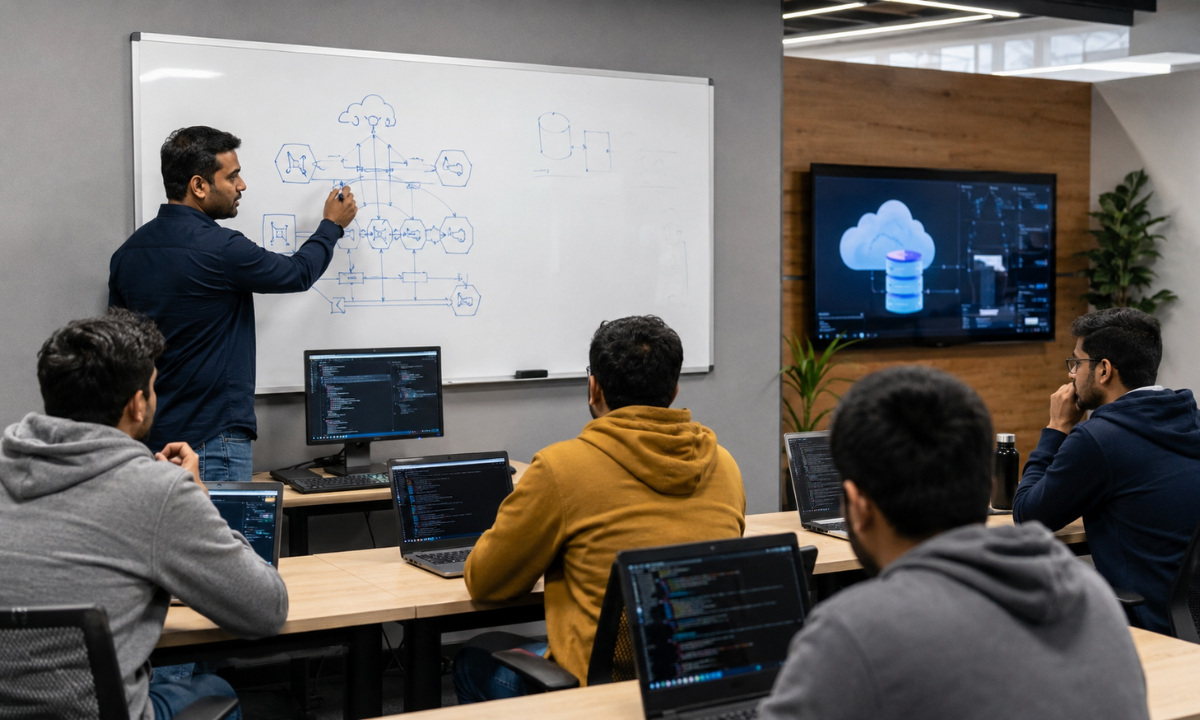
While online video platforms make syntax easy to look up, high-stakes cloud infrastructure concepts demand interactive, real-time collaboration. Learning to design fault-tolerant clusters or troubleshoot broken continuous delivery pipelines requires more than watching a pre-recorded screencast; it requires active architectural whiteboarding, peer debate, and scenario-based stress testing.
Enrolling in structured Classroom DevOps training Bangalore transforms abstract cloud concepts into practical engineering habits through direct instructor feedback and hands-on problem-solving.
Comparative Pedagogical Breakdown: Classroom vs. Self-Paced Learning
|
Learning Dimension |
Self-Paced Online Courses |
In-Person Classroom Environment |
Impact on Production Readiness
|
|---|---|---|---|
|
Architectural Whiteboarding |
Passive viewing of static, pre-drawn architecture diagrams |
Active instructor-led whiteboarding of VPC subnets, ingress routing, and pod topologies |
Builds deep mental models for system design and live technical interviews |
|
Live Pipeline Debugging |
Searching forums or waiting 24 to 48 hours on async Q&A boards |
On-the-spot over-the-shoulder log analysis and terminal troubleshooting |
Reduces time-to-resolution, instilling systematic debugging methodologies |
|
Scenario-Based Chaos Drills |
Clean, pre-scripted code examples that rarely fail |
Live chaos engineering drills (e.g., simulating node failures or state file locks) |
Prepares candidates for real-world on-call incidents and live interview tests |
|
Peer Review & Group Dynamics |
Isolated learning with minimal external code feedback |
Collaborative pull request reviews, group lab setups, and team architectural defenses |
Mirrors agile enterprise team workflows and collaborative Git branching models |
Why Whiteboarding & Incident Drills Build Senior Engineering Habits
The difference between video-based consumption and classroom engagement comes down to how technical muscle memory is built.
When an instructor walks you through a complex AWS VPC setup or Kubernetes ingress controller on a physical whiteboard, you trace packet paths, evaluate security boundaries, and justify design choices in real time.
Similarly, live incident drills where trainers intentionally break a running Terraform configuration or inject invalid Kubernetes manifests force you to read raw logs, execute diagnostic CLI commands (kubectl describe, journalctl), and apply surgical fixes rather than copying pre-written code snippets.
This interactive feedback loop develops the precise troubleshooting confidence that engineering leads look for when evaluating candidates for high-paying platform engineering roles.
Why Choose Apponix Technologies for DevOps Training?
Transitioning into cloud automation and platform engineering requires more than watching online video tutorials; it demands configuring live cloud infrastructure, writing production Terraform manifests, and managing Kubernetes clusters under expert guidance. Apponix Technologies has established itself as a premier destination for technical education, delivering a hands-on, project-centric curriculum designed to turn aspiring engineers into workplace-ready specialists.
When you train with Apponix across its strategically located learning centers, you gain access to an intensive, career-focused learning environment:
-
Dual-Hub Accessibility & Dedicated Labs: Convenient branch locations across key technology zones, equipped with high-speed dedicated cloud ranges and physical lab workstations open for extended daily practice.
-
Active Industry Practitioners & Incident Drills: Learn directly from practicing cloud architects who bring real-world migration experience, chaos engineering drills, and enterprise security frameworks into every session.
-
Production-Grade Portfolio Creation: Graduate with a public GitHub repository featuring modular Terraform manifests, Helm-packaged Kubernetes applications, and automated continuous delivery pipelines.
-
End-to-End Career Acceleration Engine: Receive personalized resume engineering, 1-on-1 mock technical architecture interviews, system design coaching, and direct placement connections with leading IT firms and GCCs.
Combining deep technical rigor with real-world cloud labs and corporate placement connections, Apponix provides the structured mentorship needed to launch a successful career in cloud infrastructure.
Conclusion
Selecting the right center to advance your cloud engineering career is a pivotal decision that requires careful evaluation of lab infrastructure, trainer expertise, and placement transparency. As the local tech ecosystem continues to demand engineers skilled in Kubernetes, Infrastructure as Code, and automated pipeline delivery, choosing an academy that offers hands-on whiteboarding and real-time mentor support gives you a distinct advantage in recruitment rounds.
Before making your final choice, visit the facility in person, inspect the live lab environments, speak directly with the mentors, and review the actual project portfolio built by previous batches. Investing in a program that prioritizes practical troubleshooting over passive lecture slides equips you with the technical authority and problem-solving confidence needed to land top-tier infrastructure roles.
Reference:
https://www.geeksforgeeks.org/blogs/best-devops-courses/

Apponix Academy
Apponix Academy