POPULAR COURSES
Master Programs




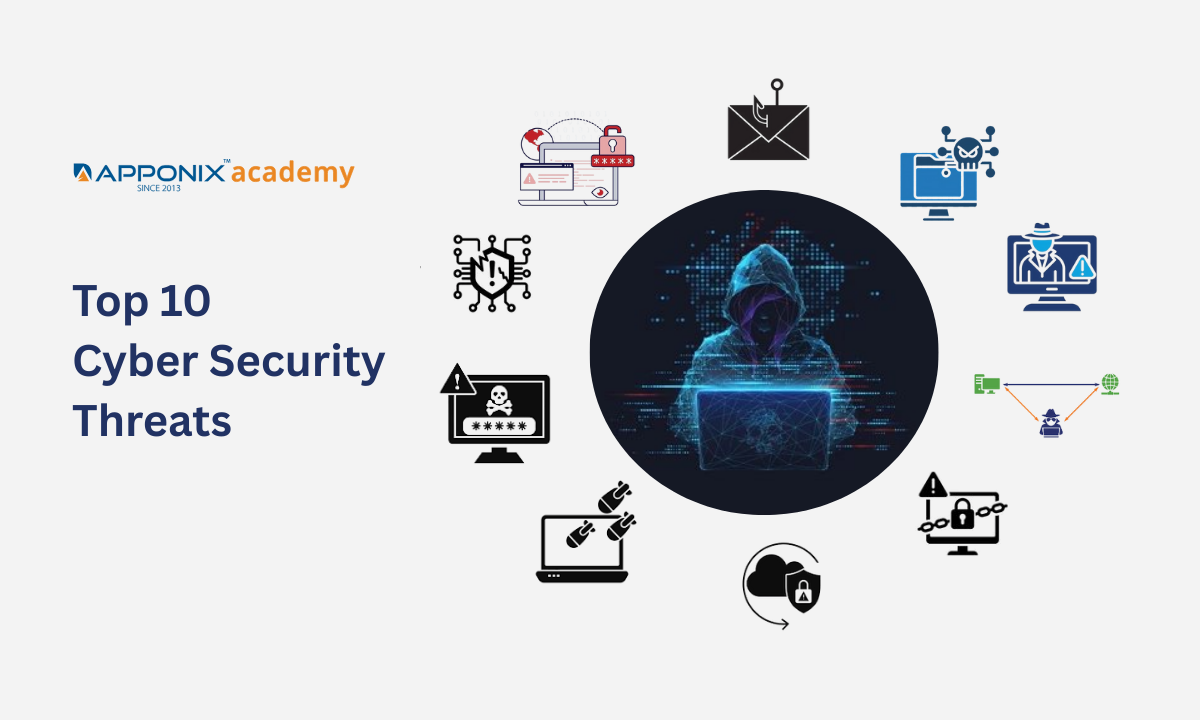
Table of contents:
|
1. Why Understanding the Top 10 Cyber Security Threats Matters |
|
2. Phishing Attacks |
|
3. Ransomware |
|
4. Malware and Spyware |
|
5. Insider Threats |
|
6. Distributed Denial-of-Service (DDoS) Attacks |
|
7. Man-in-the-Middle (MitM) Attacks |
|
8. Password Attacks |
|
9. Cloud Security Threats |
|
10. Internet of Things (IoT) Vulnerabilities |
|
11. Advanced Persistent Threats (APTs) |
|
12. The Role of Training in Combating Cyber Threats |
|
13. Final Thoughts |
|
14. FAQs |
As a cybersecurity trainer at Apponix, I engage hands-on with learners, professionals, and corporates who are on a quest to stay ahead of the ever-evolving cyber risks. In the current world that is heavily dependent on digital, knowing the top 10 cybersecurity threats is no longer a choice; it's a must.
Suppose you are either an IT professional, a business owner, or a student looking for a cybersecurity course in Bangalore; in that case, the first step in protecting yourself is becoming aware of the threats.
Cyber criminals nowadays are more intelligent, quicker, and better coordinated. Theoretically, everyone from a single individual to a large company can be a potential target for a cyberattack. In this article, I am going to share with you the core threats to our needs based on the examples from the real world that I use in my training programmes.
Why Understanding the Top 10 Cyber Security Threats Matters
As a trainer, it is my firsthand experience that ignorance of the very basics can lead to huge loss of money and damage to one's good name. The top 10 cybersecurity threats are not only the concern of the IT department. They can erode the entire business operations, customer confidence, and even shake the foundations of a nation's infrastructure.
That is why cybersecurity experts advocate for learning before an attack happens, experimenting with the new tools, and never stopping to sharpen one's competencies.
1. Phishing Attacks
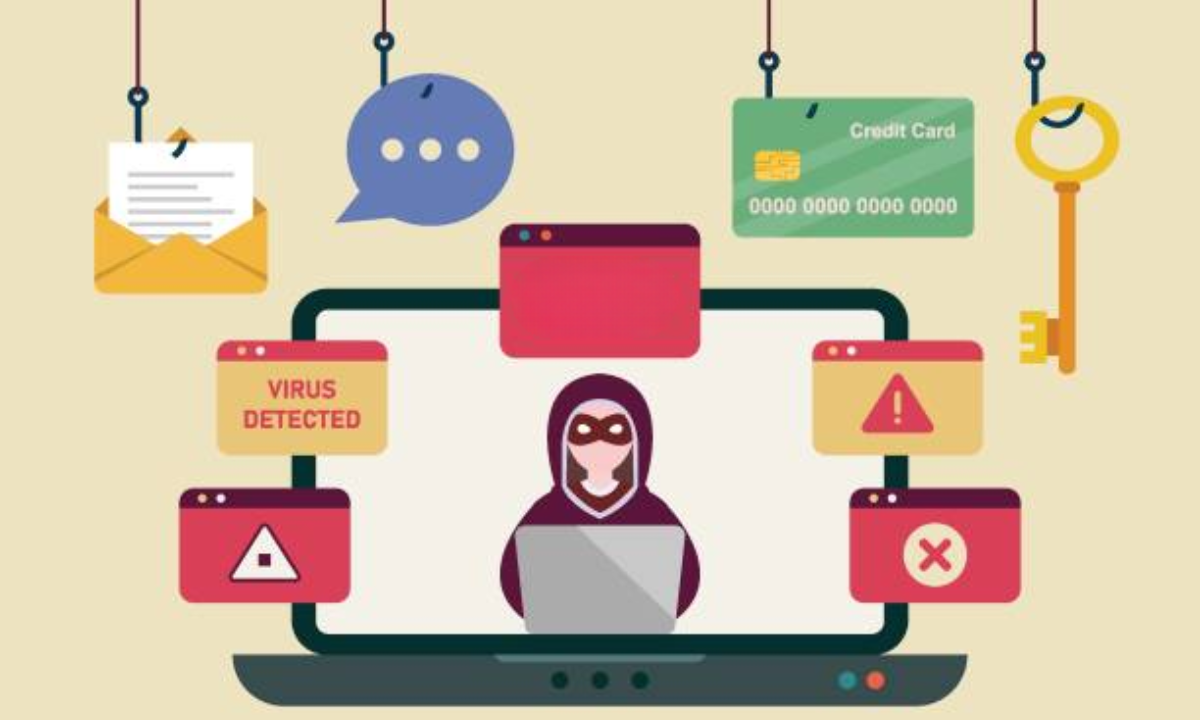
Phishing is still one of the leading and most severe issues in the realm of cyberattack issues. Phishers deceive the victims into revealing confidential information such as passwords, credit card numbers, or OTPs by means of counterfeit emails, messages, or websites.
Basically, I emphasise in training that relying on technology alone will not be enough to combat phishing. Regular discipline on the part of the users and continuous simulations are likewise essential.
2. Ransomware
Ransomware compromises the data by encrypting it, and in return, the criminals seek the ransom for the key. A number of companies that I have met tend to take this threat lightly until it is too late.
Nowadays, ransomware attacks are more and more targeted, frequently targeting the healthcare, education, and government sectors. This is one of the top 10 cybersecurity threats that organisations must be ready for through backup and incident response planning.
3. Malware and Spyware
'Malware' is a broad term that includes malicious programs such as viruses, worms, trojans, and spyware, which silently penetrate the systems. Spyware is a type of program that, apart from being secretive, actually steals sensitive information from the user.
In the course of the lab, I practically demonstrate to the learners that a single malicious download is enough for the entire network to get compromised if there are no basic security measures in place.
4. Insider Threats
Threats do not only come from outside. Insider threats are among the most difficult to detect and can be either malicious or accidental.
There are many situations where employees unintentionally expose the systems: careless data handling, use of weak passwords, and being the victims of social engineering attacks.
5. Distributed Denial-of-Service (DDoS) Attacks
DDoS attacks overwhelm servers with massive traffic, making services unavailable to legitimate users. These attacks are often used to disrupt business operations or as a distraction while other breaches occur. In training, I emphasise the importance of monitoring tools and cloud-based protection to mitigate such risks.
6. Man-in-the-Middle (MitM) Attacks
In MitM attacks, attackers intercept communication between two parties without their knowledge. This commonly happens on unsecured public Wi-Fi networks. Understanding secure communication protocols is a key learning outcome in any professional Cyber Security course in Bangalore, especially for those entering network security roles.
7. Password Attacks
Weak or reused passwords make systems extremely vulnerable. Brute-force attacks, credential stuffing, and keylogging are all methods attackers use to exploit poor password practices.
As a trainer, I strongly advocate for multi-factor authentication and password managers, simple steps that drastically reduce risk.
8. Cloud Security Threats
As organisations migrate to the cloud, misconfigurations have become a major concern. Poorly secured cloud storage can expose sensitive data to the public internet.
Many of the top 10 cybersecurity companies now focus heavily on cloud security solutions, reflecting how critical this area has become.
9. Internet of Things (IoT) Vulnerabilities
Smart devices often lack proper security controls, making them easy targets. Once compromised, IoT devices can be used as entry points into larger networks.
This is one of the fastest-growing items on the list of top 10 cyber threats, especially in smart homes and industrial environments.
10. Advanced Persistent Threats (APTs)
APTs are long-term, targeted attacks often carried out by highly skilled attackers. These threats focus on stealing data over time rather than causing immediate damage.
Detecting APTs requires advanced monitoring, threat intelligence, and skilled professionals, something I consistently highlight to students aspiring to become cybersecurity experts.
The Role of Training in Combating Cyber Threats
From my point of view at Apponix, the best defence against the top 10 cybersecurity threats is skilled human talent. Tools and technologies are important, but trained professionals make the real difference.
Many learners who join us aim to work with the top 10 cybersecurity companies, and the first step is building a strong foundation through structured learning and hands-on practice.
Final Thoughts
Cyber threats are not slowing down; they are evolving every day. As someone who trains future professionals, I firmly believe that awareness, practical skills, and continuous learning are the keys to tackling modern cyber attack issues.
If you’re serious about building a career or strengthening your organisation’s defences, enrolling in a cybersecurity course in Bangalore can be a powerful step forward. With guidance from experienced trainers and exposure to real-world scenarios, you’ll be better prepared to face the top 10 cybersecurity threats head-on.
FAQs
1. What are the top 10 cybersecurity threats today?
The top 10 cybersecurity threats include phishing, ransomware, malware, insider threats, DDoS attacks, MitM attacks, password attacks, cloud misconfigurations, IoT vulnerabilities, and advanced persistent threats.
2. Why should businesses worry about cyberattack issues?
Cyberattack issues can lead to financial loss, legal penalties, reputational damage, and operational downtime, making cybersecurity a business-critical concern.
3. How do cybersecurity experts stay ahead of threats?
Cybersecurity experts rely on continuous learning, threat intelligence, hands-on practice, and updated security frameworks to stay ahead of evolving threats.
4. Do the top 10 cybersecurity companies focus on cloud security?
Yes, most of the top 10 cybersecurity companies prioritise cloud security due to the rapid adoption of cloud-based infrastructure worldwide.
5. Can training really reduce cybersecurity risks?
Absolutely. Proper training helps individuals recognise threats early, respond correctly, and implement best security practices.
6. Who should enrol in a cybersecurity course in Bangalore?
Students, IT professionals, career switchers, and business owners who want to understand and mitigate cyber risks can all benefit from a cybersecurity course in Bangalore.

Apponix Academy
Apponix Academy