POPULAR COURSES
Master Programs



Table of contents:
|
1. Key Takeaways |
|
2. What Are SAP Course Fees in India? |
|
3. Factors That Influence SAP Course Fees
|
|
4. Why SAP Courses Are Worth the Investment |
|
5. Module-Wise Cost vs Career Opportunities
|
|
6. Why Bangalore Is a Hotspot for SAP Training |
|
7. Tips to Choose the Right SAP Course |
|
8. Common Mistakes to Avoid |
|
9. Final Thoughts |
|
10. FAQs on SAP Course Fees in India |
“Is learning SAP really worth the investment?”
“I’ve heard the fees are quite high… is that true?”
If you have ever had this conversation, you are not alone. Many aspiring professionals hesitate before enrolling because they don’t fully understand the SAP course fees in India and what exactly they are paying for in terms of training quality, certification, and career outcomes. Without clarity, it’s easy to either overpay or choose a course that doesn’t deliver real value.
Whether you are a fresher exploring career options, a working professional aiming for a salary hike, or someone planning a career switch, selecting the right SAP course in Bangalore or elsewhere in India can feel overwhelming. So, what actually goes into SAP training costs, and how can you ensure you are making a high-return investment that pays off in the long run?
Key Takeaways
-
SAP course fees in India typically range from ₹30,000 to ₹3,50,000, depending on module and expertise level
-
Advanced modules like SAP HANA / S/4HANA are priced higher due to industry demand
-
Certification, trainer expertise, and practical exposure significantly impact course fees
-
Choosing the right Training Institute in Bangalore improves placement chances and ROI
-
A well-selected SAP course can lead to 20–40% higher salary growth compared to traditional roles
What Are SAP Course Fees in India?
The SAP course fees in India are not standardised because SAP offers multiple modules catering to different industries and job roles. The pricing structure varies widely depending on whether you opt for functional, technical, or techno-functional training. Additionally, course duration, training depth, and certification inclusion play a major role in determining the final cost.
On average, most learners can expect to invest anywhere between ₹30,000 and ₹3,50,000. While this might seem like a wide range, the variation ensures that learners at different career stages, from beginners to experienced professionals, can find suitable options within their budget.
|
SAP Module |
Average Fees (INR) |
|
SAP FICO (Financial Accounting & Controlling) |
₹40,000 – ₹1,50,000 |
|
SAP MM (Materials Management) |
₹35,000 – ₹1,20,000 |
|
SAP SD (Sales and Distribution) |
₹40,000 – ₹1,30,000 |
|
SAP ABAP (Programming) |
₹50,000 – ₹1,80,000 |
|
SAP HANA / S/4HANA |
₹80,000 – ₹3,50,000 |
|
SAP HCM (Human Capital Management) |
₹30,000 – ₹1,00,000 |
|
SAP BASIS (Technical Administration) |
₹50,000 – ₹1,50,000 |
As seen above, specialised and future-ready modules like SAP HANA / S/4HANA command higher fees because they require advanced infrastructure, expert trainers, and deeper technical knowledge.
Factors That Influence SAP Course Fees
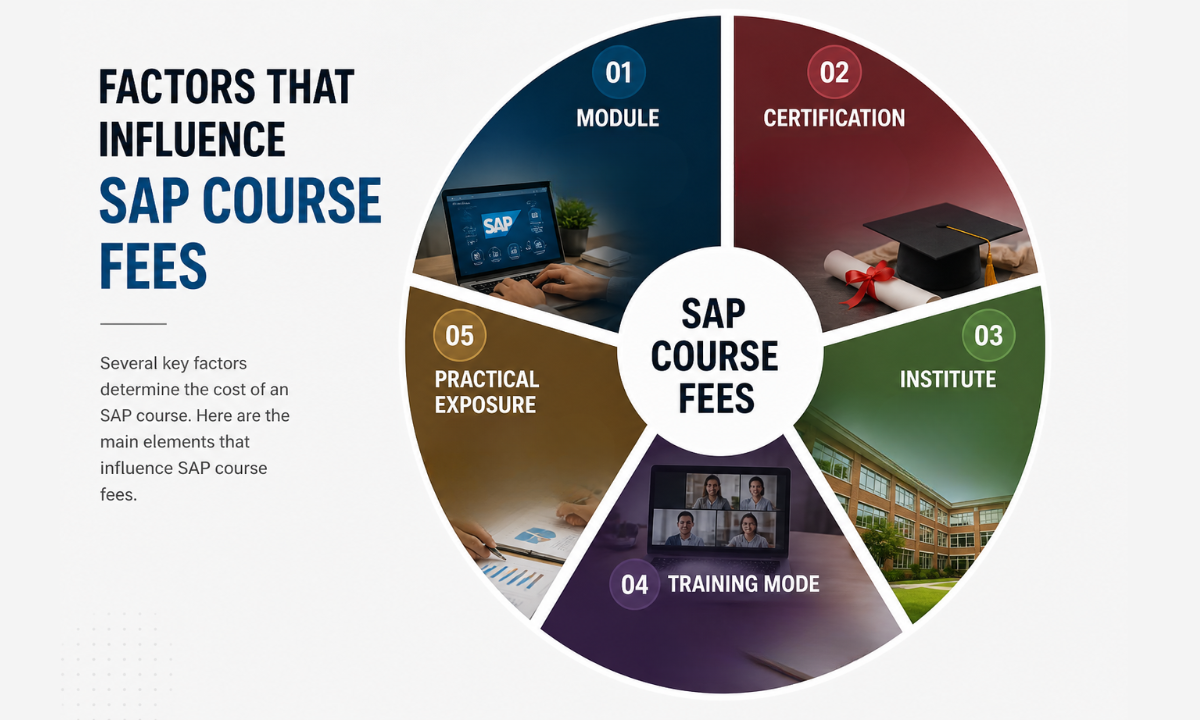
Understanding the components behind the pricing helps you evaluate whether a course is worth the investment. Instead of focusing only on the cost, it’s important to assess the value you’re receiving.
1. Module Selection
Different SAP modules serve different career paths, which directly impacts pricing. Functional modules such as SAP FICO or SAP MM are generally more affordable, while technical modules like SAP ABAP and SAP BASIS require deeper technical expertise, increasing their cost.
2. Certification Costs
SAP Global Certification is highly valued across industries and can significantly boost your employability. However, this certification often comes at an additional cost ranging from ₹40,000 to ₹70,000, unless bundled within the course package.
3. Institute Reputation
A reputed training institute in Bangalore typically charges higher fees due to experienced trainers, an updated curriculum, and strong placement support. However, the higher investment often translates into better career outcomes and job opportunities.
4. Mode of Training
The mode of learning also affects pricing. Classroom training offers direct interaction and structured learning but comes at a higher cost, whereas online training is more affordable and flexible, making it ideal for working professionals.
5. Practical Exposure
Courses that include real-time projects, live SAP servers, and case studies provide hands-on experience. Although these programs may cost more, they significantly enhance your job readiness and practical understanding of SAP systems.
Why SAP Courses Are Worth the Investment

At first glance, SAP training may seem expensive compared to other IT or management courses. However, the long-term benefits far outweigh the initial cost, especially when you consider the career growth and salary potential.
SAP professionals are in high demand across industries such as IT, finance, logistics, healthcare, and retail. According to industry trends, certified SAP consultants can earn 20–40% higher salaries, with experienced professionals earning even more in global roles.
In essence, SAP is not just a course; it’s a strategic investment that can transform your career trajectory and open doors to international opportunities.
Module-Wise Cost vs Career Opportunities
Choosing the right module is just as important as understanding the fees. Each module offers unique career opportunities and aligns with specific industry needs.
SAP FICO (Financial Accounting & Controlling)
This SAP module is ideal for finance professionals looking to transition into ERP systems. It offers excellent opportunities in multinational companies and consulting firms, with strong demand for financial reporting and compliance roles.
SAP MM (Materials Management)
SAP MM focuses on procurement and inventory management, making it highly relevant for manufacturing and supply chain industries. Professionals in this domain are essential for optimizing business operations.
SAP SD (Sales and Distribution)
This module is perfect for individuals interested in sales processes and customer management. It is widely used in the retail and FMCG sectors, offering dynamic and fast-paced career opportunities.
SAP ABAP (Programming)
SAP ABAP is designed for developers who want to work on SAP customisation and backend programming. It provides strong technical career paths with opportunities in development and system enhancement.
SAP HANA / S/4HANA
As the future of SAP, this module is highly sought after. It enables real-time data processing and advanced analytics, making it one of the most lucrative SAP skills today.
SAP HCM (Human Capital Management)
This module is tailored for HR professionals and focuses on payroll, recruitment, and employee lifecycle management. It is ideal for those looking to integrate HR processes with technology.
SAP BASIS (Technical Administration)
SAP BASIS is the backbone of SAP systems, focusing on system administration and performance optimisation. It is crucial for maintaining cloud SAP environments in large organisations.
Why Bangalore Is a Hotspot for SAP Training
Bangalore’s reputation as India’s IT capital makes it a prime location for SAP training and career opportunities. The city is home to numerous multinational companies, startups, and IT hubs that actively hire SAP professionals.
Choosing a training institute in Bangalore provides access to experienced trainers, real-time industry exposure, and strong networking opportunities. Additionally, many institutes offer placement assistance, which can significantly improve your chances of landing a job after completing the course.
This is why many aspirants actively search for an SAP course in Bangalore, as it combines quality education with excellent career prospects.
Tips to Choose the Right SAP Course
Making the right choice requires careful evaluation of multiple factors. Here are some practical tips to guide you:
-
Compare the course curriculum across at least 3 institutes
-
Check whether certification is included in the total fees
-
Ensure the course includes real-time projects and case studies
-
Verify the trainer’s industry experience and credentials
-
Ask about placement assistance and success rates
Remember, the goal is not just to complete a course but to gain skills that translate into job opportunities.
Common Mistakes to Avoid
Many learners make decisions based solely on price, which can lead to poor outcomes. Avoid these common mistakes:
-
Choosing a module without understanding your career goals
-
Ignoring the importance of certification
-
Enrolling in institutes with an outdated curriculum
-
Overlooking placement support and industry exposure
A well-informed decision can save both time and money while maximising your career potential.
Final Thoughts
Understanding SAP course fees in India is crucial for making an informed career decision that aligns with your goals and budget. While the initial investment may seem high, the long-term rewards, such as higher salaries, global opportunities, and career growth, make it a worthwhile choice.
If you are planning to enrol in an SAP course in Bangalore, focus on selecting an institute that offers practical training, certification, and strong placement support. A trusted name like Apponix can help bridge the gap between theoretical learning and real-world application, ensuring you gain the skills needed to succeed in today’s competitive job market.
FAQs on SAP Course Fees in India
1. Is SAP certification included in course fees?
SAP certification is not always included in the course fees, as it depends on the training institute and the type of program you choose. Some institutes offer bundled packages that include certification, while others charge for it separately. Since certification can significantly impact your career prospects, it’s important to confirm this detail before enrolling and plan your budget accordingly.
2. Which SAP module is the most affordable?
Among the various SAP modules, SAP HCM and SAP MM are generally considered the most affordable options, making them ideal for beginners or those entering the SAP domain for the first time. These modules require relatively less technical complexity and shorter training duration, which helps keep costs lower while still offering good career opportunities in HR and supply chain roles.
3. Which SAP module has the highest fees?
SAP HANA / S/4HANA typically has the highest course fees due to its advanced technology, real-time data processing capabilities, and strong demand in the job market. These courses require experienced trainers, modern infrastructure, and deeper technical expertise. As businesses increasingly adopt S/4HANA, professionals trained in this module often command higher salaries and better career growth.
4. Can I learn SAP online at a lower cost?
Yes, learning SAP online is usually more cost-effective compared to classroom training. Online programs eliminate infrastructure costs and often provide flexible schedules, making them ideal for working professionals. Additionally, many online courses offer recorded sessions, live projects, and access to virtual SAP servers, ensuring you still gain practical experience while saving money.
5. Is SAP worth the investment in 2026?
SAP continues to be a valuable investment in 2026 due to the rapid pace of digital transformation across industries. Organisations rely heavily on SAP systems for efficient operations, creating a consistent demand for skilled professionals. With competitive salaries, global opportunities, and diverse career paths, investing in SAP training can deliver strong long-term returns for both freshers and experienced professionals.

Apponix Academy
Apponix Academy