POPULAR COURSES
Master Programs



Entering the technology sector is no longer just about securing a job; it is about securing long-term financial independence.
Every single day, ambitious candidates searching for a Full-stack developer course in Bangalore ask one incredibly specific question: "What is the actual return on my educational investment?" At Apponix Academy, a premium Training Institute in Bangalore, we understand that financial transparency is the ultimate deciding factor for any career change
While the internet is flooded with generic salary estimates, the reality of the Indian IT market is far more nuanced and highly lucrative for those who possess the right specific skills.
The global corporate landscape has drastically evolved. A decade ago, companies eagerly hired large teams of highly isolated specialists. One person only wrote visual interface code, another only configured the database, and a third only deployed the server.
Today, this fragmented approach is financially impossible for fast-moving startups and highly inefficient for massive multinational enterprises.
The massive salaries awarded to modern digital architects are not arbitrary. Full-stack professionals command premium compensation packages because they solve three critical corporate problems simultaneously:
-
Eliminating Communication Bottlenecks: When one single engineer understands both the user interface and the hidden server logic, companies no longer lose weeks of development time waiting for two separate departments to explain their code to each other.
-
Drastic Overhead Reduction: Startups and product companies strongly prefer to pay one exceptional digital architect a very high salary rather than paying three average specialists separate salaries. The corporate math heavily favors the versatile engineer.
-
Total System Accountability: When a live application suddenly crashes, a full-stack engineer knows exactly how to trace the error from the visual button click all the way down to the database query. They provide ultimate technical security for the business.
This comprehensive guide will break down the exact financial trajectory of a modern developer in India. We will strip away the industry hype and utilize hard market data to reveal exactly what you can expect to earn from your very first day as a fresher to your peak years as a senior technical leader.
The Salary Timeline: Fresher to Senior Professional
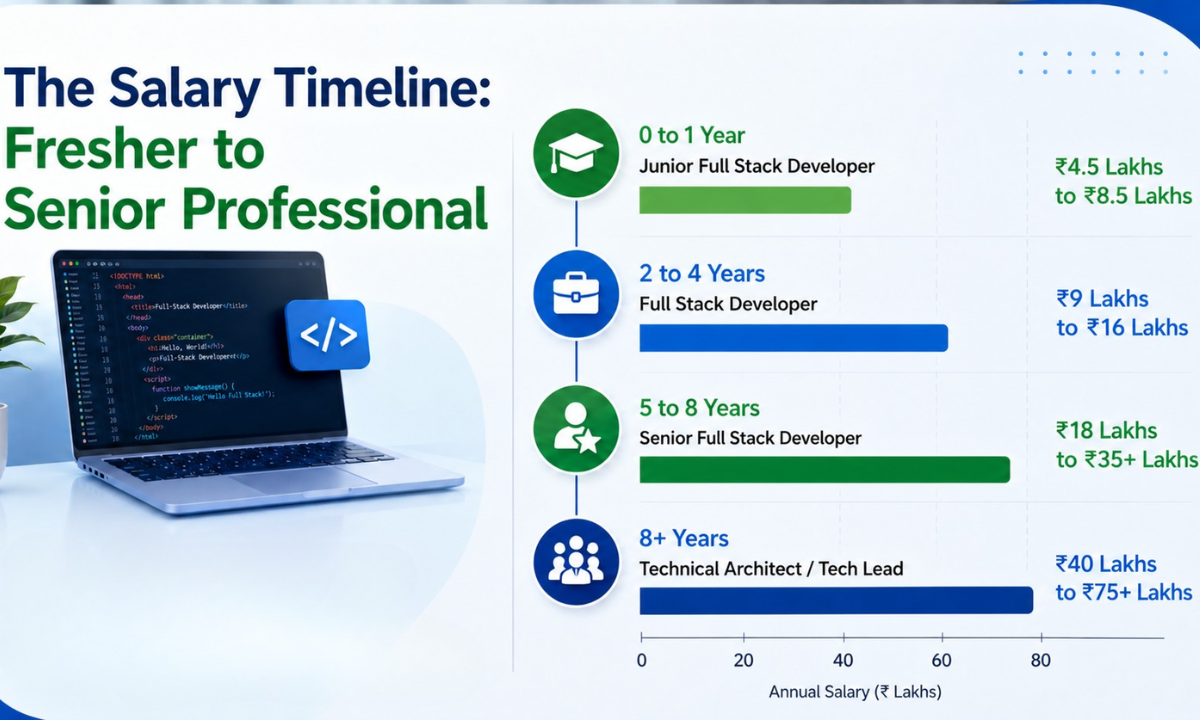
When calculating the salary of full-stack developer roles in India, candidates must understand that compensation in the technology sector does not scale linearly. It scales exponentially. As a developer gains experience, they transition from simply writing lines of code to designing massive digital ecosystems. Companies pay vast sums of money for the architectural decision-making skills that come strictly with experience.
To provide absolute financial clarity, we have analyzed current market data for 2026 across major Indian IT hubs. Here is the realistic financial trajectory of a complete digital architect, broken down by years of experience and corporate responsibility:
|
Experience Level |
Typical Job Title |
Estimated Salary Range (INR) |
Core Corporate Responsibilities |
|
0 to 1 Year |
Junior Full-Stack Developer |
₹4.5 Lakhs to ₹8.5 Lakhs |
Working under supervision, fixing minor bugs, building basic visual components, and learning the company's specific codebase. |
|
2 to 4 Years |
Full-Stack Developer |
₹9 Lakhs to ₹16 Lakhs |
Independent project execution, building RESTful APIs, optimizing database queries, and leading minor feature deployments. |
|
5 to 8 Years |
Senior full-stack developer |
₹18 Lakhs to ₹35+ Lakhs |
Designing overall system architecture, migrating legacy systems to cloud environments like AWS, and mentoring junior engineering teams. |
|
8+ Years |
Technical Architect / Tech Lead |
₹40 Lakhs to ₹75+ Lakhs |
Making executive technical decisions, ensuring the application can handle millions of simultaneous users, and managing enterprise security protocols. |
Decoding the Financial Jumps
The massive salary leaps shown in the table above are not automatic rewards for simply staying at a company for a few years. They are directly tied to the specific problems a developer learns to solve.
-
The Fresher Reality: In your first year, you are an investment. The company is actively spending resources to train you on their specific tech stack.
Your salary reflects your potential rather than your immediate independent output. This is precisely why securing a high-quality foundational training program before your first interview is so critical to maximizing your starting package.
-
The Mid-Level Acceleration: The jump from 8 Lakhs to 16 Lakhs happens when you no longer need constant supervision.
You are given a business problem, and you can build the frontend, write the backend logic, and push it to the live server completely on your own. You become a highly profitable asset to the corporation.
-
The Senior Command: A Senior full-stack developer commands a premium salary because they prevent disasters. At this stage, companies are not paying you just to type out code. They are paying for your architectural foresight.
You ensure that the database will not crash when a million users log in during a massive holiday sale. You ensure the API endpoints are completely secure from external hackers.
While the timeline above maps out the progression of a complete architect, it is vital to understand exactly how much money a developer loses by refusing to learn both sides of the digital ecosystem.
The Earning Gap of Frontend vs Backend vs Full-Stack
When candidates first enter the technology sector, they frequently ask a very logical question: "Is it not easier to just learn one side of the application?" When comparing Frontend vs Backend vs Full-stack, specializing strictly in visual design or server logic might seem like a faster route to employment, but this shortcut comes with a massive, permanent financial penalty.
To understand why a Full-stack developer commands a significantly higher salary than their specialized counterparts, we must look at how corporations value these distinct roles in the current Indian market.
Here is a direct financial comparison of the three primary development tracks for mid-level engineers with roughly 3 to 5 years of experience:
|
The Engineering Role |
Estimated Average Salary (INR) |
The Corporate Value Proposition |
|
Frontend developer |
₹7 Lakhs to ₹12 Lakhs |
Highly valuable for crafting user experiences, but entirely dependent on backend teams to make the application functional. |
|
Backend developer |
₹8 Lakhs to ₹14 Lakhs |
Crucial for security and data management, but unable to deliver a finished, user-facing product independently. |
|
Full-stack developer |
₹12 Lakhs to ₹20+ Lakhs |
The ultimate corporate asset. Capable of building, connecting, and deploying an entire digital product from scratch without relying on other departments. |
Decoding the Financial Premium
Looking at the data, a complete digital architect routinely earns 30% to 50% more than a single-layer specialist. This massive earning gap exists because modern companies do not pay for the amount of code you write; they pay for the amount of business friction you eliminate.
-
The Cost of Bottlenecks: If a company hires a dedicated Frontend developer and a dedicated Backend developer, those two individuals must constantly hold meetings to coordinate their work.
If an error occurs, they frequently blame each other, stalling the entire project. A full-stack engineer eliminates this internal friction.
-
The Startup Multiplier: Product-based companies and well-funded startups operate on incredibly tight budgets. They cannot afford to hire massive, highly segmented engineering teams.
They actively choose to pay a premium salary to one versatile architect rather than paying two average salaries to isolated specialists.
-
The Leadership Fast Track: Single-layer developers rarely get promoted to Chief Technology Officer or Senior Technical Lead.
To manage an entire technology department, you must deeply understand how the visual interface connects to the database vault. Mastering the full-stack is the only way to break through the mid-level salary ceiling and secure executive-level compensation.
Learning the entire digital ecosystem requires significantly more effort upfront. However, this initial educational investment permanently protects your career from market fluctuations and guarantees you remain in the highest possible salary bracket.
Location Matters
In the Indian technology sector, your geographic location plays an equally massive role in determining your final compensation package as your actual technical skillset.
While remote work has certainly become more common, the absolute highest-paying corporate roles are still heavily concentrated in specific metropolitan tech hubs.
Companies operating in Tier-1 cities process billions of dollars in global capital. They have the financial bandwidth to offer massive salaries, whereas companies in Tier-2 or Tier-3 cities simply do not have the same massive revenue streams to support those premium pay brackets.
If you want to maximize your earning potential, you must target the correct geography.
Here is a realistic breakdown of how average full-stack developer salaries fluctuate across India's primary technology centers:
|
Technology Hub |
Estimated Average Salary (Mid-Level) |
The Regional Market Focus |
|
Bangalore |
₹14 Lakhs to ₹22+ Lakhs |
The undisputed Silicon Valley of India. Heavy concentration of ultra-funded startups and massive global product companies. |
|
Hyderabad |
₹12 Lakhs to ₹18+ Lakhs |
The enterprise capital. Dominated by massive multinational corporations like Amazon, Microsoft, and FinTech firms. |
|
Pune |
₹10 Lakhs to ₹16 Lakhs |
A highly stable IT hub heavily integrated with global banking, manufacturing, and automotive technology sectors. |
|
Chennai / NCR |
₹9 Lakhs to ₹15 Lakhs |
Rapidly growing infrastructure hubs offering excellent entry-level opportunities and highly stable legacy corporate roles. |
Decoding the Geographic Advantage
Choosing the right city impacts much more than just your base monthly paycheck. Operating in a premium tech hub like Bangalore completely changes the trajectory of your career for three specific reasons:
-
The Talent Bidding War: In cities like Bangalore and Hyderabad, the competition for elite full-stack developers is incredibly fierce.
There are simply more open job positions than there are qualified engineers. Because of this massive talent shortage, companies are forced to aggressively bid against each other, offering massive signing bonuses just to secure your signature on an employment contract.
-
The Wealth Multipliers (ESOPs): Tier-1 tech hubs are home to India's most aggressive startups. These companies frequently offer Employee Stock Ownership Plans (ESOPs) as part of your compensation package.
If you help build a highly successful application and the company eventually goes public, those stock options can instantly generate life-changing wealth that a standard monthly salary could never match.
-
The Networking Proximity: When you work in a major tech hub, you are constantly surrounded by senior architects, venture capitalists, and startup founders.
The next massive leap in your salary will rarely come from a standard job board application. It will come from a senior manager who remembers your excellent coding skills and recruits you directly into their new, highly funded venture.
Understanding the massive financial potential of these cities is highly motivating. However, you cannot simply move to a major tech hub and expect a high salary just for showing up. You must prove to corporate recruiters that you possess the specific elite skills they are desperate to buy.
Why Choose Apponix? Your Gateway to Premium Salaries
Knowing that high salaries exist is only the first step. The real challenge is acquiring the exact enterprise-level skills that companies are willing to pay for. Generic online coding tutorials will not secure a premium compensation package. To command a top-tier salary, you need corporate-grade training. This is exactly where Apponix Academy changes the game.
We do not just teach you how to write basic code; we engineer your entry into the high-paying tech market. When you enroll in our master program, you gain access to resources designed exclusively to maximize your market value:
-
Mastering the Skill Multipliers: We teach the advanced technologies that transform a standard coder into a high-value Full-stack engineer. You will learn AWS cloud deployment, complex system architecture, and advanced database management.
-
100% Interview Guarantee: We entirely remove the friction of job hunting. Our dedicated placement cell provides guaranteed interviews with top-tier companies, giving you the platform to negotiate the best possible starting salary.
-
Live Project Portfolios: Hiring managers pay for proven experience. You will build and deploy live, complex web applications during your training, proving your exact worth before you even walk into the interview room.
Apponix is not just an educational institute; it is a direct launchpad to financial independence in the IT sector.
Conclusion
The salary of a full-stack developer in India is not a fixed, limited number. It is a direct reflection of the massive value and security you bring to a modern corporation. By choosing to master both the visual frontend and the hidden backend logic, you permanently elevate yourself above standard, single-layer developers.
The financial trajectory from a fresher to a Senior full-stack developer is incredibly lucrative, especially if you position yourself in India's major tech hubs. The demand for complete digital architects is constantly growing, and companies have the massive budgets required to secure top talent.
The high-paying jobs are waiting, but they are reserved for those who take their foundational training seriously. Do not leave your career trajectory to chance. Contact Apponix Academy today to book your free demo class, consult directly with our career advisors, and take your first definitive step toward a highly paid future in software engineering.

Apponix Academy
Apponix Academy