POPULAR COURSES
Master Programs


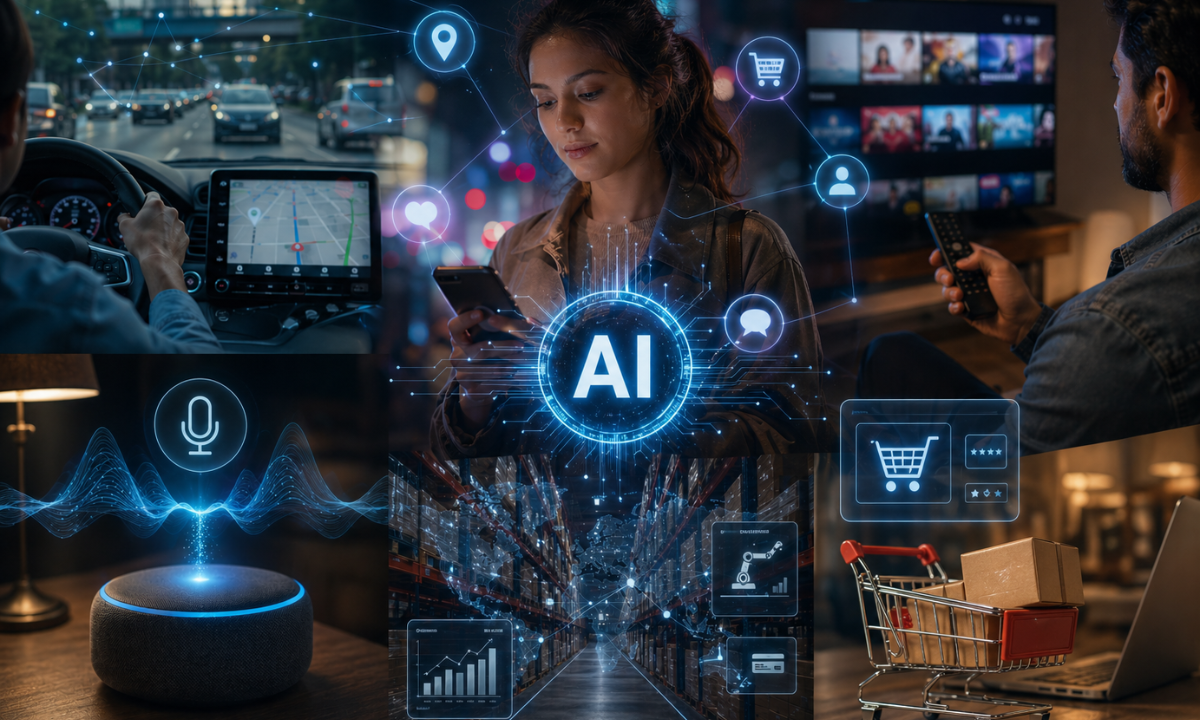
Table of contents:
|
1. Navigation Apps and Predictive Routing |
|
2. The Pocket Helper as a Digital Assistant |
|
3. Online Streaming Recommendation |
|
4. The Retail Algorithm of Online Shopping Anticipation |
|
5. Why Choose Apponix? The Engineering Sandbox |
|
6. Conclusion |
Artificial intelligence is no longer a futuristic concept reserved for science fiction movies. It is the silent, mathematical engine running quietly in the background of your smartphone right now. As a premier Training institute in Bangalore, Apponix Academy recognizes that understanding this technology is the most critical career move a professional can make today.
This is precisely why our advanced AI course in Bangalore focuses on the practical, everyday algorithms that power global industries, rather than hypothetical doomsday scenarios.
The truth is, you have likely interacted with a neural network three times before you even poured your morning coffee. To completely demystify this technology, we need to look at the actual real-life examples of artificial intelligence that silently optimize our daily routines.
We will explore how predictive machine learning acts as your invisible copilot across multiple touchpoints:
-
The Morning Commute: How graph neural networks calculate your fastest route to the office by analyzing millions of data points simultaneously.
-
The Digital Workflow: How natural language processing translates your casual voice requests into instant, executable commands.
-
The Evening Entertainment: How deep learning matrices analyze your behavioral habits to perfectly curate your downtime.
Let us strip away the Hollywood narrative and examine the exact mathematical frameworks that are currently optimizing your world.
Navigation Apps and Predictive Routing
When you enter a destination into your phone, you might assume the application is simply drawing a digital line connecting your current location to your office.
This is a massive underestimation of the technology at work. The Global Positioning System (GPS) only provides your raw coordinates. The actual routing is handled by one of the most complex machine learning frameworks deployed in the consumer market today.
Navigation applications operate on an advanced mathematical concept known as Graph Neural Networks (GNNs). To a routing algorithm, your city is not a visual map of asphalt and buildings. It is a massive, interconnected web of "nodes" (intersections) and "edges" (the streets connecting them).
To calculate the absolute fastest path, the AI acts as a high-speed data broker.
Here is the exact data matrix your application processes in milliseconds before it even suggests a route:
|
The Data Source |
The Information Ingested |
The AI Application |
|
Real Time Crowdsourcing |
The GPS speed and telemetry of thousands of other smartphones are currently ahead of you on the road. |
Identifies sudden traffic jams or accidents the exact moment multiple vehicles begin braking simultaneously. |
|
Historical Aggregation |
Traffic patterns from that exact road, on the same day of the week, over the last several years. |
Predicts that a specific intersection will back up at 8:45 AM, even if it is completely clear when you leave your house at 8:15 AM. |
|
Municipality Data Feeds |
Official government APIs detailing planned road closures, active construction zones, and toll pricing. |
Instantly removes closed roads from the mathematical graph to prevent routing you into a blocked street. |
The Predictive ETA Engine -
The most impressive feat of this artificial intelligence is not finding the shortest physical distance. It is predicting the immediate future.
The algorithm does not simply evaluate the traffic at this exact second. It uses deep learning models to predict what the traffic will look like 20 minutes from now when you actually arrive at a specific segment of the highway.
If a neural network detects a bottleneck forming five miles ahead of your current position, it will dynamically calculate the exact moment that delay will cost you more time than taking a longer secondary route.
The moment the math shifts in favor of the detour, the application reroutes you automatically. You are not just following a static map; you are being guided by a predictive engine that processes millions of geographic and behavioral variables every single second to optimize your commute.
The Pocket Helper as a Digital Assistant
Setting an alarm or asking for the weather feels instantaneous and effortless. However, underneath that simple voice command lies one of the most complex real-life applications of AI deployed in the consumer market today: Natural Language Processing (NLP).
When you speak to a piece of glass and metal, and it executes a command, you are witnessing an incredibly sophisticated conversion of analog sound waves into actionable digital code.
Before we dissect the mechanism, we must address the most common consumer anxiety: privacy. Are your Digital assistants constantly recording your private conversations and sending them to a server? The architectural answer is no.
Devices equipped with virtual assistants utilize a localized, low-power algorithm known as a "Wake Word Engine." This is a tiny, isolated neural network running locally on the physical hardware. It is trained to recognize only one specific acoustic pattern, such as "Alexa" or "Hey Google."
It does not possess the memory or processing power to understand full sentences, and it completely blocks the primary microphone from accessing the cloud until that exact wake word mathematically unlocks the system.
Once the system is awake, the true artificial intelligence takes over. Here is the exact computational pipeline that occurs in the fraction of a second after you issue a command:
|
The NLP Pipeline Phase |
The Technical Process |
The User Experience |
|
1. Automatic Speech Recognition (ASR) |
The AI captures your analog sound waves, actively filters out background noise like an air conditioner, and converts the audio frequencies into a raw digital text string. |
You casually say, "Set a timer for ten minutes." |
|
2. Natural Language Understanding (NLU) |
The algorithm parses the text string to determine your exact "intent." It identifies the action required and extracts critical "entities" (like the number 'ten' and the unit 'minutes'). |
The system recognizes that you do not want to know the current time; you want to initiate a countdown protocol. |
|
3. API Routing and Execution |
The neural network routes the interpreted command to the correct internal software module (the internal clock application) and passes the extracted parameters to start the task. |
The internal timer begins ticking down silently in the background. |
|
4. Natural Language Generation (NLG) |
The AI formulates a mathematically logical confirmation and converts that digital text back into synthesized, human-sounding audio. |
The device instantly replies, "Ten minutes, starting now." |
This four-step operation requires thousands of mathematical calculations to occur simultaneously. It is designed to be invisible. The ultimate goal of Natural Language Processing is to make highly advanced computing feel as casual and organic as speaking to a friend.
Online Streaming Recommendation
When you open your favorite streaming application, the homepage you see is unique to you. It is not a static catalog of movies. It is a highly personalized digital storefront engineered by a deep learning matrix.
The Online streaming recommendation algorithms utilized by platforms like Netflix or Spotify are designed with a singular, mathematical objective: to minimize the time you spend searching and completely maximize the time you spend consuming.
To achieve this, these platforms do not simply look at the broad genre of the last movie you watched. They deploy complex machine learning models that analyze your behavioral telemetry down to the exact second.
The clinical breakdown of the specific behavioral metrics the AI processes to curate your nightly feed:
|
The Behavioral Metric |
The Telemetry Collected |
The Algorithm's Interpretation |
|
Completion Rates |
Did you finish the entire film, or did you abandon it after exactly 14 minutes? |
Abandoning a film signals a false positive. The algorithm instantly learns to avoid similar narrative pacing or specific directors in the future. |
|
Micro-Interactions |
Pausing the video, rewinding specific scenes, or automatically skipping the opening credits. |
Rewinding indicates high engagement with a specific actor or action sequence, while fast-forwarding suggests a strict preference for faster pacing. |
|
Temporal Habits |
Do you watch 20-minute sitcoms on Tuesday mornings and three-hour historical dramas on Sunday nights? |
The AI dynamically alters the layout of your homepage based on the exact day of the week and the exact hour you log in. |
The Dynamic Thumbnail Matrix -
The most fascinating application of this artificial intelligence is dynamic artwork personalization.
The streaming platform understands that humans are highly visual creatures who make split-second decisions. Instead of using one standard movie poster, a deep learning model will automatically generate dozens of different promotional thumbnails for the exact same film.
If your historical viewing data shows you frequently click on romantic comedies, the AI will display a thumbnail featuring the two lead actors holding hands. If your data shows a strong preference for action films, that same movie will be presented to you with a thumbnail featuring an exploding car or a tense standoff.
Artificial intelligence actively manipulates the visual presentation of the content to mathematically trigger your specific psychological preferences.
The AI is not just recommending a movie to you; it is visually redesigning the marketing material in real-time to guarantee your engagement.
The Retail Algorithm of Online Shopping Anticipation
When you browse a modern e-commerce platform, you are not just looking at a digital catalog. You are interacting with a highly sophisticated predictive engine. Global retailers utilize artificial intelligence to minimize the time between your initial desire for a product and the exact moment it arrives at your doorstep.
This level of logistics is not powered by simple database queries. It relies on complex behavioral analysis and supply chain forecasting. This is exactly how Online shopping platforms deploy machine learning to anticipate your needs and secure your transaction:
-
Collaborative Filtering: This is the mathematical framework behind the famous "Customers who bought this also bought" section. The AI maps out millions of global purchase histories, finding users with buying patterns identical to yours.
If thousands of matching profiles bought a specific camera lens immediately after buying a specific camera body, the AI will instantly push that exact lens to your screen, predicting your next logical need.
-
Dynamic Pricing Algorithms: The price you see on a high-demand item is rarely static. Retail neural networks analyze competitor pricing, current warehouse inventory levels, regional demand spikes, and even the current time of day.
They continuously adjust prices in real time to guarantee the platform maximizes its profit margin while still securing your final conversion.
-
Anticipatory Shipping Models: This is the ultimate physical application of machine learning. Retail giants use predictive analytics to forecast sudden surges in regional demand.
If the algorithm detects a high probability that a specific zip code will order a large volume of portable heaters due to an incoming weather system, it will automatically route that inventory to the closest local fulfilment centre before a single customer actually clicks the purchase button.
-
Sentiment Analysis and Review Summarization: Instead of forcing a buyer to manually read through 10,000 individual product reviews, natural language processing algorithms instantly scan the entire database.
They extract the most common positive and negative experiences, presenting you with a mathematically accurate summary of the product's real-world performance in three highly digestible sentences.
The retail AI does not want to pressure you into a sale. It wants to completely remove every point of friction so that buying becomes the most logical and effortless action you can take.
Why Choose Apponix? The Engineering Sandbox
Theoretical knowledge of artificial intelligence will not secure a position in the modern tech industry. Reading about natural language processing in a textbook is fundamentally different from actually deploying the code. At Apponix Academy, we strictly focus on practical, hands-on execution.
Here is the operational advantage of our training pipeline:
-
Applied Python Frameworks: You will move past basic coding theory and learn to deploy the exact Python libraries used by global tech giants to manipulate and predict data.
-
Computer Vision and Machine Learning: You will build practical predictive models and image-processing applications, demonstrating your ability to handle real-world visual data and automate complex analysis.
-
Direct Corporate Relevance: We completely bypass outdated academic theory. You will train on the exact datasets and algorithms that modern companies are currently using to optimize their logistics, recommendation engines, and digital assistants.
We do not just teach you what a neural network is; we provide the digital sandbox for you to actually build one. Our curriculum is specifically designed to transform passive tech consumers into active software architects.
Conclusion
Artificial intelligence is the unseen infrastructure of the modern world. Every time you stream a movie, navigate through city traffic, or make an online purchase, you are interacting with a highly trained mathematical model.
The definitive career transition you must make today is moving from a passive consumer of these algorithms to the architect who builds them. The global market does not need more users; it needs developers. Take absolute control of your tech trajectory, step into the engineering sandbox at Apponix Academy, and learn to code the systems that run the world.

Apponix Academy
Apponix Academy