POPULAR COURSES
Master Programs



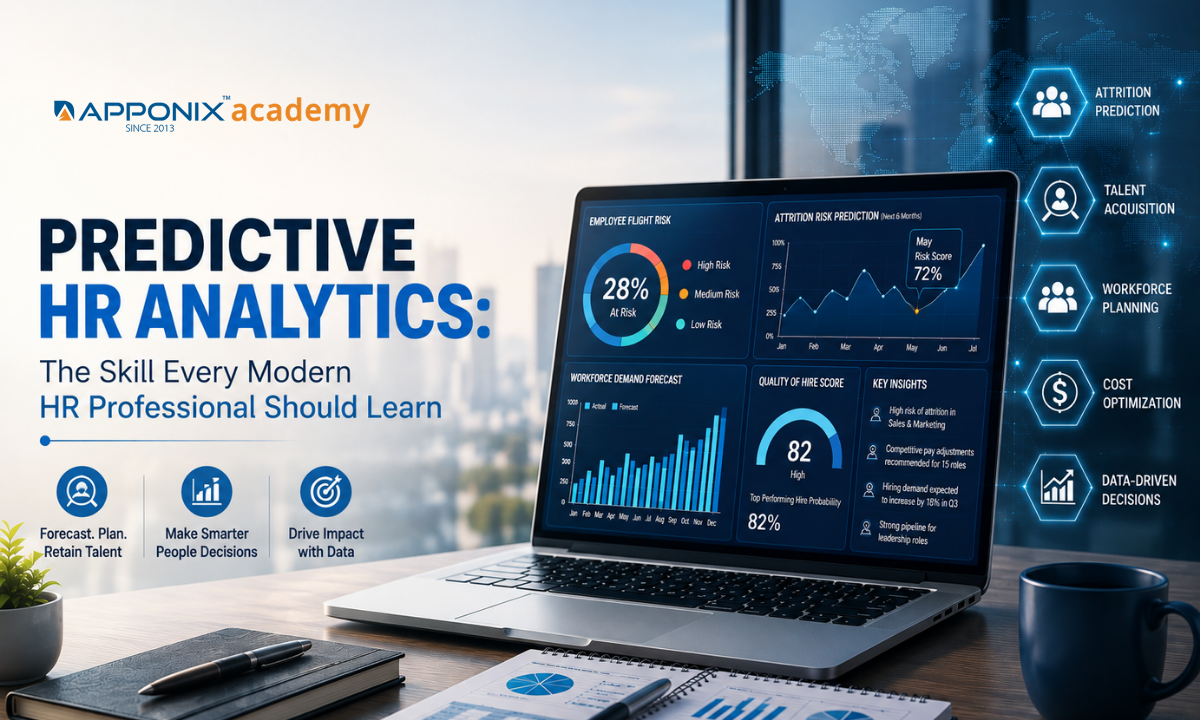
Table of contents:
|
1. What Is Predictive HR Analytics vs. Traditional Descriptive Reporting?
|
|
2. Transforming Core Pillars: Smart Recruitment & Strategic Payroll Management
|
|
3. The In-Demand HR Analytics Tech Stack: Tools & Platforms
|
|
4. Career Pathways & Salary Benchmarks for HR Analytics in India
|
| 5. Why Choose Apponix Technologies for HR Analytics Mastery? |
| 6. Conclusion |
In modern enterprise management, mastering predictive HR analytics is the single most valuable capability transforming human resources from an administrative back-office function into a core business driver.
Partnering with a premier Training institute in bangalore equips HR executives, talent recruiters, and managers with the statistical frameworks and data visualization tools needed to forecast workplace trends accurately. Enrolling in an industry-focused HR course in bangalore bridges the gap between traditional personnel records and data-backed workforce strategy, ensuring you make proactive, evidence-based talent decisions.
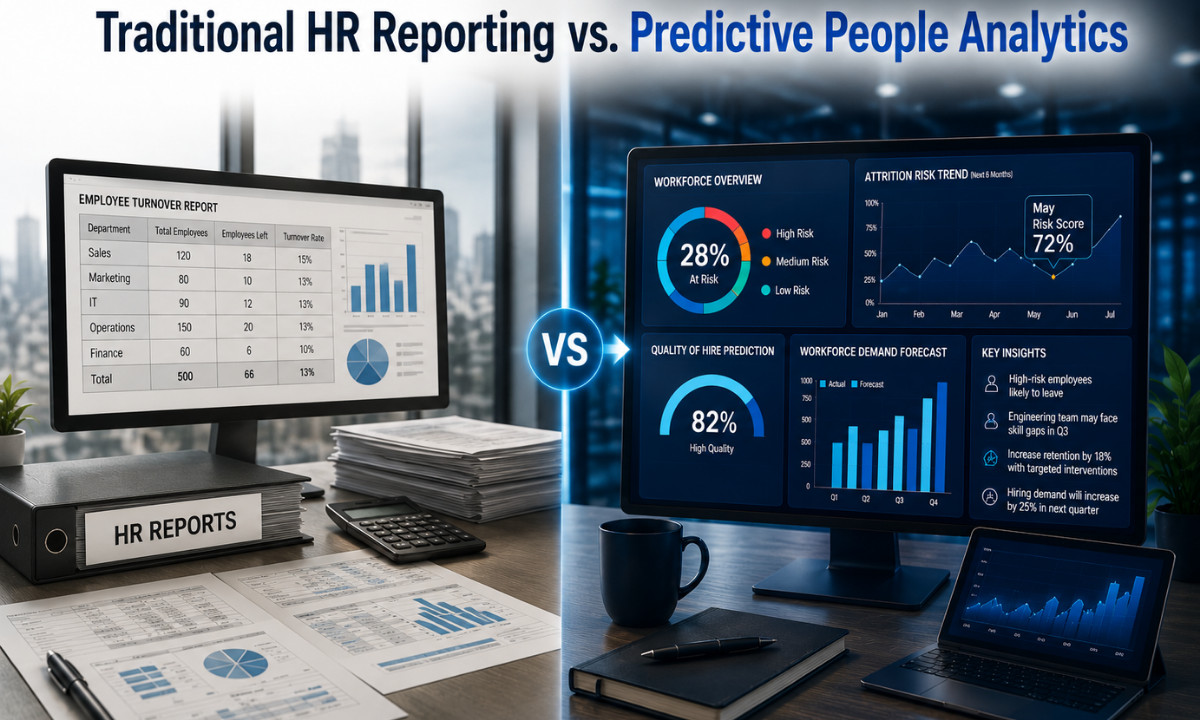
Historically, HR teams relied entirely on backward-looking reports such as tallying monthly employee turnover rates after top performers had already resigned or reviewing past quarterly absenteeism logs.
While descriptive records explain what happened in the past, fast-paced corporate environments require forward-looking intelligence that forecasts what will happen next:
-
Forecasting Employee Flight Risk: Identifying behavioral patterns, compensation disparities, and engagement trends that signal when high-performing team members are likely to leave.
-
Predicting Quality of Hire: Evaluating candidate profiles, assessment data, and sourcing channels that directly correlate with long-term retention and productivity.
-
Optimizing Workforce Costs: Projecting future headcount requirements, overtime expenses, and compensation budgets with statistical accuracy.
Replacing gut feel with predictive data modeling, modern human resource teams can anticipate talent shortages, curb costly attrition, and secure a strategic seat at the executive decision-making table.
What Is Predictive HR Analytics vs. Traditional Descriptive Reporting?
To understand the value of predictive people management, organizations must evaluate where their processes sit on the analytics maturity curve.
Enrolling in a comprehensive HR analytics course helps professionals move past manual spreadsheets and learn the statistical logic connecting past employee records with future organizational performance.
Traditional HR Reporting vs. Predictive People Analytics
|
Evaluation Dimension |
Traditional Descriptive Reporting |
Predictive HR Analytics
|
|---|---|---|
|
Primary Question Answered |
"What happened in our workforce last quarter?" (e.g., 12% voluntary turnover). |
"Which key employees are likely to leave in the next 6 months and why?" |
|
Data Approach |
Static monthly exports from attendance and payroll spreadsheets. |
Multi-variable regression models, correlation analysis, and machine learning algorithms. |
|
Business Impact |
Reactive damage control after top talent has already exited. |
Proactive retention strategies, targeted pay adjustments, and capacity planning. |
|
Decision-Making Style |
Relies on personal assumptions, subjective intuition, and gut feel. |
Guided by data-backed risk scores, probability models, and scenario forecasting. |
|
Deliverable Output |
Retrospective PDF presentation decks and static table summaries. |
Live interactive dashboards, real-time flight-risk alerts, and forecast simulations. |
Key Business Applications of Predictive HR Modeling
-
Proactive Employee Churn Modeling: Rather than analyzing exit survey feedback after critical team members depart, predictive algorithms evaluate compensation history, promotion frequency, manager changes, and engagement survey trends. This allows HR business partners to identify disengagement early and design targeted retention offers before an employee submits their resignation.
-
Workforce Demand & Capacity Forecasting: Traditional headcount planning relies on rough departmental wish lists, leading to sudden hiring freezes or costly staffing shortages. Predictive modeling reviews project pipelines, historical seasonal attrition, and ramp-up periods to forecast exact staffing requirements months in advance.
-
High-Potential Leadership Identification: Predictive talent models minimize subjective bias during annual promotion cycles by aggregating performance metrics, cross-functional project delivery speed, peer feedback sentiment, and continuous learning milestones to predict which individual contributors are most likely to succeed in leadership positions.
Shifting from backward-looking reports to predictive analytics transforms human resources from an operational record-keeper into a strategic advisory unit that directly protects company revenue and talent continuity.
Transforming Core Pillars: Smart Recruitment & Strategic Payroll Management
Talent acquisition and compensation planning account for the largest share of organizational HR budgets.
Modern HR leaders combine hands-on recruitment training with advanced predictive models to eliminate hiring bottlenecks, while integrating comprehensive payroll training to transform static salary calculations into strategic compensation planning.
1. Predictive Talent Acquisition & Smart Candidate Sourcing
Traditional hiring workflows often depend on subjective interview impressions and unstructured resume screening. Applying predictive analytics to recruitment operations ensures talent teams make data-driven, quality-focused hiring decisions.
-
Predicting Candidate Quality and Job Fit: Rather than relying solely on keyword matching on resumes, predictive models analyze past hiring cohorts to identify background indicators, skill combinations, and experience levels that correlate with high on-the-job performance and extended company tenure.
-
Forecasting Time-to-Fill and Sourcing Bottlenecks: Sourcing teams use historical pipeline metrics to predict the exact number of days required to close specialized technical or managerial roles. This insight enables recruiters to initiate sourcing campaigns before staffing shortages disrupt active client projects.
-
Optimizing Recruitment Channel ROI: Predictive algorithms evaluate conversion rates across LinkedIn, job portals, campus recruitment drives, and employee referrals. Talent acquisition teams can then allocate recruitment budgets strictly to the sourcing channels that consistently yield the highest-performing hires.
Applying predictive scoring to recruitment pipelines significantly reduces costly early-stage attrition and accelerates the onboarding of productive team members.
2. Strategic Payroll Analytics & Total Rewards Optimization
Payroll management has expanded beyond monthly salary disbursements and tax deductions. Predictive compensation models help total rewards specialists forecast wage inflation, design retention-focused incentive structures, and maintain internal pay parity.
-
Forecasting Compensation Inflation and Market Benchmarks: Predictive pay models cross-reference internal salary structures with live market benchmarks, industry hiring rates, and regional cost-of-living adjustments. This allows organizations to adjust compensation bands proactively during annual appraisal cycles to avoid losing key personnel to competitors.
-
Predicting Overtime Expenses and Resource Strain: In operational, manufacturing, and IT support environments, analyzing historical shifts and project delivery peaks enables payroll specialists to forecast overtime liabilities accurately, preventing unexpected budget overruns.
-
Simulating Incentive and Bonus Plan Outcomes: Before rolling out variable pay programs or sales commission plans, HR leaders use predictive simulations to model potential payout scenarios against company revenue targets, ensuring reward systems remain financially sustainable.
Upgrading from basic payroll execution to strategic total rewards analytics ensures compensation structures remain competitive, equitable, and aligned with overall business profitability.
The In-Demand HR Analytics Tech Stack: Tools & Platforms

Transitioning from manual HR reporting to automated predictive modeling requires familiarity with modern data architectures and analytics tools.
Enterprise talent teams do not rely on isolated spreadsheets; instead, they extract data across enterprise HRMS systems, clean it using analytical tools, and build executive dashboards for leadership. Enrolling in practical HR software training helps HR professionals understand how these tools interact across the employee lifecycle from initial recruitment sourcing to payroll automation and long-term retention forecasting.
Modern HR Analytics Tool Stack Matrix
|
Analytics Layer |
Industry-Standard Tools & Platforms |
Primary Business Function |
Key Deliverable for HR Teams
|
|---|---|---|---|
|
Enterprise HRMS / HRIS |
Workday, Darwinbox, SAP SuccessFactors, Oracle HCM |
Centralizing employee master data, attendance logs, performance reviews, and payroll records. |
Clean, standardized source data for organization-wide analysis. |
|
Business Intelligence (BI) |
Microsoft Power BI, Tableau, Qlik Sense |
Visualizing workforce trends, interactive KPI tracking, and cross-departmental filtering. |
Real-time executive dashboards and leadership reports. |
|
Statistical & Predictive Tools |
Advanced Excel (Power Query, DAX), Python (Pandas, Scikit-learn), R |
Running regression models, flight-risk probability scoring, and correlation analyses. |
Churn risk predictions and workforce demand simulations. |
|
Employee Sentiment & Engagement |
Glint, Qualtrics, Culture Amp, Visier |
Measuring pulse survey sentiment, manager effectiveness, and culture health. |
Early disengagement detection and burnout heatmaps. |
1. Enterprise HRMS & Data Management Platforms
Modern organizations store employee lifecycle records in cloud-native Human Capital Management (HCM) suites.
-
Centralized Master Data Governance: Platforms like Workday, Darwinbox, and SAP SuccessFactors unify core HR, time tracking, benefits, and payroll into a single data repository.
-
Automated Data Extraction & Cleansing: HR analysts learn to export structured transaction logs via APIs or automated scheduled reports, eliminating manual data entry discrepancies.
-
Compliance and Security Access: HCM systems enforce role-based access control, ensuring sensitive payroll figures and employee health records remain protected during data mining.
Mastering enterprise HCM platforms ensures your predictive models are built on reliable, clean, and legally compliant workforce datasets.
2. Business Intelligence & Executive Dashboard Tools
Executive stakeholders prefer visual, interactive charts over dense data tables when evaluating talent strategies.
-
Microsoft Power BI & Tableau Dashboards: Building interactive visual reports that allow leaders to filter attrition rates, hiring costs, and gender diversity ratios by department, geography, or manager level with a single click.
-
Power Query & Data Transformation: Cleaning raw attendance logs and connecting disparate CSV exports without altering the underlying source files.
-
Automated KPI Refresh Pipelines: Scheduling live data refreshes so HR dashboards update automatically at the start of every week without requiring manual report generation.
Developing strong data visualization skills enables HR professionals to present complex workforce findings to C-suite leaders clearly and persuasively.
3. Advanced Statistical Analysis & Predictive Modeling
Moving beyond visual charts requires statistical tools that can identify hidden patterns and predict future talent outcomes.
-
Advanced Excel (DAX, Pivot Tables, What-If Analysis): Utilizing regression analysis, lookup functions, and statistical formulas to calculate standard deviations in employee tenure and model salary increment scenarios.
-
Python for People Analytics (Pandas & Scikit-Learn): Writing simple Python scripts to process thousands of employee survey responses, run natural language processing (NLP) on exit feedback, and train logistic regression models to predict resignation likelihood.
-
Scenario Planning & Simulation: Building predictive forecasting sheets to test how changing bonus percentages or altering remote work policies affects long-term team retention.
Gaining confidence in statistical tools allows HR generalists to transition into specialized People Analytics roles that command significant market value.
Career Pathways & Salary Benchmarks for HR Analytics in India
The compensation structure for HR professionals in India reflects a clear premium on quantitative decision-making. While traditional HR generalists and recruiters manage administrative tasks, talent analytics specialists leverage data modeling, predictive retention strategies, and workforce dashboards to directly impact organizational profitability.
Earning a recognized HR certification Bangalore provides human resource professionals with verified credentials in data visualization, predictive modeling, and HCM systems, enabling them to transition into high-paying strategic roles across India's top tech corridors.
Comparative HR Salary Matrix across Experience Tiers in India
|
Career Stage & Experience Band |
Traditional HR Generalist / Recruiter (CTC) |
People Analytics Specialist / Strategic HRBP (CTC) |
Key Competencies & Value Drivers
|
|---|---|---|---|
|
Entry / Associate (0 – 2 Years) |
₹3.5 LPA – ₹5.5 LPA |
₹5.5 LPA – ₹9.5 LPA |
Advanced Excel, data cleaning, automated survey reporting, basic HRMS data extraction. |
|
Mid-Level Specialist (3 – 6 Years) |
₹6.0 LPA – ₹10.0 LPA |
₹11.0 LPA – ₹19.0 LPA |
Power BI/Tableau dashboards, flight-risk modeling, attrition root-cause analysis, cross-functional HRBP advisory. |
|
Senior Consultant / Lead (7 – 10 Years) |
₹11.0 LPA – ₹17.0 LPA |
₹20.0 LPA – ₹32.0 LPA |
Predictive workforce demand planning, executive compensation modeling, Python-driven sentiment mining, team leadership. |
|
Head of People Analytics / Director (10+ Years) |
₹18.0 LPA – ₹28.0 LPA |
₹35.0 LPA – ₹55.0 LPA+ |
Enterprise workforce planning, global HR technology architecture, C-suite advisory, organization-wide talent governance. |
Key Accelerators Driving Salary Growth in People Analytics
-
The Global Capability Center (GCC) Premium: Captive technology centers and multinational consultancies in Bengaluru, Hyderabad, and Pune pay 30% to 50% higher compensation packages than traditional domestic firms for identical experience levels, prioritizing candidates who can manage multi-region workforce datasets.
-
Shifting from Reactive Reporting to Predictive Business Value: HR professionals who design predictive models that measurably lower voluntary turnover among key engineering or sales talent bypass standard annual increment limits, commanding top compensation brackets during executive reviews.
-
Dual Competency in HR Strategy and Data Visualization: Candidates who combine domain expertise in labor laws, performance management, and talent acquisition with technical fluency in Power BI and DAX formulas stand out during strategic HRBP and people operations hiring rounds.
Investing in predictive data capabilities enables HR professionals to move away from routine operational bottlenecks and establish a high-growth career at the intersection of business strategy, technology, and talent management.
Why Choose Apponix Technologies for HR Analytics Mastery?
Mastering predictive workforce management requires moving beyond theoretical slides to analyze live datasets, build interactive dashboards, and simulate business outcomes. Apponix Technologies delivers a practitioner-led training ecosystem designed to help HR generalists, recruiters, and managers build data fluency with confidence.
Guided by senior HR leaders and analytics consultants, learners work directly with enterprise HRMS data, configure advanced statistical models, and present actionable insights to leadership panels.
-
Hands-On Live HRMS Dataset Projects: Practice on real-world workforce data extracted from enterprise HCM platforms, cleaning raw employee records, building attrition models, and calculating retention probabilities using Microsoft Power BI and Advanced Excel.
-
1-on-1 Mentorship from Senior HR Directors: Receive personalized guidance from seasoned HR business partners and People Analytics leaders with over a decade of corporate experience across leading IT firms and Global Capability Centers (GCCs).
-
End-to-End Recruitment & Payroll Analytics Labs: Design custom dashboards to track candidate sourcing conversion funnels, evaluate quality of hire, and build predictive compensation models that prevent budget overruns during annual appraisal cycles.
-
Portfolio Building & Resume Engineering: Craft an analytics-focused HR resume featuring live dashboard links, data transformation case studies, and business impact summaries that showcase quantitative decision-making to executive recruiters.
Connect with an established recruitment network spanning top multinational corporations, high-growth startups, and GCCs across Bengaluru, supported by structured mock behavioral and case-study interviews.
Conclusion
The modern human resource landscape no longer rewards passive record-keeping. As organizations navigate hybrid workplaces, talent shortages, and competitive wage markets, leadership teams depend on data-backed insights to protect revenue and retain top talent. Learning predictive HR analytics bridges the divide between human empathy and business economics, giving you the tools to identify workforce risks before they disrupt operations.
By combining practical data modeling with verified certifications and industry mentorship, you can transform your everyday HR role into an indispensable strategic partnership that shapes the future of the enterprise.
Reference:
https://www.coursera.org/articles/hr-analytics

Apponix Academy
Apponix Academy