POPULAR COURSES
Master Programs



Table of contents:
|
1. Neumorphism: Soft, Tactile Interfaces |
|
2. Glassmorphism: Transparency, Depth & Frosted Glass Effects |
|
3. Dark Mode & Adaptive Themes |
|
4. Animations & Microinteractions: Small Movements, Big Impact |
|
5. UI Design Standards & Accessibility in 2025 |
|
6. UI/UX Design Trends for 2025 & Beyond |
|
7. Wrapping Up |
|
8. FAQs |
When we talk about UI design trends, we’re tapping into the evolving ways users engage with digital products, and as a trainer at Apponix, I’ve seen firsthand how staying ahead in these trends can make the difference between good and great design.
As we move into 2025, the landscape of modern UI design is shifting fast, and designers who master the latest design trends in UI will lead the pack.
In this blog, I’ll walk you through the key modern UI design trends, including neumorphism, glassmorphism, animations, dark mode, microinteractions, and more. I’ll also tie in how we approach this through our UI/UX design course in Bangalore at Apponix, so you can see how training can enable you to apply these trends brilliantly in your work.
Neumorphism: Soft, Tactile Interfaces
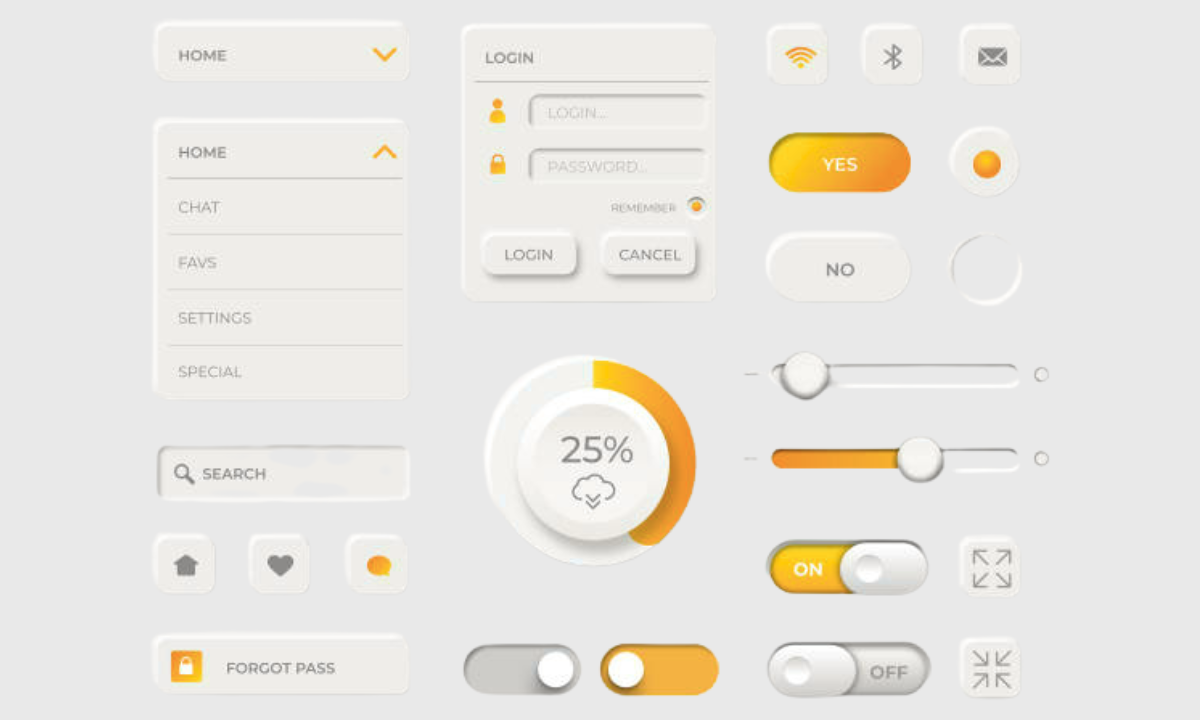
One of the standout UI design new trends is neumorphism, a style that uses soft shadows and subtle highlights to make UI elements appear tactile, nearly extruded from the background.
The effect is clean, quiet, and gives interfaces a physical feel without becoming skeuomorphic or heavy.
When we teach this at Apponix, we focus on balancing the neumorphic effect with accessibility: keeping contrast enough for readability, using proper shadowing so elements don’t feel “flat in fog”, and applying it where it supports usability rather than just aesthetics.
In practical terms, neumorphism often works best for cards, toggles, or minimal dashboards, not necessarily for complex data-heavy screens where clarity and structure matter more.
Glassmorphism: Transparency, Depth & Frosted Glass Effects
Another major trend in UI right now is glassmorphism. This style mimics translucent glass: semi-transparent layers, backdrop blurs, light borders, and depth via layering.
The design language gives a sense of dimension and sophistication.
Glassmorphism allows the interface to feel modern and sleek while still maintaining focus on content.
In our training modules at Apponix, we emphasise how to implement it properly: using CSS properties (like backdrop-filter: blur()), respecting performance constraints, and ensuring that transparency doesn’t hamper readability or performance across devices.
When used well, glassmorphism brings a refined aesthetic to light mode or dark mode interfaces, creating visual interest without distraction.
Dark Mode & Adaptive Themes
Dark mode has moved from an optional “nice-to-have” to a baseline expectation in many products, one of the essential modern UI design trends.
But for 2025, the trend is going deeper: dark mode isn’t just about inverting colours, it’s about thoughtful visual design that adapts to context, ambient lighting, user preferences, and device capabilities.
As a trainer, I emphasise that dark UI design must still prioritise readability, accessibility, and brand consistency. Contrast becomes critical, as does ensuring that graphical assets (icons, illustrations) adapt to dark mode without losing clarity.
At Apponix’s UI/UX design course in Bangalore, we teach how to design dual-theme systems, how to test in both modes, and how to make sure transitions are smooth so users don’t feel a jarring shift.
Animations & Microinteractions: Small Movements, Big Impact
One of the most overlooked yet powerful UI design new trends is animations and microinteractions. These are the subtle transitions, hover effects, button ripple effects, loading indicators, progress feedback, and other bits of motion that, when done right, make a UI feel alive, responsive, and human.
In 2025, designers are expected to treat these interactions not as embellishments but as essential parts of UI that guide, reassure, and delight the user.
For example, a microinteraction might confirm that an action succeeded, draw attention to a change, or simply add polish to the user journey.
In our Apponix training institute in Bangalore, we demonstrate best practices: animations should be purposeful, have consistent timing and easing, and not interfere with performance or accessibility.
We also show how to leverage tools like Lottie, CSS animations, or animation libraries to build polished micro-interactions that align with overall UI design systems.
UI Design Standards & Accessibility in 2025
As exciting as the visual trends are, one of the key pillars of our training is how to apply UI design standards, so that designs are not just beautiful but usable, inclusive, and maintainable.
For 2025, that means paying attention to accessibility (contrast, keyboard navigation, screen-reader support), responsiveness across devices, performance optimization, and adaptability for future tech (like foldables, AR/VR).
We teach designers in the UI/UX design course in Bangalore at Apponix how to integrate standards like WCAG, how to build modular design systems, how to document components, and how to iterate using real user data and feedback. Because visuals without usability will not sustain long-term success.
UI/UX Design Trends for 2025 & Beyond
Looking broadly at the horizon, some of the UI/UX design trends for 2025 include: immersive 3D objects, generative AI in UI, voice UI, spatial navigation, sustainability in design, and minimal-maximal contrast aesthetics.
These trends push beyond what we’ve done in the past and require designers to sharpen their strategic thinking, not just aesthetic skills.
At Apponix, we incorporate future-focused modules so you are not just trained for today’s trends, but equipped for evolving tools, platforms, and user behaviours. Whether you are learning to work in a startup or a global enterprise, understanding where UI is heading makes your skillset more valuable.
Wrapping Up
At Apponix training institute in Bangalore, I have seen many designers transform when they begin to embrace the right UI design trends with purpose.
The visual language of neumorphism and glassmorphism, the essential adoption of dark mode, the detail-oriented animations and microinteractions, and the strong foundation of UI standards and accessibility—all combine to shape modern, effective digital experiences.
In our UI/UX design course in Bangalore, we guide you through mastering these trends, understanding when and how to apply them, and building a portfolio that reflects contemporary design thinking.
Whether you’re fresh to UI or looking to upskill, staying current with these trends ensures you stay relevant in a competitive field.
We don’t just teach tools. We teach how to think like a designer who leads, not follows, the next wave of interface innovation. Join us at Apponix and let’s design the future together.
FAQs
Q1. What are the most important UI design trends right now?
In my view, the most important ones are glassmorphism, dark mode, microinteractions, and motion design, because they impact both aesthetics and usability.
Q2. How do I choose between neumorphism and glassmorphism in my design?
I suggest evaluating your context: neumorphism works best in minimalist, clean-interface scenarios; glassmorphism shines when you want layered depth and modern transparency. But always test for accessibility, readability, and performance.
Q3. Are animations and microinteractions just decorative?
No, they’re far more than decoration. Well-executed microinteractions provide feedback, guide users, improve engagement, and make the interface feel responsive. They should be meaningful, not gratuitous.
Q4. Does training in Bangalore make a difference for UI/UX design?
Yes, when you join a dedicated training institute in Bangalore like Apponix, you benefit from direct mentorship, real-world projects, a local industry ecosystem, and updates on the latest trends and standards.
Q5. What should I focus on to stay ahead in UI/UX design for 2025?
I recommend focusing on adaptive themes (including dark mode), motion design, layered visual styles (glassmorphism/neumorphism), accessibility, and future-forward topics like AI-augmented UI and immersive interfaces. Building your portfolio around these will set you apart.

Apponix Academy
Apponix Academy