POPULAR COURSES
Master Programs




Table of contents:
|
1. The Bangalore Hiring Landscape: Market Demand & Career Upside
|
|
2. Financial ROI & Cost Breakdown: Exam Fees vs. Salary Premiums
|
|
3. The Skill Gap: Why Certifications Need Practical Execution
|
|
4. Why Choose Apponix Technologies for Your DevOps Career? |
|
5. Conclusion |
Evaluating the return on investment of a formal DevOps certification in Bangalore professionals consider is a crucial step when planning a career transition in 2026. Enrolling with a recognized Training Institute in Bangalore provides the structured curriculum, hands-on cloud labs, and career support required to pass industry exams while building job-ready platform engineering skills.
In a fast-moving hiring market like Bangalore where thousands of software developers, quality assurance leads, system administrators, and technical support engineers compete for high-paying platform roles, standing out during initial resume screening rounds is increasingly difficult.
Automated Applicant Tracking Systems (ATS) and talent acquisition teams routinely use formal cloud and container credentials as primary filter criteria to manage high candidate volume. However, a persistent question among mid-career switchers is whether paper credentials alone lead to direct job offers.
The reality of today's tech hiring market comes down to a dual-validation model: an industry certification validates your theoretical understanding to clear initial recruiter screening calls, while a public GitHub portfolio and live troubleshooting ability prove your practical value during technical architecture interviews.
Understanding this balance is essential for maximizing your upskilling investment and accelerating your career progression.
The Bangalore Hiring Landscape: Market Demand & Career Upside

The demand for cloud infrastructure automation in South Asia’s technology epicenter has reached an all-time high. As enterprises shift from traditional software development models to continuous delivery and GitOps workflows, understanding the DevOps job market Bangalore offers is essential for evaluating your career potential.
From the Outer Ring Road (ORR) tech corridor housing major Global Capability Centers (GCCs) and financial tech platforms to Whitefield, Electronic City, and Manyata Tech Park, companies are actively competing for platform engineers who can automate delivery pipelines and manage distributed cloud infrastructure.
Employer Categories Driving Hiring Volume
The hiring surge spans three distinct organisational models across Bangalore:
-
Multinational GCCs & Product Hubs: Captive technology centers for global retail, banking, and healthcare giants prioritize fault-tolerant, multi-region architectures. These organizations seek engineers capable of managing zero-downtime deployments, Kubernetes clusters, and automated compliance policies.
-
High-Growth SaaS & E-Commerce Unicorns: Product-led companies based around Koramangala, Indiranagar, and HSR Layout focus on deployment velocity and system elasticity. Infrastructure specialists here manage auto-scaling event pipelines and observability stacks to handle high user concurrency.
-
Enterprise IT Services & Consultancies: Major system integrators across ITPL and Electronic City drive massive legacy-to-cloud transformation projects for global clients, requiring skilled engineers to build scalable CI/CD pipelines.
Unlocking Long-Term Career Acceleration
Beyond immediate job availability, one of the most significant benefits of learning DevOps is the structural career mobility it provides.
Moving away from manual system administration or isolated software QA testing elevates your role from routine maintenance to strategic infrastructure design.
|
Professional Milestone |
Traditional IT / Systems Role |
Platform Engineering / DevOps Role |
Career & Salary Impact
|
|---|---|---|---|
|
System Visibility |
Confined to isolated code bases or manual server configs |
End-to-end visibility across application code, infrastructure, and delivery pipelines |
High strategic importance to core engineering leadership |
|
Operational Workflow |
Manual deployments, reactive ticket handling |
Automated GitOps workflows, self-healing infrastructure, declarative IaC |
40% to 60% reduction in deployment friction and manual overhead |
|
Market Resilience |
Vulnerable to routine task automation |
High market demand across cloud-native and multi-cloud industries |
Exceptional job security and continuous compensation growth |
By positioning yourself at the intersection of development and cloud operations, you gain the technical versatility needed to advance into senior platform architect, Site Reliability Engineering (SRE), and cloud security leadership roles.
Financial ROI & Cost Breakdown: Exam Fees vs. Salary Premiums

Evaluating whether a professional credential is worth your financial investment requires looking beyond the initial exam invoice.
To measure true return on investment (ROI), you must weigh the upfront examination fees and lab training costs against the long-term compensation upside available in Bangalore's cloud engineering market.
1. Direct Exam Fee Breakdown
Certification providers standardize their examination costs globally in USD, with local Indian taxes (18% GST) applied at Pearson VUE checkout.
|
Certification Level & Exam Name |
Official List Price (USD) |
Base INR List Price |
Estimated Total Cost (incl. 18% GST) |
Primary Target Audience
|
|---|---|---|---|---|
|
AWS Certified DevOps Engineer – Professional (DOP-C02) |
$300 USD |
~₹25,659 INR |
~₹30,278 INR |
Mid-to-senior cloud, system, and platform engineers |
|
AWS Certified SysOps Administrator / Developer – Associate |
$150 USD |
~₹12,830 INR |
~₹15,140 INR |
Entry-level cloud associates and junior developers |
|
Certified Kubernetes Administrator (CKA - Linux Foundation) |
$395 USD |
~₹33,780 INR |
~₹39,860 INR |
Container orchestration & Kubernetes specialists |
|
HashiCorp Certified: Terraform Associate |
$70 USD |
~₹5,980 INR |
~₹7,050 INR |
Infrastructure as Code (IaC) automation specialists |
Understanding the exact AWS DevOps certification cost, which totals approximately ₹30,278 INR when factoring in standard 18% GST, helps you budget your upskilling journey effectively alongside hands-on lab training resources.
2. Salary Premium & Payback Period Analysis in Bangalore
While spending ₹30,000 to ₹50,000 on certification fees and structured training requires an upfront commitment, the financial return upon transitioning into Bangalore's cloud ecosystem is substantial.
|
Transition Pathway |
Pre-Transition Salary Range |
Post-Transition Salary Range (Bangalore) |
Average Annual Salary Lift |
Estimated Investment Payback Period
|
|---|---|---|---|---|
|
QA / Manual Tester -> Junior DevOps Engineer |
₹4.5 LPA – ₹6.5 LPA |
₹8.5 LPA – ₹12.0 LPA |
+₹4.0 LPA – ₹5.5 LPA |
Less than 2 months |
|
L1/L2 Tech Support -> Cloud Operations Engineer |
₹3.5 LPA – ₹5.5 LPA |
₹7.5 LPA – ₹10.5 LPA |
+₹4.0 LPA – ₹5.0 LPA |
Less than 2 months |
|
System Administrator -> Platform / DevOps Engineer |
₹6.0 LPA – ₹9.0 LPA |
₹12.0 LPA – ₹17.5 LPA |
+₹6.0 LPA – ₹8.5 LPA |
1 to 2 months |
|
Backend Developer -> Senior DevSecOps / Cloud Specialist |
₹8.0 LPA – ₹12.0 LPA |
₹16.0 LPA – ₹24.0 LPA |
+₹8.0 LPA – ₹12.0 LPA |
1 month |
3. Calculating the Net ROI Over 3 Years
When evaluating the long-term economics of upskilling:
-
Total Initial Outlay: ₹30,278 (Professional Exam) + ~₹20,000 to ₹35,000 (Hands-on Lab Training & Cloud Sandbox Resources) = ~₹50,000 to ₹65,000 total investment.
-
Average Annual Realized Gain: A conservative ₹4,00,000 (+₹4.0 LPA) annual CTC lift in the Bangalore market.
-
3-Year Cumulative Yield: Over 36 months, a ₹4.0 LPA lift yields ₹12,00,000 (₹12 Lakhs) in additional gross earnings, representing a return on investment exceeding 18x to 20x your initial outlay.
Factoring in Bangalore's rapid compensation scaling for cloud talent, the financial case for earning recognized credentials when backed by true practical capability is exceptionally strong.
The Skill Gap: Why Certifications Need Practical Execution

While earning a credential proves your dedication to mastering theoretical concepts, a certificate alone will not solve a production outage or fix a broken continuous integration pipeline. In Bangalore's mature technical ecosystem, hiring managers frequently encounter "paper-certified" candidates who can answer multiple-choice questions about cloud service limits but stumble when asked to write a declarative Terraform module or debug a crashing Kubernetes pod during a live interview drill.
To successfully navigate technical hiring rounds, your study approach must bridge the gap between exam prep and real-world engineering execution.
The Limitations of Exam-Only Learning
Multiple-choice certification exams test your ability to recognize correct architecture patterns and service definitions under ideal conditions. Production environments, however, are rarely ideal:
-
Scenario vs. Execution: An exam asks which AWS service handles distributed tracing; a production incident requires you to instrument AWS X-Ray inside a live microservice container and analyze latency bottlenecks.
-
Syntax vs. Structure: An exam tests whether you know what Terraform is used for; an employer tests whether you can structure reusable Terraform modules with remote state locking to prevent concurrent deployment collisions.
-
Ideal vs. Edge Cases: Certification questions assume clean, isolated inputs. Production deployments involve legacy technical debt, misconfigured firewall rules, and complex multi-region dependencies.
Key Hands-On Skills Interviewers Actually Test
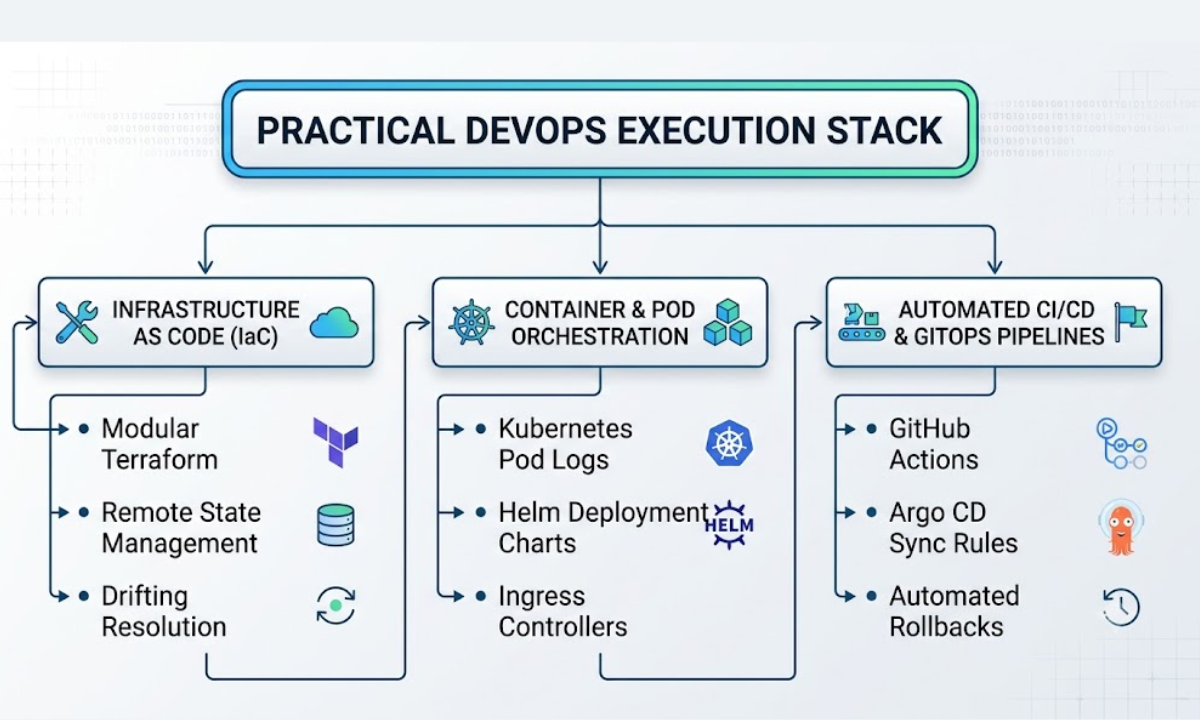
Image Credits: Apponix Technologies
To convert recruiter calls into final job offers, candidates must demonstrate practical fluency across three core operational pillars:
-
Declarative Infrastructure as Code (IaC): Writing maintainable HCL code in HashiCorp Terraform to provision Virtual Private Clouds (VPCs), subnets, and IAM roles without touching the cloud console interface.
-
Container Orchestration & Troubleshooting: Navigating kubectl command-line tools to inspect container logs, identify crashing Pods (CrashLoopBackOff), and manage ingress traffic routes across Kubernetes clusters.
-
Automated GitOps Pipelines: Configuring GitHub Actions workflows and Argo CD deployment syncs to automate testing, build Docker images, and push zero-downtime updates directly to staging and production environments.
Bridging the Gap with Guided Projects
Overcoming this skill gap requires structured, project-based training where you build, break, and fix production-style architectures. Enrolling in a hands-on DevOps course in Bangalore gives you access to sandbox cloud environments and mentorship from experienced platform engineers.
Furthermore, choosing a comprehensive DevOps developer course in Bangalore ensures you don't just learn tool syntax, but also develop a verified public GitHub portfolio, giving hiring managers concrete, verifiable proof of your real-world technical capabilities.
Why Choose Apponix Technologies for Your DevOps Career?
Transitioning from theoretical certification study to real-world execution requires more than watching video tutorials or taking online quizzes; it demands hands-on lab time under guided corporate mentorship. Apponix Technologies has built an established reputation across Bangalore as a premier career transformation hub designed to help software engineers, testers, and IT administrators master enterprise-grade cloud automation.
When you enroll with Apponix, you step into an immersive learning ecosystem structured around practical technical capability:
-
100% Practical Live Cloud Sandbox Labs: Configure, test, and troubleshoot production workloads on AWS and Azure cloud environments without relying on simulated interfaces.
-
Mentorship from Active Enterprise Architects: Learn directly from practicing senior platform leads and cloud architects who bring real-world chaos engineering, security auditing, and pipeline workflows into every session.
-
Production-Grade GitHub Portfolio Creation: Build, document, and publish 2 to 3 end-to-end projects featuring Terraform infrastructure modules, Docker microservices, and Kubernetes GitOps delivery pipelines.
-
1-on-1 Resume Engineering & Interview Coaching: Receive specialized resume restructuring to pass ATS filters, alongside mock technical interviews and whiteboarding practice tailored to Bangalore hiring standards.
-
Guaranteed Placement Connections & Career Support: Tap into Apponix's active hiring network connecting trained candidates directly with hiring managers across major product hubs and global capability centers.
Combining deep technical instruction with hands-on lab practice and active career coaching, Apponix bridges the gap between exam preparation and enterprise execution, helping you step into your new role with complete confidence.
Conclusion
Evaluating whether a professional credential is worth your time and financial investment ultimately comes down to how effectively you pair exam preparation with practical engineering execution. In a competitive technology hub like Bangalore, holding a recognized cloud credential helps your application pass automated ATS filters and recruiter shortlists, while your ability to write declarative infrastructure code and debug live container pipelines secures the final job offer. Earning credentials without hands-on lab experience limits your interview performance, but combining formal study with real-world project deployment creates a powerful competitive advantage that accelerates your career progression.
To maximize your career transition in 2026, follow a clear four-step decision framework. First, evaluate your current technical background and choose a clear learning track, whether advancing from software testing into CI/CD pipeline engineering, or moving from system administration into infrastructure automation. Second, master foundational system prerequisites including Linux command-line tools, shell scripting, Git version control, and core networking concepts. Third, enroll in a hands-on, mentor-led program where you spend dedicated time building and troubleshooting real-world cloud architectures inside live sandbox environments. Fourth, build and publish a public portfolio of production-ready projects on GitHub, optimize your resume for automated screening, and actively engage with enterprise hiring networks across Bangalore to launch your platform engineering career.
Reference:

Apponix Academy
Apponix Academy