POPULAR COURSES
Master Programs


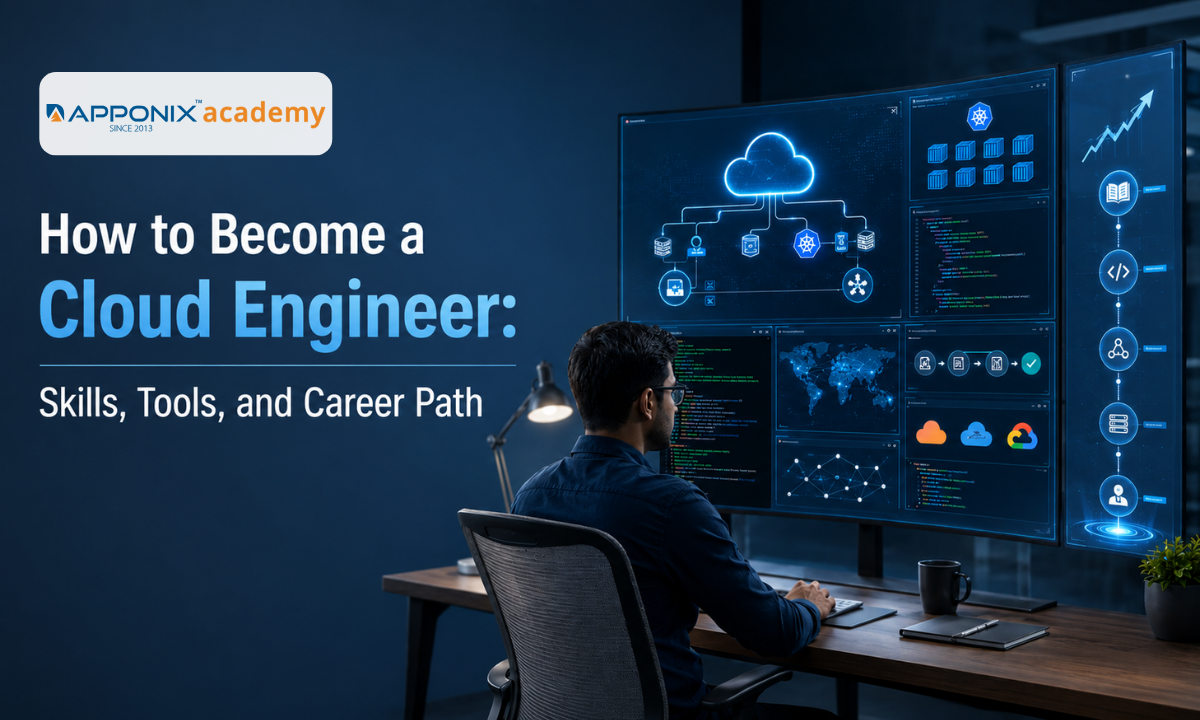
Table of contents:
|
1. Core Competencies & Technical Foundation
|
|
2. The Production Toolchain (IaC, Containers & CI/CD)
|
|
3. Job Roles, Specializations & Salary Insights
|
|
4. Step-by-Step Career Roadmap: From Beginner to Job-Ready
|
|
5. Why Choose Apponix Technologies for Your Cloud Journey? |
|
6. Conclusion |
As global enterprises and product startups accelerate their digital transformation initiatives, understanding how to become a cloud engineer has emerged as one of the most lucrative career pursuits in technology.
Enrolling in an industry-aligned Cloud Computing Course in Bangalore equips aspiring infrastructure professionals with the practical competencies required to architect, automate, and secure scalable multi-cloud systems.
With enterprise IT operations rapidly migrating from legacy on-premises servers to cloud-native platforms, skilled engineers who can design resilient architectures are in unprecedented demand across global technology corridors. The modern cloud engineering landscape extends far beyond basic server provisioning and manual console configurations.
In today's distributed software environments, organizations require engineers capable of writing declarative infrastructure code, orchestrating containerized microservices, implementing Zero-Trust security governance, and optimizing compute costs for AI-driven workloads. Demonstrating these production-grade capabilities through hands-on project implementations and recognized credentials establishes immediate credibility with technical recruiters.
This comprehensive guide outlines the essential technical proficiencies, modern toolsets, compensation benchmarks, and structured roadmap required to launch a high-impact engineering career.
Core Competencies & Technical Foundation

Before managing enterprise workloads on hyperscalers like AWS, Azure, or Google Cloud, aspiring infrastructure professionals must establish a rock-solid foundation in underlying systems and protocols.
Developing these foundational cloud engineer skills ensures that when distributed microservices experience latency or connectivity failures in production, you possess the diagnostic capabilities to trace faults directly to the root operating system process, network packet, or firewall rule.
Linux Systems Administration & Headless Operations
Over 90% of cloud workloads and container runtimes execute on enterprise Linux distributions. Linux administration is a core skill for cloud engineers, covering server management, user permissions, processes, services, networking, and security. Modern engineering workflows prioritize headless virtual machines and stripped-down base images that lack graphical interfaces to maximize performance and minimize security attack surfaces.
-
Access & User Governance: Managing SSH key-based authentication, user groups, and fine-grained file permissions (chmod, chown, umask) to enforce least-privilege access.
-
Process & Service Management: Inspecting system resource utilization, background daemon lifecycles, and service logs using systemctl, journalctl, top, and htop.
-
Text Processing & File Analysis: Rapidly parsing configuration files and high-volume web logs directly within the terminal using standard utilities like grep, awk, sed, and find.
Mastering these terminal-based commands enables engineers to troubleshoot virtual machines and container instances quickly without relying on external diagnostic software.
Software-Defined Cloud Networking
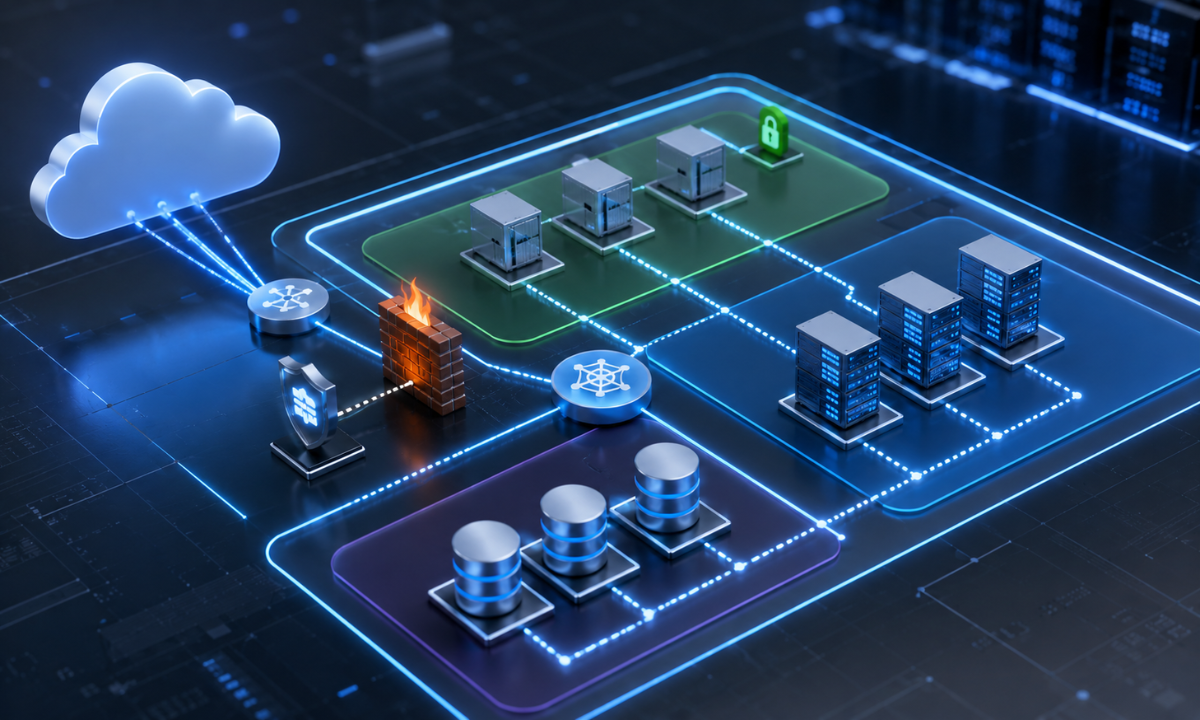
Cloud architecture relies entirely on software-defined networking (SDN) to establish private boundaries, route global user traffic, and protect sensitive database tiers.
|
Networking Concept |
Cloud Infrastructure Role |
Practical Engineering Application
|
|---|---|---|
|
CIDR & Subnetting |
IP address partitioning |
Designing isolated public and private subnets within Virtual Private Clouds (VPCs). |
|
DNS Resolution |
Domain-to-IP translation |
Configuring routing policies, health checks, and latency-based failovers via Route 53 or Cloud DNS. |
|
Transport Protocols (TCP/UDP) |
Packet delivery & connection rules |
Mapping port bindings, configuring Network Load Balancers, and diagnosing socket timeouts. |
|
Firewalls & Access Lists |
Packet-level perimeter security |
Defining stateless Network Access Control Lists (NACLs) and stateful Security Group rules. |
Understanding how data traverses physical networks and virtual abstractions prevents IP exhaustion during scaling events and ensures zero-trust communication across multi-tier applications.
Scripting & Task Automation (Bash & Python)
Modern cloud infrastructure is driven by automated scripts rather than manual command execution. Proficiency in Bash is essential for creating custom server bootstrap scripts (user-data), managing environment variables, and automating file backups.
Simultaneously, Python serves as the standard programming language for interacting with cloud Software Development Kits (SDKs) such as AWS Boto3, allowing engineers to programmatically provision resources, automate snapshot lifecycles, and parse JSON API payloads efficiently.
The Production Toolchain (IaC, Containers & CI/CD)
Modern cloud infrastructure is no longer managed through manual dashboard interactions. Enterprise engineering teams manage systems through automated software pipelines where code defines, provisions, and maintains every compute instance, network gateway, and security policy.
Enrolling in a targeted cloud engineer course provides direct exposure to this production-grade toolchain, transitioning learners from theoretical architecture concepts to hands-on deployment automation.
Infrastructure as Code (IaC) & Configuration Management
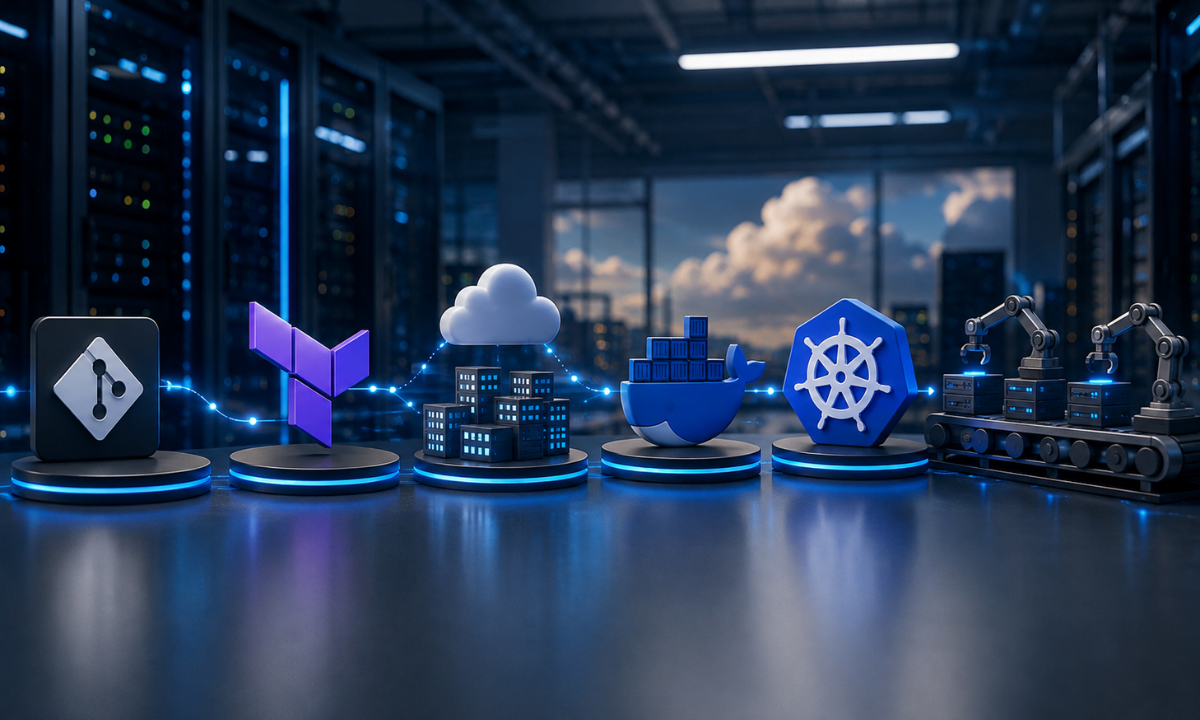
Infrastructure as Code treats data center architecture with the same rigor as software development. Declarative configuration files are stored in version control systems, enabling peer code reviews, automated policy enforcement, and reproducible multi-region deployments.
-
Terraform & OpenTofu: Industry-standard tools for declarative provisioning across hyperscalers. Engineers write HashiCorp Configuration Language (HCL) to define VPC topologies, compute clusters, and storage buckets, maintaining precise state files to eliminate configuration drift.
-
Ansible: An agentless automation engine used for post-provisioning configuration. It automates software installations, applies security patches, and manages runtime environments across fleets of virtual servers using declarative YAML playbooks.
-
AWS CloudFormation & Azure Bicep: Provider-native IaC frameworks that offer deep, day-one support for platform-specific resources and managed services.
Declarative Terraform snippet provisioning an isolated subnet:
|
Terraform |
|
resource "aws_subnet" "production_private_subnet" { |
Containerization & Orchestration (Docker & Kubernetes)
Monolithic server deployments have been largely replaced by containerized microservices that package code alongside all runtime dependencies. This guarantees consistent behavior across local developer workstations, staging environments, and production clusters.
|
Tool |
Core Function |
Production Responsibility
|
|---|---|---|
|
Docker |
Application containerization |
Building immutable, lightweight container images using optimized, multi-stage Dockerfiles. |
|
Kubernetes (K8s) |
Container orchestration |
Automating deployment scheduling, service discovery, self-healing restarts, and horizontal pod autoscaling. |
|
Managed K8s (EKS / AKS / GKE) |
Cloud-native cluster management |
Offloading Kubernetes control plane maintenance to cloud providers while managing worker node groups. |
Continuous Integration & Continuous Delivery (CI/CD)
CI/CD pipelines automate the path from code commit to live infrastructure deployment. Tools like GitHub Actions, GitLab CI/CD, and ArgoCD automatically execute unit tests, run security vulnerability scans on container images, and trigger declarative Terraform or Kubernetes rollouts without manual human intervention.
Mastering this automated workflow ensures you can maintain high deployment velocity while upholding strict stability and security standards across enterprise environments.
Job Roles, Specializations & Salary Insights
As enterprise IT architectures grow increasingly specialized, the umbrella title of "Cloud Engineer" has branched into distinct, high-impact career tracks.
Organizations no longer hire generic administrators; they recruit specialists who can solve distinct challenges around architecture design, continuous delivery, automated compliance, and unit economics. Understanding how compensation scales across these roles is essential when planning your career transition, as the benchmark cloud engineer salary is heavily influenced by specialization, verified project portfolios, and regional hiring concentration.
Core Specializations in Modern Cloud Infrastructure
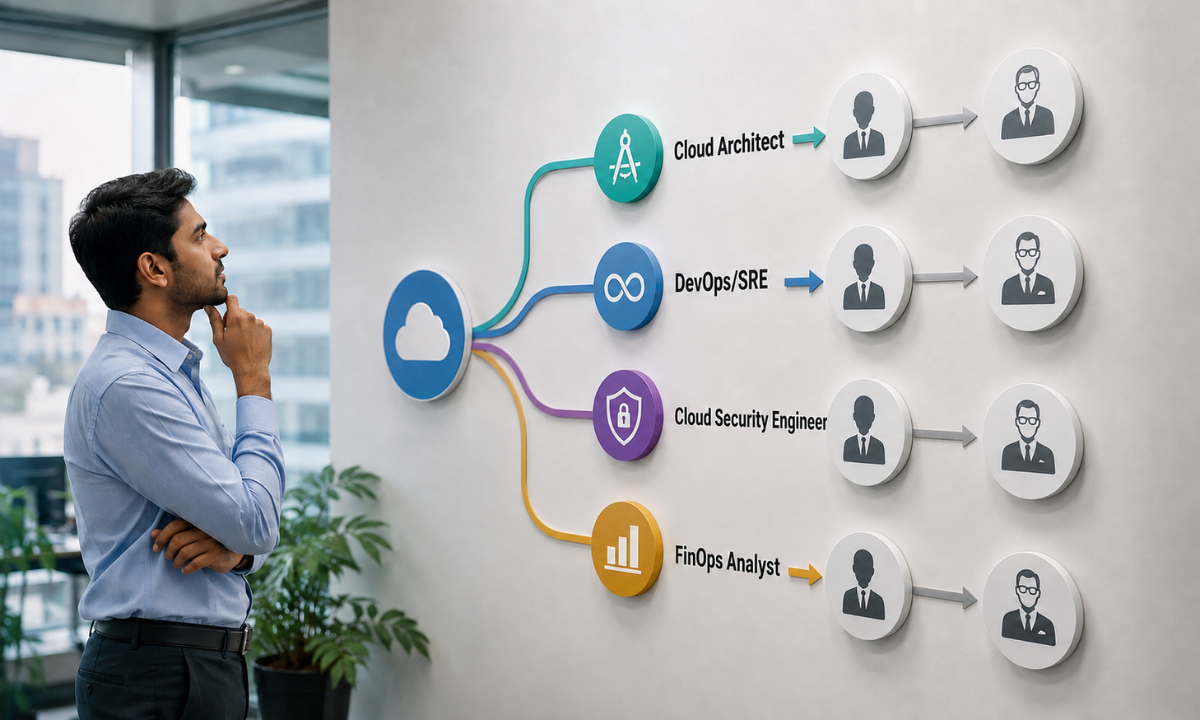
-
Cloud Solutions Architect: Responsible for high-level system design, defining multi-region availability boundaries, selecting appropriate managed database systems, and orchestrating zero-downtime migration plans from legacy infrastructure.
-
DevOps & Site Reliability Engineer (SRE): Bridges the gap between application developers and infrastructure by building CI/CD pipelines, writing Infrastructure as Code (IaC) definitions, and maintaining system uptime through automated monitoring.
-
Cloud Security Engineer (DevSecOps): Enforces Zero-Trust identity frameworks, configures Web Application Firewalls (WAF), audits container registries for vulnerabilities, and ensures regulatory compliance across distributed environments.
-
Cloud FinOps Analyst: Analyzes compute utilization telemetry to eliminate idle infrastructure waste, rightsizes over-provisioned virtual machine instances, and structures enterprise Savings Plans and Reserved Instances to optimize operational expenditures.
Compensation Benchmarks Across Experience Tiers (India)
|
Career Stage |
Experience Range |
Typical Salary Benchmark (INR per annum) |
Primary Value Driver & Focus Areas
|
|---|---|---|---|
|
Associate / Junior Engineer |
0 - 2 Years |
₹4.5 LPA - ₹8.5 LPA |
Linux troubleshooting, Bash scripting, basic VPC setup, and console administration. |
|
Mid-Level Cloud Engineer |
3 - 6 Years |
₹9.0 LPA - ₹18.0 LPA |
Terraform automation, Docker packaging, Kubernetes cluster support, and CI/CD management. |
|
Senior Cloud Engineer / SRE |
7 - 10 Years |
₹20.0 LPA - ₹35.0 LPA |
Multi-region disaster recovery, Zero-Trust security governance, and Kubernetes cluster orchestration. |
|
Principal Architect / Lead |
10+ Years |
₹35.0 LPA - ₹60.0+ LPA |
Enterprise cloud migration strategy, multi-cloud cost governance, and executive technical leadership. |
Key Factors Driving Salary Premiums
Compensation in major technology hubs like Bengaluru, Hyderabad, and Pune reflects the high demand for engineers who possess hands-on code automation skills rather than theoretical knowledge alone:
-
Product Companies & GCCs vs. Legacy IT Services: Global Capability Centers (GCCs) and product startups in Bengaluru frequently offer 40% to 60% higher compensation packages compared to traditional IT service firms for engineers demonstrating production-level code proficiency.
-
Verifiable GitHub Repositories: Candidates who present public repositories featuring modular Terraform templates and functional CI/CD workflows consistently negotiate stronger entry and mid-level packages than candidates with certifications alone.
-
Cross-Platform Competence: While deep specialization in one primary cloud provider (such as AWS or Azure) is mandatory, foundational working knowledge of a secondary platform (like GCP for data analytics or Kubernetes workloads) provides immediate leverage during salary negotiations.
Step-by-Step Career Roadmap: From Beginner to Job-Ready
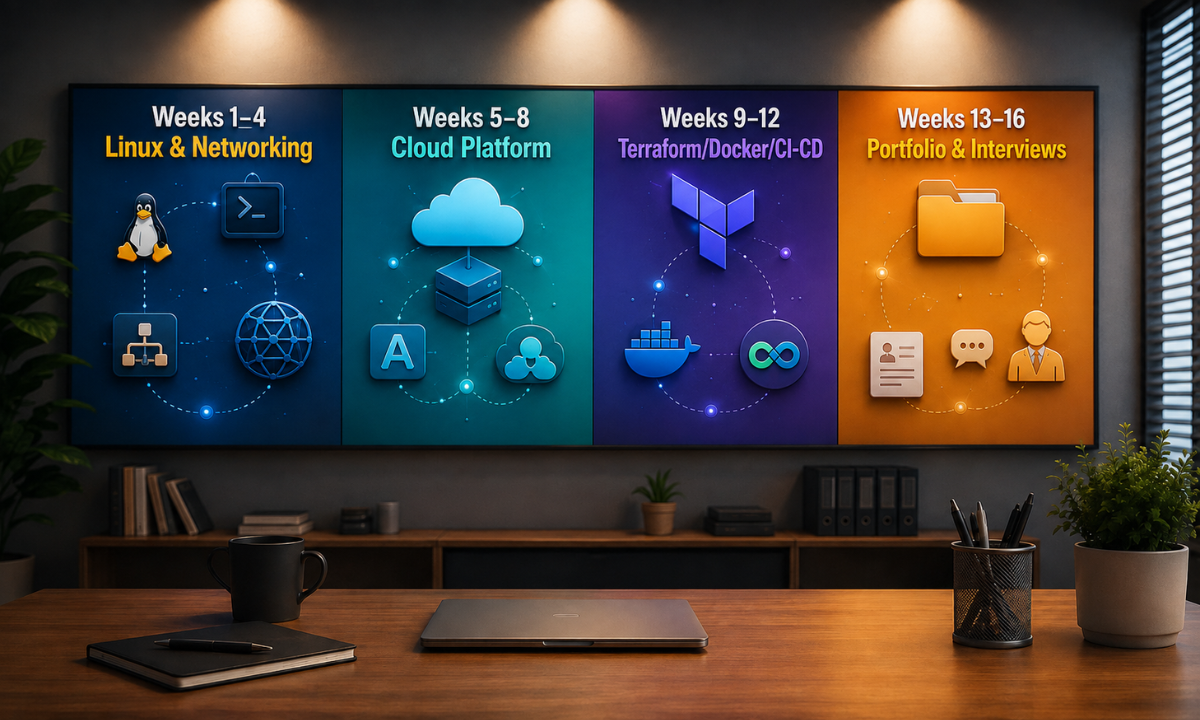
Transitioning into enterprise infrastructure requires a disciplined, milestone-driven strategy rather than random tutorial consumption. Launching a high-growth cloud computing career in 2026 demands progressing through four structured development phases that transform absolute beginners into production-ready engineers capable of handling complex cloud deployments.
Phase 1: Core Systems & Networking Groundwork (Weeks 1-4)
Before provisioning virtual machines or opening a cloud vendor's console, you must build baseline fluency in the operating systems and protocols that underpin every data center.
-
Linux Systems Administration: Practice navigating terminal directories, editing configuration files with Vim or Nano, managing file permissions (chmod, chown), and analyzing running processes.
-
Networking Protocols: Master the mechanics of the TCP/IP stack, CIDR subnet calculations, DNS resolution flows, and firewall port configurations.
-
Version Control & Scripting: Learn Git branching workflows on GitHub and write basic Bash scripts to automate daily operational tasks on Linux instances.
Establishing this fundamental systems knowledge guarantees that you understand what happens beneath the hypervisor layer when deploying cloud infrastructure.
Phase 2: Single-Platform Hyperscaler Mastery (Weeks 5-8)
Rather than spreading your efforts thinly across multiple platforms, dedicate your focus to mastering one primary ecosystem—either Amazon Web Services (AWS) or Microsoft Azure.
-
Core Compute & Storage: Deploy scalable virtual machines (EC2/Azure VMs), configure block storage volumes (EBS), and organize object storage repositories (S3/Blob Storage).
-
Virtual Private Networking: Build custom Virtual Private Clouds (VPCs), configure internet gateways, and establish private subnets isolated behind NAT gateways.
-
Identity & Access Management (IAM): Enforce least-privilege security policies, configure role-based access control (RBAC), and eliminate root-user dependencies.
Gaining deep, hands-on familiarity with a single platform enables you to internalize core cloud patterns that translate seamlessly to any other provider later in your career.
Phase 3: Infrastructure as Code & Container Automation (Weeks 9-12)
Modern cloud teams do not manage servers manually; they provision and scale environments entirely through declarative code and automated deployment pipelines.
-
Declarative Provisioning (Terraform): Write reusable Terraform modules to build and tear down multi-tier VPC network topologies automatically.
-
Application Containerization (Docker): Package web applications and microservice dependencies into optimized, lightweight container images.
-
Continuous Integration/Delivery (CI/CD): Configure automated GitHub Actions workflows to validate Terraform code and trigger rolling application deployments.
Automating these workflows transitions your engineering profile from traditional server maintenance to modern cloud infrastructure engineering.
Phase 4: Portfolio Construction & Technical Interview Preparation (Weeks 13-16)
The final phase focuses on translating your practical technical abilities into verifiable proof-of-work repositories that capture the attention of engineering recruiters.
-
Architecting Real-World Capstone Projects: Deploy a three-tier containerized web application behind an auto-scaling load balancer with automated SSL termination and database failover.
-
Engineering Repository Documentation: Publish clean GitHub repositories featuring detailed architectural diagrams, cost estimations, and automated setup instructions.
-
Whiteboard Architecture Preparation: Practice articulating trade-offs regarding high availability, latency reduction, and disaster recovery recovery-point objectives (RPO).
Completing these production-grade projects provides tangible evidence of your engineering competence, giving you concrete architectural decisions to discuss during technical interview rounds.
Why Choose Apponix Technologies for Your Cloud Journey?
Bridging the gap between theoretical certification study and enterprise-grade deployment requires intensive, practical application within live technical environments. Apponix Technologies, a leading Training institute in Bangalore, delivers an industry-aligned curriculum structured specifically to help aspiring infrastructure professionals develop hands-on competency under the direct guidance of practicing architects. Rather than relying on static multiple-choice practice tests, the training emphasizes production-level configuration, deployment automation, and system troubleshooting.
Apponix offers a comprehensive, project-centric learning experience designed to bridge the gap between basic syntax and corporate job readiness:
-
100+ Hours of Practical Sandbox Labs: Gain hands-on exposure by provisioning multi-tier VPC topologies, writing automated Terraform scripts, and deploying containerized workloads on Kubernetes clusters in real-time sandbox environments.
-
Active Architect Mentorship & Code Reviews: Work directly with seasoned infrastructure specialists who provide granular feedback on your Infrastructure as Code modules, CI/CD pipelines, and network designs.
-
Official Certification Exam Guidance: Master the architectural principles and scenario-based problem-solving required to clear recognized credentials from AWS, Microsoft Azure, and Google Cloud on your first attempt.
-
Strategic Portfolio & Resume Optimization: Transform your academic exercises into production-grade GitHub repositories with clear documentation, architecture schematics, and clean code that pass corporate technical screening filters.
-
Direct Placement Connections Across Bangalore Tech Hubs: Leverage Apponix's established network of hiring partners across Bangalore's major tech parks for direct interview opportunities, featuring guaranteed interview scheduling support.
Combining intensive lab practice, focused credential preparation, and dedicated career coaching, Apponix Technologies empowers IT professionals to validate their skills, execute modern cloud strategies, and confidently step into high-paying infrastructure roles.
Conclusion
Succeeding in enterprise infrastructure architecture requires a deliberate transition from passive learning to active, code-first engineering. As organizations continually modernize their workloads to support distributed microservices and scalable artificial intelligence systems, the demand for engineers who understand operating systems, networking fundamentals, and declarative automation will only continue to rise.
Your progress depends on following a structured path: mastering Linux and networking prerequisites, gaining deep proficiency in at least one major hyperscaler, automating deployments using Terraform and Docker, and assembling a verifiable GitHub portfolio that showcases your architectural decision-making. Backing these practical repositories with vendor credentials validates your expertise to hiring managers across the industry. With disciplined execution, continuous lab practice, and professional mentorship, you can successfully build the technical foundation needed to thrive at the forefront of modern cloud infrastructure.
Reference:
1. https://www.digitalocean.com/resources/articles/cloud-engineer
2. https://www.igmguru.com/blog/how-to-become-a-cloud-engineer

Apponix Academy
Apponix Academy