POPULAR COURSES
Master Programs





Table of contents:
|
1. What Is a Certified Business Analysis Professional (CBAP)? |
|
2. Why Pursue the CBAP Certification in 2026? |
|
3. CBAP Eligibility Criteria |
|
4. CBAP Certification Cost Breakdown
|
|
5. ROI: Is CBAP Financially Worth It? |
|
6. Salary After Certified Business Analysis Professional (CBAP)
|
|
7. CBAP Exam Pattern & Difficulty |
|
8. How to Prepare for the CBAP Business Analyst Certification |
|
9. CBAP vs CCBA vs ECBA |
|
10. CBAP Renewal Process |
|
11. Business Analyst Course In Bangalore for CBAP Aspirants |
|
12. Final Thougths |
|
13. Frequently Asked Questions |
Many mid-level business analysts hit a silent ceiling.
They manage requirements. They support stakeholders. They deliver documentation.
But when enterprise transformation roles open up, hiring managers often look for one signal of advanced credibility: the Certified Business Analysis Professional (CBAP) designation.
The Certified Business Analysis Professional CBAP credential, issued by IIBA, is considered the gold standard for experienced business analysts. In 2026, as organisations accelerate AI adoption, digital transformation, and product-led strategies, senior analysts are expected to think beyond execution and operate at a strategic level.
The CBAP Business Analyst Certification validates that capability.
This guide explains eligibility, exam structure, salary impact, ROI, CBAP Certification Cost, renewal requirements, comparisons with other credentials, and training options, including Business Analyst Course in Bangalore programmes.
What Is a Certified Business Analysis Professional (CBAP)?

The Certified Business Analysis Professional (CBAP) is an advanced-level certification offered by IIBA for experienced business analysts with 7,500+ hours of documented project experience. It validates enterprise-level expertise aligned with the BABOK framework.
The CBAP Certified Business Analysis Professional credential is designed for senior practitioners who:
-
Lead complex initiatives
-
Align business strategy with execution
-
Influence cross-functional stakeholders
-
Drive transformation programmes.
Unlike entry-level certifications, the CBAP Certified Business Analyst designation evaluates applied judgment through scenario-based questions rather than theoretical recall.
It signals readiness for leadership.
Why Pursue the CBAP Certification in 2026?
The business analysis profession is no longer limited to requirement documentation and stakeholder coordination. In 2026, organisations expect senior analysts to contribute strategically to digital initiatives, governance frameworks, and enterprise-level transformation. As companies adopt AI, automation, and product-centric models, advanced certification has become a strong differentiator.
In 2026, organisations expect analysts to:
-
Support AI governance initiatives
-
Lead digital modernisation programmes.
-
Operate in product-centric delivery models
-
Collaborate with enterprise architects and product owners
The Business Analyst Certification CBAP positions professionals for roles such as:
-
Lead Business Analyst
-
Enterprise Business Analyst
-
Business Analysis Manager
-
Digital Transformation Consultant
The Certified Business Analysis Professional credential strengthens credibility across industries such as IT services, fintech, consulting, healthcare, and large enterprise environments.
CBAP Eligibility Criteria

The CBAP certification is designed for experienced professionals who have demonstrated significant expertise in business analysis. Unlike entry-level certifications, it validates advanced knowledge, leadership capability, and practical application of industry standards. The eligibility criteria are intentionally rigorous to maintain the certification’s global credibility and professional value.
To apply for the CBAP Certification, candidates must meet strict requirements:
-
7,500 hours of business analysis experience in the last 10 years
-
900 hours in four of the six BABOK knowledge areas
-
35 hours of professional development training
-
Two professional references
-
Agreement to IIBA’s Code of Conduct
These requirements ensure the CBAP Business Analyst Certification remains an elite-level credential.
CBAP Certification Cost Breakdown
Understanding the CBAP Certification Cost is critical before applying, as the total investment goes beyond just the exam fee. Candidates should consider membership benefits, training format, preparation materials, and potential retake expenses. Planning the budget helps avoid surprises and ensures you select the most cost-effective preparation pathway.
Application Fee
$145 (non-refundable). This fee is paid when submitting your eligibility application and is required regardless of the approval outcome.
Membership Fee
Annual IIBA membership (varies by region). Becoming a member reduces the exam fee and provides access to study resources, webinars, and professional communities.
Exam Fee
$350 (member)
$505 (non-member)
Membership significantly lowers the examination cost, making it financially beneficial for many applicants.
Retake Fee
$295 (member)
$450 (non-member)
If a candidate does not pass on the first attempt, retake fees apply, so thorough preparation is recommended.
Training Costs
-
Self-paced: $150–$500 (ideal for experienced professionals comfortable with independent study)
-
Instructor-led online: $300–$900 (structured learning with expert guidance)
-
Classroom: $600–$1,200+ (interactive sessions, networking, and focused mentoring)
Estimated Total Investment
Most candidates spend between $1,000 and $2,000, depending on training format, membership choice, and study materials. While the cost may seem significant, the long-term salary growth and leadership opportunities often justify the investment.
ROI: Is CBAP Financially Worth It?
Let’s break this down practically.
Average investment: $1,500
Average salary increase in India: ₹5–10 LPA
Even at the lower end, professionals often recover their CBAP Certification Cost within 3–6 months of promotion or role transition.
Over 5 years, the lifetime return can be substantial.
The CBAP Certified Business Analysis Professional credential often functions as a shortlisting differentiator in senior hiring processes.
Salary After Certified Business Analysis Professional (CBAP)
The Certified Business Analysis Professional CBAP credential supports a structured jump from mid-level to senior roles.
India Salary Range
Mid-Level BA (Pre-CBAP): ₹8–15 LPA
Senior / Lead BA (Post-CBAP): ₹15–28 LPA
High-end consulting/product roles: ₹30+ LPA
Global Salary Range
USA/Canada: $110,000–$140,000+
UK: £60,000–£90,000
Western Europe: €65,000–€95,000
The CBAP Certified Business Analyst designation strengthens salary negotiation leverage, especially in enterprise and consulting environments.
CBAP Exam Pattern & Difficulty
The CBAP exam is designed to assess not just theoretical understanding, but practical application of business analysis principles in real-world scenarios. It evaluates how effectively candidates can interpret complex situations, apply the BABOK framework, and make sound professional judgments. The structure ensures that only experienced analysts with strong conceptual clarity and decision-making ability succeed.
The CBAP Certification exam includes:
-
120 multiple-choice questions focused on application rather than direct definitions
-
3.5 hours duration, requiring strong time management
-
Scenario-based case studies that test analytical and situational judgment skills
-
Competency-based evaluation aligned with BABOK knowledge areas
IIBA does not disclose a fixed passing score, as results are based on scaled scoring and performance across domains.
The exam is considered challenging because it emphasizes applied reasoning, cross-domain understanding, and the ability to choose the “best” answer rather than just a correct one within the BABOK framework.
How to Prepare for the CBAP Business Analyst Certification
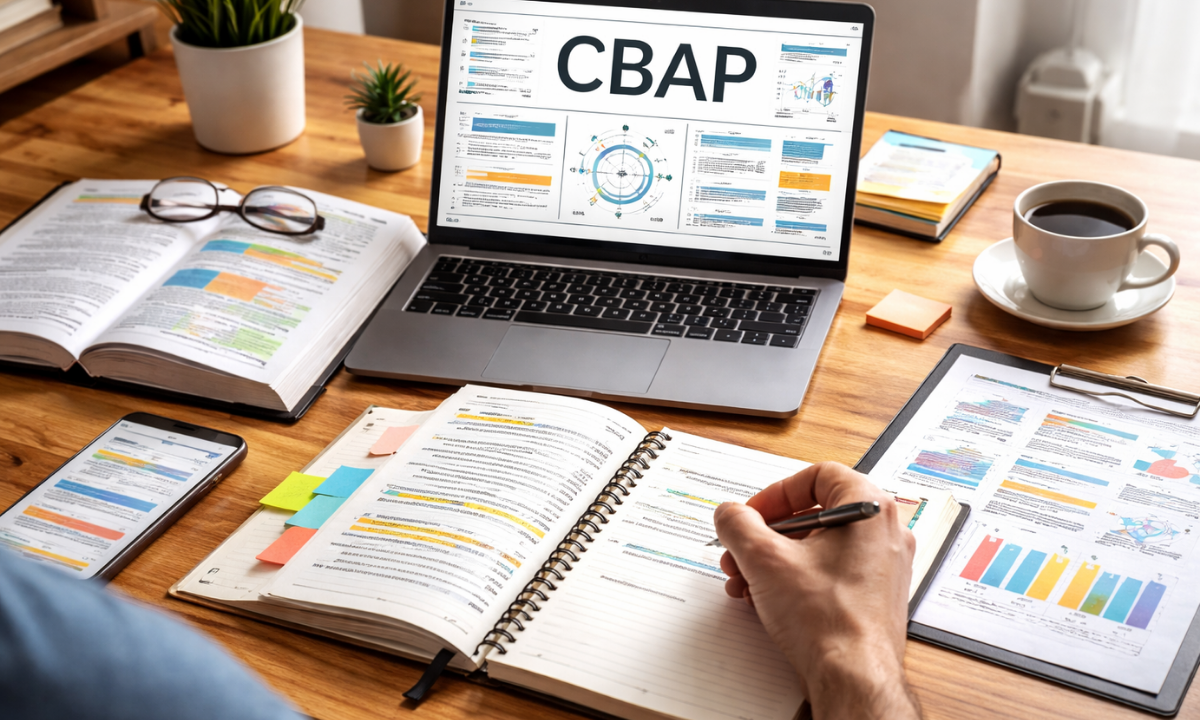
Preparing for the CBAP Business Analyst Certification requires disciplined planning and consistent practice. Since the exam focuses on application rather than memorisation, candidates must build conceptual clarity and strengthen scenario-based reasoning. A structured three-month preparation strategy helps balance theory, practice, and exam readiness effectively.
A structured 3-month approach is recommended:
Month 1
-
Deep BABOK study
-
Concept mapping
-
Knowledge area alignment
Month 2
-
Scenario-based practice
-
Domain revision
-
Weak-area reinforcement
Month 3
-
Full-length mock exams
-
Time management strategy
-
Exam simulation
Preparation should focus on practical application, decision-making logic, and structured thinking aligned with the Certified Business Analysis Professional (CBAP) framework.
CBAP vs CCBA vs ECBA
|
Criteria |
ECBA |
CCBA |
CBAP |
|
Level |
Entry |
Intermediate |
Advanced |
|
Experience |
None |
3,750 hours |
7,500 hours |
|
Target |
Beginners |
Working BAs |
Senior professionals |
|
Difficulty |
Basic |
Moderate |
High |
|
Career Impact |
Entry-level |
Skill validation |
Leadership eligibility |
Choose CBAP Certified Business Analysis Professional if:
-
You have 5+ years of experience
-
You target enterprise-level roles
-
You want stronger salary negotiation leverage
-
You aim for consulting or leadership transitions
CBAP Renewal Process
The CBAP Certification remains valid for three years.
To maintain the Certified Business Analysis Professional (CBAP) credential:
-
Earn 60 Continuing Development Units (CDUs)
-
Pay the renewal fee
Continuous professional development is mandatory.
Business Analyst Course In Bangalore for CBAP Aspirants
For professionals based in Bangalore, structured training can enhance preparation for the CBAP Business Analyst Certification.
A reputable Business Analyst Course in Bangalore at Apponix can:
-
Fulfill 35 PD hour requirement
-
Provide BABOK-aligned preparation
-
Offer realistic mock exam simulations
-
Support application documentation
What to Compare
-
Verified PD hours
-
Trainer expertise
-
Mock exam quality
-
Transparent pricing
-
Application guidance support
Choosing the right program can streamline preparation for the Business Analyst Certification CBAP.
Final Thoughts
The Certified Business Analysis Professional (CBAP) credential represents strategic maturity, enterprise-level capability, and leadership readiness.
In a competitive 2026 job market shaped by digital transformation and AI-driven initiatives, the CBAP Certified Business Analysis Professional designation remains one of the most respected credentials in business analysis.
For experienced professionals aiming to move from execution-focused responsibilities into high-impact leadership roles, the Business Analyst Certification CBAP can be a decisive and financially rewarding step.
Frequently Asked Questions
1. What is the eligibility for Certified Business Analysis Professional (CBAP)?
To qualify for the Certified Business Analysis Professional (CBAP), candidates must document 7,500 hours of business analysis experience within the last 10 years, complete 35 hours of professional development training, and provide two professional references.
They must also agree to IIBA’s Code of Conduct. The certification is designed strictly for experienced professionals.
2. What is the CBAP Certification Cost?
The total CBAP Certification cost typically ranges between $1,000 and $2,000. This includes the application fee, exam fee, optional IIBA membership, and training expenses.
Costs vary depending on whether candidates choose self-paced, instructor-led online, or classroom preparation. Membership often reduces exam fees, making it financially beneficial.
3. Is CBAP Business Analyst Certification worth it?
Yes, the CBAP Business Analyst Certification is highly valuable for experienced professionals aiming for senior or leadership roles. It enhances credibility, validates advanced expertise, and strengthens global recognition.
The certification often improves salary prospects and positions professionals for enterprise-level responsibilities in consulting, digital transformation, and strategic business analysis functions.
4. Is CBAP Certification difficult?
Yes, the CBAP Certification is considered challenging. The exam is scenario-driven and competency-based, requiring strong analytical reasoning rather than memorisation.
Candidates must apply BABOK concepts to complex business situations and select the most appropriate solution. Thorough preparation, practice exams, and domain clarity are essential for success.
5. Can beginners pursue Certified Business Analysis Professional (CBAP)?
No, beginners cannot pursue the Certified Business Analysis Professional (CBAP) credential. The certification requires substantial documented work experience in business analysis.
Entry-level professionals should consider foundational certifications first and gain practical exposure before applying for CBAP, which is intended for mid-to-senior-level analysts.

Apponix Academy
Apponix Academy