POPULAR COURSES
Master Programs




Table of contents:
|
1. The Google Cloud Certification Pathway: From Associate to Professional
|
|
2. Key Job Roles & Specialized Infrastructure Domains
|
|
3. Google Cloud Salary Trends & Compensation Across Indian Tech Hubs
|
|
4. Career Growth, Market Demand, and Hiring Trends in India
|
|
5. Why Choose Apponix Technologies for Google Cloud Training? |
|
6. Conclusion |
As Indian enterprises and Global Capability Centers rapidly accelerate their data modernization and artificial intelligence initiatives, understanding the core Google Cloud certification benefits has become essential for engineers aiming to stay competitive.
Enrolling in an industry-focused Cloud Computing Course in Bangalore equips IT professionals with the verified architecture competencies required to deploy scalable infrastructure, orchestrate microservices, and manage large-scale data pipelines on Google Cloud Platform (GCP).
With India emerging as a critical global hub for cloud analytics and sovereign AI deployments, certified engineers are securing significant advantages in hiring velocity, role specialization, and long-term compensation.
While Amazon Web Services and Microsoft Azure maintain expansive footprints in legacy migrations, Google Cloud has established a distinct technological moat across high-value domains:
-
Serverless Big Data Processing: Tools like BigQuery and Dataflow enable organizations to analyze multi-petabyte datasets in real time without managing complex server infrastructure.
-
Native Container Orchestration: Google Kubernetes Engine (GKE) provides the industry's most advanced automated environment for scaling containerized microservices.
-
Enterprise Generative AI Pipelines: Vertex AI and native Gemini infrastructure empower developers to build, fine-tune, and productionize machine learning agents directly on Google's specialized Tensor Processing Units (TPUs).
Because GCP adoption in India is concentrated within high-complexity data engineering, FinTech, and product-focused development, the market faces a pronounced shortage of certified specialists. This comprehensive guide outlines the certification pathway, core technical roles, regional compensation benchmarks, and career growth strategies needed to establish a high-earning Google Cloud career in India.
The Google Cloud Certification Pathway: From Associate to Professional

Google Cloud structures its credential hierarchy around hands-on operational capability rather than passive conceptual memorization. Earning an accredited GCP certification validates your ability to provision, automate, secure, and troubleshoot production workloads using modern command-line tools (gcloud CLI) and Google Cloud console interfaces.
The certification track spans three progressive tiers, ensuring a clear roadmap from fundamental administration to deep domain specialization:
|
Certification Tier |
Target Credential |
Recommended Experience & Prerequisites |
Core Technical Validation
|
|---|---|---|---|
|
Foundational |
Cloud Digital Leader |
Beginners, product managers, and non-technical stakeholders (No prerequisites). |
Fundamental cloud concepts, shared responsibility models, and cost governance. |
|
Associate (Core Gateway) |
Associate Cloud Engineer (ACE) |
6+ months of hands-on Google Cloud console and CLI experience. |
Deploying applications, monitoring operations, managing IAM permissions, and configuring networks. |
|
Professional (Architecture) |
Professional Cloud Architect (PCA) |
3+ years of industry IT experience with 1+ years managing GCP environments. |
Designing dynamic, highly available, secure, and compliant multi-region cloud architectures. |
|
Professional (Data & AI) |
Professional Data Engineer (PDE) |
3+ years in data engineering with 1+ years building GCP data pipelines. |
Building scalable data processing systems, BigQuery pipelines, and operationalizing ML models. |
|
Professional (Operations) |
Professional Cloud DevOps Engineer |
3+ years in software engineering/DevOps with 1+ years on GCP. |
Implementing CI/CD pipelines, site reliability engineering (SRE) practices, and GKE cluster management. |
|
Professional (Security) |
Professional Cloud Security Engineer |
3+ years in enterprise IT security with 1+ years on GCP. |
Configuring perimeter security, Cloud Armor, identity federation, and Zero-Trust access policies. |
Navigating the Progression: Associate vs. Professional
For technical engineers, the Associate Cloud Engineer (ACE) credential serves as the essential baseline. It confirms your ability to execute day-to-day infrastructure tasks: spinning up Google Compute Engine instances, managing Google Cloud Storage buckets, partitioning VPC networks, and maintaining basic Google Kubernetes Engine (GKE) clusters.
Once the operational core is mastered, advancing to the Professional Tier allows engineers to specialize in high-yield domains. Professional exams evaluate your capacity to translate complex business requirements into resilient, fault-tolerant infrastructure, making these credentials a key hiring benchmark across enterprise technical screening rounds.
Key Job Roles & Specialized Infrastructure Domains
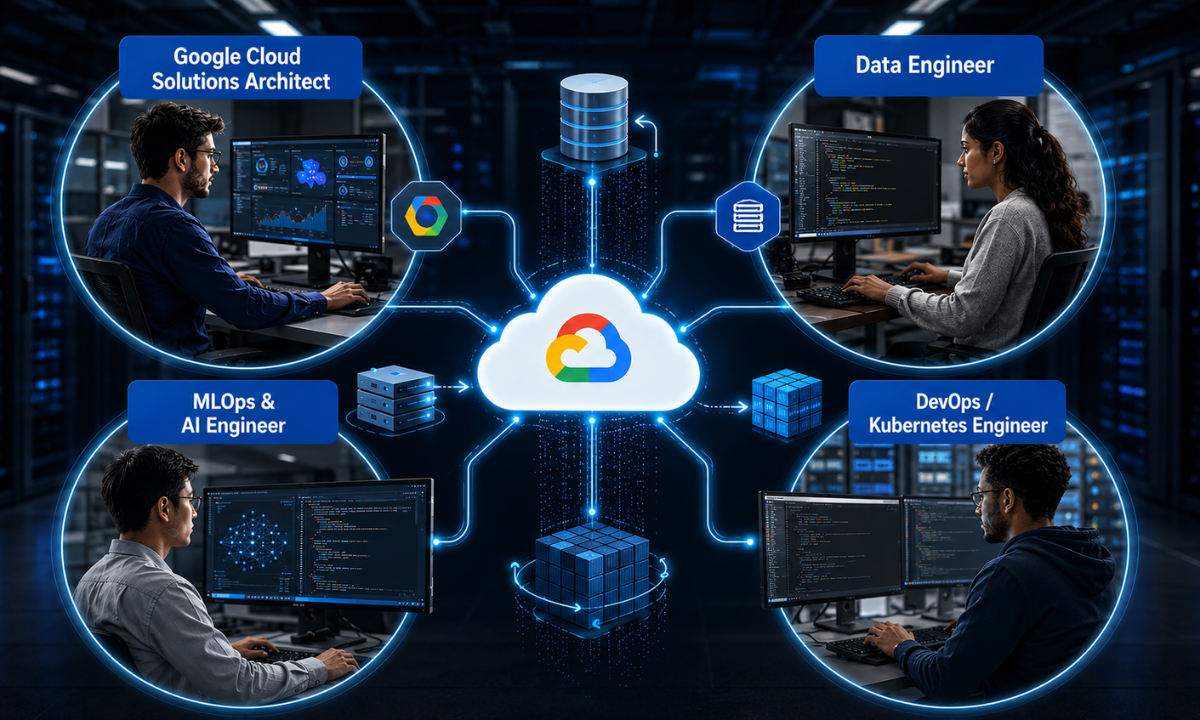
Enterprise hiring managers across India’s primary technology centers are moving away from hiring generalized IT administrators in favor of domain-focused cloud engineers.
Enrolling in a hands-on Google Cloud course in Bangalore engineering candidates rely on bridges the gap between basic console navigation and mastering the specialized infrastructure stacks demanded by tier-1 product firms and Global Capability Centers (GCCs).
1. Google Cloud Solutions Architect
Enterprise Cloud Architects design resilient, highly available multi-region infrastructures that balance high compute performance with cost efficiency.
-
Multi-Region Disaster Recovery: Architecting active-passive and active-active failover topologies across international GCP regions using Cloud Load Balancing and Cloud Spanner.
-
Infrastructure as Code Governance: Implementing declarative infrastructure templates via Terraform to enforce security baselines, tag allocations, and automated deployment boundaries.
-
Enterprise Hybrid Interconnect: Designing dedicated Cloud Interconnect connections to link on-premises enterprise data centers with Google’s software-defined private network.
Architects operating in this capacity serve as the technical bridge between executive business roadmaps and day-to-day engineering execution, ensuring that systems scale securely without budget overruns.
2. GCP Data Engineer & Analytics Specialist
Data engineering represents the highest-volume hiring segment within the Google Cloud ecosystem, driven by enterprise migration toward serverless streaming pipelines and real-time business intelligence.
-
Streaming & Batch Ingestion: Building low-latency ingestion pipelines using Google Cloud Pub/Sub and Apache Beam on Cloud Dataflow to process high-velocity financial and IoT telemetry.
-
Data Lakehouse Architecture: Structuring enterprise data warehouses in BigQuery, implementing column-level encryption, partition filtering, and automated clustering for petabyte-scale queries.
-
Workflow Orchestration: Managing complex data transformation workflows using Cloud Composer (managed Apache Airflow) and Google Dataform.
Engineers in this discipline ensure that raw organizational data is cleaned, validated, and instantly accessible to analytics platforms and machine learning models across the company.
3. MLOps & AI Infrastructure Engineer
With generative AI models becoming central to enterprise applications, MLOps engineers build the compute infrastructure needed to train, fine-tune, and deploy models at scale.
-
Model Lifecycle Automation: Constructing automated machine learning pipelines with Vertex AI Pipelines to track dataset lineage, hyperparameters, and model versioning.
-
Hardware Acceleration Tuning: Allocating and optimizing custom Cloud TPU v5e/v5p pods and NVIDIA GPU clusters to accelerate training workloads while monitoring compute spend.
-
Model Serving & Latency Optimization: Deploying foundation models behind secure REST and gRPC endpoints with automated horizontal pod autoscaling.
By uniting traditional site reliability engineering with data science workflows, AI platform engineers keep production inference reliable, fast, and secure.
4. Cloud DevOps & Kubernetes Platform Engineer
Platform engineers focus on developer velocity, operational uptime, and container lifecycle governance using Google’s native container ecosystems.
-
Automated GKE Cluster Management: Provisioning and maintaining Google Kubernetes Engine (GKE) clusters in Autopilot mode to offload node management and patching.
-
Continuous Deployment Pipelines: Building GitOps-driven CI/CD delivery pipelines using Cloud Build, Artifact Registry, and ArgoCD.
-
Observability & Telemetry: Establishing monitoring thresholds, distributed tracing, and automated alert policies using Google Cloud Observability (formerly Stackdriver).
Platform engineers ensure software development teams can deploy code changes multiple times a day without risking production outages or violating enterprise compliance boundaries.
Google Cloud Salary Trends & Compensation Across Indian Tech Hubs

The compensation structure for cloud professionals in India reflects a clear supply-and-demand imbalance. While there is an abundance of basic system administrators, certified engineers who possess advanced capabilities in BigQuery optimization, Vertex AI deployments, and Kubernetes orchestration remain scarce.
Consequently, embarking on a Google Cloud career positions engineers to command noticeable compensation premiums compared to more saturated infrastructure domains.
Comprehensive GCP Salary Benchmarks in India
|
Experience Tier |
Relevant Credentials & Job Titles |
Benchmark CTC Range (INR per annum) |
Primary Value Drivers
|
|---|---|---|---|
|
Fresher / Junior (0 – 2 Years) |
Associate Cloud Engineer, Junior Cloud Admin |
₹5.0 LPA – ₹9.0 LPA |
IAM administration, basic Compute Engine sizing, VPC networking, Cloud Storage lifecycles. |
|
Mid-Level Engineer (3 – 6 Years) |
GCP Data Engineer, Cloud DevOps Specialist |
₹10.5 LPA – ₹20.0 LPA |
Terraform-based IaC provisioning, GKE cluster operations, BigQuery SQL tuning, Cloud Pub/Sub pipelines. |
|
Senior Engineer (7 – 10 Years) |
Senior Cloud Architect, MLOps Infrastructure Lead |
₹22.0 LPA – ₹38.0 LPA |
Multi-region disaster recovery, Vertex AI model serving, Zero-Trust network security, Cloud Armor. |
|
Principal / Enterprise Lead (10+ Years) |
Enterprise Cloud Director, Chief Architect |
₹40.0 LPA – ₹65.0 LPA+ |
Multi-cloud cost governance, legacy enterprise migrations, executive technical roadmapping, FinOps leadership. |
Factors Influencing Indian Tech Corridor Packages
-
Global Capability Centers (GCCs) vs. Traditional IT Services: Multinational GCCs in Bengaluru, Hyderabad, and Pune typically offer compensation packages that are 35% to 55% higher than conventional IT services firms for candidates demonstrating hands-on scripting and pipeline automation.
-
Specialization in Data & AI Infrastructure: Data engineers and MLOps professionals building on Vertex AI and BigQuery routinely command upper-quartile pay brackets due to the intense enterprise push toward real-time analytics and generative AI integration.
-
Verified Code Contributions & GitHub Proof-of-Work: Candidates who bring documented Terraform modules, automated deployment scripts, and architecture blueprints to technical interviews consistently secure higher starting offers during compensation negotiations.
These salary trends highlight that building production-level engineering competence directly translates into strong financial outcomes, particularly within high-growth Indian technology corridors where enterprise cloud adoption continues to accelerate.
Career Growth, Market Demand, and Hiring Trends in India
The Indian IT sector is undergoing a structural shift from traditional maintenance operations to high-value product engineering, sovereign AI deployments, and data modernization.
As enterprises across banking, e-commerce, and healthcare migrate legacy data warehouses to serverless cloud environments, the overall volume of cloud jobs India offers continues to expand rapidly across tier-1 and tier-2 technology corridors.
Core Drivers Fueling Google Cloud Hiring
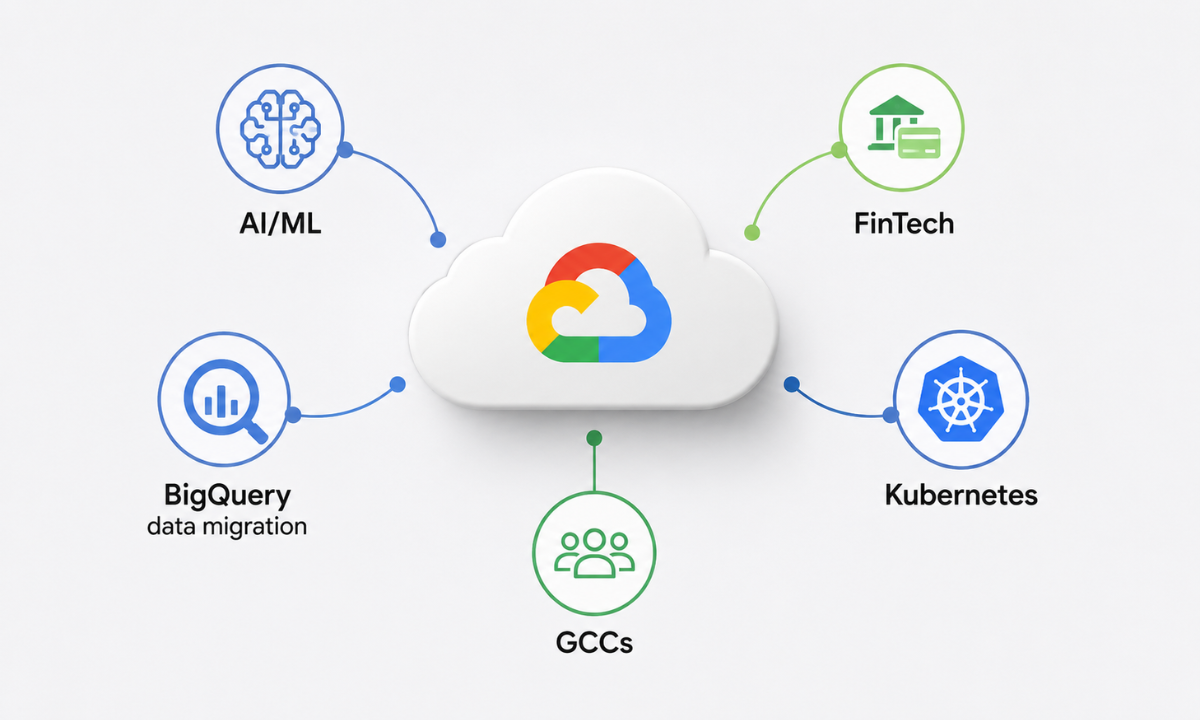
The demand for certified Google Cloud specialists is propelled by four distinct architectural shifts across the Indian enterprise landscape:
-
Accelerated Generative AI & MLOps Adoption: With enterprises operationalizing foundation models for customer intelligence and automated code generation, organizations are investing heavily in GCP’s Vertex AI and custom TPU infrastructure. Companies require engineers who can build low-latency inference endpoints, automate model retraining pipelines, and manage GPU clusters cost-effectively.
-
Legacy Data Warehouse Migration: Legacy on-premises appliances and older relational systems are rapidly being retired in favor of Google BigQuery. Organizations seek specialists capable of designing serverless data lakehouses that handle petabyte-scale real-time SQL analytics without physical database administration overhead.
-
Expansion of Global Capability Centers (GCCs): Over 2,100 GCCs operating in Bengaluru, Hyderabad, and Pune are transitioning from offshore support centers into strategic innovation hubs. These centers actively recruit GCP architects and data engineers to manage global analytics platforms and microservice backbones.
-
FinTech & BFSI Regulatory Modernization: Indian financial institutions and digital payments platforms are building hybrid-cloud architectures on GCP to comply with Reserve Bank of India (RBI) data localization mandates while leveraging Google Cloud Armor and Chronicle for advanced threat detection.
These market drivers ensure that infrastructure engineers who possess specialized skills in containerization, data pipelines, and security governance remain insulated from routine hiring slowdowns and general IT commoditization.
Strategic Career Trajectory: The 5-Year Growth Pat
Progressing along this timeline requires consistent upskilling: moving from foundational compute management to declarative Infrastructure as Code, then advancing to multi-region system design and corporate cost governance.
Why Choose Apponix Technologies for Google Cloud Training?
Mastering Google Cloud Platform requires moving beyond theoretical exam preparation and working directly with enterprise-grade infrastructure. Apponix Technologies provides an immersive, instructor-led training model designed specifically to help engineers build verifiable skills on live Google Cloud environments.
Guided by senior industry practitioners working at leading multinational corporations, learners transition from fundamental console navigation to architecting distributed data pipelines, scaling microservices, and automating infrastructure deployments.
-
40+ Hours of Applied Sandbox Labs: Build production-grade architectures inside dedicated cloud sandboxes, gaining practical experience in configuring VPC networks, IAM governance, Compute Engine instances, and Cloud Storage lifecycles.
-
BigQuery & Kubernetes Capstone Projects: Design end-to-end data pipelines using Cloud Dataflow and BigQuery alongside deploying auto-scaling container workloads on Google Kubernetes Engine (GKE).
-
1-on-1 Code & Architecture Mentorship: Receive personalized feedback on your Terraform scripts and system design diagrams from working enterprise cloud specialists.
-
Targeted Resume Engineering & Portfolio Building: Transform lab exercises into documented GitHub repositories with comprehensive architectural diagrams, helping you stand out during corporate technical screenings.
-
Direct Placement Assistance Across Major Tech Corridors: Leverage an established recruitment network connected to Global Capability Centers (GCCs), product firms, and premier IT consulting enterprises across Karnataka and India.
Pairing rigorous lab practice with dedicated mentorship and recruitment support, Apponix Technologies equips infrastructure professionals with the verified proof-of-work required to step confidently into high-demand enterprise engineering roles.
Conclusion
The rapid expansion of artificial intelligence, serverless big data analytics, and modern container orchestration has cemented Google Cloud as an essential platform for enterprise digital transformation. As organizations across India modernize legacy data warehouses and deploy generative AI applications, the demand for specialized cloud engineers will continue to outpace available market supply.
Navigating this expanding landscape requires a deliberate commitment to practical, code-first engineering. By mastering Linux and networking fundamentals, gaining hands-on proficiency across core services like BigQuery and Google Kubernetes Engine, and validating your skills through industry-recognized credentials, you establish a solid foundation for long-term career growth.
Backing your technical abilities with documented GitHub repositories and real-world implementation experience ensures that you capture the attention of hiring managers at top-tier product firms and Global Capability Centers. With structured learning, consistent lab execution, and experienced mentorship, you can confidently build a high-impact trajectory at the forefront of modern infrastructure technology.
Reference:
https://www.coursera.org/in/articles/google-cloud-certification
https://support.google.com/cloud-certification/answer/9750149?hl=en

Apponix Academy
Apponix Academy