POPULAR COURSES
Master Programs



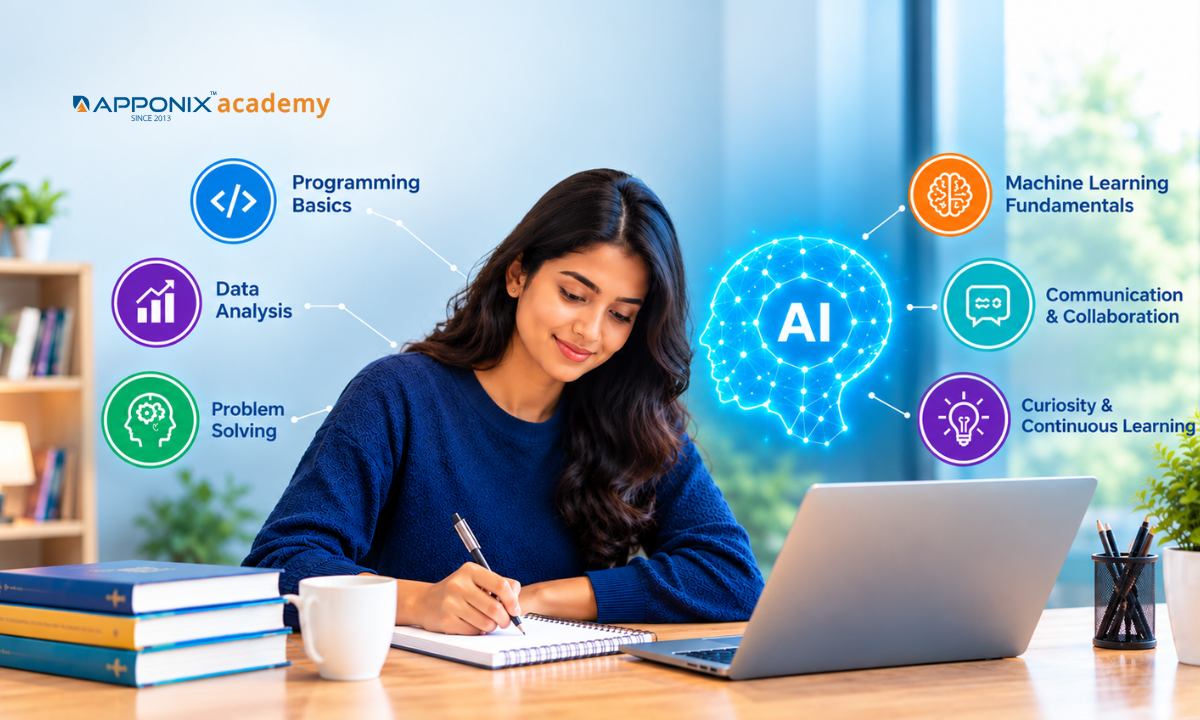
Table of contents:
|
1. Why Build Artificial Intelligence Skills Before You Enroll?
|
| 2. AI Learning Prerequisites at a Glance |
| 3. Common Mistakes Beginners Should Avoid |
| 4. Career Opportunities After Building These Skills |
| 5. Why Choose Apponix Academy for Your AI Journey? |
| 6. Frequently Asked Questions |
Artificial intelligence is now part of everyday business, from chatbots and recommendation engines to fraud detection and self-learning software. If you are planning to join an AI Course in Bangalore, it helps to know which artificial intelligence skills to build first. Learners who prepare in advance understand concepts faster, finish projects with confidence and perform better in interviews.
This guide covers the AI skills for beginners, the skills required for artificial intelligence roles and the AI learning prerequisites that will make your training count.
Why Build Artificial Intelligence Skills Before You Enroll?
Many beginners assume AI is only for people with a computer science degree. That is not true. Graduates from commerce, science, arts and engineering backgrounds enter AI every year. What separates successful learners is preparation.
Building foundational skills first gives you three advantages:
-
Faster learning: You spend class time on advanced topics instead of catching up on basics.
-
Better project quality: Hands-on work becomes easier when you already understand data and logic.
-
Higher confidence: You can follow the trainer, ask better questions and solve problems independently.
Think of it like learning to drive. You can start without knowing the engine, but understanding the basics makes you safer and more skilled on the road.
1. Mathematics Fundamentals
Mathematics is the language of AI. You do not need to be a mathematician, but you should be comfortable with these four areas.
Linear algebra. Vectors, matrices and operations on them sit behind how models process data. Images, text and numbers are all converted into matrices before an algorithm can learn from them.
Statistics and probability. AI models make predictions, and predictions involve uncertainty. Concepts like mean, median, standard deviation, distributions and probability help you interpret model output correctly.
Calculus basics. Derivatives and gradients explain how a neural network improves itself during training. A conceptual understanding is enough to begin with.
Discrete mathematics. Logic, sets and graphs are useful for problem solving, search algorithms and recommendation systems.
Tip for beginners: Revisit school-level algebra and statistics first. Free video lessons and practice sets can fill gaps within a few weeks.
2. Programming Skills, Especially Python
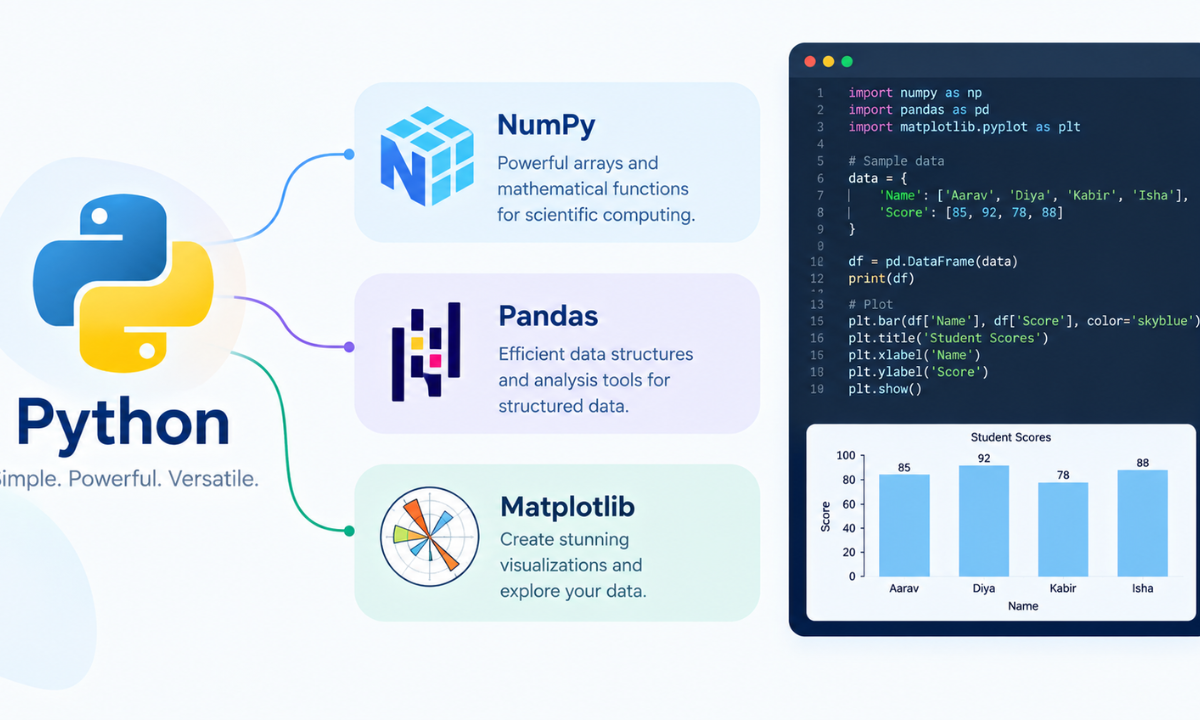
Among all artificial intelligence skills, programming is the one that pays off most visibly. Python is the most widely used language in AI because it is readable, beginner friendly and supported by powerful libraries.
Before joining a course, aim to learn:
-
Variables, data types and operators
-
Loops and conditional statements
-
Functions and modules
-
Lists, dictionaries, tuples and sets
-
File handling and error handling
-
Basics of object-oriented programming
Once these feel comfortable, explore libraries such as NumPy for numerical work, Pandas for data handling and Matplotlib for visualization. If you want structured guidance, the Python programming course at Apponix Academy is a practical starting point for AI aspirants.
3. Data Handling and Analysis
AI runs on data. A model is only as good as the data used to train it, so professionals spend a large share of their time collecting, cleaning and understanding data.
Key skills to develop:
-
Data cleaning: Handling missing values, duplicates and inconsistent formats.
-
Exploratory data analysis: Finding patterns, trends and outliers.
-
Data visualization: Presenting insights through charts and dashboards.
-
Basic SQL: Retrieving and filtering data from databases.
If you enjoy working with numbers and insights, a Data Analytics training program can strengthen this layer. Tools such as Excel, Power BI and Tableau are also valuable additions to your toolkit. You can explore the Tableau and Data Visualization course to learn how to turn raw data into clear business stories.
4. Understanding Machine Learning Concepts
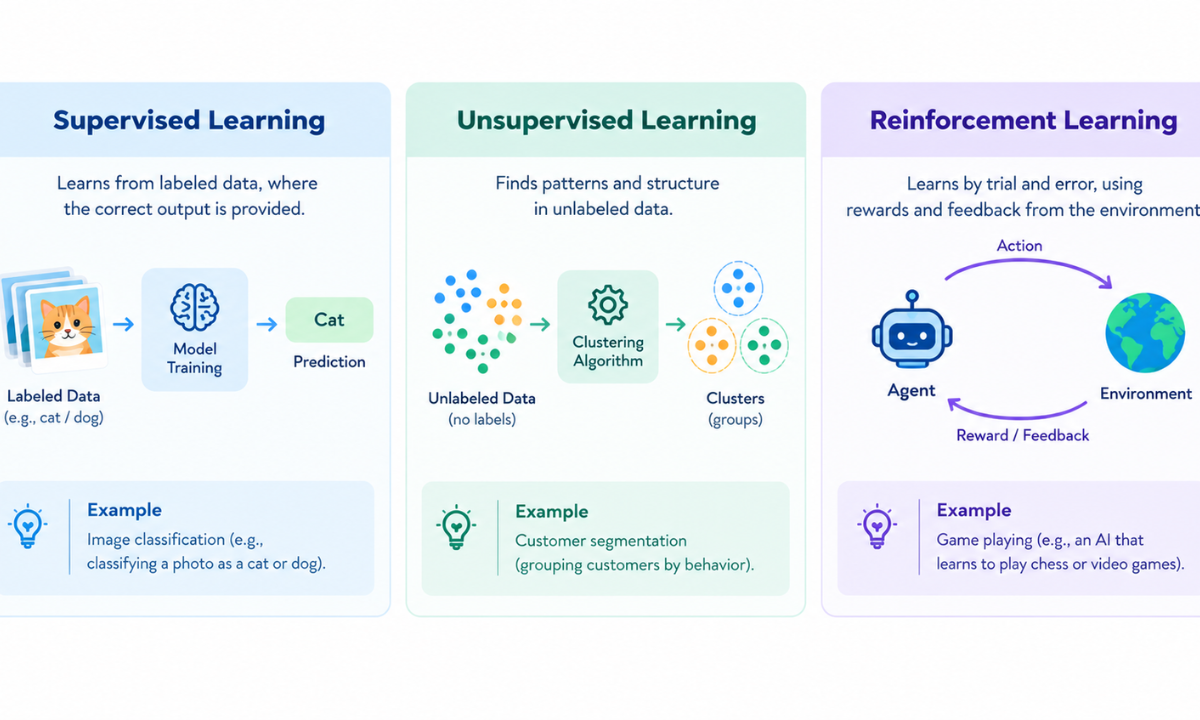
Machine learning is the engine of modern AI. Before you start a formal program, get familiar with the core ideas so that classroom explanations feel familiar.
Types of machine learning:
-
Supervised learning: The model learns from labeled examples, such as predicting house prices.
-
Unsupervised learning: The model finds hidden patterns in unlabeled data, such as customer segmentation.
-
Reinforcement learning: The model learns by trial and reward, as used in robotics and game playing.
Key terms to know: training data, testing data, features, labels, overfitting, underfitting, accuracy and model evaluation.
A dedicated Machine Learning course will take you deeper into algorithms such as regression, decision trees, clustering and neural networks.
5. Logical Thinking and Problem Solving
Technical tools change quickly, but strong reasoning stays valuable. AI professionals break large, vague problems into small, testable steps.
You can build this skill by:
-
Solving logic puzzles and aptitude questions
-
Practicing coding challenges on beginner platforms
-
Writing pseudocode before writing actual code
-
Explaining your solution aloud as if teaching someone else
Interviewers for AI roles often test how you think, not only what you know. A candidate who explains reasoning clearly stands out.
6. Knowledge of Data Science Fundamentals
Data science and AI overlap heavily. Data science focuses on extracting insight from data, while AI focuses on building systems that act intelligently. Understanding both gives you a wider career range.
Learn how the data science workflow runs: problem definition, data collection, cleaning, modeling, evaluation and deployment. If you want a complete, career-focused path, the Data Science with Python course and the Master Program in Data Science at Apponix Academy cover this journey with practical projects.
7. Awareness of Generative AI and Modern Tools
Generative AI has changed how people write, design, code and research. Tools that create text, images and code are now part of many job descriptions.
As a beginner, you should:
-
Understand what large language models are at a high level
-
Learn the basics of prompt writing
-
Explore how AI assistants support daily tasks
-
Know the limits, risks and ethical concerns of AI output
To go beyond curiosity and build real skills, look at the Generative AI course, which introduces you to modern AI workflows used in industry.
8. Basic Cloud and Deployment Awareness
Building a model is only half the job. Companies need models running reliably for real users, and that usually happens on the cloud. Beginners do not need to be experts, but a basic understanding of cloud platforms, APIs and version control (such as Git) will help you later.
If this area interests you, the Cloud Computing training can help you understand how AI applications are hosted and scaled.
9. Communication and Business Understanding
Many learners overlook this one. AI professionals work with managers, clients, designers and developers. You must be able to explain a technical result in simple language and connect it to a business goal.
Practice these habits:
-
Summarize a technical topic in three simple sentences
-
Write short reports explaining your findings
-
Ask clarifying questions about the problem before coding
-
Present your small projects to friends or peers
Strong communication improves your interview performance and helps you grow into leadership roles.
10. Curiosity and Continuous Learning
AI evolves rapidly. A tool that is popular today may be replaced within two years. The most employable people are those who keep learning. Follow reputable AI news, read blogs, join community groups and build small projects regularly. Visit the Apponix blog for more career guidance and technology updates.
AI Learning Prerequisites at a Glance
|
Skill Area |
What to Learn |
Priority for Beginners |
|
Mathematics |
Linear algebra, statistics, probability |
High |
|
Programming |
Python, NumPy, Pandas |
High |
|
Data handling |
Cleaning, analysis, SQL |
High |
|
Machine learning basics |
Supervised and unsupervised learning |
Medium |
|
Problem solving |
Logic, algorithms |
High |
|
Generative AI awareness |
Prompting, LLM basics |
Medium |
|
Cloud basics |
APIs, Git, hosting |
Low to Medium |
|
Communication |
Reporting, presenting |
Medium |
A Simple 90-Day Roadmap for Beginners
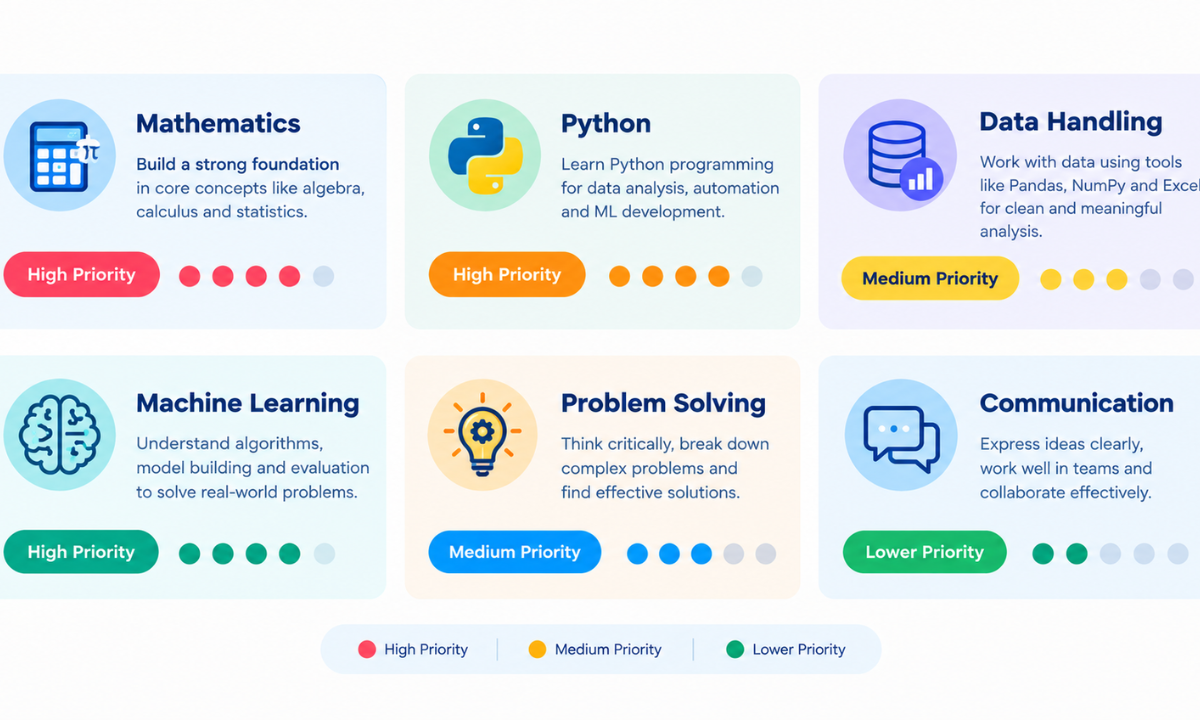
Days 1 to 30: Learn Python basics, refresh school-level mathematics and practice small programs every day.
Days 31 to 60: Study statistics, work with NumPy and Pandas, and complete one small data analysis project using a public dataset.
Days 61 to 90: Learn core machine learning ideas, explore a few generative AI tools and prepare a simple portfolio project.
By the end of this period, you will be ready to get the most out of professional training.
Common Mistakes Beginners Should Avoid
-
Skipping the basics: Jumping straight into deep learning without Python or statistics leads to confusion.
-
Only watching tutorials: Passive learning is not enough. Build projects.
-
Ignoring data quality: Clean data matters more than complex algorithms.
-
Collecting certificates without skills: Employers look for practical ability and project work.
-
Learning without guidance: An experienced mentor saves months of trial and error.
Career Opportunities After Building These Skills
Once you have the right foundation and complete professional training, several roles open up:
-
AI Engineer
-
Machine Learning Engineer
-
Data Scientist
-
Data Analyst
-
Business Intelligence Analyst
-
Generative AI Specialist
-
NLP Engineer
-
AI Product Associate
Bangalore, often called the technology capital of India, hosts startups, global product companies and research centers that continuously hire AI talent. This makes the city one of the best places to learn and start your career.
Why Choose Apponix Academy for Your AI Journey?
Choosing the right institute shapes how quickly you grow. Apponix Academy, established in 2013, is recognized as a leading name and a No 1 training institute in Bangalore for job-oriented technology programs. Here is what learners value:
-
Expert trainers: Instructors are working professionals with 10 or more years of industry experience, and Apponix has trained more than 50,000 learners.
-
100% practical learning: Every program includes industry-based scenarios and hands-on projects.
-
Flexible batches: Classes run from 7:00 AM to 9:00 PM, with classroom and online options to suit students and working professionals.
-
Lab access: Learners can access labs for most courses from anywhere.
-
Placement assistance: Resume support, interview preparation and tie-ups with recruitment partners help you take the next step. See the Apponix placements page for recent success stories.
-
Affordable fees: Programs are designed to be accessible for students and fresh graduates.
If you want to speed up your career move, explore the job oriented courses designed to make you industry ready. Whether you are a fresher, a graduate or a working professional looking to switch fields, an AI Course in Bangalore from Apponix gives you structured guidance, mentorship and real project exposure in one place.
Frequently Asked Questions
Do I need a coding background to learn AI?
No. Many successful AI professionals started from scratch. Learning Python basics before or during your course is enough to begin.
How much mathematics is required for AI?
You need a working understanding of linear algebra, probability, statistics and basic calculus. Deep theoretical knowledge can come later.
How long does it take to build the prerequisites?
Most beginners can build a strong foundation in two to three months with consistent practice.
Can working professionals join an AI program?
Yes. Flexible batch timings and online options make it possible to learn alongside a job.
What is the best way to choose an institute?
Look at trainer experience, practical content, project work, placement support and student feedback before enrolling.
Final Thoughts
Entering artificial intelligence is less about being a genius and more about building the right foundation step by step. Focus on mathematics, Python, data skills, machine learning basics, problem solving and communication. Add curiosity and consistent practice, and you will be well prepared for professional training and real-world roles.
When you are ready to turn preparation into a career, join an AI Course in Bangalore at Apponix Academy and learn from industry experts through hands-on, placement-focused training.
Reference:
https://machine-learning-made-simple.medium.com/how-to-develop-the-most-important-skill-required-for-ai-60d33f4d04cc

Apponix Academy
Apponix Academy