POPULAR COURSES
Master Programs



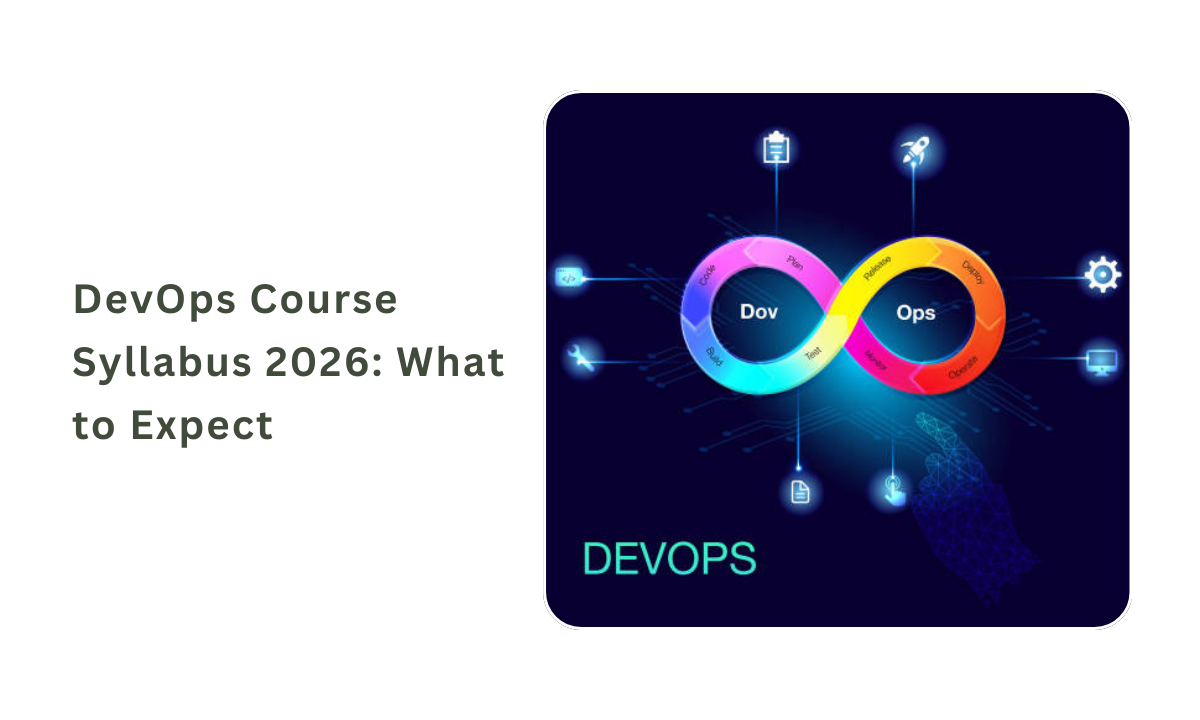
Table of contents:
|
1. Fundamentals and Culture |
|
2. Version Control |
|
3. Containers |
|
4. Orchestration |
|
5. Cloud Basics |
|
6. Infrastructure as Code |
|
7. Monitoring and Logging |
|
8. Security |
|
9. Why Choose a DevOps Course in Bangalore |
|
10. Wrapping Up |
|
11. FAQs |
As a trainer at Apponix, I’m excited to walk you through a comprehensive guide on what our DevOps course syllabus looks like for 2026.
Suppose you are considering a DevOps course in Bangalore and exploring training options. In that case, this breakdown will help you understand what to expect and how each module ties into industry-ready skills.
1. Fundamentals and Culture
The journey begins with building a strong foundation. In this module, we cover:
-
Understanding what DevOps really means, its origins, objectives and the value it brings. This aligns with the DevOps mindset of accelerating delivery, improving quality and enhancing collaboration.
-
The shift from traditional silos (development vs operations) to the integrated culture of DevOps.
-
Key cultural elements: communication, collaboration, continuous feedback loops, shared responsibility, and breaking down walls.
-
The “three ways” of DevOps: flow, feedback, and continual learning, are core to the full DevOps lifecycle.
-
The reason we emphasise culture first: technology is important, but if you don’t change how teams operate, you won’t truly realise the benefits of DevOps.
By the end of this section, you’ll have clarity on why DevOps rather than just what. That sets the tone for the rest of the syllabus.
2. Version Control
Next up in our DevOps syllabus is version control – the backbone of any modern software delivery practice. Key elements:
-
Introduction to version control systems: primarily Git. Learning how repositories work and how commits, branching, and merging operate.
-
Advanced Git workflows: branch strategies (feature, release, hotfix), pull requests, rebase vs merge, tagging and versioning.
-
Collaboration platforms: GitHub, GitLab, Bitbucket, and how these relate to DevOps pipelines and governance.
-
Integrating version control with CI/CD pipelines and how version control acts as the single source of truth for code and infrastructure definitions.
In short, you will become comfortable not just with versioning code but also with managing change in a way that supports continuous delivery and operations stability.
3. Containers
Moving up the stack, the next important topic in our DevOps curriculum is containers. This part is extremely relevant for 2026 and beyond because containerisation underpins agility and scalability. We cover:
-
What containers are (Docker as the standard), how they differ from traditional VMs, and why they matter.
-
Building and managing container images: Dockerfiles, registries, tagging, and versioning containers.
-
Best practices for container design: microservices architecture, decoupled components, and immutable infrastructure.
-
Hands-on labs in containerising sample applications, understanding how containers enable portability across environments.
By mastering containers, you lay the groundwork for the next module: orchestration.
4. Orchestration
The orchestration piece in the syllabus ties everything together. After containers, you need automated mechanisms to manage them at scale. In this section, we cover:
-
Introduction to container orchestration platforms: notably Kubernetes (K8S). Understanding pods, services, deployments, nodes, and clusters.
-
Scheduling, scaling, self-healing, rolling updates/rollbacks.
-
Integration of orchestration with CI/CD pipelines and monitoring.
-
Use cases and architecture patterns: stateful vs stateless services, multi-cluster, and hybrid/cloud-native deployments.
-
Practicals: setting up a Kubernetes cluster, deploying apps, using Helm charts, setting up autoscaling, and observing behaviour in production-like scenarios.
This is a core skill for any modern DevOps engineer and forms a significant part of our DevOps course syllabus for 2026.
5. Cloud Basics
A strong DevOps syllabus cannot skip the cloud. In our training, we equip you with cloud fundamentals so you can deliver modern applications that run on cloud platforms and leverage cloud services. Topics include:
-
Understanding public clouds (AWS, Azure, GCP) and private/hybrid cloud models.
-
Core cloud services: compute (VMs/containers), storage, networking, IAM (Identity and Access Management), and serverless basics.
-
How DevOps practices map to the cloud: autoscaling, infrastructure as a service, managed services, and cost optimisation.
-
Hands-on labs: provisioning cloud resources, deploying containerised apps to the cloud, monitoring cost/performance, and using cloud-native DevOps tools.
In short, you gain both the conceptual and practical fluency to execute DevOps in a cloud context.
6. Infrastructure as Code
No modern DevOps syllabus is complete without Infrastructure as Code (IaC). Here, we ensure you can define, provision, and manage infrastructure in a declarative, automated way. The module covers:
-
What IaC means and why it matters: repeatability, consistency, and versioning infrastructure alongside code.
-
Tools such as Terraform, Ansible, and AWS CloudFormation (or equivalents) – how to write code (HCL, YAML) to define infrastructure, configuration, and deployments.
-
How IaC integrates with CI/CD pipelines and orchestration environments.
-
Practicals: designing infrastructure blueprints, deploying stacks, versioning infrastructure, managing drift, and rollback strategies.
-
Concepts of immutable infrastructure, composable infrastructure modules, managing environments (dev/test/prod), and using modules/workspaces for reuse.
This module is critical: it turns infrastructure from manual tasks into code-enabled operations, aligning with DevOps goals of automation and agility.
7. Monitoring and Logging
After deploying your applications and infrastructure, you need visibility. In our DevOps syllabus, we emphasise monitoring and logging that enable feedback loops and operational excellence. Key topics:
-
Why monitoring matters in DevOps: metrics, alerts, dashboards, and SRE (Site Reliability Engineering) practices.
-
Tools and platforms: Prometheus, Grafana, ELK/EFK stack (Elasticsearch/Fluentd/Kibana), and cloud-native monitoring services.
-
Logging strategies: structured logs, log aggregation, analysing logs to detect patterns, troubleshooting issues, and driving ML/AI insights.
-
Setting SLA/SLI/SLO metrics, incident management, root cause analysis, and feedback into the development cycle.
-
Hands-on labs: instrumenting applications, capturing metrics, creating dashboards, setting alerts, and responding to incidents in a simulated environment.
This part is essential because DevOps isn’t just about delivery; it’s also about maintaining reliability, improving velocity and enabling teams to learn from failures.
8. Security
Finally, in our 2026-ready DevOps course syllabus, we cover security – often referred to as DevSecOps. Security is integrated, not bolted on. Topics include:
-
The shift from separate security teams to integrated DevOps teams: “shift left” security.
-
Secure coding practices, static/dynamic code analysis, vulnerability scanning, container security, and image scanning.
-
Infrastructure security: secrets management, IAM, network policies, encryption, compliance, audit trails.
-
Pipeline security: securing CI/CD workflows, access controls, automated security gates, and policy-as-code.
-
Incident response, secure logging, security monitoring, and continuous improvement of the security posture.
By the end of this module, you’ll understand how security fits into every phase of the DevOps lifecycle and how a trained DevOps team can deliver secure software without sacrificing speed.
Why Choose a DevOps Course in Bangalore
If you are searching for “DevOps Course in Bangalore”, here are the advantages we bring to our training institute in Bangalore:
-
You get access to real-world labs and local instructor-led sessions that cater to Indian enterprise use cases.
-
We integrate the full syllabus above, aligned with global standards but contextualised for regional industries.
-
Networking opportunities with peers and recruiters in the Bangalore ecosystem, giving you an edge when you complete the training.
-
Our placements and support help you move from learning to applying: in Bangalore’s rich tech marketplace, DevOps skills are in high demand.
Wrapping Up
In summary, our DevOps course syllabus for 2026 is thoughtfully structured to cover fundamentals and culture, version control, containers, orchestration, cloud basics, infrastructure as code, monitoring and logging, and security.
Each module builds on the previous, taking you from foundational mindset shifts right through to advanced toolchains and practices. If you choose to pursue the best DevOps course in Bangalore, making sure the syllabus aligns with this roadmap will prepare you for the real-world demands of DevOps engineering.
In my role as trainer at Apponix Training Institute in Bangalore, I have seen how students who engage with this structure are far better placed to succeed and to evolve with this rapidly changing domain.
FAQs
Q1: How Long Does The Full DevOps syllabus take to complete?
It typically depends on the format (full-time vs part-time). A well-structured course may range from 8 to 16 weeks, including hands-on labs and projects.
Q2: Do I Need Prior Experience Before Starting A DevOps Course?
While some familiarity with software development, operations or scripting helps, many modules begin with fundamentals (especially culture and version control) to bring everyone up to speed.
Q3: Will I Get Practical Hands-On Experience?
Yes. The syllabus emphasises hands-on labs and real-world scenarios, containerizing apps, deploying on cloud, orchestrating with Kubernetes, setting up IaC, and monitoring pipelines.
Q4: Is Security Really Part Of A DevOps Syllabus?
Absolutely. In 2026 and beyond, DevOps cannot ignore security; that’s why DevSecOps and integrated security practices are included in our syllabus.

Apponix Academy
Apponix Academy