POPULAR COURSES
Master Programs



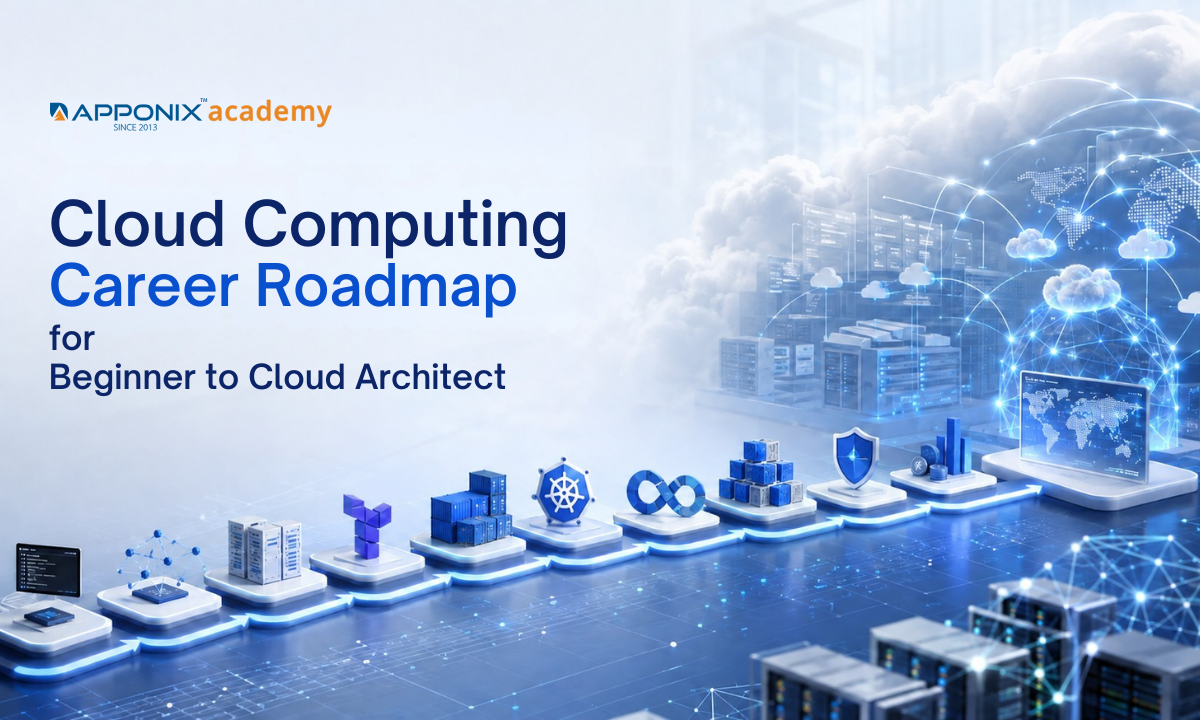
Table of contents:
|
1. Systems Groundwork to Certified Cloud Administrator
|
|
2. Mastering Distributed Systems & Enterprise Solutions Architecture
|
|
3. Compensation Trajectories, Role Hierarchy & Hiring Landscape in India
|
|
4. Why Choose Apponix Technologies for Your Cloud Architect Journey? |
|
5. Conclusion |
Transitioning from an IT novice to an enterprise Solutions Architect is widely recognized as one of the most transformative professional journeys in modern enterprise infrastructure.
Pursuing a structured Cloud Computing Course in Bangalore offers an accelerated gateway to navigate this multi-tiered ecosystem, helping aspiring technologists master systems thinking, infrastructure automation, and governance frameworks that tech leaders demand.
While many aspiring engineers assume architecture is simply an extension of routine system administration, charting a sustainable cloud computing career path requires a deliberate shift from executing tactical commands to designing resilient, multi-region distributed environments.
The distinction between maintaining servers and architecting enterprise platforms involves two distinct operational tiers:
-
Tactical Cloud Engineers: Focus primarily on day-to-day operational mechanics, provisioning virtual compute instances, monitoring block storage, configuring security groups, and troubleshooting broken CI/CD deployment builds.
-
Enterprise Cloud Architects: Design holistic technical ecosystems, evaluate multi-cloud disaster recovery strategies, enforce Zero-Trust identity perimeters, structure microservices communication, and optimize multimillion-dollar compute budgets through FinOps.
Understanding how these engineering layers connect prevents learners from stalling out at intermediate operations roles.
This comprehensive roadmap details the progressive milestones, production toolsets, compensation tiers, and architectural decision patterns necessary to ascend from your very first terminal command to the role of Enterprise Cloud Architect.
Systems Groundwork to Certified Cloud Administrator
Every high-level architectural decision rests upon low-level systems mechanics.
Following a structured cloud skills roadmap ensures you do not skip the fundamental operating system and networking concepts that determine how virtualized infrastructure functions under production workloads.
Phase 1: Operating Systems, Networking & Shell Automation (Months 1-2)
Before interacting with vendor consoles or managed cloud platforms, engineers must gain complete command over headless terminal environments and internet protocol routing.
-
Headless Linux Administration: Navigating file systems without a graphical interface, managing user privileges with sudo and chmod, inspecting system performance metrics via top/htop, and diagnosing background daemon failures using systemctl and journalctl.
-
Enterprise Networking Fundamentals: Mastering the TCP/IP stack, calculating custom IPv4 CIDR blocks, managing DNS record propagation (A, CNAME, PTR, MX), and mapping stateful vs. stateless firewall traffic.
-
Shell Scripting & Version Control: Writing automated Bash scripts for environment bootstrapping, log parsing, and scheduling cron jobs, alongside managing code branches and pull requests via Git.
Mastering these core system primitives ensures that when an application container fails to bind to a network port or a virtual server experiences kernel panics, you can diagnose the root failure without relying on guesswork.
Phase 2: Hyperscaler Administration & Core Services (Months 3-4)

Once terminal and networking fundamentals are second nature, your focus shifts to mastering core infrastructure services within a single primary hyperscaler (AWS or Microsoft Azure).
-
Elastic Compute & Block Storage: Provisioning virtual machines (Amazon EC2 / Azure VMs), attaching persistent block storage volumes (EBS / Azure Managed Disks), and configuring automated backup snapshot schedules.
-
Virtual Private Cloud (VPC) Architecture: Constructing isolated software-defined networks, configuring public and private subnets, routing internet traffic through NAT gateways, and setting up peering connections.
-
Identity & Access Management (IAM): Defining strict role-based access control (RBAC), configuring temporary credential issuance via AssumeRole policies, and eliminating static access keys to enforce least-privilege security.
Achieving an associate-level certification at the end of Phase 2 validates that you understand how managed cloud resources interact, moving your skill set from theoretical knowledge to production-level administration.
Phase 3: Automation, Containers & IaC Engineering

Advancing along a modern cloud career roadmap requires abandoning manual web console interactions in favor of software-driven automation.
Enterprise engineering teams do not manually configure subnets or launch virtual machines one by one; they write declarative code that provisions, validates, and tears down infrastructure across multi-region environments automatically.
1. Infrastructure as Code (IaC) with Terraform & OpenTofu
As a key part of modern DevOps practices, declarative infrastructure tools allow engineers to define cloud topologies in version-controlled text files, ensuring reproducibility and eliminating configuration drift across development, staging, and production environments.
-
Modular Architecture Design: Structuring reusable Terraform modules for networking, compute clusters, and database tiers to prevent code duplication across microservices.
-
State Management & Locking: Storing remote state files in encrypted object storage (such as Amazon S3 or Azure Blob Storage) with distributed state locking via DynamoDB or native storage locks to support concurrent team workflows.
-
Automated Policy as Code: Integrating automated static analysis tools like TFLint, Checkov, and OPA (Open Policy Agent) to detect security misconfigurations before code is merged.
|
# Production-ready Terraform module snippet for an autoscaling compute cluster |
Adopting these modular IaC practices enables engineering teams to deploy entire multi-tier environments across new geographical regions in minutes rather than weeks.
2. Containerization & Microservice Packaging (Docker)
Traditional server virtualization packages an entire guest operating system, which introduces significant boot latency and compute overhead. Containers abstract the operating system kernel, enabling lightweight and portable application packaging.
-
Multi-Stage Dockerfile Optimization: Writing optimized build steps that separate the compilation environment from the final execution runtime, reducing production image sizes from gigabytes down to a few megabytes.
-
Container Security & Image Hardening: Utilizing non-root container users, scanning registries for Common Vulnerabilities and Exposures (CVEs), and adopting minimal base images (such as Distroless or Alpine).
-
Local Development Orchestration: Using Docker Compose to spin up local multi-service testing stacks with databases, cache layers, and mock APIs before pushing code to remote repositories.
Standardizing application code into immutable container images ensures consistent performance across developer workstations, automated test runners, and production clusters.
3. Container Orchestration & GitOps Pipelines (Kubernetes & CI/CD)
As applications scale from individual containers into fleets of hundreds of interconnected microservices, automated orchestration becomes essential.
|
Orchestration Layer |
Production Toolset |
Primary Architectural Responsibility
|
|---|---|---|
|
Container Engine |
Docker / Containerd |
Packaging code, system libraries, and runtime dependencies into immutable runtime images. |
|
Managed Kubernetes |
AWS EKS / Azure AKS / GCP GKE |
Scheduling workloads, automated health restarts, rolling zero-downtime updates, and horizontal pod autoscaling. |
|
Package Management |
Helm Charts |
Templating and versioning complex Kubernetes YAML manifests across multiple environments. |
|
GitOps Delivery |
ArgoCD / Flux |
Continuously synchronizing the live cluster state with declarative Git configuration repositories. |
Automating this deployment pipeline eliminates human error during production releases, giving teams the confidence to deploy software updates multiple times per day.
Mastering Distributed Systems & Enterprise Solutions Architecture

Transitioning to the pinnacle of a cloud architect career requires moving past single-server implementations and mastering the design of resilient, fault-tolerant distributed systems. At this advanced level, architects do not just write code; they balance complex trade-offs between system latency, multi-region availability, compliance mandates, and cloud unit economics.
Phase 4: Distributed Systems, High Availability & Security Governance (Months 5-8)
Enterprise platforms must maintain operational integrity despite localized data center outages, hardware degradation, or cyber attacks.
-
Multi-Region Disaster Recovery Topologies: Architecting active-passive (Pilot Light, Warm Standby) and active-active multi-region failover models. This involves establishing strict Recovery Point Objectives (RPO) and Recovery Time Objectives (RTO) using global DNS routing and cross-region database replication.
-
Asynchronous Microservices Decoupling: Designing event-driven architectures utilizing message queues and event streams to buffer high-traffic spikes and prevent cascading failures across downstream microservices.
-
Enterprise Zero-Trust Security: Enforcing Zero-Trust security through identity-aware perimeters, automated KMS encryption key rotation, centralized audit logging via SIEM integration, and role-based federated access via SAML 2.0 / OIDC.
Implementing these resilient communication patterns ensures that individual component failures do not trigger catastrophic platform-wide outages.
Phase 5: Enterprise Solutions Architecture, FinOps & Cloud Migrations (Months 9-12+)
The final phase bridges technical execution with executive business value, equipping you to guide large-scale digital transformations.
|
Architectural Domain |
Core Focus Areas |
Enterprise Deliverable
|
|---|---|---|
|
Enterprise Migrations |
6Rs Framework (Rehost, Replatform, Refactor, Repurchase, Retain, Retire) |
Multi-phase workload migration roadmaps with zero-downtime cutover strategies. |
|
Cloud FinOps & Cost Engineering |
Resource rightsizing, commitment discounts (Savings Plans / RIs), unit cost economics |
Automated compute governance policies and departmental cost-allocation chargebacks. |
|
Well-Architected Reviews |
Reliability, Security, Cost, Performance, Operational Excellence, Sustainability |
Formal architectural risk assessments and mitigation blueprints for mission-critical apps. |
- Workload Migration Strategy: Assessing on-premises application dependencies using automated discovery tools and executing database migrations with minimal replication lag.
-
Cost Optimization & Unit Economics: Establishing automated tagging governance, eliminating orphan storage volumes, and rightsizing compute instances to maximize return on cloud infrastructure spend.
-
Executive Stakeholder Communication: Translating complex technical designs into actionable business impact metrics, security compliance reports, and ROI projections for C-level leadership.
Mastering these cross-functional competencies prepares senior engineers to design and defend mission-critical systems in enterprise environments.
Compensation Trajectories, Role Hierarchy & Hiring Landscape in India
The compensation landscape across India’s premier technology corridors, including Bengaluru, Hyderabad, and Pune, reflects a distinct bifurcation. While entry-level maintenance roles face standard IT pay scales, enterprise demand for high-tier cloud computing jobs that require declarative automation, distributed system design, and cost engineering commands significant salary premiums.
Understanding how compensation scales across technical tiers allows engineers to set realistic career milestones and target high-yield capabilities that drive compensation growth.
Cloud Architecture Compensation Benchmarks in India
|
Career Tier |
Experience Band |
Typical CTC Range (INR per annum) |
Primary Value Drivers & Focus Areas
|
|---|---|---|---|
|
Associate / Cloud Administrator |
0 - 2 Years |
₹4.5 LPA - ₹8.5 LPA |
Headless Linux administration, Bash automation, basic VPC setup, and IAM access controls. |
|
Cloud / DevOps Engineer |
3 - 5 Years |
₹9.0 LPA - ₹18.0 LPA |
Modular Terraform templates, Docker containerization, GitHub Actions CI/CD, and basic Kubernetes management. |
|
Senior Cloud Architect / SRE |
6 - 9 Years |
₹20.0 LPA - ₹36.0 LPA |
Multi-region disaster recovery (active-active), Zero-Trust security governance, and Kubernetes cluster orchestration. |
|
Principal / Enterprise Lead Architect |
10+ Years |
₹38.0 LPA - ₹65.0 LPA+ |
Enterprise cloud migration roadmaps, multi-million-dollar FinOps governance, and C-suite technical strategy. |
Critical Factors Governing Compensation Premiums
-
Global Capability Centers (GCCs) vs. Traditional IT Services: Over 2,100 GCCs in Bengaluru and Hyderabad routinely offer 40% to 60% higher baseline compensation packages than legacy system integrators for engineers demonstrating production code proficiency.
-
Verifiable GitHub Repositories: Candidates who present public GitHub repositories featuring modular Terraform code, automated CI/CD workflows, and detailed architectural diagrams consistently negotiate higher starting offers during screening rounds.
-
FinOps & Cloud Cost Governance: As organizations scale compute infrastructure for AI and data workloads, architects who can identify idle resources and optimize unit economics through Savings Plans and automated right-sizing are valued as strategic business partners.
Demonstrating measurable business impact, such as reducing infrastructure expenditure or cutting deployment cycle times, consistently places engineers in the upper quartile of Indian compensation brackets.
Why Choose Apponix Technologies for Your Cloud Architect Journey?
Ascending from fundamental infrastructure operations to the rank of Enterprise Cloud Architect requires moving beyond surface-level video tutorials and mastering high-availability design within live production topologies. Apponix Technologies provides an immersive, practitioner-led training curriculum engineered specifically to guide IT professionals through this progressive architectural journey.
Under the direct mentorship of working industry specialists, learners bridge the gap between running isolated terminal commands and architecting multi-region, automated, and secure enterprise cloud systems.
-
100+ Hours of Applied Multi-Cloud Sandbox Labs: Gain real-world execution experience by provisioning Virtual Private Clouds, writing Infrastructure as Code modules, and deploying resilient Kubernetes clusters inside dedicated sandbox environments.
-
1-on-1 Mentorship from Practicing Enterprise Architects: Receive personalized code reviews, architectural critiques, and scenario-based guidance directly from senior consultants who design live systems for multinational technology firms.
-
Verified Portfolio & GitHub Architecture Engineering: Transform classroom exercises into documented, production-grade GitHub repositories featuring complete architectural diagrams, Terraform templates, and automated deployment pipelines that showcase your capabilities to technical recruiters.
-
Targeted Associate & Professional Certification Guidance: Master the core system design patterns, disaster recovery trade-offs, and FinOps governance models required to clear premier AWS, Microsoft Azure, and Google Cloud credentials on your first attempt.
-
Dedicated Placement Support & GCC Hiring Access: Connect directly with a recruitment network of Global Capability Centers (GCCs), enterprise IT services firms, and tech startups across Bengaluru and India, supported by resume engineering and rigorous mock interviews.
Uniting code-first lab practice with personalized architectural mentorship, a Training Institute in Bangalore, and direct corporate hiring access, Apponix Technologies ensures you develop the hands-on proficiency required to thrive in senior cloud engineering and architecture roles.
Conclusion
The trajectory from an absolute beginner to an Enterprise Cloud Architect is a marathon of continuous, structured skill-building rather than a sprint through multiple-choice exam dumps. As organizations worldwide modernize legacy infrastructure and expand computational footprints for distributed microservices and artificial intelligence workloads, the demand for architects who can design secure, cost-effective, and fault-tolerant systems continues to accelerate.
Achieving long-term career growth requires anchoring your foundation in low-level operating system mechanics and networking protocols before advancing to single-platform administration. From there, transitioning to code-driven automation through Terraform, containerizing microservices with Docker, and orchestrating deployments via Kubernetes establishes your technical authority as a modern infrastructure engineer.
Elevating your capabilities further into multi-region disaster recovery, Zero-Trust compliance, and FinOps unit economics prepares you to guide executive-level digital transformations. Backed by verifiable GitHub repositories, continuous lab experimentation, and structured mentorship, you can confidently navigate this roadmap and secure your place at the forefront of modern cloud infrastructure architecture.
Reference:
1. https://zerotomastery.io/blog/how-to-become-a-cloud-architect/
2. https://www.knowledgehut.com/blog/cloud-computing/cloud-solution-architect-roadmap

Apponix Academy
Apponix Academy