POPULAR COURSES
Master Programs



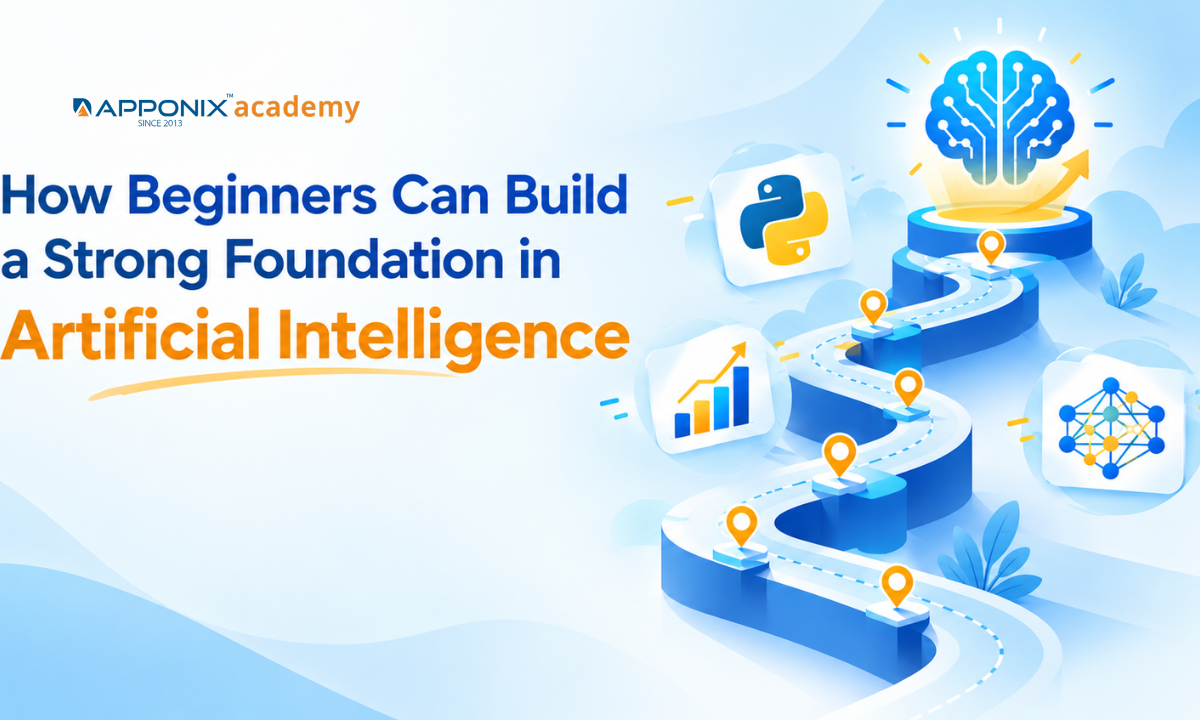
Table of contents:
| 1. Understanding What Artificial Intelligence Really Means |
| 2. AI Fundamentals for Beginners: The Core Building Blocks |
|
3. Essential AI Skills You Must Develop
|
| 4. Your Artificial Intelligence Learning Roadmap in Six Stages |
| 5. Roadmap Summary Table |
| 6. Free and Paid Ways to Learn |
| 7. Beginner Projects That Reinforce Your Learning |
| 8. Mistakes That Hold Beginners Back |
| 10. Where an AI Skill Set Can Take You |
| 11. What Makes Apponix Academy a Trusted Choice |
| 12. Common Doubts from New Learners |
| 13. Conclusion |
Every strong AI career begins with a solid base. Many beginners rush into advanced tools, get confused and lose motivation within weeks. A clear artificial intelligence learning roadmap prevents this by showing you what to learn, in which order and why. If you plan to join an AI Course in Bangalore, understanding this roadmap first will help you learn faster and ask smarter questions in class.
This AI learning guide explains artificial intelligence basics in simple language, lists the essential AI skills you need and gives you a practical plan to follow from day one.
Understanding What Artificial Intelligence Really Means
Artificial intelligence is the ability of a computer system to perform tasks that normally need human intelligence. These tasks include understanding language, recognizing images, making decisions and learning from experience.
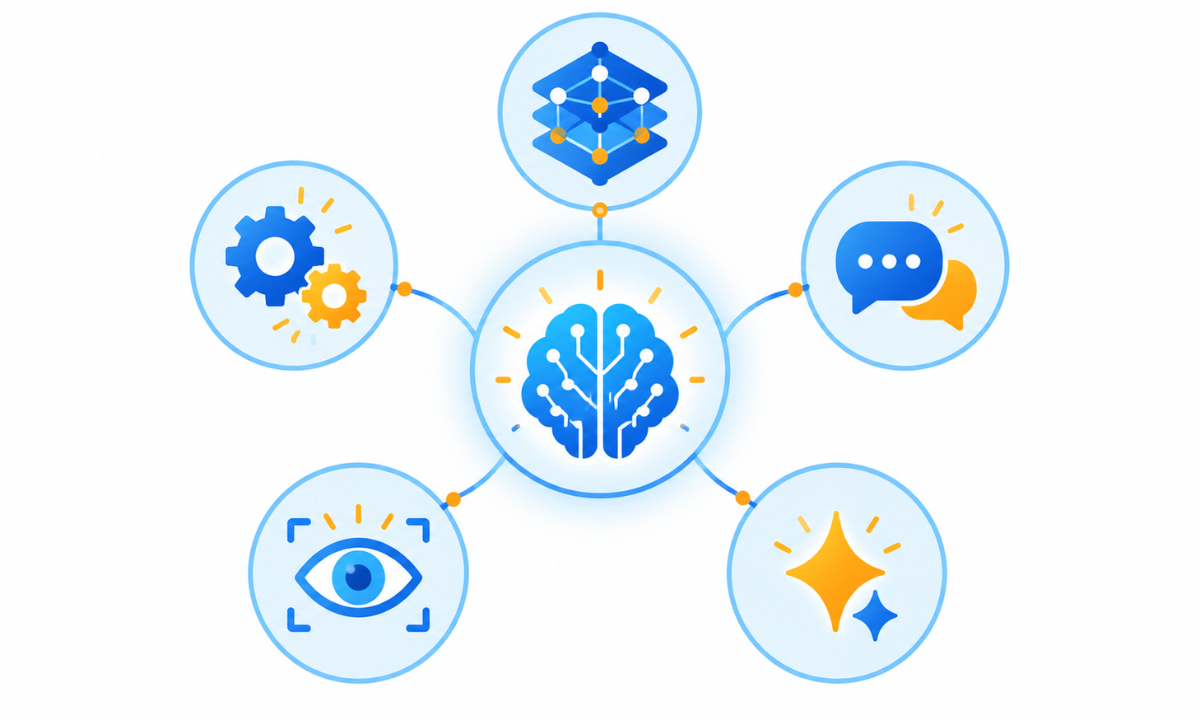
AI is not one single technology. It is a family of related fields:
-
Machine learning: Systems that learn patterns from data instead of following fixed rules.
-
Deep learning: A branch of machine learning that uses layered neural networks for complex tasks like image and speech recognition.
-
Natural language processing: Teaching machines to read, understand and generate human language.
-
Computer vision: Helping machines interpret photos and videos.
-
Generative AI: Models that create new text, images, audio and code.
You encounter AI daily, whether you unlock your phone with your face, get a movie suggestion or receive a fraud alert from your bank. Knowing where AI fits in real life makes the technical topics easier to connect with.
AI Fundamentals for Beginners: The Core Building Blocks
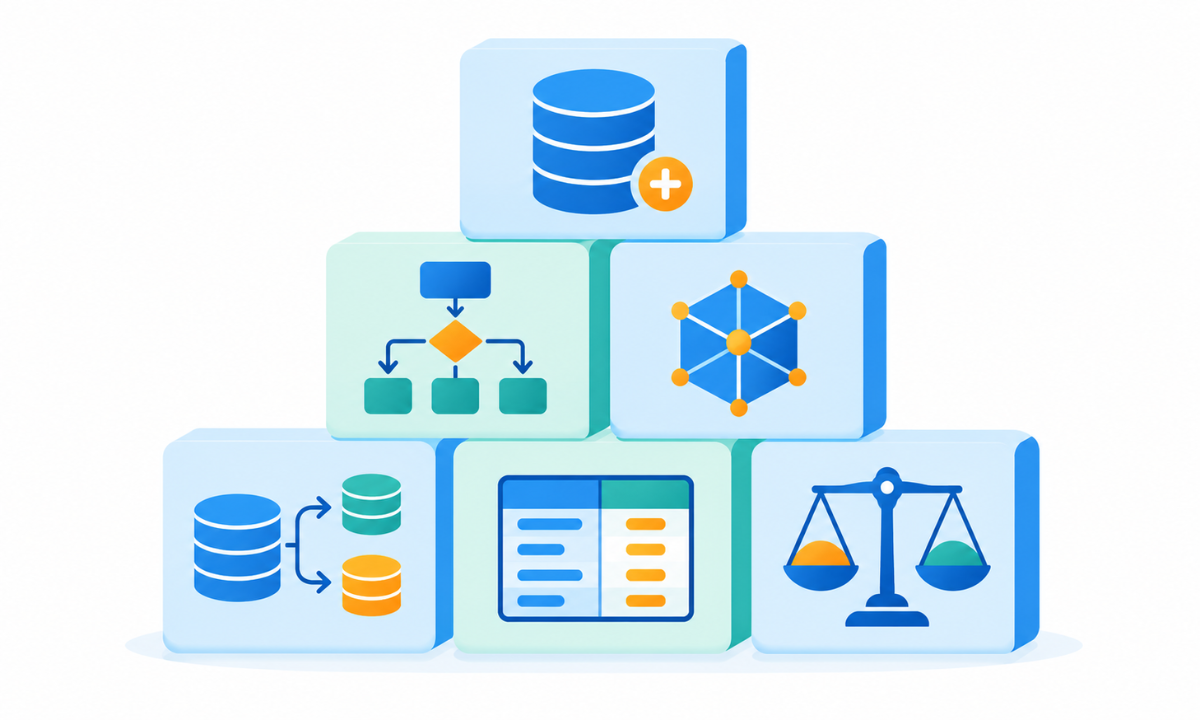
Before touching advanced tools, master these AI fundamentals for beginners. They form the foundation of everything that follows.
Data
Data is the fuel of AI. Models learn from examples, so the quality and quantity of data directly affect results. Learn the difference between structured data (tables) and unstructured data (text, images, audio).
Algorithms
An algorithm is a set of steps a computer follows to solve a problem. In AI, algorithms find patterns and make predictions.
Models
A model is the outcome of training an algorithm on data. Once trained, it can predict or classify new information.
Training and testing
You train a model on one portion of data and test it on another to check how well it performs on unseen examples.
Features and labels
Features are the input details (such as age or income), while labels are the answers you want to predict (such as loan approval).
Overfitting and underfitting
A model that memorizes training data performs poorly in real life, while one that is too simple misses important patterns. Balancing the two is a core skill.
Essential AI Skills You Must Develop
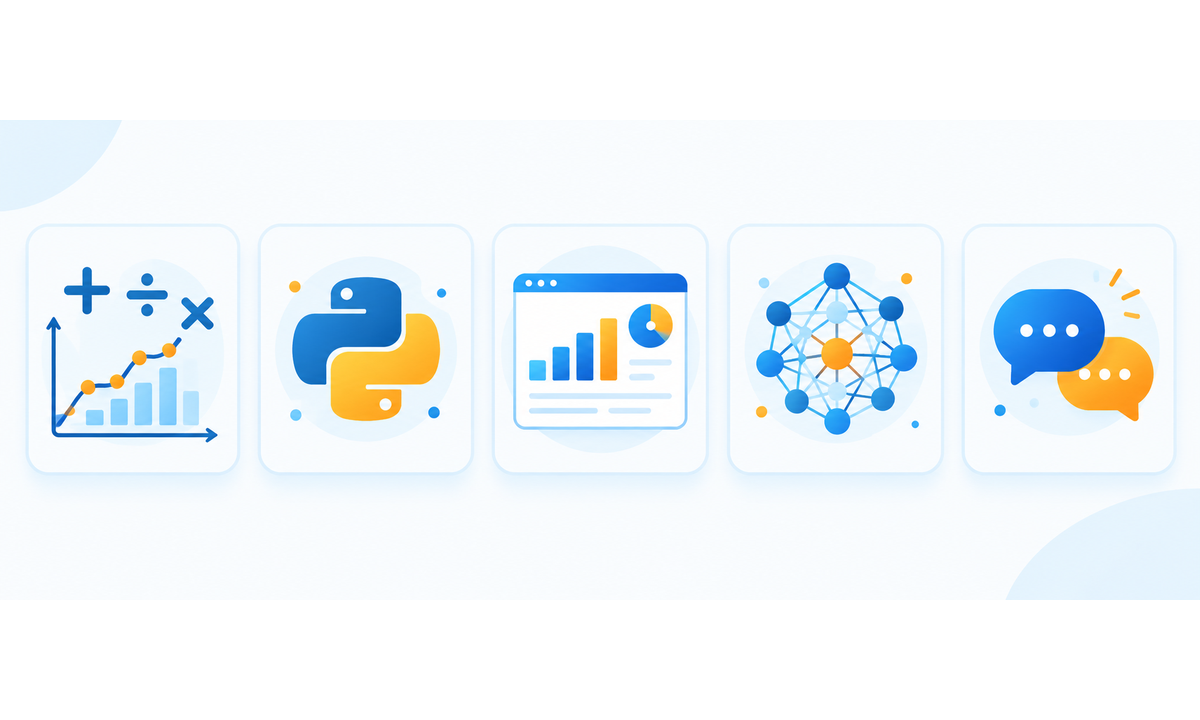
The list of essential AI skills can look long, but each one builds on the last. Here is what to focus on.
Mathematics and Statistics
You need comfort with linear algebra, probability, statistics and basic calculus. These explain how models learn and how to interpret their results. Revisit school-level topics first, then move to applied examples.
Python Programming
Python is the most popular language in AI because it is simple and supported by powerful libraries such as NumPy, Pandas, Scikit-learn, TensorFlow and PyTorch. Structured practice through the Python programming course can take you from zero to confident quickly.
Data Handling and Visualization
Real-world data is messy. You must know how to clean it, explore it and present insights using charts. Tools like Excel, Tableau and Power BI help here. The Tableau and Data Visualization course is a useful companion for this skill.
Machine Learning Concepts
Learn supervised learning, unsupervised learning and the basics of evaluation metrics. A guided Machine Learning course helps you apply these ideas to real datasets instead of memorizing definitions.
Problem Solving and Communication
AI work is teamwork. You must break down vague business problems, test ideas and explain results clearly to people who are not technical.
Your Artificial Intelligence Learning Roadmap in Six Stages
This is the heart of the guide. Follow these stages in order, spending as long as you need on each.
Stage 1: Build the Mindset and Basics (Weeks 1 to 2)
Read beginner-friendly articles, watch introductory videos and learn the vocabulary of AI. Aim to explain artificial intelligence basics in your own words to a friend.
Stage 2: Learn Python and Math (Weeks 3 to 6)
Practice Python daily for at least 45 minutes. Write small programs, then move to NumPy and Pandas. Alongside, revise statistics and probability with simple exercises.
Stage 3: Work with Data (Weeks 7 to 9)
Download a public dataset and practice cleaning, filtering and visualizing it. Learn basic SQL to pull data from databases. The Data Analytics training is a strong option if you want expert direction here.
Stage 4: Learn Machine Learning (Weeks 10 to 14)
Study regression, classification and clustering. Build two or three small models, such as a house price predictor or a spam classifier, and learn to evaluate them properly.
Stage 5: Explore Deep Learning and Generative AI (Weeks 15 to 18)
Begin with simple neural networks, then explore language models and generative tools. The Generative AI course introduces practical workflows that companies already use.
Stage 6: Build Projects and Prepare for Jobs (Weeks 19 to 24)
Create a portfolio of three to five projects, upload them to GitHub and prepare for interviews. Strengthen your profile with resume writing services so your skills stand out to recruiters.
Roadmap Summary Table
|
Stage |
Focus Area |
Key Outcome |
Time Needed |
|
1 |
AI concepts and vocabulary |
Clear understanding of basics |
2 weeks |
|
2 |
Python and mathematics |
Coding confidence |
4 weeks |
|
3 |
Data handling |
Clean and visualize datasets |
3 weeks |
|
4 |
Machine learning |
Build and evaluate models |
5 weeks |
|
5 |
Deep learning and generative AI |
Work with modern tools |
4 weeks |
|
6 |
Projects and job prep |
Portfolio and interview readiness |
6 weeks |
Free and Paid Ways to Learn
Beginners often ask whether self-study is enough. The honest answer is that it depends on your discipline and goals.
Self-study works when:
-
You are highly self-motivated.
-
You already have some programming experience.
-
You only want to explore AI as a hobby.
Structured training works better when:
-
You want a job-ready career in a fixed timeframe.
-
You need mentor feedback on your code and projects.
-
You want placement support and interview preparation.
-
You are switching careers and need a clear path.
Many learners combine both: they study basics on their own and then join a professional program for depth, projects and placement help.
Beginner Projects That Reinforce Your Learning
Concepts become permanent only when you apply them. Try these starter ideas as you move through the roadmap:
-
Predict house prices using regression.
-
Detect spam messages using text classification.
-
Segment customers using clustering.
-
Build a simple chatbot that answers common questions.
-
Recognize handwritten digits using a basic neural network.
Each project teaches a different part of the workflow and gives you something concrete to discuss in interviews.
Mistakes That Hold Beginners Back
-
Jumping to deep learning too early: Without Python and statistics, advanced topics feel impossible.
-
Watching without practicing: Videos create a false sense of progress. Code along every time.
-
Collecting too many resources: Pick one structured path and finish it.
-
Ignoring math entirely: You do not need a degree, but you need working understanding.
-
Studying inconsistently: Thirty minutes daily beats five hours once a week.
-
Not building a portfolio: Employers want proof of skill, not only certificates.
Where an AI Skill Set Can Take You
After completing the roadmap and gaining hands-on experience, you can pursue roles such as:
-
AI Engineer
-
Machine Learning Engineer
-
Data Scientist
-
Data Analyst
-
NLP Engineer
-
Generative AI Specialist
-
Business Intelligence Analyst
-
AI Product Associate
Bangalore is home to startups, product companies and global technology centers, so opportunities for skilled AI professionals are strong and growing.
What Makes Apponix Academy a Trusted Choice
Choosing the right training partner can save you months of trial and error. Established in 2013, Apponix Academy is recognized as a No 1 training institute in Bangalore for job-oriented technology programs. Learners value several things:
-
Expert trainers: Working professionals with 10 or more years of experience, with over 50,000 learners trained.
-
100% practical learning: Industry-based scenarios and hands-on projects in every program.
-
Flexible schedules: Batches from 7:00 AM to 9:00 PM, available in classroom and online modes.
-
Lab access: Learn from anywhere for most courses.
-
Placement assistance: Interview preparation and company tie-ups, with success stories on the placements page.
-
Affordable fees: Programs designed for students, freshers and working professionals.
To plan a complete career path, explore the job oriented courses or the Master Program in Data Science. A well-designed AI Course in Bangalore from Apponix follows the same roadmap shared above, with mentor support at every stage.
Common Doubts from New Learners
Do I need a technical degree to learn AI?
No. Learners from commerce, arts, science and engineering backgrounds succeed in AI when they build the right foundation.
How long does it take to learn AI basics?
Most beginners can grasp artificial intelligence basics in two to three months with steady daily practice.
Is AI too difficult for someone without coding experience?
Not at all. Python is beginner friendly, and a structured plan makes the learning curve manageable.
Which should I learn first, machine learning or Python?
Start with Python and basic statistics. Machine learning becomes much easier afterward.
Can working professionals follow this roadmap?
Yes. Flexible batch timings and online options allow you to learn alongside a full-time job.
Conclusion
A strong foundation in AI is built step by step. Start with the basics, learn Python and mathematics, work with real data, practice machine learning and then explore generative AI. Back every stage with small projects, and document your work in a portfolio. Consistent effort, the right roadmap and expert guidance will take you further than any shortcut.
When you are ready to turn learning into a career, join an AI Course in Bangalore at Apponix Academy and train with industry experts through hands-on, placement-focused programs.
Reference:
- https://www.atlassian.com/blog/ai-at-work/learn-ai
- https://www.copy.ai/blog/how-to-start-ai-learning

Apponix Academy
Apponix Academy