POPULAR COURSES
Master Programs



Table of contents:
| 1. What Building Projects Does for Your Career |
| 2. Tools and Knowledge to Gather First |
|
3. Six Beginner Machine Learning Projects to Try First
|
|
4. Six AI Automation Projects That Save Real Time
|
| 5. Stretch Ideas Once You Feel Confident |
| 6. Project Difficulty and Time Estimates |
| 7. An Eight-Step Method You Can Reuse |
| 8. Turning Finished Work into a Standout Portfolio |
| 9. Pitfalls That Slow Down New Learners |
| 10. Roles You Can Aim for After Practice and Training |
| 11. Why Learners Pick Apponix Academy |
| 12. Questions Beginners Often Ask Us |
| 13. Conclusion |
Reading about artificial intelligence is useful, but building something is what makes the concepts stick. Whether you are a fresher, a graduate or a working professional planning a career switch, hands-on practice is the fastest way to grow. If you are considering an AI Course in Bangalore, starting with a few small projects beforehand will give you a real advantage in class and in interviews.
This guide shares practical AI projects for beginners, grouped by difficulty, with the tools you need, the skills each one builds and tips to present them in your portfolio.
What Building Projects Does for Your Career
Recruiters rarely shortlist candidates on certificates alone. They want proof that you can take a problem, work with data, build a solution and explain your results. Practical artificial intelligence projects give you that proof.
-
Theory becomes skill: You understand algorithms better when you apply them to real data.
-
Your portfolio grows: A GitHub profile with three to five solid projects can outweigh a long list of courses.
-
Interviews get easier: You can talk about challenges, decisions and results from your own work.
-
Your interests become clear: Trying different projects helps you choose between machine learning, automation, language processing or computer vision.
Tools and Knowledge to Gather First
You do not need advanced knowledge, but a few basics will make your first attempts smoother.
-
Python basics: Variables, loops, functions and data structures. The Python programming course is a good place to begin.
-
Core libraries: NumPy, Pandas, Matplotlib and Scikit-learn.
-
A coding environment: Google Colab or Jupyter Notebook, both free and beginner friendly.
-
Basic statistics: Mean, median, correlation and probability.
Not sure which foundations to strengthen? Browse the Apponix blog for beginner guides on AI prerequisites and career planning.
Six Beginner Machine Learning Projects to Try First
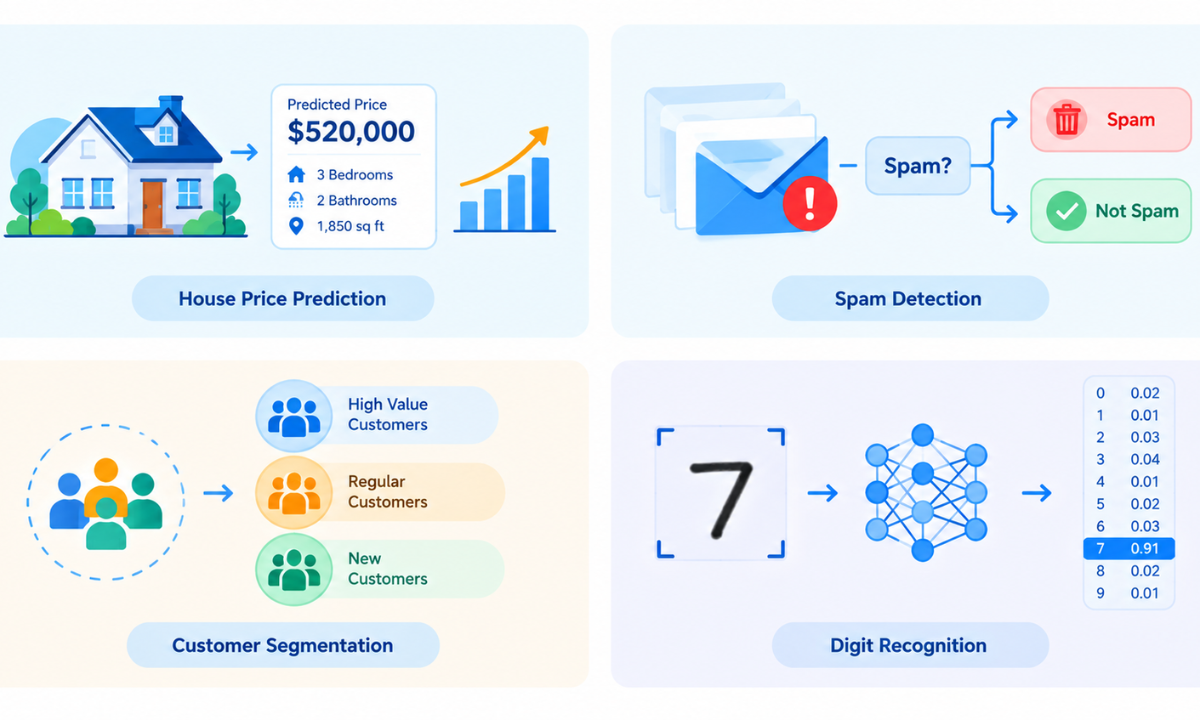
These beginner machine learning projects use clean, public datasets, so you can focus on the workflow: load data, clean it, train a model, test it and interpret results.
1. House Price Prediction
What it does: Predicts the price of a house from features such as area, number of rooms and location.
Skills built: Regression, feature selection, data cleaning.
Tools: Python, Pandas, Scikit-learn.
How to start: Download a public housing dataset, handle missing values, train a Linear Regression model, compare it with a Random Forest and evaluate using R-squared and Mean Absolute Error.
This is one of the best first projects because it teaches the complete machine learning pipeline in a simple setting.
2. Spam Email or SMS Detector
What it does: Classifies messages as spam or not spam.
Skills built: Text preprocessing, classification, evaluation metrics.
Tools: Python, NLTK, Scikit-learn.
How to start: Clean the text, convert it into numbers using TF-IDF, train a Naive Bayes classifier and measure accuracy, precision and recall.
3. Student Performance Predictor
What it does: Predicts exam results from study hours, attendance and past scores.
Skills built: Classification and regression, data visualization.
Tools: Python, Pandas, Matplotlib, Scikit-learn.
This project is relatable and easy to explain in interviews.
4. Customer Segmentation
What it does: Groups customers by purchase behavior so businesses can target them better.
Skills built: Unsupervised learning, clustering, business thinking.
Tools: Python, K-Means, Seaborn.
How to start: Use a retail customer dataset, scale the features, apply K-Means and add a short business interpretation for each cluster.
5. Movie Recommendation System
What it does: Suggests movies based on a user’s past preferences.
Skills built: Similarity measures, content-based and collaborative filtering.
Tools: Python, Pandas, Scikit-learn.
Recommendation engines power streaming and shopping platforms, so this project shows real industry relevance.
6. Handwritten Digit Recognition
What it does: Identifies digits from images using the MNIST dataset.
Skills built: Neural networks, image basics, model tuning.
Tools: Python, TensorFlow or Keras.
This is a classic introduction to deep learning and computer vision. To go deeper into algorithms, the Machine Learning course covers regression, clustering and neural networks in a structured way.
Six AI Automation Projects That Save Real Time
Automation is where AI becomes immediately useful. These AI automation projects reduce manual effort and mirror tasks that businesses handle every day.
7. Smart Email Categorizer
What it does: Reads incoming emails and sorts them into categories such as work, finance or promotions.
Skills built: Text classification, API usage, workflow design.
Tools: Python, Gmail API, a trained text classifier.
8. Resume Screening Assistant
What it does: Reads resumes and ranks them against a job description.
Skills built: Natural language processing, keyword extraction, similarity scoring.
Tools: Python, spaCy, Scikit-learn.
This is especially valuable if you are interested in HR technology.
9. Customer Support Chatbot
What it does: Answers common questions such as order status, timings or fees.
Skills built: Intent recognition, conversational design, API integration.
Tools: Python, Rasa or a large language model API.
Start with ten to fifteen frequently asked questions, then expand gradually.
10. Automated Report Generator
What it does: Pulls data from spreadsheets, summarizes trends and produces a weekly report automatically.
Skills built: Data analysis, scripting, text generation.
Tools: Python, Pandas, Google Sheets API, a language model for summaries.
Businesses value this because it replaces hours of manual reporting.
11. Social Media Content Scheduler
What it does: Generates post ideas, drafts captions and schedules them based on audience activity.
Skills built: Generative AI, prompt design, scheduling logic.
Tools: Python, a generative AI API, a scheduling library.
To build stronger skills here, the Generative AI course introduces modern AI workflows used in industry.
12. Document Summarizer
What it does: Converts long PDFs or articles into short, readable summaries.
Skills built: NLP, text extraction, summarization techniques.
Tools: Python, PyPDF, Hugging Face Transformers.
Stretch Ideas Once You Feel Confident
When the earlier work feels comfortable, try these practical artificial intelligence projects.
-
Product Review Sentiment Analysis: Classify reviews as positive, negative or neutral and visualize trends over time.
-
Fake News Detector: Combine NLP with classification to flag misleading headlines.
- Stock Trend Analyzer: Predict simple price movements from historical data. Treat this as a learning exercise, not financial advice.
-
Sales Forecasting Dashboard: Predict future sales and display results in an interactive dashboard using skills from the Tableau and Data Visualization course.
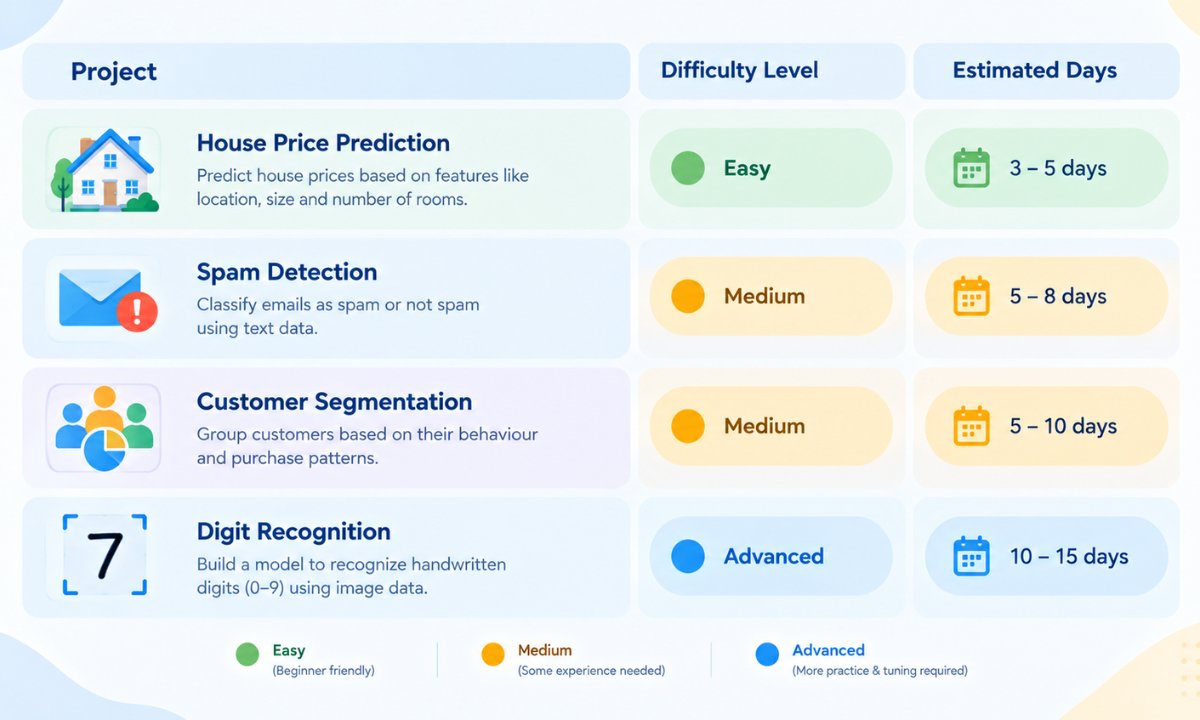
Project Difficulty and Time Estimates
|
Project |
Level |
Main Skill |
Estimated Time |
|
House Price Prediction |
Easy |
Regression |
3 to 5 days |
|
Spam Detector |
Easy |
Text classification |
3 to 5 days |
|
Customer Segmentation |
Easy |
Clustering |
3 to 4 days |
|
Recommendation System |
Medium |
Similarity methods |
1 week |
|
Resume Screener |
Medium |
NLP |
1 week |
|
Chatbot |
Medium |
NLP and APIs |
1 to 2 weeks |
|
Object Detection |
Advanced |
Computer vision |
2 weeks |
An Eight-Step Method You Can Reuse
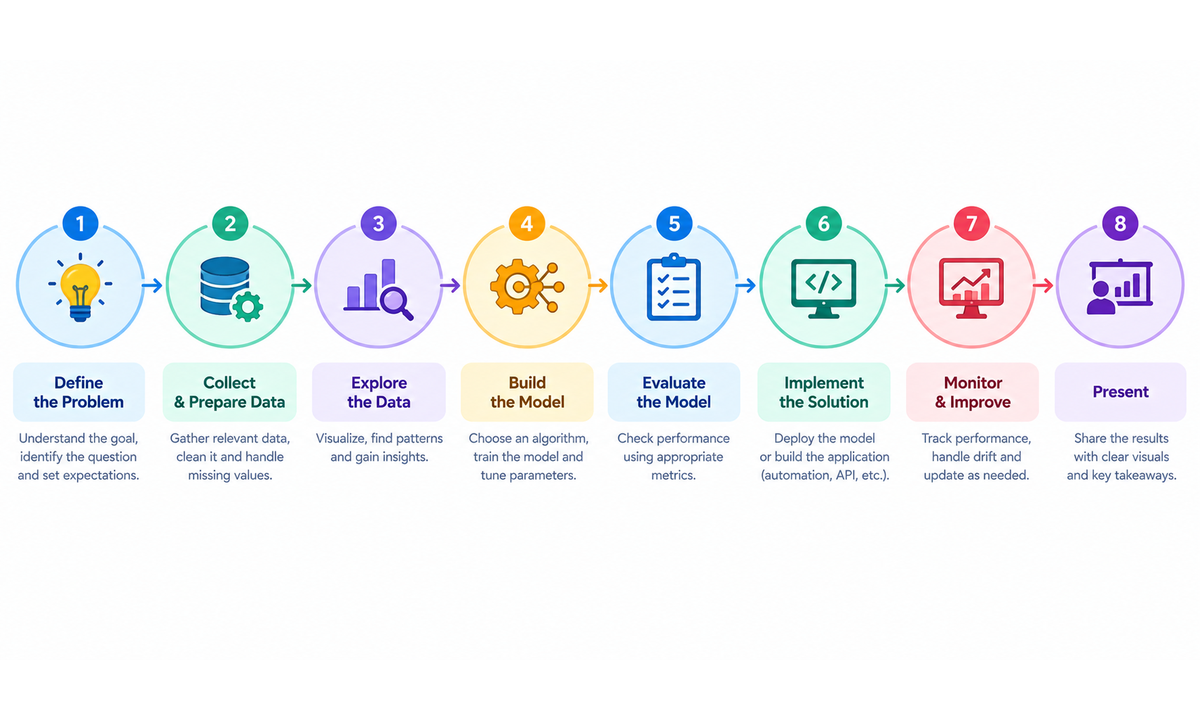
Whichever idea you pick, a consistent process keeps your work organized.
-
Define the problem: Write one sentence describing what you want to predict or automate.
-
Collect data: Use public sources such as Kaggle or government open data portals.
-
Clean and explore: Handle missing values, remove duplicates and visualize patterns.
-
Choose a model: Start simple, then try more advanced options.
-
Train and test: Split your data so you never test on what you trained on.
-
Evaluate: Use suitable metrics such as accuracy, precision, recall or error values.
-
Improve: Tune settings and experiment with different features.
-
Present: Document the process, results and lessons learned.
If data handling feels challenging, the Data Analytics training and the Data Science with Python course can help you build confidence quickly.
Turning Finished Work into a Standout Portfolio
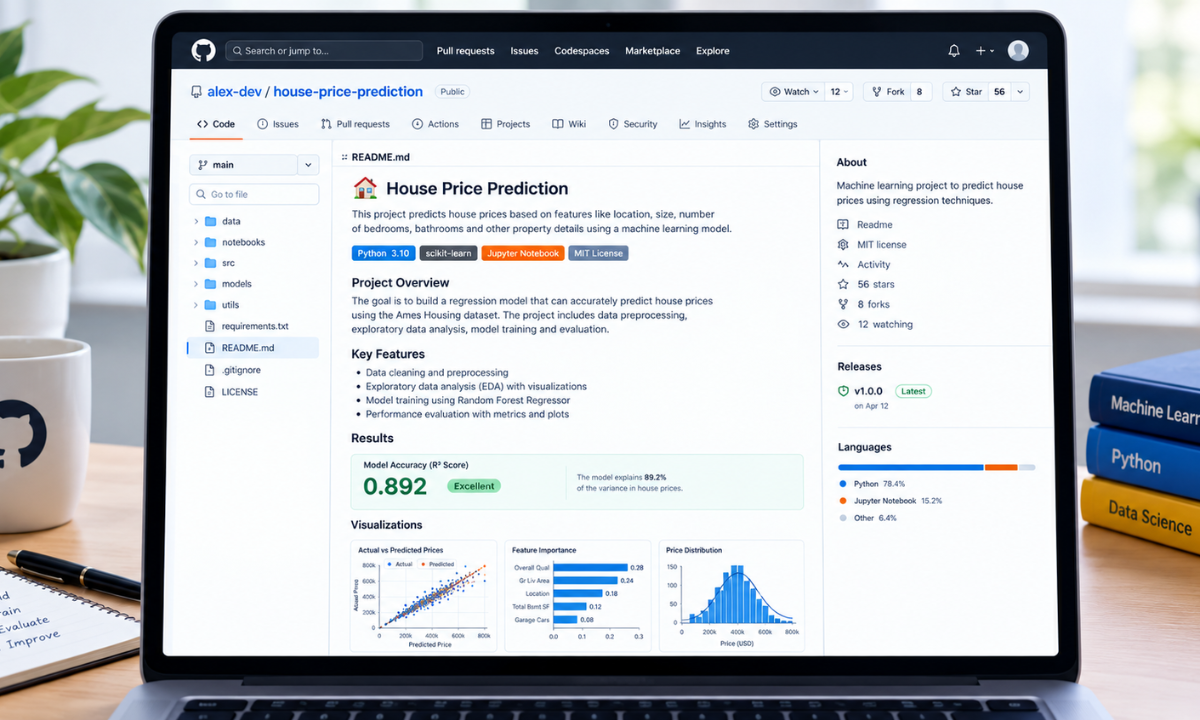
Building is only half the job. Presentation decides whether recruiters notice your effort.
-
Create a GitHub repository for each project with a clear README.
-
Write a short case study covering the problem, approach, results and next steps.
-
Add visuals such as charts, screenshots or a short demo video.
-
Mention measurable results, for example “achieved 91% accuracy on test data.”
-
Link your work on your resume and LinkedIn profile.
Apponix Academy also offers resume writing services to help you position your skills effectively.
Pitfalls That Slow Down New Learners
-
Copying tutorials without understanding them: Change something, such as the dataset or the model, so the work becomes your own.
-
Ignoring data quality: Poor data produces poor models, however advanced the algorithm.
-
Chasing complexity too early: A well-explained simple project beats a confusing complex one.
-
Skipping documentation: If you cannot explain your project, it will not help in interviews.
-
Learning in isolation: Mentorship and feedback speed up growth dramatically.
Roles You Can Aim for After Practice and Training
Consistent project work, combined with structured training, prepares you for positions such as:
-
Machine Learning Engineer
-
AI Engineer
-
Data Analyst
-
Data Scientist
-
Automation Engineer
-
Generative AI Associate
-
NLP Engineer
-
Business Intelligence Analyst
Bangalore hosts many startups, product companies and global technology centers that hire for these positions, which makes it one of the best cities to learn and begin your career.
Why Learners Pick Apponix Academy
Self-learning works up to a point, but guided training saves months of confusion. Established in 2013, Apponix Academy is recognized as a No 1 training institute in Bangalore for job-oriented technology courses. Here is what learners appreciate:
-
Industry expert trainers with 10 or more years of experience, backed by more than 50,000 trained learners.
-
100% practical training with real-world scenarios and live project work.
-
Flexible batches from 7:00 AM to 9:00 PM, in both classroom and online modes.
-
Lab access from anywhere for most courses.
-
Placement assistance with interview preparation and company tie-ups. See recent success stories on the placements page.
-
Affordable fees that suit students, freshers and working professionals.
You can also explore the job oriented courses and the Master Program in Data Science for a longer, career-focused pathway. A well-structured AI Course in Bangalore at Apponix lets you build projects like these under expert guidance, with feedback at every stage.
Questions Beginners Often Ask Us
Which project should an AI beginner build first?
House price prediction or a spam detector. Both are simple, use clean data and teach the full workflow.
Do I need a powerful computer?
No. Google Colab provides free cloud computing that is enough for most beginner work.
How many projects belong in a portfolio?
Three to five well-documented projects are better than ten rushed ones. Include at least one machine learning project and one automation project.
Can non-IT graduates build these projects?
Yes. With basic Python and steady practice, learners from any background can complete them.
How long does one project take?
Most take between three days and two weeks, depending on your pace and prior knowledge.
Conclusion
The best way to learn artificial intelligence is to build. Begin with a simple prediction task, move on to an automation idea, and then try a language or vision challenge. Each project strengthens your Python, data handling and problem-solving skills, and gives you real work to show recruiters.
To recap, focus on three things:
-
Start small: Pick one beginner machine learning project and finish it before moving on.
-
Add automation: Build at least one AI automation project that solves a real, everyday problem.
-
Document and share: Publish your work on GitHub and explain your results clearly.
Guided learning makes this journey faster. When you are ready to turn practice into a profession, join an AI Course in Bangalore at Apponix Academy and learn through hands-on projects led by industry experts.
Reference:
- https://medium.com/@arslanshoukatali/6-beginner-machine-learning-projects-that-completely-humbled-me-bba722a3cb38
- https://clickup.com/blog/machine-learning-projects-for-beginners/

Apponix Academy
Apponix Academy