POPULAR COURSES
Master Programs



Table of contents:
|
1. Understanding the Basics: What Are AI Agents? |
|
2. Core Skills for AI Agents Development
|
|
3. Preparing for AI Agents Jobs |
|
4. Why Take an Artificial Intelligence Course in Bangalore (Focused on AI Agents)? |
|
5. Final Thoughts |
|
6. FAQs |
As a trainer at Apponix Training Institute in Bangalore, I regularly guide aspiring professionals through the world of AI agents development, a rapidly evolving domain where understanding the AI agents meaning, mastering their architecture, and developing real-world solutions are all key to success.
Whether you are planning to create AI agents for enterprise use, exploring AI agent jobs, or looking into an artificial intelligence course in Bangalore, you will need to develop a strong foundation across multiple skill sets.
Understanding the Basics: What Are AI Agents?
In the simplest terms, AI agents are autonomous software entities that perceive their environment, make decisions, and act to achieve predefined goals. They differ from standard scripted bots in their ability to learn, adapt, and operate with a degree of independence. To succeed in AI agents development, one must first grasp the full scope of AI agents meaning, beyond just chatbots.
There are several types of artificial intelligence agents, for example:
-
Reactive agents respond directly to stimuli.
-
Goal-based agents evaluate possible actions to reach a specific target.
-
Utility-based agents choose actions that maximise a utility function.
-
Learning agents adapt through experience and feedback.
By understanding these types, you’ll be better prepared when practising architecture design or development workflows.
Core Skills for AI Agents Development
1. Domain Knowledge & Problem Definition
Before writing a line of code, you must clearly define the problem your agent will solve. What environment will it operate in? What tasks will it perform? Trainers emphasise starting with a narrow, manageable use-case rather than trying to build “an agent that does everything”.
To excel in AI agents development, you should be able to:
-
Map business or user requirements to agent capabilities.
-
Identify relevant performance metrics (e.g., accuracy, latency, ROI).
-
Understand the environment where the agent will be deployed (web, mobile, enterprise back-end).
2. Technical Foundations: Programming, ML and Architecture
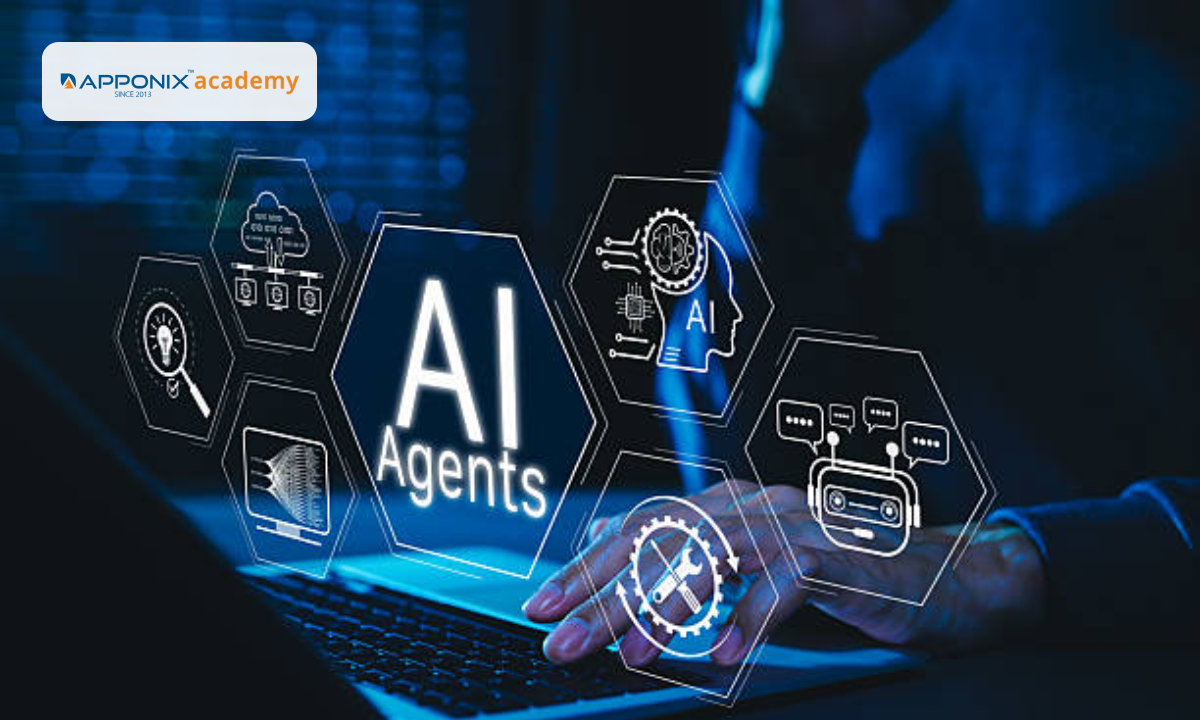
Building AI agents demands solid technical skills:
-
Programming languages like Python (for ML/NLP) and possibly Java/Go for scalable systems.
-
Understanding machine learning and NLP basics, since many agents leverage these.
-
Knowledge of how to design AI agent architecture: defining sensing/perception modules, decision logic, action modules, feedback loops, and continuous learning pipelines.
As a trainer, I emphasise the architecture part because it influences scalability, maintainability and performance. The concept of agent architecture is central to creating robust solutions.
3. Data Handling & Training
No agent can perform without good data. Skills here include:
-
Data collection, cleaning and preparation.
-
Choosing appropriate datasets and ensuring they are relevant to your agent’s domain.
-
Training and fine-tuning models, integrating with the agent’s decision-making pipeline.
-
Building feedback loops: monitoring agent behaviour and iterating.
If you’re pursuing an AI agent course, these data handling aspects are often covered deeply.
4. Integration, APIs, Deployment & Monitoring
An agent must work in practice, not just in a notebook. Important skills:
-
Integrating with external systems (APIs, databases, services).
-
Deploying the agent into a live environment (cloud, on-premise).
-
Monitoring, logging, error handling and continuous improvement.
-
Ensuring the agent can adapt in production and has mechanisms for updating.
5. Ethics, Explainability & Safety
With increasing adoption of AI agents, developers must incorporate responsible practices:
-
Ensure decisions/actions are explainable and transparent.
-
Be aware of bias, privacy and security risks.
-
Design agents that align with user expectations, regulatory frameworks and ethical guidelines.
Preparing for AI Agents Jobs
For those aiming at AI agents jobs, the following competencies raise your employability:
-
Experience building a complete agent end-to-end: from use case design to deployment and monitoring.
-
Proficiency in languages, frameworks (e.g., TensorFlow, PyTorch), and agent platforms.
-
Awareness of architectures, agent types and their applications (customer support, e-commerce, logistics).
-
Documentation, communication and teamwork skills: agents often sit inside larger systems.
-
For job seekers in Bangalore, having completed an artificial intelligence course in Bangalore that includes a focus on AI agents can give a strong edge.
When I train candidates, I emphasise not only the “how” but also the “why”: companies are using agents because they can increase productivity, operate 24/7 and reduce repetitive workload; knowing this helps align technical work with business value.
Why Take an Artificial Intelligence Course in Bangalore (Focused on AI Agents)?
If you are looking at a training institute in Bangalore, choose one that covers:
-
AI agents meaning, and types of agents (goal-based, utility, and learning).
-
Hands-on modules on building agents (designing architecture, integrating systems).
-
Case studies and real-world projects.
-
Skills for AI developers entering agent development roles.
Such a course can fast-track your path from theory to practically building agents and getting ready for the job market.
Final Thoughts
The field of AI agents development in 2026 presents exciting opportunities but requires a blended skill set. From understanding AI agents meaning and types of artificial intelligence agents to mastering development, architecture, data pipelines and deployment, you will need a strong foundation.
As a trainer at Apponix Training Institute in Bangalore, I have seen how the right preparation transforms beginners into confident developers ready for AI agents jobs. If you are serious about a career in this space, consider enrolling in an artificial intelligence (AI) course in Bangalore that emphasises the creation of agents, architectures, integrations and real-world workflows.
Your journey to building autonomous, intelligent systems starts with robust training and deliberate practice.
FAQs
Q1: What Exactly Is The Meaning Of “AI agents”?
A: Simply put, AI agents are autonomous programmes that sense their environment, make decisions and act to achieve specific goals. They differ from basic bots by being adaptive, goal-oriented and often learning from feedback.
Q2: What Are The Common Types Of Artificial Intelligence Agents?
A: Typical categories include reactive agents (responding directly to input), goal-based agents (choosing actions to reach a goal), utility-based agents (optimising a utility function), and learning agents (improving over time).
Q3: How Do I Go About Creating AI Agents As A Developer?
A: The process generally involves defining the use case, gathering and preparing data, choosing the tech stack, designing the agent architecture, training the model, integrating with systems (APIs/services), and deploying and monitoring.
Q4: What Skills Should I Have To Work As An AI Developer Focusing On Agents?
A: You’ll need programming skills (Python, etc.), knowledge of ML/NLP, understanding of system architecture, data handling, experience with integrations & deployment, and awareness of ethics and explainability.
Q5: Why Should I Opt For A Training Institute In Bangalore For Artificial Intelligence, Specifically Focusing On Agents?
A: Bangalore is a major tech hub with numerous institutes offering specialised programmes. A good course will give you practical experience, an understanding of AI agents architecture, and align you with industry demand for AI agents jobs in regional and global markets.

Apponix Academy
Apponix Academy