POPULAR COURSES
Master Programs

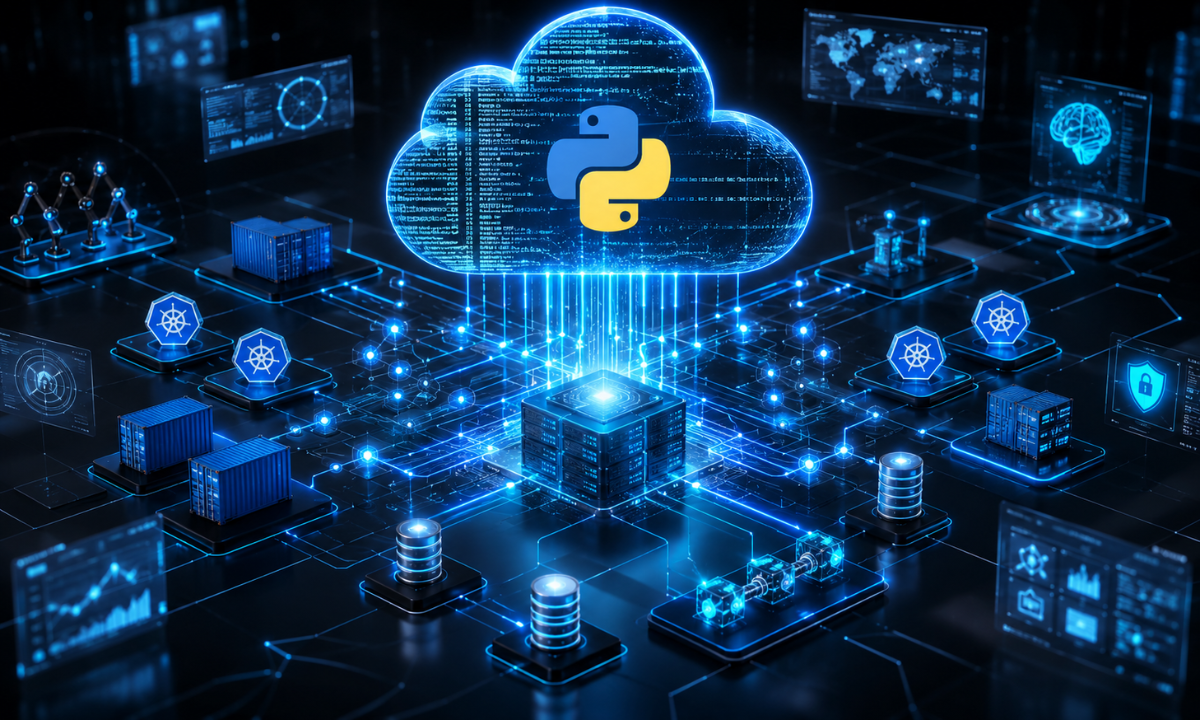
Table of contents:
|
1. Dynamic Cloud Provisioning (Moving Beyond YAML) |
|
2. Programmatic Container Lifecycle Management |
|
3. Automated Cloud Sweeping & Cost Optimization |
|
4. Advanced CI/CD Pipeline Logic (Beyond Simple YAML)
|
|
5. Self-Healing Infrastructure (The Core of AIOps) |
|
6. MLOps and DAG Orchestration |
|
7. Custom Monitoring Exporters & Telemetry Pipelines |
|
8. Automated Security Auditing & Compliance Guardrails |
|
9. API-Driven Secrets Rotation and Identity Management |
|
10. Programmatic Disaster Recovery Validation |
|
11. Why Choose Apponix? Bridging the Execution Gap |
|
12. Conclusion |
The era of manual server configuration and clicking through cloud consoles is officially dead. In 2026, enterprise infrastructure is highly distributed, relentlessly automated, and deeply integrated with artificial intelligence.
If you are still relying on fragile shell scripts to manage massive environments, your skill set is already obsolete.
The industry standard has violently shifted, making Python for DevOps Engineers an absolute, non-negotiable requirement for high-level engineering roles. Closing this critical execution gap is exactly why our premier DevOps course in Bangalore forces students to abandon basic tool memorization and focus entirely on writing production-grade automation code.
To understand why this language separates junior operators from highly compensated Cloud Architects, we must look at how it is actually deployed in production.
Here are the first three powerful, enterprise-grade use cases where Python fundamentally changes how infrastructure is managed.
1. Dynamic Cloud Provisioning (Moving Beyond YAML)

For years, the standard approach to provisioning cloud infrastructure relied on static, declarative configuration files like YAML or HCL (Terraform). While these are excellent for specifying desired end states, they lack programmable logic.
You cannot natively write a complex for loop or dynamic if/else conditions to provision environments based on live external data.
Modern Infrastructure as Code (IaC) has evolved. Elite engineering teams utilize frameworks like the AWS Cloud Development Kit (CDK) and Pulumi, which allow you to define entire cloud architectures using native Python. Instead of copying and pasting thousands of lines of JSON to create fifty slightly different S3 buckets, a DevOps engineer can write a five-line Python for loop that iterates over a dictionary, dynamically tagging and provisioning the buckets in seconds.
Furthermore, because it is native Python code, you can use standard testing frameworks like pytest to validate your infrastructure logic before it is ever deployed mathematically.
2. Programmatic Container Lifecycle Management

Most junior administrators interact with containers by manually typing docker run or writing fragile Bash scripts that wrap the Docker CLI. However, when you are orchestrating complex, ephemeral testing environments or building custom deployment utilities, shelling out to the command line is slow and prone to silent failures.
Leveraging the Docker SDK for Python (docker-py), architects achieve deep programmatic control over the container engine. The intersection of Python and Docker allows you to dynamically build container images based on real-time environment variables, parse container logs programmatically to trigger specific alerts, and forcefully prune dangling images without relying on blind cron jobs.
When your CI/CD pipeline needs to spin up a database container, run a test suite, evaluate the JSON results, and tear the container down gracefully based on the exit code, Python is the engine driving that automation.
3. Automated Cloud Sweeping & Cost Optimization

Cloud waste is a multi-million-dollar problem for enterprise organizations. Orphaned EBS volumes, unattached Elastic IPs, and forgotten developer staging environments silently drain infrastructure budgets month over month. Relying on humans to manually log into the AWS console to find and delete these resources is highly inefficient and dangerous.
Senior DevOps engineers solve this by writing sophisticated Python automation scripts utilizing vendor SDKs, such as boto3 for AWS. These scripts run on serverless platforms (like AWS Lambda) and act as automated janitors.
A Python cloud sweeper can automatically iterate through every cloud region, identify EC2 instances that lack mandatory billing tags or have had zero CPU utilization for 14 days, dynamically snapshot their attached volumes for safety, and terminate the instances.
The script then parses the exact cost savings and pushes a formatted notification directly to the engineering team's Slack channel via a webhook, saving the company thousands of dollars without a single human click.
4. Advanced CI/CD Pipeline Logic (Beyond Simple YAML)

Standard declarative configurations are rarely sufficient for complex, enterprise-grade release workflows. Pushing code from a developer's machine to a live server is no longer a straight line; it requires dynamic decision-making at every stage of the pipeline. If your deployment logic relies entirely on static YAML configurations, you are severely limited in how you handle unexpected build states.
By injecting Python scripting for DevOps directly into your CI/CD platforms (like Jenkins, GitLab CI, or GitHub Actions), engineers transform static pipelines into intelligent deployment engines. Python allows the pipeline to interact with REST APIs on the fly.
Consider the execution flow of a Python-driven deployment:
1. Pre-Flight Vulnerability Parsing:
The pipeline queries a container security scanner (like Trivy or SonarQube). Instead of just passing or failing, a Python script’/ parses the complex JSON response, filters out accepted risks, and halts the build only if a zero-day CVE is detected.
2. Dynamic Environment Provisioning:
Before deploying the code, Python queries the current database state and dynamically provisions a temporary, isolated testing environment sized exactly to the incoming workload requirements.
3. Intelligent Rollback Triggers:
Post-deployment, a Python script runs end-to-end API tests. If the failure rate exceeds 2%, the script automatically triggers a rollback via the cloud provider's API and updates the Jira ticket without human intervention.
This level of programmable intelligence ensures that DevOps best practices, such as secure, mathematically validated releases, are strictly enforced at every stage of the software lifecycle.
5. Self-Healing Infrastructure (The Core of AIOps)

In 2026, waking up a Site Reliability Engineer (SRE) at 3:00 AM because a single Kubernetes pod crashed is considered an organizational failure. Modern infrastructure is expected to self-remediate common failures, and Python is the connective tissue that makes Artificial Intelligence for IT Operations (AIOps) possible.
Instead of just triggering pagers, modern observability platforms (like Datadog or Prometheus) send webhooks directly to serverless Python functions when an anomaly is detected.
The AIOps Execution Loop: An alert fires indicating that an application is consuming 95% of its allocated memory. A Python self-healing script intercepts this alert, authenticates with the Kubernetes API, gracefully drains the failing node, dynamically provisions three new instances to absorb the traffic spike, and posts a plain-English incident report to the team's Slack channel.
This automated remediation drastically reduces the Mean Time to Resolution (MTTR) from hours down to seconds, allowing DevOps teams to sleep through the night while the code handles the crisis.
6. MLOps and DAG Orchestration

As enterprises aggressively scale their Artificial Intelligence initiatives, a massive execution gap has emerged: Data Scientists know how to build machine learning models, but they do not know how to deploy, scale, and monitor them in production. This has birthed the discipline of MLOps, which is entirely reliant on Python.
To orchestrate the complex, multi-step workflows required to train and deploy AI models, DevOps engineers utilize platforms like Apache Airflow. Because Airflow pipelines are written entirely in native Python, you can dynamically generate Directed Acyclic Graphs (DAGs) to handle highly complex data engineering tasks.
|
Static Task Execution |
Python-Native DAGs (Airflow) |
|
Linear Processing: Running a single training job sequentially, bottlenecking compute resources. |
Dynamic Mapping: A Python script assesses the dataset size and dynamically spins up 50 parallel container jobs to process the data simultaneously. |
|
Blind Retries: Failing the entire pipeline when a single external API times out. |
Intelligent Branching: Python evaluates the failure; if it is a rate limit, it implements an exponential backoff retry. If the model accuracy drops below 90%, it branches the pipeline to an alert state. |
|
Manual Data Cleaning: Relying on human analysts to normalize gigabytes of incoming log files. |
Automated ETL: Python scripts programmatically clean, chunk, and embed data directly into vector databases before model training even begins. |
If you want to command the highest salaries in the modern tech ecosystem, mastering Python to bridge the gap between AI modeling and infrastructure operations is no longer optional.
7. Custom Monitoring Exporters & Telemetry Pipelines

Out-of-the-box monitoring agents like Datadog, Prometheus, or New Relic are fantastic for tracking standard system metrics such as CPU utilization and memory consumption. However, they fall completely short when it comes to capturing unique, domain-specific application metrics such as the number of abandoned checkout carts per minute or custom database queue depths.
Senior engineering teams solve this observability bottleneck by using Python to build custom monitoring exporters. Leveraging libraries like prometheus_client, you can write micro-services that tap directly into legacy databases or internal APIs, extract hyper-specific business logic metrics, format them into standard time-series data, and expose them on an HTTP endpoint for Prometheus to scrape.
This level of granular visibility allows teams to build predictive dashboards that catch application-level degradation long before standard infrastructure alerts are triggered.
8. Automated Security Auditing & Compliance Guardrails

In a high-velocity production environment, moving fast cannot come at the expense of security. Traditional security audits that happen quarterly are an existential risk; compliance must be validated continuously. This is the core mandate of DevSecOps, and Python is the weapon of choice for enforcing automated security guardrails.
Instead of relying on human inspectors to verify cloud compliance, engineers deploy automated scanning scripts into their delivery pipelines.
|
Security Vector |
Automated Python Action |
|
Static Code Analysis |
Integrating libraries like Bandit into pre-commit hooks to automatically scan developer code for hardcoded passwords, insecure encryption algorithms, or vulnerable dependencies. |
|
IAM Policy Verification |
Writing scripts that query Identity and Access Management (IAM) configurations via cloud APIs to instantly revoke any user account or resource that is granted overly permissive administrative access. |
|
Network Perimeter Scans |
Running scheduled scripts that interact with security group APIs to detect and automatically close any server ports that have been accidentally exposed to the public internet. |
9. API-Driven Secrets Rotation and Identity Management

Hardcoding database credentials, API keys, or SSL certificates into application source code is one of the most egregious architectural mistakes an engineer can make. Modern security frameworks demand that all highly sensitive credentials be abstracted away into specialized vaults, such as HashiCorp Vault or AWS Secrets Manager. However, simply storing secrets is not enough to prevent credential leakage; those secrets must be rotated frequently.
Python acts as the secure automation layer that handles this lifecycle without human intervention. By writing scheduled Python scripts, you can programmatically interact with both your cloud vault and your backend databases simultaneously.
The script generates a brand-new, highly encrypted password, updates the database engine's access controls, modifies the application's runtime secret configuration in the vault, and gracefully restarts the container pods to apply the new credentials. This eliminates the human element from credential handling, mitigating the risk of insider threats or accidental exposures.
10. Programmatic Disaster Recovery Validation

Every company claims to have a disaster recovery plan, but very few actually know if their backups will work when a real crisis strikes. Taking regular data backups is trivial; proving that those backups are uncorrupted and capable of spinning up a live environment is where most organizations fail.
Advanced engineering teams use Python to completely automate disaster recovery testing through a process known as backup verification.
The Programmatic Recovery Loop: A scheduled Python script runs every midnight to pull the latest production database backup from a secure storage bucket. It automatically spins up an isolated, temporary database instance in a sandbox environment, restores the data, executes a rigorous suite of data-integrity queries to verify that no tables are corrupted, and tests query latency. Once the validation passes, the script tears down the temporary infrastructure and logs a cryptographic proof of compliance to the auditing system.
If the restoration fails at any point during this automated process, the script immediately flags the backup as corrupted and alerts the on-call engineering team, ensuring that data integrity is guaranteed before a real disaster occurs.
Why Choose Apponix? Bridging the Execution Gap
Reading about telemetry pipelines, disaster recovery scripts, and programmatic cloud sweeps is a great first step, but it will not secure a high-paying enterprise job. Tech companies do not pay for theoretical awareness; they pay for the immediate ability to solve infrastructure crises and eliminate deployment friction. If you cannot independently open an IDE, import a cloud SDK, and build a self-healing pipeline under pressure, you are not ready for a senior architect role.
This stark reality is exactly why ambitious IT professionals choose Apponix Technologies. As a premier Training Institute in Bangalore, our entire curriculum is engineered to bypass textbook definitions and focus completely on production-grade execution.
Here is why our training structure completely outpaces traditional upskilling programs:
-
100% Practical Lab Ecosystem: We do not rely on static slideshows or simple multiple-choice quizzes. You will spend over 40 hours inside fully functional, live cloud environments writing custom automation scripts, setting up container engines, and configuring live Kubernetes clusters.
-
Mentorship Under Active Practitioners: Your instructors are not career academics. They are active Senior DevOps Consultants and Enterprise Solutions Architects who bring real-world infrastructure problems and their production-tested solutions—directly into the classroom.
We eliminate the friction of job hunting. Apponix provides comprehensive career acceleration services, including professional resume restructuring, intensive mock technical interviews, and guaranteed interview opportunities with top-tier tech firms to fast-track your career transition.
Conclusion
The trajectory of modern cloud infrastructure is clear: the future belongs entirely to engineers who can programmatically govern systems at scale. The days of the traditional "click-ops" system administrator who manually provisions servers or manages configuration panels line-by-line are officially over.
Relying solely on baseline configuration tools caps your earning potential and locks you into entry-level support roles. Python is the definitive key that unlocks the upper echelons of the engineering hierarchy, allowing you to seamlessly navigate the worlds of high-leverage automation, DevSecOps, and MLOps.
Step out of the cycle of fragmented tutorials and surface-level certifications. Connect with Apponix Technologies, master the execution of advanced automation workflows, and transform your career into a high-impact, highly compensated asset.
Reference:
1. https://www.igmguru.com/blog/python-for-devops
2. https://www.cetpainfotech.com/blogs/how-python-and-devops-work-together

Apponix Academy
Apponix Academy